Method for increasing the efficiency of a combined gas/steam power station with integrated gasification combined cycle
US20100146929A1
2010-06-17
11/990,034
2006-07-26
✅ Patent granted
US 8,020,388 B2
2011-09-20
WO; PCT/EP2006/064693; 20060726
WO; WO2007/017387; 20070215
Ted Kim
2028-12-09
Abstract:
The invention relates to a method for increasing the efficiency of a combined gas/steam power station (10) with integrated gasification combined cycle. Said power station comprises a gas turbine compressor (14) and an air-separation unit (18) having a defined working pressure. Compressed air is removed from the gas turbine compressor (14) at a pressure level that is adapted to the working pressure of the air-separation unit (18). The removed air is then supplied to the air-separation unit (18) where the air is broken down into its individual constituents, especially oxygen and nitrogen. The nitrogen produced in the air-separation unit (18) is removed from the air-separation unit and at least a part of the removed nitrogen quantity is used as a coolant in the gas/steam power station in order to improve its efficiency.
Inventors:
- Gerhard Zimmermann 27 🇩🇪 Hochstadt/Aisch, Germany
- Erik Wolf 22 🇩🇪 Rottenbach, Germany
- Werner Günster 1 🇩🇪 Weisendorf, Germany
Assignee:
- SIEMENS AKTIENGESELLSCHAFT 12,417 🇩🇪 Munich, Germany
Interested in similar patents?
Get notified when new applications in this technology area are published.
Classification:
F01K23/068 » CPC main
Plants characterised by more than one engine delivering power external to the plant, the engines being driven by different fluids the engine cycles being thermally coupled combustion heat from one cycle heating the fluid in another cycle the combustion heat coming from a gasification or pyrolysis process, e.g. coal gasification in combination with an oxygen producing plant, e.g. an air separation plant
F25J3/04545 » CPC further
Processes or apparatus for separating the constituents of gaseous or liquefied gaseous mixtures involving the use of liquefaction or solidification by rectification, i.e. by continuous interchange of heat and material between a vapour stream and a liquid stream for air; Coupling of the air fractionation unit to an air gas-consuming unit, so-called integrated processes; Integration with an oxygen consuming unit, e.g. glass facility, waste incineration or oxygen based processes in general for the H/CO synthesis by partial oxidation or oxygen consuming reforming processes of fuels for the gasification of solid or heavy liquid fuels, e.g. integrated gasification combined cycle [IGCC]
F25J3/04563 » CPC further
Processes or apparatus for separating the constituents of gaseous or liquefied gaseous mixtures involving the use of liquefaction or solidification by rectification, i.e. by continuous interchange of heat and material between a vapour stream and a liquid stream for air; Coupling of the air fractionation unit to an air gas-consuming unit, so-called integrated processes Integration with a nitrogen consuming unit, e.g. for purging, inerting, cooling or heating
F25J3/04575 » CPC further
Processes or apparatus for separating the constituents of gaseous or liquefied gaseous mixtures involving the use of liquefaction or solidification by rectification, i.e. by continuous interchange of heat and material between a vapour stream and a liquid stream for air; Coupling of the air fractionation unit to an air gas-consuming unit, so-called integrated processes; Integration with a nitrogen consuming unit, e.g. for purging, inerting, cooling or heating for a gas expansion plant, e.g. dilution of the combustion gas in a gas turbine
F25J3/04581 » CPC further
Processes or apparatus for separating the constituents of gaseous or liquefied gaseous mixtures involving the use of liquefaction or solidification by rectification, i.e. by continuous interchange of heat and material between a vapour stream and a liquid stream for air; Coupling of the air fractionation unit to an air gas-consuming unit, so-called integrated processes; Integration with a nitrogen consuming unit, e.g. for purging, inerting, cooling or heating for a gas expansion plant, e.g. dilution of the combustion gas in a gas turbine Hot gas expansion of indirect heated nitrogen
F25J3/04606 » CPC further
Processes or apparatus for separating the constituents of gaseous or liquefied gaseous mixtures involving the use of liquefaction or solidification by rectification, i.e. by continuous interchange of heat and material between a vapour stream and a liquid stream for air; Coupling of the air fractionation unit to an air gas-consuming unit, so-called integrated processes; The air gas consuming unit is also fed by an air stream Partially integrated air feed compression, i.e. independent MAC for the air fractionation unit plus additional air feed from the air gas consuming unit
F25J3/04618 » CPC further
Processes or apparatus for separating the constituents of gaseous or liquefied gaseous mixtures involving the use of liquefaction or solidification by rectification, i.e. by continuous interchange of heat and material between a vapour stream and a liquid stream for air; Coupling of the air fractionation unit to an air gas-consuming unit, so-called integrated processes; Heat exchange integration with process streams, e.g. from the air gas consuming unit for cooling an air stream fed to the air fractionation unit
F25J2210/04 » CPC further
Processes characterised by the type or other details of the feed stream Mixing or blending of fluids with the feed stream
F25J2240/70 » CPC further
Processes or apparatus involving steps for expanding of process streams Steam turbine, e.g. used in a Rankine cycle
F25J2240/82 » CPC further
Processes or apparatus involving steps for expanding of process streams; Hot exhaust gas turbine combustion engine with waste heat recovery, e.g. in a combined cycle, i.e. for generating steam used in a Rankine cycle
F25J2245/42 » CPC further
Processes or apparatus involving steps for recycling of process streams the recycled stream being nitrogen
F25J2260/44 » CPC further
Coupling of processes or apparatus to other units; Integrated schemes; Integration in an installation using nitrogen, e.g. as utility gas, for inerting or purging purposes in IGCC, POX, GTL, PSA, float glass forming, incineration processes, for heat recovery or for enhanced oil recovery using nitrogen for cooling purposes
Y02E20/16 » CPC further
Combustion technologies with mitigation potential Combined cycle power plant [CCPP], or combined cycle gas turbine [CCGT]
Y02E20/16 » CPC further
Combustion technologies with mitigation potential Combined cycle power plant [CCPP], or combined cycle gas turbine [CCGT]
Y02E20/18 » CPC further
Combustion technologies with mitigation potential; Combined cycle power plant [CCPP], or combined cycle gas turbine [CCGT] Integrated gasification combined cycle [IGCC], e.g. combined with carbon capture and storage [CCS]
Y02E20/18 » CPC further
Combustion technologies with mitigation potential; Combined cycle power plant [CCPP], or combined cycle gas turbine [CCGT] Integrated gasification combined cycle [IGCC], e.g. combined with carbon capture and storage [CCS]
F01K23/10 IPC
Plants characterised by more than one engine delivering power external to the plant, the engines being driven by different fluids the engine cycles being thermally coupled combustion heat from one cycle heating the fluid in another cycle with exhaust fluid of one cycle heating the fluid in another cycle
F02C7/14 IPC
Features, components parts, details or accessories, not provided for in, or of interest apart form groups - ; Air intakes for jet-propulsion plants; Cooling of plants of fluids in the plant, e.g. lubricant or fuel
F25J3/04 IPC
Processes or apparatus for separating the constituents of gaseous or liquefied gaseous mixtures involving the use of liquefaction or solidification by rectification, i.e. by continuous interchange of heat and material between a vapour stream and a liquid stream for air
F01K9/00 IPC
Plants characterised by condensers arranged or modified to co-operate with the engines
F02C3/28 IPC
Gas-turbine plants characterised by the use of combustion products as the working fluid using a special fuel, oxidant, or dilution fluid to generate the combustion products the fuel or oxidant being solid or pulverulent, e.g. in slurry or suspension using a separate gas producer for gasifying the fuel before combustion
F02C6/08 IPC
Plural gas-turbine plants; Combinations of gas-turbine plants with other apparatus ; Adaptations of gas- turbine plants for special use; Gas-turbine plants providing heated or pressurised working fluid for other apparatus, e.g. without mechanical power output providing compressed gas the gas being bled from the gas-turbine compressor
F02C6/18 IPC
Plural gas-turbine plants; Combinations of gas-turbine plants with other apparatus ; Adaptations of gas- turbine plants for special use using the waste heat of gas-turbine plants outside the plants themselves, e.g. gas-turbine power heat plants
Description
BACKGROUND OF THE INVENTION
The invention relates to a method for increasing the efficiency of a combined gas and steam power generating plant, or a gas and steam turbine power generating plant, as the case may be, with integrated fuel gasification, which has a gas turbine compressor and an air fractionation plant with a predetermined operating pressure.
In the last decade, a large number of power generating plants were constructed worldwide, upon which is based a combined gas and steam turbine process, and by which the pollutant emission can be significantly reduced. These power generating plants are designated in technical jargon as combined cycle power generating plants.
In a subform of the combined cycle power generating plant, in the so-called IGCC power generating plants (“IGCC” is an abbreviation for “Integrated Gasification Combined Cycle”), the combined cycle power generating plant additionally has an integrated fuel gasification, by means of which a liquid or solid fuel, for example hard coal, is converted in a gasifier into a synthesis gas, which is then combusted in a gas turbine. As a rule, a purification of the synthesis gas takes place before the combustion. Generally speaking, pollutants are separated before the combustion in this manner, or arise hardly at all in the first place.
Oxygen is required for the gasification of the fuels into synthesis gas. For the producing of the oxygen, IGCC power generating plants have air fractionation plants in which particularly nitrogen is produced from the environmental air by fractional distillation, in addition to the required oxygen. The synthesis gas has to be cooled down before the further treatment. In this connection, a steam develops, which contributes to electric power generation in the steam turbine of the IGCC power generating plant. After the cooling down of the gas, first filters keep back ash particulate, then carbon dioxide can also be extracted, if required. Other pollutants, such as sulfur compounds or heavy metals, are also bound by chemical and physical processes. As a result of this, the required fuel cleanliness for the operation of the gas turbines and for low emissions of the IGCC power generating plant is realized.
The synthesis gas is mixed with nitrogen from the air fractionation plant, and/or with water steam, before the combustion chamber of the gas turbine, in order to suppress the formation of nitrogen oxide. The working gas which then ensues from the combustion with air is expanded in the turbine stages of the gas turbine.
After expansion of the working gas in the gas turbine and subsequent waste heat utilization in a steam generator, the flue gas is discharged to the atmosphere.
The steam flows from the crude gas and flue gas cooling are combined and, together, fed to the steam turbine. After the expansion in the steam turbine, the steam is condensed via a condenser, and the condensate is returned via the feed water tank to the water or steam circuit, as the case may be.
The gas and the steam turbine (a combined cycle power generating plant, or an IGCC power generating plant, as the case may be) are coupled to a generator in which the rotational work of the turbines is converted into electrical energy.
Combined cycle power generating plants, or IGCC power generating plants, as the case may be, are constantly being developed. In this connection, the aim is pursued, inter alia, of constantly increasing the efficiency or the power output of these power generating plants, as the case may be.
Underlying Problem
The invention is based on the problem of disclosing a method for increasing the efficiency of a combined cycle power generating plant in the form of an IGCC power generating plant, by which the efficiency can be more noticeably increased in relation to known methods.
Solution According to the Invention
This problem is solved according to the invention, by the method mentioned at the start for increasing the efficiency of a combined gas and steam power generating plant with integrated fuel gasification (IGCC power generating plant), which has a gas turbine compressor and an air fractionation plant with a predetermined operating pressure, in which compressed air is extracted from the gas turbine compressor at a pressure level which is adapted to the operating pressure of the air fractionation plant, in which the extracted air is then fed to the air fractionation plant, in which the air is broken down into its individual component parts, especially into oxygen and nitrogen, the nitrogen produced in the air fractionation plant is extracted from the air fractionation plant, and at least a part of the extracted nitrogen volume is used as cooling medium. The cooling air which is saved by this leads to an increase in efficiency.
According to the invention, air which is compressed in the gas turbine compressor, with a pressure level which is adapted to the operating pressure of the air fractionation plant, is fed to the air fractionation plant. For adaptation to the operating pressure of the air fractionation plant, this already compressed air, therefore, does not need to be compressed like the rest of the air which is fed via a compressor from the environment into the air fractionation plant, or is compressed in the air fractionation plant, as the case may be.
According to the invention, in this case a part of the air, or even all of the air, which is to be fed to the air fractionation plant, can be extracted from the gas turbine compressor. The power and efficiency loss which accompanies the air fractionation is, therefore, noticeably reduced.
In the air fractionation plant, nitrogen in particular is produced from the air by fractional distillation, in addition to the oxygen required for the gasification of the fuels. The nitrogen which is produced in the air fractionation plant, which has a low temperature owing to the fractional distillation (cryogenic air fractionation) undertaken in the air fractionation plant, is extracted according to the invention from the air fractionation plant, wherein at least a part of the extracted nitrogen volume is used as cooling medium in the IGCC power generating plant, in order to increase its efficiency.
Generally speaking, a cooling medium is ultimately provided by means of the method according to the invention, which can be produced without appreciable losses for the efficiency of the IGCC power generating plant. This cooling medium produced in this way according to the invention can be used for the realization of cooling processes which aim to increase the efficiency or the power of the IGCC power generating plant, as the case may be. The method according to the invention is especially advantageous if there is a comparatively low operating pressure of the air fractionation plant, and consequently also a low nitrogen delivery pressure, in which an energy conversion by expansion of the nitrogen is not practical.
The problem mentioned at the start is solved further according to the invention by a method for increasing the efficiency of a combined gas and steam power generating plant with integrated fuel gasification, which has a gas turbine compressor and an air fractionation plant with a predetermined operating pressure, in which compressed air is extracted from the gas turbine compressor at a pressure level which is adapted to the operating pressure of the air fractionation plant, the extracted air is then fed to the air fractionation plant in which the air is broken down into its individual component parts, especially into oxygen and nitrogen, the nitrogen which is produced in the air fractionation plant, is extracted from the air fractionation plant, and at least a part of the extracted nitrogen volume is heated, and, after heating, is expanded in a further turbine of the combined gas and steam power generating plant with integrated fuel gasification, in order to increase its efficiency. In this case, the utilizable rotational work which develops during the expansion improves the efficiency of the plant.
As distinct from the aforementioned first method according to the invention, this method is especially advantageous when the operating pressure of the air fractionation plant, and, as a result, the nitrogen delivery pressure, have an average pressure level. An energy conversion is then practical by expansion of the nitrogen in a further turbine, preferably in the form of an expander. After expansion, the nitrogen according to the method described above can be used as cooling medium.
Preferably, in this case, for the heating of the part of the extracted nitrogen volume, thermal energy of the extracted, compressed air is transmitted via a heat exchanger to the part of the nitrogen volume which is produced.
Advantageous Developments of the Invention
In an advantageous development of the method according to the invention, the part of the nitrogen volume produced which is used as cooling medium is introduced into the gas turbine compressor in order to cool air compressed in the gas turbine compressor by mixing with the part of the nitrogen volume which is produced. By the cooling of the air compressed in the gas turbine compressor, which is undertaken like this according to the invention, the efficiency of the IGCC power generating plant can be noticeably increased.
For cooling air which is compressed in the gas turbine compressor, in a practical development of the method according to the invention thermal energy of the compressed air is transmitted via a heat exchanger to the part of the produced nitrogen volume which is used as cooling medium. Therefore, in contrast to the aforementioned advantageous development, a cooling of the air which is compressed in the gas turbine compressor is enabled according to the invention by an indirect heat transfer by means of a heat exchanger, which results in a noticeable increase in the efficiency.
In a further advantageous development of the method according to the invention, the part of the extracted nitrogen volume which is used as cooling medium is mixed with air which is inducted by the gas turbine compressor, in order to cool the inducted air. According to the invention, the air to be compressed in the gas turbine compressor can be already cooled in this way by means of the cold nitrogen before compression. As an alternative to the direct mixing, in a practical development of the method according to the invention, thermal energy of the inducted air can be transmitted via a heat exchanger to the part of the extracted nitrogen volume which is used as cooling medium, for cooling the inducted air.
In a further practical development of the method according to the invention, the part of the extracted nitrogen volume which is used as cooling medium can also be used alternatively as additional cooling medium for a condenser of a steam turbine of the combined gas and steam power generating plant with integrated fuel gasification, as a result of which the expansion back pressure after the last steam turbine stage is further reduced, and so a power output gain and an improvement of the steam turbine efficiency can be achieved.
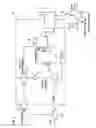
The method according to the invention is subsequently explained in detail with reference to schematic views of the construction of an IGCC power generating plant. In the drawing:
FIG. 1 shows a schematic view of a combined gas and steam power generating plant with integrated fuel gasification (IGCC power generating plant),
FIG. 2 shows a schematic view of the IGCC power generating plant from FIG. 1, which illustrates the cooling of compressed air by means of nitrogen from an air fractionation plant, and
FIG. 3 shows a schematic view of the IGCC power generating plant from FIG. 1, which illustrates the increase in the efficiency of the IGCC power generating plant by expansion of nitrogen from an air fractionation plant.
The IGCC power generating plant 10, which is shown schematically in FIG. 1, comprises inter alia a gas turbine 12 and a gas turbine compressor 14 connected ahead of the gas turbine 12. Fuel, such as hard coal, is gasified in a gasification unit 16 for the production of a synthesis gas. The oxygen required for the gasification is produced in an air fractionation plant 18, in which oxygen is produced from air by fractional distillation. As a rule, the air is taken from the environment, and, by a gas turbine compressor and/or auxiliary compressor, is introduced via a compressor 20 into the air fractionation plant 18 and compressed to the pressures required for the fractional distillation.
The synthesis gas which is produced in the gasification unit 16 is cooled down in a synthesis gas cooling unit 22 before the further treatment, and is then fed to a gas purification unit 24. In the gas purification unit 24, filters (not shown) first hold back ash particulate, then carbon dioxide can also be extracted, if required. Other pollutants, such as sulfur compounds or heavy metals, are also bound by chemical and physical processes. Generally speaking, the fuel cleanliness required for the operation of the gas turbine 12 can be realized in this way. The purified synthesis gas is next combusted in a combustion chamber 26, and the working gas produced from the combustion with air flows into the gas turbine 12, to which is coupled a generator (not shown). After the working gas is expanded in the gas turbine 12 it is fed to a waste heat steam generator 28 in order to utilize the heat which is contained in the working gas to produce steam. The waste heat steam generator 28 is integrated into a steam circuit 32, through which inter alia the steam produced during the cooling down of the synthesis gas in the synthesis gas cooling unit 22 is fed to the waste heat steam generator 28. The steam which is produced by the cooling down of the synthesis gas and the working gas is expanded in a steam turbine 34 which is coupled to a generator (not shown) to produce electrical energy. After the expansion in the steam turbine 34, the steam is condensed by a condenser 36, and the condensate is returned via a feed water pump 38 to the waste heat steam generator 28, and so into the steam circuit 32.
There is provision according to the invention to feed to the air fractionation plant 18 air which is already compressed in the gas turbine compressor 14, which has a pressure level which is adapted to the operating pressure of the air fractionation plant 18, especially corresponding to this operating pressure value-wise, wherein the compressed air is precooled, preferably via a heat exchanger 40, before entry into the air fractionation plant 18. For adaptation to the operating pressure of the air fractionation plant 18, the air which has already been compressed does not need to be compressed, therefore, like the rest of the air which is inducted into the air fractionation plant from the environment by the compressor 20 and compressed in the air fractionation plant 18, with accompanying lowering of the efficiency or power output, as the case may be. A part of the air, or even all of the air, which is to be fed to the air, fractionation plant 18, can be extracted from the gas turbine compressor 14. The nitrogen produced in the air fractionation plant 18, which has a low temperature owing to the fractional distillation which is undertaken in the air fractionation plant 18, is extracted from the air fractionation plant 18 according to the invention and fed via a nitrogen compressor 42 to the synthesis gas flow, in order to suppress to a great extent the formation of nitrogen oxides.
According to the invention, a part of the cold nitrogen to be fed to the gas purification unit 24, or gas conditioning, as the case may be, is tapped off between the air fractionation plant 18 and gas purification unit 24 so as to be used as cooling medium, with the aim of increasing the efficiency of the IGCC power generating plant by suitable cooling. According to the invention, this can take place inter alia as schematically shown in FIG. 2. For this purpose, the nitrogen volume which is provided as cooling medium is introduced directly into the gas turbine compressor 14 in order to cool air, which is compressed in the gas turbine compressor 14, by mixing with the tapped nitrogen.
Alternatively, the air which is to be compressed in the gas turbine compressor 14 can also be cooled via a heat exchanger (not shown), by which the air which is to be compressed is cooled against the tapped, cold nitrogen. As also schematically shown in FIG. 2, the tapped nitrogen can also be mixed with the induction air, in order to cool the inducted air. According to the invention, in this way the air to be compressed in the gas turbine compressor 14 is already cooled by means of the cold tapped nitrogen, before compression. Alternatively, the induction air can also be cooled in this case via a heat exchanger (not shown), by which the induction air is cooled against the tapped, cold nitrogen.
A further possible way of increasing the efficiency of the IGCC power generating plant according to the invention is to use the tapped, cold nitrogen as additional cooling medium for the condenser 36 of the steam turbine 34 in order to also achieve, via the condenser 36, a noticeable increasing of the efficiency, or power output, as the case may be.
FIG. 3 shows a schematic view of the IGCC power generating plant 10, which illustrates the increasing of the efficiency of the IGCC power generating plant 10 by expansion of nitrogen from an air fractionation plant 18.
As shown in FIG. 3, the tapped, cold nitrogen is routed through the heat exchanger 40, where it is heated against hot compressed air of the gas turbine compressor 14. After heating, the tapped nitrogen is expanded in a separate expander 44 in order to drive a generator 46 which is coupled to the expander 44. This method for increasing the efficiency is effectively applicable when the operating pressure of the air fractionation plant 18 and, as a result, the nitrogen delivery pressure, have an average pressure level. An energy conversion by expansion of the nitrogen in an expander 44 is then practical. After expansion, the nitrogen can be used as cooling medium, according to the aforementioned method.
Claims
1.-8. (canceled)
9. A method for increasing the efficiency of a combined gas and steam power generating plant with integrated fuel gasification where the plant has a gas turbine compressor and an air fractionation plant with a predetermined operating pressure, comprising:
extracting compressed air from the gas turbine compressor at a pressure level adapted to the operating pressure of the air fractionation plant;
feeding the extracted air to the air fractionation plant;
breaking down the extracted air into at least component parts of nitrogen and oxygen via the air fractionation plant;
extracting the broken down nitrogen from the air fraction plant; and
cooling components of the gas and power generating plant with at least a portion of the extracted nitrogen volume to increase the overall plant operating efficiency.
10. The method as claimed in claim 9, wherein the portion of the extracted nitrogen volume is introduced into the gas turbine compressor such that the air which is compressed in the gas turbine compressor is cooled by mixing with the part of the extracted nitrogen volume.
11. The method as claimed in claim 10, wherein thermal energy of the compressed air is transmitted via a heat exchanger to the portion of the extracted nitrogen volume in order to cool the air which is to be compressed in the gas turbine compressor.
12. The method as claimed in claim 9, wherein the portion of the extracted nitrogen volume is mixed with air that is inducted by the gas turbine compressor in order to cool the inducted air.
13. The method as claimed in claim 12, wherein, for cooling air which is inducted by the gas turbine compressor, thermal energy of the inducted air is transmitted via a heat exchanger to the part of the extracted nitrogen volume.
14. The method as claimed in claim 9, wherein the portion of the extracted nitrogen volume is used as additional cooling medium for a condenser of a steam turbine of the combined gas and steam power generating plant with integrated fuel gasification.
15. A method for increasing the efficiency of a combined gas and steam power generating plant with integrated fuel gasification, where the generating plant has a gas turbine compressor and an air fractionation plant with a predetermined operating pressure, comprising:
extracting compressed air from the gas turbine compressor at a pressure level adapted to the operating pressure of the air fractionation plant; feeding the extracted air to the air fractionation plant;
breaking down the extracted air into at least component parts of nitrogen and oxygen via the air fractionation plant;
extracting the broken down nitrogen from the air fraction plant;
heating at least a portion of the extracted nitrogen volume;
expanding the heated nitrogen in a further turbine to increase the operational efficiency of the gas and steam power generating plant with integrated fuel gasification.
16. The method as claimed in claim 15, wherein thermal energy of the extracted and compressed air is transmitted via a heat exchanger to the portion of the extracted nitrogen volume.
Images & Drawings included:



Sources:
- United States Patent and Trademark Office - verify current appl. status at the USPTO↗
Recent applications in this class:
- » 20220325638 2022-10-13
System and method for obtaining power by the use of low-quality hydrocarbons and hydrogen produced from the water in the generation of combustion energy - » 20140130509 2014-05-15
COMBINED GASIFICATION AND POWER GENERATION - » 20120039776 2012-02-16
System for heat integration within a gas processing section - » 20110260113 2011-10-27
Water gas shift reactor system for integrated gasification combined cycle power generation systems - » 20110162382 2011-07-07
IGCC power plant having flue gas recirculation and flushing gas - » 20110000221 2011-01-06
Low emission power generation and hydrocarbon recovery systems and methods - » 20100288474 2010-11-18
Method and system for sealing an annulus - » 20100275648 2010-11-04
EFFICIENTLY COMPRESSING NITROGEN IN A COMBINED CYCLE POWER PLANT - » 20100236254 2010-09-23
Power plant for IGSC-process - » 20100175426 2010-07-15
Power Management For Gasification Facility
Recent applications for this Assignee:
- » 20250262772 2025-08-21
PLACE CONDITIONED PICK FOR ROBOTIC PICK AND PLACE OPERATIONS - » 20250242498 2025-07-31
SYSTEM AND METHOD FOR PICK POSE ESTIMATION FOR ROBOTIC PICKING WITH ARBITRARILY SIZED END EFFECTORS - » 20250216836 2025-07-03
PRIORITIZATION BETWEEN AGENTS IN AGENT-BASED PROCESS AUTOMATION - » 20250168873 2025-05-22
WLAN Communication Method and Devices - » 20250168152 2025-05-22
Communication System, Adapter for a Terminal and Method for Securely Transmitting Time-Critical Data within the Communication System - » 20250166165 2025-05-22
TRAINING SYSTEMS FOR SURFACE ANOMALY DETECTION - » 20250162095 2025-05-22
Method for Operating a Machine Tool, Computer Program Product, Control Unit, Machine Tool, Simulation Program Product and Use of the Control Unit - » 20250147755 2025-05-08
INDUSTRIAL APPLICATION PACKAGE MANAGEMENT - » 20250126041 2025-04-17
METHOD OF CAPTURING PACKETS FROM APPLICATIONS HOSTED ON CONTAINERS - » 20250117920 2025-04-10
SELF-SUPERVISED ANOMALY DETECTION FRAMEWORK FOR VISUAL QUALITY INSPECTION IN MANUFACTRUING