Cardiac function change evaluating device
US20100160801A1
2010-06-24
12/598,849
2008-05-09
✅ Patent granted
US 8,870,738 B2
2014-10-28
WO; PCT/JP2008/058610; 20080509
WO; WO2008/140034; 20081120
Niketa Patel | William Levicky
Andrew Wilford
2028-07-09
Abstract:
A cardiac function variation evaluation apparatus includes: a continuous flow type auxiliary artificial heart 20 connected to a ventricle (10A); a pressure sensor 30 for detecting ventricle (10A) internal pressure; and means (a personal computer 40) for evaluating contractile variation of the ventricle, to which the auxiliary artificial heart 20 is connected, based on internal area APMp of a closed-loop of a relationship between the ventricle internal pressure detected by the pressure sensor 30 and a consumption power of the auxiliary artificial heart 20. Thus, the contractile variation of the ventricle, to which an auxiliary artificial heart is connected, can be continuously evaluated not by use of an ultrasonic echo apparatus or a conductance catheter but by use of a non-invasive method.
Inventors:
- Yoshimasa YOKOYAMA 8 🇯🇵 Tokyo, Japan
- THOMAS SCHMITZ-RODE 42 🇩🇪 AACHEN, Germany
- Ulrich Steinseifer 12 🇧🇪 Hauset, Belgium
- Setsuo Takatani 4 🇯🇵 Tokyo, Japan
Assignee:
- Reinheart GmbH 2 🇩🇪 Bad Oeynhausen, Germany
Applicant:
Interested in similar patents?
Get notified when new applications in this technology area are published.
Classification:
A61M60/148 » CPC further
Blood pumps; Devices for mechanical circulatory actuation; Balloon pumps for circulatory assistance; Location thereof with respect to the patient's body; Implantable pumps or pumping devices, i.e. the blood being pumped inside the patient's body implantable via, into, inside, in line, branching on, or around a blood vessel in line with a blood vessel using resection or like techniques, e.g. permanent endovascular heart assist devices
A61M60/205 » CPC further
Blood pumps; Devices for mechanical circulatory actuation; Balloon pumps for circulatory assistance; Type thereof Non-positive displacement blood pumps
A61M60/50 » CPC further
Blood pumps; Devices for mechanical circulatory actuation; Balloon pumps for circulatory assistance Details relating to control
A61M60/562 » CPC further
Blood pumps; Devices for mechanical circulatory actuation; Balloon pumps for circulatory assistance; Details relating to control; Electronic control means, e.g. for feedback regulation for making blood flow pulsatile in blood pumps that do not intrinsically create pulsatile flow
A61B5/02 IPC
Measuring for diagnostic purposes ; Identification of persons Detecting, measuring or recording pulse, heart rate, blood pressure or blood flow; Combined pulse/heart-rate/blood pressure determination; Evaluating a cardiovascular condition not otherwise provided for, e.g. using combinations of techniques provided for in this group with electrocardiography or electroauscultation; Heart catheters for measuring blood pressure
A61M2230/04 » CPC further
Measuring parameters of the user Heartbeat characteristics, e.g. ECG, blood pressure modulation
A61B5/6846 » CPC further
Measuring for diagnostic purposes ; Identification of persons; Arrangements of detecting, measuring or recording means, e.g. sensors, in relation to patient specially adapted to be brought in contact with an internal body part, i.e. invasive
A61B5/0215 » CPC main
Measuring for diagnostic purposes ; Identification of persons; Detecting, measuring or recording pulse, heart rate, blood pressure or blood flow; Combined pulse/heart-rate/blood pressure determination; Evaluating a cardiovascular condition not otherwise provided for, e.g. using combinations of techniques provided for in this group with electrocardiography or electroauscultation; Heart catheters for measuring blood pressure; Measuring pressure in heart or blood vessels by means inserted into the body
A61B5/029 » CPC further
Measuring for diagnostic purposes ; Identification of persons; Detecting, measuring or recording pulse, heart rate, blood pressure or blood flow; Combined pulse/heart-rate/blood pressure determination; Evaluating a cardiovascular condition not otherwise provided for, e.g. using combinations of techniques provided for in this group with electrocardiography or electroauscultation; Heart catheters for measuring blood pressure; Measuring blood flow Measuring or recording blood output from the heart, e.g. minute volume
A61N1/362 IPC
Electrotherapy; Circuits therefor; Applying electric currents by contact electrodes alternating or intermittent currents for stimulation Heart stimulators
A61B5/00 IPC
Measuring for diagnostic purposes ; Identification of persons
Description
TECHNICAL FIELD
The present invention relates to a cardiac function variation evaluation apparatus, more particularly, it relates to a cardiac function variation evaluation apparatus capable of continuously evaluating contractile variation of a ventricle, to which an auxiliary artificial heart is connected, not by use of an ultrasonic echo apparatus or a conductance catheter to be inserted into the ventricle through a peripheral blood vessel but by use of a non-invasive method.
BACKGROUND ART
The applicant has proposed a continuous flow type auxiliary artificial heart constituted by a centrifugal pump, the auxiliary artificial heart being disclosed in Japanese Published Unexamined Patent Application No. 2007-44302 (Patent Document 1). In the case where such an auxiliary artificial heart is connected, a cardiac function of a person having the connected auxiliary artificial heart sometimes recovers, and cardiac function variation, more particularly, contractile variation of a left ventricle, is sometimes desired to be evaluated.
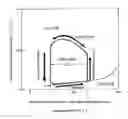
On the other hand, as one of the methods for evaluating the cardiac function variation, more particularly, the contractile variation of the left ventricle, there is a method for inserting a conductance catheter into the left ventricle, calculating an internal area of a closed-loop from a relationship between left ventricle internal pressure and left ventricle internal volume, the relationship being indicated in FIG. 1, and then evaluating the cardiac function variation, the method being disclosed in Japanese Published Unexamined Patent Application No. 2002-143109 (Patent Document 2). The closed-loop area (stroke volume) in FIG. 1 corresponds to workload.
However, in the conventional method, it is necessary to use an expensive ultrasonic echo apparatus or to insert the conductance catheter into the left ventricle of the person having the connected auxiliary artificial heart. Therefore, the method is invasive, and not only imposes a burden on the person, but also has a possibility of causing infection or a thrombus in the case of long-time use.
DISCLOSURE OF THE INVENTION
The present invention was made in order to solve the above conventional problem, and aims at continuously evaluating contractile variation of a ventricle, to which an auxiliary artificial heart is connected, not by use of an ultrasonic echo apparatus or a conductance catheter but by use of a non-invasive method.
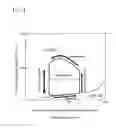
According to experiments by the inventors, it is possible to prepare a graph indicating a relationship between left ventricle internal pressure and a motor consumption power as indicated in FIG. 3 based on a consumption power wave obtained by multiplying a current wave of a motor of a continuous flow type left ventricle auxiliary artificial heart 20 shown in FIG. 2 and motor voltage; and the internal pressure of a left ventricle 10A, the internal pressure being detected by a pressure sensor 30 built in a blood removal tube 22, and possible to, as indicated in FIG. 4, obtain a sufficient correlation between a closed-loop internal area APMp of the above relationship and an external work EW for circulating blood through the whole body including the left ventricle 10A and the auxiliary artificial heart 20. The correlation indicates that, regardless of characteristics of a pump of the artificial heart, the contractile variation of the left ventricle, to which the auxiliary artificial heart is connected, can be evaluated based on the closed-loop internal area APMp.
The present invention was made based on such knowledge, and solves the above problem by providing a cardiac function evaluation apparatus including: a continuous flow type auxiliary artificial heart connected to a ventricle; a pressure sensor for detecting the ventricle internal pressure; and means for evaluating contractile variation of the ventricle, to which the auxiliary artificial heart is connected, based on a relationship between the ventricle internal pressure detected by the pressure sensor and a consumption power of the auxiliary artificial heart.
Here, the contractile variation of the ventricle, to which the auxiliary artificial heart is connected, can be evaluated based on a closed-loop internal area of the relationship between the ventricle internal pressure and the consumption power of the auxiliary artificial heart.
Additionally, the pressure sensor can be built in a blood removal cannula for connecting the ventricle and the auxiliary artificial heart.
Additionally, as the auxiliary artificial heart, a diagonal flow pump, a centrifugal pump or an axial flow pump is applicable.
According to the present invention, it is possible to evaluate the contractile variation of the ventricle, to which the auxiliary artificial heart is connected, not by use of an ultrasonic echo apparatus or a conductance catheter but by use of a non-invasive method.
BRIEF DESCRIPTION OF THE DRAWINGS
FIG. 1 is a graph indicating one cycle using left ventricle internal pressure and a volume loop regarding the left ventricle.
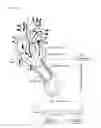
FIG. 2 is a view showing an embodiment of the present invention.
FIG. 3 is a graph indicating a relationship between the left ventricle internal pressure and a motor consumption power of an auxiliary artificial heart, the relationship explaining the principle of the present invention.
FIG. 4 similarly is a graph indicating an example of a relationship between a closed-loop internal area APMp calculated based on the motor consumption power and an external work calculated based on the left ventricle internal pressure and the volume loop.
FIG. 5 is a view showing a partial bypass state of the embodiment.
BEST MODE FOR CARRYING OUT THE INVENTION
Hereinafter, an embodiment of the present invention will be described in detail with reference to the drawings.
As shown in FIG. 2, a cardiac function variation evaluation apparatus of the embodiment includes: a continuous flow type auxiliary artificial heart 20 connected to a left ventricle 10A of a heart 10 and a drive controller 21 of the same; a pressure sensor 30 for detecting internal pressure of the left ventricle 10A and a sphygmomanometer 31; and a personal computer (PC) 40 for evaluating contractile variation of the left ventricle, to which the auxiliary artificial heart is connected, based on a closed-loop internal area APMp of a relationship between the left ventricle internal pressure detected by the pressure sensor 30 and a motor consumption power of the auxiliary artificial heart 20.
In FIG. 2, the reference symbol 11 denotes an ascending aorta, 12 denotes an aortic arch, 14 denotes a descending aorta, and 23 denotes a blood feed tube.
As the auxiliary artificial heart 20, a diagonal flow pump is usable, for example. Alternatively, a centrifugal pump or an axial flow pump, etc., may be used.
It is desirable that the pressure sensor 30 is provided on an wall at the top end of a blood removal cannula 22 for connecting the left ventricle 10A and the auxiliary artificial heart 20, the wall being in the vicinity of the ventricle.
A graph indicating a relationship as shown in FIG. 3 between the left ventricle internal pressure and the motor consumption power is prepared based on the motor consumption power of the auxiliary artificial heart 20 and an output of the pressure sensor 30, which are calculated by using a simulated circulation circuit or a conventional conductance catheter and the like in an animal experiment. Then, a relationship between the calculated closed-loop internal area APMp and a loop internal area of the left ventricle pressure and volume which is calculated by using a conventional conductance catheter and the like, is obtained in advance, and a relational expression as indicated in FIG. 4 is prepared.
As shown in FIG. 2, in a full bypass state in which the heart is weak and a valve is not opened, a high correlation (correlation coefficient: r=0.94) as indicated by a solid line A in FIG. 4, is obtained in which an external work EW is small relative to the closed-loop internal area APMp.
Solid line A: EW=20 APMp−230 (1)
On the other hand, in the case of a partial bypass state where the heart recovers and an aorta valve is opened as shown in FIG. 5, the external work EW becomes relatively high and the correlation becomes slightly worse (correlation coefficient: r=0.87) as indicated by a broken line B in FIG. 4.
Broken line B: EW=27 APMp−390 (2)
Accordingly, if variation of the closed-loop internal area APMp is continuously monitored, it suggests that the contractile variation of the left ventricle can be presumed.
Moreover, although the diagonal flow pump is employed as the auxiliary artificial heart in the embodiment, the present invention is not limited to it. The present invention is also applicable to the centrifugal pump proposed by the Applicant in Patent Document 1, or the axial pump.
INDUSTRIAL APPLICABILITY
The present invention is usable for the case of continuously evaluating contractile variation of a ventricle, to which an auxiliary artificial heart is connected, not by use of an ultrasonic echo apparatus or a conductance catheter to be inserted into the ventricle through a peripheral blood vessel but by use of a non-invasive method.
Claims
1. A cardiac function variation evaluation apparatus comprising:
a continuous flow type auxiliary artificial heart connected to a ventricle;
a pressure sensor for detecting ventricle internal pressure; and
means for evaluating contractile variation of the ventricle, to which the auxiliary artificial heart is connected, based on a relationship between the ventricle internal pressure detected by the pressure sensor and a consumption power of the auxiliary artificial heart.
2. The cardiac function variation evaluation apparatus according to claim 1 wherein the contractile variation of the ventricle, to which the auxiliary artificial heart is connected, is evaluated based on an internal area of a closed-loop of the relationship between the ventricle internal pressure and the consumption power of the auxiliary artificial heart.
3. The cardiac function variation evaluation apparatus according to claim 1 wherein the pressure sensor is built in a blood removal cannula via which the auxiliary artificial heart is connected to the ventricle.
4. The cardiac function variation evaluation apparatus according to claim 1 wherein, as the auxiliary artificial heart, a diagonal flow pump, a centrifugal pump or an axial flow pump is used.
Images & Drawings included:


Sources:
- United States Patent and Trademark Office - verify current appl. status at the USPTO↗
Recent applications in this class:
- » 20250248608 2025-08-07
FLEX CIRCUIT FOR ELECTRICAL CONNECTION IN INTRALUMINAL DEVICE AND ASSOCIATED DEVICES, SYSTEMS, AND METHODS - » 20250228461 2025-07-17
METHODS FOR ASSESSING A VESSEL WITH SEQUENTIAL PHYSIOLOGICAL MEASUREMENTS - » 20250194942 2025-06-19
APPARATUS, SYSTEMS, AND METHODS TO IMPROVE ATRIAL FIBRILLATION OUTCOMES INVOLVING THE LEFT ATRIAL APPENDAGE - » 20250194941 2025-06-19
WIRELESS, BATTERYLESS BLOOD PRESSURE SENSOR IMPLANT - » 20250185928 2025-06-12
IMPLANTABLE DEVICE AND METHOD FOR DETECTING IN VIVO PRESSURE IN AN ORGAN OF A SUBJECT - » 20250107718 2025-04-03
INTRAVASCULAR DEVICES, SYSTEMS, AND METHODS HAVING A CORE WIRE WITH EMBEDDED CONDUCTORS - » 20250098966 2025-03-27
AUTOMATIC CONTROL OF A MEASUREMENT TIME OF AN IMPLANTABLE DEVICE - » 20250057431 2025-02-20
Device for Indicating Pressure of Fluids - » 20250049333 2025-02-13
PRESSURE SENSOR - » 20250000376 2025-01-02
VENTRICULAR ASSIST DEVICE
Recent applications for this Assignee:
- » 20160061209 2016-03-03
Impeller of a centrifugal pump apparatus