Thiophene derivatives and its applications
US20100237771A1
2010-09-23
12/486,307
2009-06-17
✅ Patent granted
US 8,592,054 B2
2013-11-26
-
-
Gregory Clark
Patterson Thuente Pedersen, P.A.
2031-01-24
Abstract:
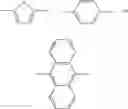
A thiophene derivative, which has a chemical structure of formula (1):
wherein,
- X is a substituted or non-substituted C6-C20 aromatic or C1-C20 aliphatic group;
- R1 and R2 are independently H, a C1-C10 linear, branched, or cyclic aliphatic group, or connected with the carbon atoms of formula (1) to form a first heterocyclic ring;
- R3 and R4 are independently H, a C1-C10 linear, branched, or cyclic aliphatic group, or connected with the carbon atoms of formula (1) to form a second heterocyclic ring; and
- b is an integer ranging from 1 to 10,
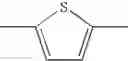
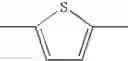
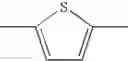
with a proviso that X is not
when all of R1, R2, R3 and R4 are H.
Assignee:
- ETERNAL CHEMICAL CO., LTD. 54 🇹🇼 Kaohsiung, Taiwan
Applicant:
Interested in similar patents?
Get notified when new applications in this technology area are published.
Classification:
C09K11/06 » CPC main
Luminescent, e.g. electroluminescent, chemiluminescent materials containing organic luminescent materials
C07D333/08 » CPC further
Heterocyclic compounds containing five-membered rings having one sulfur atom as the only ring hetero atom not condensed with other rings not substituted on the ring sulphur atom with only hydrogen atoms, hydrocarbon or substituted hydrocarbon radicals, directly attached to the ring carbon atoms Hydrogen atoms or radicals containing only hydrogen and carbon atoms
C07D333/18 » CPC further
Heterocyclic compounds containing five-membered rings having one sulfur atom as the only ring hetero atom not condensed with other rings not substituted on the ring sulphur atom with only hydrogen atoms, hydrocarbon or substituted hydrocarbon radicals, directly attached to the ring carbon atoms; Radicals substituted by singly bound hetero atoms other than halogen by sulfur atoms
C07D495/04 » CPC further
Heterocyclic compounds containing in the condensed system at least one hetero ring having sulfur atoms as the only ring hetero atoms in which the condensed system contains two hetero rings Ortho-condensed systems
H01L51/0068 » CPC further
Solid state devices using organic materials as the active part, or using a combination of organic materials with other materials as the active part; Processes or apparatus specially adapted for the manufacture or treatment of such devices, or of parts thereof; Selection of organic semiconducting materials, e.g. organic light sensitive or organic light emitting materials; Macromolecular systems with low molecular weight, e.g. cyanine dyes, coumarine dyes, tetrathiafulvalene aromatic compounds comprising a hetero atom, e.g.: N,P,S comprising only sulfur as heteroatom
H05B33/20 » CPC further
Electroluminescent light sources; Light sources with substantially two-dimensional radiating surfaces characterised by the chemical or physical composition or the arrangement of the material in which the electroluminescent material is embedded
H01L51/0037 » CPC further
Solid state devices using organic materials as the active part, or using a combination of organic materials with other materials as the active part; Processes or apparatus specially adapted for the manufacture or treatment of such devices, or of parts thereof; Selection of organic semiconducting materials, e.g. organic light sensitive or organic light emitting materials; Organic polymers or oligomers comprising aromatic, heteroaromatic, or arrylic chains, e.g. polyaniline , polyphenylene , polyphenylene vinylene; Heteroaromatic compounds comprising sulfur or selene, e.g. polythiophene Polyethylene dioxythiophene [PEDOT] and derivatives
H01L51/0052 » CPC further
Solid state devices using organic materials as the active part, or using a combination of organic materials with other materials as the active part; Processes or apparatus specially adapted for the manufacture or treatment of such devices, or of parts thereof; Selection of organic semiconducting materials, e.g. organic light sensitive or organic light emitting materials; Macromolecular systems with low molecular weight, e.g. cyanine dyes, coumarine dyes, tetrathiafulvalene Polycyclic condensed aromatic hydrocarbons, e.g. anthracene
H01L51/5012 » CPC further
Solid state devices using organic materials as the active part, or using a combination of organic materials with other materials as the active part; Processes or apparatus specially adapted for the manufacture or treatment of such devices, or of parts thereof specially adapted for light emission, e.g. organic light emitting diodes [OLED] or polymer light emitting devices [PLED] Electroluminescent [EL] layer
H01J1/63 IPC
Details of electrodes, of magnetic control means, of screens, or of the mounting or spacing thereof, common to two or more basic types of discharge tubes or lamps; Screens on or from which an image or pattern is formed, picked-up, converted, or stored; Luminescent coatings on vessels; Luminescent screens; Selection of materials for luminescent coatings on vessels characterised by the luminescent material
C07D409/02 IPC
Heterocyclic compounds containing two or more hetero rings, at least one ring having sulfur atoms as the only ring hetero atoms containing two hetero rings
C07D495/02 IPC
Heterocyclic compounds containing in the condensed system at least one hetero ring having sulfur atoms as the only ring hetero atoms in which the condensed system contains two hetero rings
Description
CROSS-REFERENCES TO RELATED APPLICATIONS
This application claims priority to Taiwan Patent Application No. 098109348 filed on Mar. 23, 2009, the disclosures of which are incorporated herein by reference in their entirety.
BACKGROUND OF THE INVENTION
1. Field of the Invention
The present invention provides a thiophene derivative. In particular, the present invention provides a thiophene derivative suitable for use as an organic light-emitting material or a conductive material.
2. Descriptions of the Related Art
Currently, light-emitting diodes (LEDs) are commonly used. For example, most traffic lights and large monitors use inorganic LEDs. As for the organic material-based LEDs, they can be manufactured into displays. Also, it has been predicted that organic LEDs will be the mainstream of medium-size or mini-size displays in the next generation due to their advantages such as self-luminous property, high response rate, low power consumption, large viewing angle, light weight, thin thickness, high brightness, full-color, and ability to display animated images.
Organic light-emitting diodes (OLEDs), first published by Kodak in the 1980s, are display elements that use the electroluminescence of an organic light-emitting material, i.e., a property that shows reversible color change to provide display effects when a voltage or current is applied. The OLED is mostly composed of a pair of electrodes and an organic light emitting layer, wherein the organic light emitting layer includes a light emitting material.
In 1990s, D. D. Bradley found another conjugated polymer with electroluminescence, i.e., poly(p-phenylene vinylene). The conjugated polymers have since been applied in LEDs. The conjugated polymers are polymers where the main chain thereof is composed of mutually connected double bonds and single bonds. Such polymers have special photoelectric properties, and have been the focal point of the development of organic semiconductor materials.
Compared to inorganic LEDs, the polymer LEDs can be prepared more easily. Among the numerous conjugated polymers, polythiophene and its derivatives are especially representative conjugated polymers. In addition to superior stability and thermal stability, polythiophene and its derivatives also have electrochromic properties, and thereby can be used as conductive materials or light emitting materials. The conductive/light emitting materials are widely used in the electro-optical field, e.g., as conductive materials required for thin film transistors (TFTs), capacitors, solar cells, or fuel cells, or as light emitting materials of OLEDs. In addition, they can be used in anti-statics, sealing applications etc.
In the electro-optical field, the “relative quantum yield” is usually a basis for judging the luminous efficiency of electro-optical materials. In other words, electro-optical materials with a higher relative quantum yield demonstrate better luminous efficiency, while electro-optical materials with a lower relative quantum yield demonstrate poor luminescent efficiency. The relative quantum yield is measured by using Coumadine having a quantum yield of 0.55 under 10−5 M sulfuric acid solution as a standard with UV-absorbing spectrum and fluorescence emission spectrum. The relative quantum yields can be obtained from the ratio of the integration values of the above two spectrums and the refractive index of the testing solution.
The sulfur element in the structure of the conductive polymers of polythiophene and its derivatives will lower the relative quantum yield, and thereby lower the application efficiency. In view of this, the inventor of the present invention conducted a lot of research and found that the relative quantum yield of polythiophene or its derivatives can be increased to improve the applicability by doping an aromatic ring or heterocyclic ring.
Thus, the present invention provides a thiophene derivative, which has a better relative quantum yield. Also, the conjugation length can be changed by changing the structure of the thiophene derivative to change the color of luminescence, and thereby, the thiophene derivative can be more widely used. The longer the conjugation length is, the longer the wavelength of the emitted light (i.e., red shift) and the smaller the band gap (E) will be. On the contrary, the shorter the conjugation length is, the shorter the wavelength of the emitted light (i.e., blue shift) and the greater the band gap will be. The band gap can be obtained by the formula E=hc/λ=1240/λ, wherein λ is the wavelength at the intersection point of X-axis (wavelength axis) and the absorption peak of the longest wavelength of the UV spectrum. The conjugation length of the thiophene derivative can be changed by designing its molecular structure to adjust the color of luminescence, and thus, the thiophene derivative can be more widely used. Moreover, the solubility of the thiophene derivative of the present invention is improved in the presence of an aromatic ring, and thus, is more convenient for use.
SUMMARY OF THE INVENTION
One objective of this invention is to provide a thiophene derivative, which has a chemical structure of formula (1):
wherein,
- X is a substituted or non-substituted C6-C20 aromatic or C1-C20 aliphatic group;
- R1 and R2 are independently H, a C1-C10 linear, branched, or cyclic aliphatic group, or connected with the carbon atoms of formula (1) to form a first heterocyclic ring;
- R3 and R4 are independently H, a C1-C10 linear, branched, or cyclic aliphatic group, or connected with the carbon atoms of formula (1) to form a second heterocyclic ring; and
- b is an integer ranging from 1 to 10,
with a proviso that X is not
when all of R1, R2, R3 and R4 are H.
Another objective of this invention is to provide a conductive material comprising the above thiophene derivative, wherein the conductive material is used as a capacitor material or sensitizing dye of solar cells.
Yet a further objective of this invention is to provide an organic light-emitting material including the above thiophene derivative.
The detailed technology and preferred embodiments implemented for the subject invention are described in the following paragraphs accompanying the appended drawings for people skilled in this field to well appreciate the features of the claimed invention.
DESCRIPTION OF THE PREFERRED EMBODIMENT
The thiophene derivative according to the present invention has a chemical structure of formula (1):
wherein,
- X is a substituted or non-substituted C6-C20 aromatic or C1-C20 aliphatic group;
- R1 and R2 are independently H, a C1-C10 linear, branched, or cyclic aliphatic group, or connected with the carbon atoms of formula (1) to form a first heterocyclic ring;
- R3 and R4 are independently H, a C1-C10 linear, branched, or cyclic aliphatic group, or connected with the carbon atoms of formula (1) to form a second heterocyclic ring; and
- b is an integer ranging from 1 to 10,
with a proviso that X is not
when all of R1, R2, R3 and R4 are H.
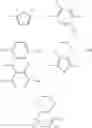
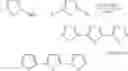
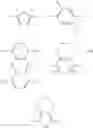
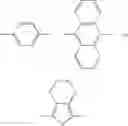
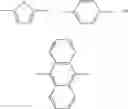
Preferably, X of formula (1) is selected from a group consisting of the following formulas (2) to (10):
wherein,
- A is S, O, N or Se; and
- S1, S2, S3 and S4 are independently H, a C1-C8 alkyl group or a C1-C8 alkoxy group.
According to the preferred embodiments of the present invention, in formula (1), X is selected from a group consisting of
wherein A is S, O, N or Se, and S1, S2, S3 and S4 are independently H or a C1-C3 alkyl group; R1, R2, R3 and R4 are independently H, CH3, C2H5, OCH3, OC2H5, OC2H3, OC3H5 or C3H7; and b is an integer ranging from 1 to 3.
More preferably, in formula (1), X is
R1, R2, R3 and R4 are independently H or CH3; and b is 1.
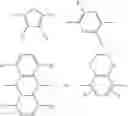
According to the other preferred embodiments of the present invention, in formula (1), X is selected from a group consisting of
wherein A is S, O, N or Se, and S1, S2, S3 and S4 are independently H or a C1-C3 alkyl group; R1 and R2 are connected with the carbon atoms of formula (1) to form a first heterocyclic ring; R3 and R4 are connected with the carbon atoms of formula (1) to form a second heterocyclic ring; and b is an integer ranging from 1 to 3. The first heterocyclic ring and the second heterocyclic ring are further illustrated below through the following formula (1′):
R1 and R2 form a 3 to 10 element first heterocyclic ring with carbon atoms 1 and 2 of formula (1′) and R3 and R4 form a 3 to 10 element second heterocyclic ring with carbon atoms 3 and 4 of formula (1′). The number of the hetero-atoms of the first heterocyclic ring or the second heterocyclic ring ranges from 1 to 3, and the hetero-atom can be N, O or S, preferably O.
In other preferred embodiments of the present invention, more preferably, X is selected from a group consisting of
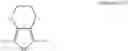
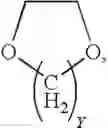
wherein S1, S2, S3 and S4 are independently H or CH3; the first heterocyclic ring and/or the second heterocyclic ring are/is
and Y is an integer ranging from 0 to 6; and b is 1.
In other preferred embodiments of the present invention, most preferably, X is
the first heterocyclic ring and/or the second heterocyclic ring are/is
and b is 1.
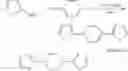
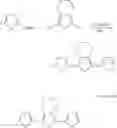
The thiophene derivatives of the present invention can be prepared according to the synthesis method familiar to people with ordinary skill in the art. For example, the thiophene derivatives of the present invention may be prepared by the following method: reacting halogenated thiophene with Mg powders in a solvent of ethyl ether or tetrahydrofuran to generate Grignard reagent (alkyl halogenated magnesium, R—MgX); and then reacting the Grignard reagent with a halogenated aliphatic or halogenated aromatic to generate the thiophene derivatives of the present invention. The above illustration may be represented by the following equations:
The thiophene derivatives of the present invention have improved relative quantum yield and are especially suitable for use as conductive materials. Thus, the present invention also relates to a conductive material comprising the thiophene derivative of formula (1). The conductive material can be used as, for example, a capacitor material or sensitizing dye of solar cell materials.
The thiophene derivatives of formula (1) according to the present invention are also suitable for use in an organic light-emitting material. The organic light-emitting material comprising the thiophene derivative of formula (1) can be applied in an OLED element as a material of light emitting layer and provides well luminous efficiency. Furthermore, said organic light emitting material can be incorporated into an OLED element as a material of light emitting layer or a portion of the material of light emitting layer by any familiar method in this field. Namely, the organic light-emitting material of the present invention can be mixed with other materials in various ratios and then applied on the elements as a material of the light emitting layer of an organic light emitting element. The luminous efficiency of OLED elements can be improved and the luminescent color can be regulated when the light emitting material is doped in light-emitting. For example, through doping techniques, the organic light-emitting material comprising the thiophene derivative of formula (1) of the present invention may play the role of the host of energy, or the guest of energy as a light emitting dopant.
COMPARATIVE EXAMPLE
According to the following equation, the thiophene derivative of formula (11) was prepared from the reactants in a molar ratio of 2 (up to 2.1):1 in the presence of a catalyst of 5 wt % NiCl2 (dppe) (1,2-bis-(diphenylphosphino)ethane) and a solvent of ethyl ether.
The molecular weight of the prepared compound was 248. The identified location of hydrogen spectrum was characterized by 1H NMR (solvent: CDCl3, 400 MHz, ppm) and the chemical shift (3) was as follows: 7.24-7.22 (d, Ar—H 2H), 7.19-7.18 (d, Ar—H 2H), 7.09 (s, Ar—H 2H), 7.04-7.02 (m, Ar—H 2H).
Example 1
According to the following equation, the thiophene derivative of formula (12) was prepared from the reactants in a molar ratio of 2 (up to 2.1):1.
The molecular weight of the prepared compound was 242. The identified location of hydrogen spectrum was characterized by 1H NMR (solvent: CDCl3, 400 MHz, ppm) and the chemical shift (δ) was as follows: 7.63 (s, Ar—H 4H), 7.36-7.35 (d, Ar—H 2H), 7.31-7.30 (d, Ar—H 2H), 7.12-7.09 (m, Ar—H 2H).
Example 2
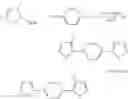
According to the following equation, the thiophene derivative of formula (13) was prepared from the reactants in a molar ratio of 2 (up to 2.1):1.
The molecular weight of the prepared compound was 342. The identified location of hydrogen spectrum was characterized by 1H NMR (solvent: CDCl3, 400 MHz, ppm) and the chemical shift (δ) was as follows: 7.90-7.87 (m, Ar—H 4H), 7.65-7.63 (m, Ar—H 2H), 7.43-7.41 (m, Ar—H 4H), 7.35-7.32 (m, Ar—H 2H), 7.24-7.23 (m, Ar—H 2H).
Example 3
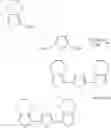
According to the following equation, the thiophene derivative of formula (14) was prepared from the reactants in a molar ratio of 2 (up to 2.1):1.
The molecular weight of the prepared compound was 270. The identified location of hydrogen spectrum was characterized by 1H NMR (solvent: CDCl3, 400 MHz, ppm) and the chemical shift (δ) was as follows: 7.52 (s, Ar—H 4H), 7.24-7.23 (d, Ar—H 2H), 6.96-6.95 (d, Ar—H 2H), 2.38 (s, —CH3 6H).
Example 4
According to the following equation, the thiophene derivative of formula (15) was prepared from the reactants in a molar ratio of 2 (up to 2.1):1.
The molecular weight of the prepared compound was 306. The identified location of hydrogen spectrum was characterized by 1H NMR (solvent: CDCl3, 400 MHz, ppm) and the chemical shift (δ) was as follows: 7.25-7.22 (m, Ar—H 2H), 7.13-7.08 (m, Ar—H 4H), 4.32-4.38 (m, —OCH2— 4H).
Example 5
According to the following equation, the thiophene derivative of formula (16) was prepared from the reactants in a molar ratio of 2 (up to 2.1):1.
The molecular weight of the prepared compound was 364. The identified location of hydrogen spectrum was characterized by 1H NMR (solvent: CDCl3, 400 MHz, ppm) and the chemical shift (δ) was as follows: 7.24-7.22 (m, Ar—H 1H), 7.06-6.96 (m, Ar—H 1H), 4.41-4.39 (m, —OCH2— 4H), 4.37-4.36 (m, —OCH2— 4H).
Efficiency Test
Coumadine, having a quantum yield of 0.55 under 10−5 M sulfuric acid solution, was taken as a standard. The relative quantum yields of the thiophene derivatives prepared from Comparative Example and Examples 1 to 5 were measured and recorded in Table 1.
| TABLE 1 | ||||||
| Comparative | Exam- | Exam- | Exam- | Exam- | Exam- | |
| example | ple 1 | ple 2 | ple 3 | ple 4 | ple 5 | |
| Relative | 16.2 | 37.8 | 51.6 | 44.9 | 24.2 | 28 |
| quantum | ||||||
| yield (%) | ||||||
As seen in Table 1, compared to Comparative Example, the thiophene derivatives of Examples 1 to 5 (doped with aromatic rings or heterocyclic rings) have better relative quantum yields. In other words, the thiophene derivatives provided by the present invention provide better relative quantum yields indeed, and thereby, can be applied more widely.
Given the above, the thiophene derivatives provided by the present invention certainly have improved relative quantum yields and industrial applicability.
The above disclosure is related to the detailed technical contents and inventive features thereof. People skilled in this field may proceed with a variety of modifications and replacements based on the disclosures and suggestions of the invention as described without departing from the characteristics thereof. Nevertheless, although such modifications and replacements are not fully disclosed in the above descriptions, they have substantially been covered in the following claims as appended.
Claims
What is claimed is:1. A thiophene derivative, which has a chemical structure of formula (1):
wherein,
X is a substituted or non-substituted C6-C20 aromatic or C1-C20 aliphatic group;
R1 and R2 are independently H, a C1-C10 linear, branched, or cyclic aliphatic group, or connected with the carbon atoms of formula (1) to form a first heterocyclic ring;
R3 and R4 are independently H, a C1-C10 linear, branched, or cyclic aliphatic group, or connected with the carbon atoms of formula (1) to form a second heterocyclic ring; and
b is an integer ranging from 1 to 10,
with a proviso that X is not
when all of R1, R2, R3 and R4 are H.
2. The thiophene derivative of claim 1, wherein X is selected from a group consisting of following formulas (2) to (10):
wherein,
A is S, O, N or Se; and
S1, S2, S3 and S4 are independently H, C1-C8 alkyl or C1-C8 alkoxy.
3. The thiophene derivative of claim 1, wherein X is selected from a group consisting of
wherein A is S, O, N or Se and S1, S2, S3 and S4 are independently H or C1-C3 alkyl;
R1, R2, R3 and R4 are independently H, CH3, C2H5, OCH3, OC2H5, OC2H3, OC3H5 or C3H7; and
b is an integer ranging from 1 to 3.
4. The thiophene derivative of claim 3, wherein X is
R1, R2, R3 and R4 are independently H or CH3; and
b is 1.
5. The thiophene derivative of claim 1, wherein X is selected from a group consisting of
wherein A is S, O, N or Se and S1, S2, S3 and S4 are independently H or C1-C3 alkyl;
R1 and R2 are connected with the carbon atoms of formula (1) to form the first heterocyclic ring;
R3 and R4 are connected with the carbon atoms of formula (1) to form the second heterocyclic ring; and
b is an integer ranging from 1 to 3.
6. The thiophene derivative of claim 5, wherein X is selected from a group consisting of
wherein S1, S2, S3 and S4 are independently H or C1-C3 alkyl;
the first heterocyclic ring or the second heterocyclic ring is
and y is an integer ranging from 0 to 6; and
b is 1.
7. The thiophene derivative of claim 6, wherein X is
and the first heterocyclic ring or the second heterocyclic ring is
8. A conductive material, comprising the thiophene derivative of claim 1.
9. An organic light emitting material, comprising the thiophene derivative of claim 1.
Images & Drawings included:














Sources:
- United States Patent and Trademark Office - verify current appl. status at the USPTO↗
Similar patent applications:
Recent applications in this class:
- » 20250282992 2025-09-11
LIGHT-EMITTING DEVICE INCLUDING CONDENSED CYCLIC COMPOUND AND ELECTRONIC APPARATUS INCLUDING THE LIGHT-EMITTING DEVICE - » 20250282991 2025-09-11
Light conversion agent, a light conversion adhesive film composition, a light conversion adhesive film, and a photovoltaic module - » 20250277146 2025-09-04
ORGANOMETALLIC COMPOUND, ORGANIC LIGHT-EMITTING DEVICE INCLUDING THE SAME, AND ELECTRONIC APPARATUS INCLUDING THE ORGANIC LIGHT-EMITTING DEVICE - » 20250270445 2025-08-28
COMPOUNDS AND USES THEREOF IN FIELD OF OPTOELECTRONICS - » 20250270444 2025-08-28
Symmetric Charge Transfer Compounds for Organic Photovoltaics - » 20250270443 2025-08-28
ORGANIC METAL COMPLEX SCINTILLATORS AND METHODS OF MAKING THE SAME - » 20250263600 2025-08-21
LIGHT-EMITTING POLYMER FILM AND PROCESS OF ITS FORMATION - » 20250257261 2025-08-14
PLURALITY OF LIGHT-EMITTING MATERIAL AND ORGANIC ELECTROLUMINESCENT DEVICE COMPRISING THE SAME - » 20250257260 2025-08-14
HETEROCYCLIC COMPOUND, AND ORGANIC LIGHT-EMITTING DEVICE AND ELECTRONIC APPARATUS INCLUDING THE SAME - » 20250250484 2025-08-07
LIGHT-EMITTING DEVICE AND ELECTRONIC APPARATUS COMPRISING SAME
Recent applications for this Assignee:
- » 20150129539 2015-05-14
Passivation composition and its application - » 20140356253 2014-12-04
BIOMEDICAL DEVICES - » 20140340820 2014-11-20
Conductive material formulation and use thereof - » 20140231862 2014-08-21
Curable composition and method for manufacturing the same - » 20140231861 2014-08-21
Curable composition and method for manufacturing the same - » 20140228512 2014-08-14
Polyimides, coating composition formed therefrom and use thereof - » 20140036415 2014-02-06
Conductive polymer composite and preparation and use thereof - » 20140018474 2014-01-16
COMPOSITION FOR ANTI-SCRATCH AND WEAR-RESISTANCE PROPERTIES, METHOD OF PREPARING THE SAME, AND ITS APPLICATIONS - » 20130296485 2013-11-07
Self-sensitive polymerizable liquid resin and use thereof - » 20130284982 2013-10-31
Conductive coating compositions