Use of grafted SMA copolymers in liquid compositions
US20100249281A1
2010-09-30
12/667,256
2008-06-23
✅ Patent granted
US 8,133,944 B2
2012-03-13
WO; PCT/FR2008/051121; 20080623
WO; WO2009/004264; 20090108
Ling Choi | Hui Chin
2028-06-23
Abstract:
The subject of the invention is the use of a grafted copolymer derived from the grafting: —of an SMA copolymer (II) derived from the copolymerization of at least two monomers, (i) the first monomer being chosen from styrene and its derivatives and (ii) the second monomer including at least one anhydride function, —with either (iii) M-R—X molecules (I) including at least one pattern (M) chosen from patterns (1) to (4): formula (I), with A=oxygen, sulfur or NH; and including at least one chemical function (X) chosen from among halogen, a primary or secondary amine function, an alcohol function, a thiol function, a carboxylic acid function or a derivative of said function and an epoxy function, the pattern (M) and said function (X) being connected by a rigid or flexible chain (R); namely (iv) molecules belonging to the family of triazoles; used as the majority composition or additive of liquid compositions intended to be applied in or on sheets of paper or cardboard, onto hard surfaces, on leather or on textiles.
Inventors:
- Sandra GRIMALDI 9 🇫🇷 Sainte-Foy-Les-Lyon, France
- Manuel HIDALGO 49 🇫🇷 Brignais, France
- Sandra Grimaldi 1 🇫🇷 Saint-Foy-les-Lyons, France
Assignee:
- Arkema France 1,711 🇫🇷 Colombes, France
Interested in similar patents?
Get notified when new applications in this technology area are published.
Classification:
C08F257/02 » CPC main
Macromolecular compounds obtained by polymerising monomers on to polymers of aromatic monomers as defined in group on to polymers of styrene or alkyl-substituted styrenes
D21H11/08 » CPC further
Pulp or paper, comprising cellulose or lignocellulose fibres of natural origin only Mechanical or thermomechanical pulp
D21H11/14 » CPC further
Pulp or paper, comprising cellulose or lignocellulose fibres of natural origin only Secondary fibres
D21H19/58 » CPC further
Coated paper ; Coating material; Coatings with pigments characterised by the other ingredients, e.g. the binder or dispersing agent; Macromolecular organic compounds or oligomers thereof obtained by reactions only involving carbon-to-carbon unsaturated bonds Polymers or oligomers of diolefins, aromatic vinyl monomers or unsaturated acids or derivatives thereof
D21H21/18 » CPC further
Non-fibrous material added to the pulp, characterised by its function, form or properties; Paper-impregnating or coating material, characterised by its function, form or properties characterised by function or properties in or on the paper Reinforcing agents
C08F2800/10 » CPC further
Copolymer characterised by the proportions of the comonomers expressed as molar percentages
C08F2800/20 » CPC further
Copolymer characterised by the proportions of the comonomers expressed as weight or mass percentages
C08F2810/50 » CPC further
Chemical modification of a polymer wherein the polymer is a copolymer and the modification is taking place only on one or more of the monomers present in minority
C08L51/003 » CPC further
Compositions of graft polymers in which the grafted component is obtained by reactions only involving carbon-to-carbon unsaturated bonds ; Compositions of derivatives of such polymers grafted on to macromolecular compounds obtained by reactions only involving unsaturated carbon-to-carbon bonds
C09D151/003 » CPC further
Coating compositions based on graft polymers in which the grafted component is obtained by reactions only involving carbon-to-carbon unsaturated bonds ; Coating compositions based on derivatives of such polymers grafted on to macromolecular compounds obtained by reactions only involving unsaturated carbon-to-carbon bonds
C08L2666/02 » CPC further
Composition of polymers characterized by a further compound in the blend, being organic macromolecular compounds, natural resins, waxes or and bituminous materials, non-macromolecular organic substances, inorganic substances or characterized by their function in the composition Organic macromolecular compounds, natural resins, waxes or and bituminous materials
C08F220/08 » CPC further
Copolymers of compounds having one or more unsaturated aliphatic radicals, each having only one carbon-to-carbon double bond, and only one being terminated by only one carboxyl radical or a salt, anhydride ester, amide, imide or nitrile thereof; Monocarboxylic acids having less than ten carbon atoms; Derivatives thereof Anhydrides
C08F8/32 » CPC further
Chemical modification by after-treatment; Introducing nitrogen atoms or nitrogen-containing groups by reaction with amines
C08F8/48 » CPC further
Chemical modification by after-treatment Isomerisation; Cyclisation
C08F212/08 » CPC further
Copolymers of compounds having one or more unsaturated aliphatic radicals, each having only one carbon-to-carbon double bond, and at least one being terminated by an aromatic carbocyclic ring; Monomers containing only one unsaturated aliphatic radical containing one ring; Hydrocarbons Styrene
C08F222/06 » CPC further
Copolymers of compounds having one or more unsaturated aliphatic radicals, each having only one carbon-to-carbon double bond, and at least one being terminated by a carboxyl radical and containing at least one other carboxyl radical in the molecule; Salts, anhydrides, esters, amides, imides, or nitriles thereof; Anhydrides, e.g. cyclic anhydrides Maleic anhydride
C08L79/04 IPC
Compositions of macromolecular compounds obtained by reactions forming in the main chain of the macromolecule a linkage containing nitrogen with or without oxygen or carbon only, not provided for in groups - Polycondensates having nitrogen-containing heterocyclic rings in the main chain; Polyhydrazides; Polyamide acids or similar polyimide precursors
C08K3/26 IPC
Use of inorganic substances as compounding ingredients; Oxygen-containing compounds, e.g. metal carbonyls; Acids; Salts thereof Carbonates; Bicarbonates
C08K3/34 IPC
Use of inorganic substances as compounding ingredients Silicon-containing compounds
C08K5/3445 IPC
Use of organic ingredients; Nitrogen-containing compounds; Heterocyclic compounds having nitrogen in the ring having two nitrogen atoms in the ring Five-membered rings
C08K3/00 IPC
Use of inorganic substances as compounding ingredients
Description
The present invention relates to the field of polymer additives based on styrene and anhydride units, constituted of macromolecular chains grafted by molecules of nitrogen-containing heterocycle type. In particular, it also, relates to the compositions comprising such additives and also to the uses thereof in particular in the field of the papermaking industry. The polymers comprising units derived from styrene or from a styrene derivative and units derived from an anhydride, in particular maleic anhydride are known as SMAs.
The use of SMA copolymers is well known in the manufacture of paper.
Indeed, polymer additives based on styrene and anhydride units make it possible to improve the properties of the paper such as its hydrophobicity, its water resistance, its printability and its surface appearance. These additives are often used as ingredients in liquid compositions for sizing or coating paper, the rheology of which they may also favorably modify by helping to reduce the viscosity, especially at high shear or by helping to increase the concentration of fillers or of pigments. These liquid compositions used for treating paper during its manufacture are aqueous suspensions of fillers or pigments which may also contain a binder and other additives.
Application WO 02/48459 cites polymers derived from the polymerization of styrene and of maleic anhydride that are incorporated into the formulation of compositions used for coating paper in high-speed processes.
However, the copolymers based on styrene and anhydride units do not make it possible to respond to certain problems encountered in the manufacture of paper in particular.
The Applicant has now found that the grafting of polymers based on styrene and anhydride units by molecules comprising nitrogen-containing heterocycles such as, for example, UDETA makes it possible to adjust the hydrophilic-hydrophobic balance of the copolymer making it possible, for example, to better dissolve styrene-rich copolymers, which is expressed by an improvement of the hydrophobicity properties of the treated paper. Furthermore, the grafting with molecules comprising nitrogen-containing heterocycles such as UDETA provides better compatibility with cellulose fibers and favors the dispersion of pigments and/or of fillers in liquid compositions used for the manufacture of paper. Similarly, in the other applications according to the invention, better surfactants and dispersants may be obtained by virtue of the grafting of molecules such as UDETA to copolymers based on styrene and anhydride units.
The polymer additive according to the invention is a graft copolymer derived from the grafting:
-
- of an SMA copolymer (II) derived from the copolymerization of at least two monomers, (i) the first monomer being chosen from styrene and derivatives thereof and (ii) the second monomer comprising at least one anhydride functional group;
- with either (iii) M-R—X molecules (1) comprising at least one unit (M) chosen from the units (1) to (4):
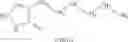
with A=oxygen, sulfur or NH;
and comprising at least one chemical functional group (X) chosen from a halogen, a primary or secondary amine functional group, an alcohol functional group, a thiol functional group, a carboxylic acid functional group or a derivative of this functional group and an epoxy functional group, the unit (M) and said functional group (X) being joined by a rigid or flexible chain (R);
or (iv) molecules belonging to the family of triazoles.
In the case of the SMA copolymer (II), units derived from other monomers may also be present without this excluding these polymers from the SMA designation. SMA copolymers may also be joined by covalent bonding to other polymers, especially to elastomeric polymers which may be chemically bonded to the SMAs. Since the anhydride units have a reactive or functional site of the copolymer remaining, they may be involved in a chemical reaction with other types of molecules.
When the anhydride groups will have participated in any modification reaction involving the opening of the anhydride groups, the resulting product is called a modified SMA or a functionalization derivative of SMA. It also appears pertinent to specify that, during the dissolution in aqueous media of an SMA copolymer, the addition of a mineral or organic base, usually an amine for the latter, is common practice. In this case, the anhydride groups may open and form carboxylic acid salts with the organic or mineral base. This salification leads to or favors the solubilization of the SMA copolymer. The modification of the SMA copolymers (II) by grafting of the molecules (I) according to the invention does not correspond simply to an acid-base salification reaction, but rather to a true chemical grafting of the molecules (I) to the copolymer (II) which is carried out prior to the use of the modified SMA additive, in a separate grafting step carried out in solution in a suitable solvent with subsequent separation of the graft copolymer or in the melt state, with no solvent, and such that it can be carried out in equipment for converting thermoplastic polymers, well known to a person skilled in the art, such as extruders, calandering machines and other mixers.
The SMA copolymer (II) is derived from the copolymerization of at least two different monomers, namely a styrene monomer, preferably styrene, and a monomer comprising an anhydride functional group, preferably maleic anhydride. The SMA copolymers may also be derived from copolymerizations with one or more other supplementary monomers such as, for example, acrylic comonomers such as alkyl(meth)acrylates. The SMA copolymers may also be joined, by chemical bonding, to other polymers, especially to elastomeric polymers.
The SMA copolymer (II) is derived from the copolymerization of a mixture of monomers comprising between 0.5 and 65% of monomers comprising an anhydride functional group (% by weight relative to the total mixture of monomers).
The molecular weights of the SMA copolymer according to the invention may vary between 500 and 500 000 daltons for the number-average molecular weight, Mn. Preferably, the SMA copolymers of use for the invention have number-average molecular weights between 2000 and 100 000 daltons.
The ratio of styrene units to anhydride units may vary between 0.6 to 1 and 29 to 1 and preferably between 1 to 1 and 6 to 1.
The M-R—X molecule (I) is derived from the reaction of urea with at least one compound chosen from alkyleneamines, amines, amino alcohols and amides. Advantageously, said compound comprises at least one primary amine functional group (—NH2) and at least one secondary amine functional group (—NH—), said functional groups being joined by a carbon-based chain comprising at least 2 carbon atoms. The rigid or flexible chain (R) is a hydrocarbon-based chain which may bear one or more heteroelements. It could be a linear or branched hydrocarbon-based chain composed of one to 30 carbon atoms, a ring or a succession of alkyl or aryl elements, joined by —C(O)O—, OC(O), C(O), —O—, —S—, —NH-bridges.
Mention may be made, for example, of:
-
- the UTETA molecule: 1-(2-[(2-aminoethyl)amino]-ethyl)imidazolidin-2-one derived from the reaction of urea with triethylenetetramine (TETA);
-
- the UTEPA molecule: 1-(2-{2-[(2-amino-ethylamino]ethyl}amino)ethyl]imidazolidin-2-one derived from the reaction of urea with tetraethylenepentamine (TEPA)
-
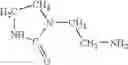
- the UDETA molecule: 2-aminoethylimidazolidinone or 1-(2-aminoethyl)imidazolidin-2-one derived from the reaction of urea with diethylenetriamine (DETA);
1-(2-aminoethyl)imidazolidin-2-one
-
- the UDETA molecule (formula below): 2-aminoethylimidazolidinone or 1-(2-aminoethyl)-imidazolidin-2-one derived from the reaction of urea with diethylenetriamine (DETA).
Advantageously, the functional group (X) of the molecule (I) is a primary or secondary amine functional group.
Advantageously, the unit (M) of the molecule (I) is the unit (1) which is a heterocycle of imidazolidone type with A=oxygen.
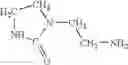
Advantageously, the molecule (I) is 1-(2-aminoethyl)-imidazolidin-2-one or UDETA:
1-(2-aminoethyl)imidazolidin-2-one or UDETA
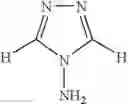
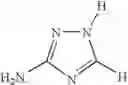
Regarding the molecules from the family of triazoles, mention may be made of:
- 4-amino-1,2,4-triazole
- 3-amino-1,2,4-triazole
The reaction between the molecules (I) and the copolymer (II) may be carried out in solution or in the melt state. The molecules (I) and the copolymer (II) may be put into solution in a suitable solvent, such as chloroform, by choosing the reaction temperature so that the reaction takes place over a reasonable time ranging from a few minutes to a few hours. Or else, the molecules (I) may be brought into contact with the copolymer (II) in the melt state, with no solvent, such that this can be carried out in equipment for converting thermoplastic polymers, well known to a person skilled in the art, such as extruders, calandering machines and other mixers.
Regarding the uses of the modified SMA polymers according to the invention, mention may be made of the following uses:
-
- as an additive in the field of the manufacture of paper. The additive is an ingredient of liquid compositions applied in or on the paper. These compositions may be used in the sizing or coating of paper. They may also be used within the context of paper finishing processes, for example for covering the sheets of paper with a view to facilitating subsequent printing on the paper. This additive thus improves the characteristics of the coated paper in terms of printability, color rendering, resolution, mechanical strength and feel. An advantageous compromise between the strength and the flexibility of the coated paper which is coated with a coating to which the additive according to the invention has been added and a good adhesion of one or more coating layers to the paper are obtained. Furthermore, by virtue of this additive, a better printing resolution is obtained. It also gives the paper a resistance, in particular to water (for making the paper hydrophobic), to greases or to other substances. It improves the retention of water in the paper (water/binder and fillers or pigments compatibility);
- as the predominant compound or as an additive for the production of liquid coatings or compositions that can be applied to surfaces such as floors, in particular to tiled or parquet floors in order to give them a shiny and new appearance. These coatings have a good adhesion to their support and a good mechanical strength which constitutes an advantage on stressed supports such as floors for example;
- as a surfactant, in particular for the stabilization of polymerizations in a dispersed medium such as direct and inverse (conventional, mini-emulsion, micro-emulsion) emulsion polymerization, direct and inverse suspension polymerization and dispersion or precipitation polymerization. See chapter 7 of the book “Les latex synthétiques. Elaboration-Propriétés-Applications [Synthetic latices. Development-Properties-Applications] compiled by Jean-Claude Daniel and Christian Pichot, published by Tec&Doc Lavoisier, 2006, ISBN 2-7430-0741-9 for a description of the various types of polymerizations in a dispersed medium;
- as a co-surfactant: —for manufacturing aqueous compositions of inks, of paints or of varnish during the synthesis of acrylic binders by emulsion polymerization that can be used:
- for manufacturing binders or coatings for leather or woven or nonwoven textiles;
- as a dispersant of mineral or organic pigments especially in ink compositions. It furthermore facilitates the milling of pigments;
- as a dispersant of mineral fillers such as calcium carbonate, kaolin, titanium dioxide or cement, in compositions such as grouts, mortars, concretes, paints and varnishes. It may also be a dispersant in another type of coatings (coating for sheets of paper for example); and
- as the predominant compound or an additive of liquid compositions intended to be applied in or on sheets of paper or cardboard, on hard surfaces, on leather or on textiles.
Preferably, the sheets of paper are sheets of printing/writing paper or of wrapping paper, in particular of wrapping paper produced from deinked mechanical paper pulp or from recycled paper pulp.
Preferably, the hard surfaces are chose from floors, walls and ceilings.
The following examples illustrate the invention, without limiting the scope thereof.
EXAMPLE 1
Grafting of an SMA Copolymer in an Extruder with UDETA
The SMA copolymer before grafting is an Aldrich® product containing 14% by weight of maleic anhydride. Its number-average molecular weight, Mn, is 85 000 g/mol and its weight-average molecular weight, Mw, is 188 000 g/mol. The grafting is carried out in a DSM Micro 15 Compounder micro-extruder under a stream of nitrogen. The SMA is first treated at 120° C. for 12 hours in a vacuum oven so as to reform the anhydrides capable of being hydrolyzed. 12 g of SMA are then mixed with 400 mg of UDETA having a molar purity greater than 85%. The extrusion temperature is 220° C. for screws rotating at 50 rpm. The material retains a good processability.
Thermal Analysis:
Samples of grafted SMA and non-grafted SMA of 10 mg each are analyzed by calorimetry using a DSC TA Q1000 machine operating in T4 mode. The glass transition temperatures of these two materials are estimated with heating and cooling rates of 10° C./min. The grafted SMA has a glass transition temperature of 5.4° C. higher than the non-grafted SMA (respectively 135.5° C. and 130.1° C.).
EXAMPLE 2
Grafting of an SMA Copolymer in an Extruder with a Smaller Amount of UDETA
The SMA copolymer before grafting is the same as that from example 1. The grafting is carried out in a DSM Micro 15 Compounder micro-extruder under a stream of nitrogen. The SMA is first treated at 120° C. for 12 hours in a vacuum oven so as to reform the anhydrides capable of being hydrolyzed. 12 g of SMA are then mixed with 170 mg of UDETA having a molar purity greater than 85%. The extrusion temperature is 220° C. for screws rotating at 50 rpm. The material retains a good processability.
Thermal Analysis:
Samples of grafted SMA and non-grafted SMA of 10 mg each are analyzed by calorimetry using a DSC TA Q1000 machine operating in T4 mode. The glass transition temperatures of these two materials are estimated with heating and cooling rates of 10° C./min. The grafted SMA has a glass transition temperature of 2.7° C. higher than the non-grafted SMA (respectively 132.7° C. and 130.1° C.).
EXAMPLE 3
Hydrophobizing Effect on Paper
The polymers from examples 1 and 2 are put into aqueous dispersion at 5% by weight in demineralized water with stirring. The polymer dispersion is mixed with a 33° SR pulp of refined paper fibers and with a cationic polymer agent (known as a retention agent) used for the manufacture, in a sheet machine, of sheets of paper, polyDADMAC (polydiallyldimethylammonium chloride) in an amount of 0.3% by weight relative to the fibers. The amount of grafted polymer dispersion according to the invention is adjusted so that the amount of polymer is of the order of 5% relative to the fibers. The suspension is then passed through a laboratory sheet machine in order to obtain sheets of paper of 60 to 70 g/m2 having a thickness of 80 to 100 microns. As a reference, sheets that do not contain the polymers from example 1 and 2, but that contain polyDADMAC, are manufactured.
The hydrophobicity of the paper thus manufactured is obtained from a COBB test, well known to a person skilled in the art and which is carried out according to the standard NF EN 20535—ISO 535; the comparative results between the reference sheets of paper and those containing the graft polymer according to the invention are shown in table 1:
| COBB value (g/m2) |
| Reference pulp | 160 | |
| with ex. 1 polymer | 100 | |
| with ex. 2 polymer | 80 | |
The hydrophobizing effect of the polymer is expressed by a reduction in the COBB value.
EXAMPLE 4
Grafting of a Low Molecular Weight SMA Copolymer and Surfactant Properties of the Resulting Polymer
The SMA copolymer before grafting is a Sartomer SMA 1000 product comprising a ratio of styrene:maleic anhydride units of 1:1. Granules of SMA 1000 are ground in a mortar or in a mill in order to have a fine powder which is then treated at 120° C. for 12 hours in a vacuum oven so as to reform the anhydrides capable of being hydrolyzed. 12 g of this powder are mixed with 170 mg of UDETA having a molar purity greater than 85% in a DSM Micro 15 Compounder micro-extruder under a stream of nitrogen. The extrusion is carried out at 220° C. and 50 rpm. The material is very fluid.
For the purpose of determining the surfactant properties of dilute aqueous solutions of the graft copolymer from example 1, an aqueous solution in demineralized water is prepared containing 1% by weight of this graft copolymer. This solution is filtered with a 0.8 micron filter. Next, solutions at 0.1%, 0.05%, 0.01% and 0.001% by weight are prepared by successive dilution of the filtered 1% solution. The surface tensions of these solutions are measured using a Tracker® brand drop tensiometer machine, controlled by Windrop® software with a needle having a diameter of 20 microns. Table 2 presents the result of the measurements taken.
| TABLE 2 | |
| Conc (%) |
| 0.0010 | 0.010 | 0.045 | 0.10 | 1.0 | |
| Tension | 69 | 69 | 67 | 58 | 45 | |
| (mN/m) | ||||||
It emerges from this table that the graft copolymer from example 1 has surfactant properties associated with an amphiphilic character. It may therefore be used for giving a certain hydrophobicity to sheets of paper or of cardboard while making it possible, by virtue of its hydrophilic part, to thoroughly disperse the fillers and pigments, while having a good affinity with the (hydrophilic) cellulose fibers constituting the paper.
Claims
1. A liquid composition for use in or on a substrate comprising
a graft copolymer derived from the grafting:
of a copolymer (II) derived from the copolymerization of at least two monomers, (i) the first monomer being chosen from styrene and derivatives thereof and (ii) the second monomer comprising at least one anhydride functional group;
with either (iii) M-R—X molecules (I) comprising at least one unit (M) chosen from the units (1) to (4):
with A=oxygen, sulfur or NH;
and comprising at least one chemical functional group (X) chosen from a halogen, a primary or secondary amine functional group, an alcohol functional group, a thiol functional group, a carboxylic acid functional group or a derivative of this functional group and an epoxy functional group, the unit (M) and said functional group (X) being joined by a rigid or flexible chain (R);
or (iv) molecules belonging to the family of triazoles;
wherein said substrate is selected from the group consisting of paper, cardboard, hard surfaces, leather and textiles.
2. The liquid composition as claimed in claim 1, wherein the sheets of paper are sheets selected from the group consisting of printing/writing paper, wrapping paper, wrapping paper produced from deinked mechanical paper pulp, and wrapping paper produced from recycled paper pulp.
3. The liquid composition as claimed in claim 1, wherein the hard surfaces are chosen from floors, walls and ceilings.
4. The liquid composition as claimed in one of claim 1, wherein said liquid composition is an aqueous liquid compositions of inks, of paints or of varnishes.
5. The liquid composition as claimed in claim 4, wherein said graft copolymer is a surfactant or a co-surfactant.
6. The liquid composition as claimed in claim 4, wherein said graft copolymer is a dispersant of mineral or organic pigments and/or of mineral fillers.
7. The liquid composition as claimed in claim 6, wherein said graft copolymer is a mineral filler dispersant wherein said mineral filler is chosen from calcium carbonate, kaolin, titanium dioxide and cement.
8. The liquid composition as claimed in claim 6, wherein said liquid composition comprises grouts, mortars or concretes.
9. The liquid composition as claimed in claim 1, wherein the copolymer (II) is derived from the copolymerization of a mixture of monomers comprising between 0.5 and 65% by weight of monomers comprising an anhydride functional group (% by weight relative to the total mixture of monomers).
10. The liquid composition as claimed in claim 1, wherein the number-average molecular weight (Mn) of the copolymer (II) is between 500 and 500 000 daltons.
11. The liquid composition as claimed in claim 1, wherein the monomer comprising an anhydride functional group is maleic anhydride.
12. The liquid composition as claimed in claim 1, wherein the molecules (I) are derived from the reaction of urea with at least one compound chosen from alkyleneamines, amines, amino alcohols and amides.
13. The liquid composition as claimed in claim 1, wherein the molecules (I) are derived from the reaction of urea with at least one compound containing at least one primary amine functional group (—NH2) and at least one secondary amine functional group (—NH—), said functional groups being joined by a carbon-based chain comprising at least 2 carbon atoms.
14. The liquid composition as claimed in claim 1, wherein the functional group (X) is a primary or secondary amine functional group.
15. The liquid composition as claimed in claim 1, wherein the unit (M) of the molecule (I) is the unit (1) which is a heterocycle of imidazolidone type with A=oxygen.
16. The liquid composition as claimed in claim 1, wherein the molecule (I) is 1-(2-aminoethyl)imidazolidin-2-one or UDETA:
1-(2-aminoethyl)imidazolidin-2-one
17. The liquid composition as claimed in claim 1, wherein the family of triazoles is constituted by 4-amino-1,2,4-triazole and 3-amino-1,2,4-triazole.
18. The liquid composition as claimed in claim 10, wherein the number-average molecular weight (Mn) of the copolymer (II) is between 2000 and 100 000 daltons.
Images & Drawings included:




Sources:
- United States Patent and Trademark Office - verify current appl. status at the USPTO↗
Similar patent applications:
- » 20120136095
USE OF GRAFTED SMA COPOLYMERS IN LIQUID COMPOSITIONS
Recent applications in this class:
- » 20240376243 2024-11-14
RESIN COMPOSITION, CURED PRODUCT, PREPREG, METAL FOIL-CLAD LAMINATE, RESIN SHEET, AND PRINTED WIRING BOARD - » 20240279377 2024-08-22
PREPARATION OF MONODISPERSE POLYMER BEADS WITH ROOM TEMPERATURE INITIATION METHODS - » 20240239936 2024-07-18
ACRYLIC RUBBER FOR THERMOPLASTIC MATERIAL WITH GOOD LOW TEMPERATURE IMPACT STRENGTH - » 20240092957 2024-03-21
Reactor for Treating Polystyrene Material - » 20230391939 2023-12-07
RESIN COMPOSITION, PREPREG, LAMINATED PLATE, RESIN FILM, PRINTED WIRING BOARD, AND SEMICONDUCTOR PACKAGE - » 20230340174 2023-10-26
Sustainable Graft Polymers and Methods for Making and Recycling - » 20230012924 2023-01-19
COMBINATION OF CROSSLINKERS TO IMPROVE COATING PROPERTIES - » 20220403084 2022-12-22
PROCESS FOR PREPARATION OF MONODISPERSE PARTICLES - » 20220332873 2022-10-20
Quaternary ammonium group-grafted cation resin and preparation method thereof - » 20220332872 2022-10-20
ABS MOLDING COMPOSITION FOR SHEET EXTRUSION AND THERMOFORMING WITH HIGH ESCR, HIGH COLOR AND THERMAL STABILITY AND LOW TENDENCY TO DELAMINATION
Recent applications for this Assignee:
- » 20250289955 2025-09-18
DUCTILE FLAME-RETARDANT POLYAMIDE COMPOSITIONS AND USES THEREOF, IN PARTICULAR FOR RAILWAYS - » 20250282700 2025-09-11
METHOD FOR PRODUCING TRIFLUOROETHYLENE - » 20250276896 2025-09-04
PROCESS FOR THE PRODUCTION OF HYDROGEN-ENRICHED SYNTHESIS GAS - » 20250243358 2025-07-31
COMPOSITION COMPRISING A MULTISTAGE POLYMER AND A (METH)ACRYLIC POLYMER, ITS METHOD OF PREPARATION AND ITS USE - » 20250236584 2025-07-24
IMPROVED METHOD FOR PRODUCING HIGH-PURITY BUTYL ACRYLATE - » 20250207693 2025-06-26
MULTILAYER TUBULAR STRUCTURE INTENDED FOR TRANSPORTING A HEAT-TRANSFER FLUID - » 20250197545 2025-06-19
(METH)ACRYLIC COMPOSITION, POLYMERIC COMPOSITE MATERIAL OBTAINED FROM SUCH A COMPOSITION, METHOD FOR PRODUCING SAID COMPOSITION AND MATERIAL, AND USES THEREOF - » 20250196484 2025-06-19
MULTILAYER STRUCTURE BASED ON RECYCLED POLYAMIDE - » 20250183400 2025-06-05
FIREPROOFED MULTILAYER TUBULAR STRUCTURE FOR COOLING ELECTRIC VEHICLE BATTERIES OR STATIONARY ENERGY STORAGE SYSTEM BATTERIES - » 20250179254 2025-06-05
COMPOSITIONS WITH LITTLE OR NO SOLVENT COMPRISING CARBON NANOTUBES AND AT LEAST ONE POLYMER