Ligand iron catalysts for selective hydrogenation
US20100286401A1
2010-11-11
11/942,774
2007-11-20
✅ Patent granted
US 7,834,224 B1
2010-11-16
-
-
Porfirio Nazario Gonzalez
2029-07-29
Abstract:
Disclosed are iron ligand catalysts for selective hydrogenation of aldehydes, ketones and imines. A catalyst such as dicarbonyl iron hydride hydroxycyclopentadiene) complex uses the OH on the five member ring and hydrogen linked to the iron to facilitate hydrogenation reactions, particularly in the presence of hydrogen gas.
Inventors:
- Hairong GUAN 3 🇺🇸 Cincinnati, OH, United States
- Charles P. Casey 1 🇺🇸 Madison, WI, United States
Assignee:
- WISCONSIN ALUMNI RESEARCH FOUNDATION 3,088 🇺🇸 Madison, WI, United States
Interested in similar patents?
Get notified when new applications in this technology area are published.
Classification:
B01J31/2295 » CPC further
Catalysts comprising hydrides, coordination complexes or organic compounds containing coordination complexes; Organic complexes; Unsaturated compounds used as ligands Cyclic compounds, e.g. cyclopentadienyls
B01J2231/643 » CPC further
Catalytic reactions performed with catalysts classified in; Reduction reactions, e.g. hydrogenation; Reductions in general of organic substrates, e.g. hydride reductions or hydrogenations; Hydrogenation of organic substrates, i.e. H or H-transfer hydrogenations, e.g. Fischer-Tropsch processes of R2C=O or R2C=NR (R= C, H)
B01J2531/842 » CPC further
Additional information regarding catalytic systems classified in; Complexes comprising metals of Group VIII as the central metal; Metals of the iron group Iron
C07C2601/02 » CPC further
Systems containing only non-condensed rings with a three-membered ring
C07C41/26 » CPC further
Preparation of ethers; Preparation of compounds having groups, groups or groups; Preparation of ethers by reactions not forming ether-oxygen bonds by introduction of hydroxy or O-metal groups
C07C33/025 » CPC further
Unsaturated compounds having hydroxy or O-metal groups bound to acyclic carbon atoms; Acyclic alcohols with carbon-to-carbon double bonds with only one double bond
C07C29/145 » CPC further
Preparation of compounds having hydroxy or O-metal groups bound to a carbon atom not belonging to a six-membered aromatic ring by reduction of an oxygen containing functional group of >C=O containing groups, e.g. —COOH of ketones with hydrogen or hydrogen-containing gases
C07C33/20 » CPC further
Unsaturated compounds having hydroxy or O-metal groups bound to acyclic carbon atoms; Monohydroxylic alcohols containing only six-membered aromatic rings as cyclic part monocyclic
C07C33/26 » CPC further
Unsaturated compounds having hydroxy or O-metal groups bound to acyclic carbon atoms Polyhydroxylic alcohols containing only six-membered aromatic rings as cyclic part
C07C33/46 » CPC further
Unsaturated compounds having hydroxy or O-metal groups bound to acyclic carbon atoms; Halogenated unsaturated alcohols containing only six-membered aromatic rings as cyclic parts
C07C43/1787 » CPC further
Ethers; Compounds having groups, groups or groups; Ethers having all ether-oxygen atoms bound to acyclic carbon atoms; Unsaturated ethers containing hydroxy or O-metal groups containing six-membered aromatic rings and having unsaturation outside the aromatic rings
C07C253/30 » CPC further
Preparation of carboxylic acid nitriles by reactions not involving the formation of cyano groups
C07C211/42 » CPC further
Compounds containing amino groups bound to a carbon skeleton having amino groups bound to carbon atoms of rings other than six-membered aromatic rings of an unsaturated carbon skeleton containing condensed ring systems with six-membered aromatic rings being part of the condensed ring systems
C07C209/52 » CPC main
Preparation of compounds containing amino groups bound to a carbon skeleton by reduction of carboxylic acids or esters thereof in presence of ammonia or amines, or by reduction of nitriles, carboxylic acid amides, imines or imino-ethers by reduction of imines or imino-ethers
C07C211/48 » CPC further
Compounds containing amino groups bound to a carbon skeleton having amino groups bound to carbon atoms of six-membered aromatic rings of the carbon skeleton having amino groups bound to only one six-membered aromatic ring; Monoamines N-alkylated amines
C07C255/53 » CPC further
Carboxylic acid nitriles having cyano groups bound to carbon atoms of six-membered aromatic rings of a carbon skeleton containing cyano groups and hydroxy groups bound to the carbon skeleton
C07D211/70 IPC
Heterocyclic compounds containing hydrogenated pyridine rings, not condensed with other rings with only hydrogen or carbon atoms directly attached to the ring nitrogen atom having one double bond between ring members or between a ring member and a non-ring member with only hydrogen atoms, hydrocarbon or substituted hydrocarbon radicals, directly attached to ring carbon atoms
C07C211/00 IPC
Compounds containing amino groups bound to a carbon skeleton
C07C27/04 IPC
Processes involving the simultaneous production of more than one class of oxygen-containing compounds by reduction of oxygen-containing compounds
C07C29/14 IPC
Preparation of compounds having hydroxy or O-metal groups bound to a carbon atom not belonging to a six-membered aromatic ring by reduction of an oxygen containing functional group of >C=O containing groups, e.g. —COOH of a —CHO group
C07C209/00 IPC
Preparation of compounds containing amino groups bound to a carbon skeleton
C07F15/00 IPC
Compounds containing elements of Groups 8, 9, 10 or 18 of the Periodic System
Description
STATEMENT REGARDING FEDERALLY SPONSORED RESEARCH/DEVELOPMENT
This invention was made with United States government support awarded by the following agency: Department of Energy—DE-FG02-85-ER13406. The United States has certain rights in this invention.
CROSS-REFERENCE TO RELATED APPLICATIONS
Not applicable.
BACKGROUND OF THE INVENTION
The present invention relates to catalysts useful to reduce/hydrogenate ketones, aldehydes and imines. More specifically, it relates to improved ligand iron metal bifunctional catalysts for that purpose.
In connection with a variety of organic syntheses it is desirable to hydrogenate particular functional groups. Particularly desirable reactions are those which are efficient, selective insofar as hydrogenating only those groups of interest, produce few by-products that complicate purification, and use only relatively inexpensive materials.
Hydrogenation reactions often involve use of a chemical such as sodium borohydride or lithium aluminum hydride. However, these are very powerful reducing agents, making them not particularly selective.
A variety of enzymatic “hydrogenase” catalysts have been developed that facilitate hydrogenation reactions of various types. See generally J. Peters et al., X-ray Crystal Structure Of The Fe-Only Hydrogenase (Cp1) From Clostridium pasteurian To 1.8 Angstrom Resolution, 282 1853 et seq. (1998); Y. Nicolet et al., Desulfovibrio Desulfuricans Iron Hydrogenase: The Structure Shows Unusual Coordination To An Active Site Fe Binuclear Center, 7 Structure 13-23 (1999); H.-J. Fan et al., A Capable Bridging Ligand For Fe-Only Hydrogenase: Density Functional Calculations Of A Low-Energy Route For Electrolytic Cleavage And Formation Of Dihydrogen, 123 J. Am. Chem. Soc. 3828-3829 (2001). However, enzymatic catalysts often cause a variety of purification and other concerns, and often require a narrow range of reaction conditions which may not be optimal for other reasons during a synthesis.
There have been attempts to try Ru or Rh based bifunctional catalysts for the hydrogenation of polar multiple bonds. See R. Noyori et al., Asymmetric Catalysis By Architectural And Functional Molecular Engineering: Practical Chemo- And Stereoselective Hydrogenation Of Ketones, 40 Angew. Chem. Int. Ed. 40-73 (2001); T. Ikariya et al., Bifunctional Transition Melta-Based Molecular Catalysts For Asymmetric Syntheses, 4 Org. Biomol. Chem. 393-406 (2006); Y. Shvo et al., A New Group Of Ruthenium Complexes: Structure And Catalysis, 108 J. Am. Chem. Soc. 7400-7402 (1986); C. Casey et al., Hydrogen Transfer To Carbonyls And Imines From A Hydroxycyclopentadienyl Ruthenium Hydride: Evidence For Concerted Hydride And Proton Transfer, 123 J. Am. Chem. Soc. 1090-1100 (2001).
See also J. Casey et al., Isomerization And Deuterium Scrambling Evidence For A Change In the Rate-Limiting Step During Imine Hydrogenation By Shvo's Hydroxycyclopentadienyl Ruthenium Hydride, 127 J. Am. Chem. Soc. 1883-1894 (2005); J. Casey et al., Reduction Of Imines By Hydroxycyclopentadienyl Ruthenium Hydride: Intramolecular Trapping Evidence For Hydride And Proton Transfer Outside The Coordination Sphere Of The Metal, 127 J. Am. Chem. Soc. 14062-14071 (2005); J. Casey et al., Stereochemistry Of Imine Reduction By A Hydroxycyclopentadienyl Ruthenium Hydride, 128 J. Am. Chem. Soc. 2286-2293 (2006). However, Ru and Rh are relatively expensive to obtain and use.
There have also been a number of attempts to use certain iron-based catalysts in connection with certain hydrogenation reactions. Some of these catalysts selectively catalyze alkene hydrogenation. See M. Schroeder et al., Pentacarbonyliron(O) Photocatalyzed Hydrogenation And Isomerization Of Olefins, 98 J. Am. Chem. Soc. 551-558 (1976) (Fe(CO)5; S. Bart et al., Preparation and Molecular and Electronic Structures of Iron(O) Dinitrogen And Silane Complexes And Their Application To Catalytic Hydrogenation And Hydrosilation, 126 J. Am. Chem. Soc. 13794-13807 (2004); E. Daida et al., Considering FeII/IV Redox Processes As Mechanistically Relevant To The Catalytic Hydrogenation Of Olefins by [PhBP/PR3]Fe—Hx Species, 43 J. C. Inorg. Chem. 7474-7485 (2004). See also M. Radhi et al., Hydrogenation Of N-Benzylideneaniline With Molecular Hydrogen Using Iron Pentacarbonyl As Catalyst Precursor, 262 J. Organomet. Chem. 359-364 (1984). However, these publications did not report similar success in hydrogenating certain other groups such as ketones and aldehydes.
Also, there was a disclosure by Steven W. Singer, on pages 232-239 of an appendix of his PhD thesis entitled “Formation And Reactions Of A Hydroxycyclopentadienyl Ruthenium Hydride: An Organometallic Complex Containing Electronically Coupled Acidic And Hydridic Hydrogens”, University Of Wisconsin (2002), regarding synthesis of a ditolyl, diphenyl, hydroxycyclopentadienyl iron hydride compound, and its use in transferring hydrogen to an aldehyde. However, the catalytic capabilities of this compound were marginal, and there were other issues of concern regarding its use.
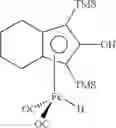
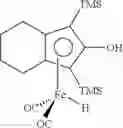
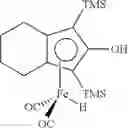
In unrelated work, in H.-J. Knoelker et al., Demetalation Of Tricarbonyl(cyclopentadieone)iron Complexes Initiated By A Ligand Exchange Reaction With NaOH-X-Ray Analysis Of A Complex With Nearly Square-Planar Coordinated Sodium, 38 Angew. Chem. Int. Ed. 2064-2066 (1999), the authors reported on the isolation of an intermediate having the following formula, where “TMS” refers to trimethyl silyl:
However, that article did not propose a catalytic utility for this compound, much less suggest any potential hydrogenation-related function.
Thus, there is a continuing need for improved catalysts for use in hydrogenation reactions.
SUMMARY OF THE INVENTION
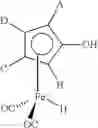
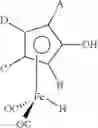
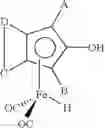
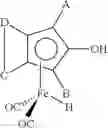
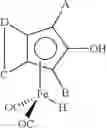
In one aspect the invention provides a method of reducing a ketone moiety to an alcohol moiety. One exposes the ketone moiety to a catalyst having the following formula:
where A represents hydrogen, a silyl moiety (e.g. trimethyl silyl; triphenyl silyl; triisopropyl silyl), or an alkyl moiety (e.g. tertiary butyl; methyl), B represents hydrogen, a silyl moiety (e.g. trimethyl silyl; triphenyl silyl; triisopropyl silyl), or an alkyl moiety (e.g. tertiary butyl; methyl), C linked to the five member ring represents an alkyl moiety, and D represents an alkyl moiety, where C linked to the five member ring and D both have a carbon that is part of the same cyclic moiety. For example, the C and D together could form a —(CH2)4— or —(CH2—O—CH2)— chain. These alkyl groups are preferably groups of less than twenty carbons, even more preferably groups of less than five carbons.
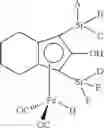
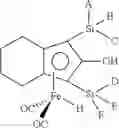
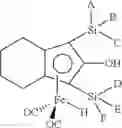
In preferred forms the catalyst has the following formula:
where the A, B, C, D, E and F which are attached to a silicon each is alkyl (e.g. methyl or isopropyl) or aryl (e.g. phenyl). These alkyl groups are preferably groups of less than twenty carbons, even more preferably groups of less than five carbons.
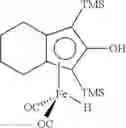
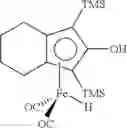
For example, the catalyst may have the following formula:
In further preferred forms hydrogen gas is added during the method, the reducing occurs at a temperature at or above 15° C. (e.g. most preferably at below 35° C.), at less than 5 atmosphere pressure, and the ketone moiety is a portion of a compound that has less than 30 carbons.
In another aspect the invention provides a method of reducing an aldehyde moiety to an alcohol moiety. One exposes the aldehyde moiety to a catalyst having the following formula:
where A represents hydrogen, a silyl moiety (e.g. trimethyl silyl; triphenyl silyl; triisopropyl silyl), or an alkyl moiety (e.g. tertiary butyl; methyl) B represents hydrogen, a silyl moiety (e.g. trimethyl silyl; triphenyl silyl; triisopropyl silyl), or an alkyl moiety (e.g. tertiary butyl; methyl), C linked to the five member ring represents an alkyl moiety, and D represents an alkyl moiety, where C linked to the five member ring and D both have a carbon that is part of the same cyclic moiety. For example, the C and D together could form a —(CH2)4— or —(CH2—O—CH2)— chain. These alkyl groups are preferably groups of less than twenty carbons, even more preferably groups of less than five carbons.
In preferred forms the catalyst has the following formula:
where the A, B, C, D, E and F which are attached to a silicon each is alkyl (e.g. methyl or isopropyl) or aryl (e.g. phenyl). These alkyl groups are preferably groups of less than twenty carbons, even more preferably groups of less than five carbons.
For example, the catalyst may have the following formula:
Again, in further preferred forms hydrogen gas is added during the method, the reducing occurs at a temperature at or above 15° C. (preferably below 35° C.), at less than 5 atmosphere pressure, and the aldehyde moiety is a portion of a compound that has less than 30 carbons.
In another aspect the invention provides a method of reducing an imine moiety to an amine moiety. One exposes the imine moiety to a catalyst having the following formula:
where A represents hydrogen, a silyl moiety (e.g. trimethyl silyl; triphenyl silyl; triisopropyl silyl), or an alkyl moiety (e.g. tertiary butyl; methyl), B represents hydrogen, a silyl moiety (e.g. trimethyl silyl; triphenyl silyl; triisopropyl silyl), or an alkyl moiety (e.g. tertiary butyl; methyl), C linked to the five member ring represents an alkyl moiety, and D represents an alkyl moiety, where C linked to the five member ring and D both have a carbon that is part of the same cyclic moiety. For example, the C and D together could form a —(CH2)4— or —(CH2—O—CH2)— chain. These alkyl groups are preferably groups of less than twenty carbons, even more preferably groups of less than five carbons.
In preferred forms the catalyst has the following formula:
where the A, B, C, D, E and F which are attached to a silicon each is alkyl (e.g. methyl or isopropyl) or aryl (e.g. phenyl). These alkyl groups are preferably groups of less than twenty carbons, even more preferably groups of less than five carbons.
For example, the catalyst may have the following formula:
In further preferred forms hydrogen gas is added during the method, the reducing occurs at a temperature at or above 15° C. (preferably below 85° C.), at less than 5 atmosphere pressure, and the aldehyde moiety is a portion of a compound that has less than 30 carbons.
The desired hydrogenation can occur with minimal reduction of alkyne and alkene bonds, and without affecting ester or ether moieties. It is also an advantageous attribute of our methods that many reactions using these catalysts can be conducted at or about room temperature with only slightly elevated hydrogen pressures. These relatively mild conditions help avoid other undesirable consequences.
Very high yields of many compounds have been obtained within less than 24 hours of reaction time.
The above and still other advantages of the present invention will be apparent from the description that follows. It should be appreciated that the following description is merely of the preferred embodiments of our invention. The claims should therefore be looked to in order to understand the full claimed scope of the invention.
BRIEF DESCRIPTION OF THE DRAWINGS
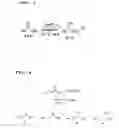
FIG. 1 depicts, in schematic form, how the most preferred catalyst of the present invention can help reduce acetophenone or acetone (representative ketones) to the corresponding alcohol;
FIG. 2 schematically illustrates how, in the presence of hydrogen gas, this catalyst can be regenerated by the hydrogen so as to act as a catalyst, rather than as a consumable;
FIG. 3 illustrates a specific synthesis using hydrogen gas and acetophenone;
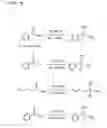
FIG. 4 is a chart listing a variety of substrates which are an aldehyde, a ketone, or an imine, which have been reduced to the corresponding alcohol or amine using hydrogen gas and a catalyst of the present invention;
FIG. 5 schematically depicts a specific reaction involving a ketone in which instead of using hydrogen gas to regenerate the catalyst, a hydrogen donating alcohol is used for that purpose;
FIG. 6 depicts how under varied process conditions, differing product mixes can be obtained; and
FIG. 7 illustrates several additional syntheses.
DESCRIPTION OF THE PREFERRED EMBODIMENTS
Our methods involve the use of ligand iron catalysts for selective hydrogenation of ketones, aldehydes, and imines. A synthesis for the most preferred catalyst:
is described in H.-J. Knoelker et al., Demetalation Of Tricarbonyl(cyclopentadieone)iron Complexes Initiated By A Ligand Exchange Reaction With NaOH-X-Ray Analysis Of A Complex With Nearly Square-Planar Coordinated Sodium, 38 Angew. Chem. Int. Ed. 2064-2066 (1999).
More generally, we believe that compounds having the following formula:
can be created by analogous syntheses.
As general background we describe below how to make another iron hydride catalyst. We mixed a dialkyne (42 mmol), Fe(CO)5 (11.04 mL, 84 mmol), and glyme (10 mL) in a Fisher-Porter glass tube. We then flushed with 3 atm of CO several times, and then disconnect the tube to the CO gas cylinder.
The closed system was then heated in a 120° C. oil bath for 22 h. After cooling, the reaction mixture was then concentrated in vacuo and the residue was then subjected to column chromatography (eluted with hexanes/CH2Cl2=1:1 first, and then with hexanes/EtOAc=1:1). The iron tricarbonyl was then isolated, typically as a yellow solid.
Then, under a nitrogen atmosphere, a degassed solution of NaOH (0.80 g, 20 mmol) in 30 mL of H2O can be added to a solution of complex iron tricarbonyl (4.0 mmol) in 30 mL THF. The resulting biphasic mixture can be vigorously stirred at room temperature for 3.0 h before 85 wt. % of H3PO4 in H2O (about 0.8 mL) is added to neutralize the reaction mixture.
The organic layer can then be transferred via cannula into a Schlenk flask under nitrogen and the aqueous layer can then be extracted with Et2O several times. The combined organic layers were concentrated in vacuo, dissolved in degassed benzene, dried over Na2SO4, and filtered into another Schlenk flask. The resulting solution was pumped to dryness to afford an iron hydride, as a yellow powder.
Example 1
As shown in FIG. 1, we first studied the reaction of our preferred catalyst with acetophenone in the presence of PPh3 (as a trapping agent for a reactive intermediate “A”). We found a complete hydrogen transfer reaction within 4 hours under these conditions, with clean formation of the trapped iron triphenylphosphine complex and free 1-phenylethanol. Hence, this confirmed that the hydroxyl group on the catalyst could be caused to give up its hydrogen in a hydrogenation reaction.
Example 2
As shown in FIGS. 2 and 3 we then used hydrogen gas in the reaction to efficiently regenerate the catalyst (without using a trapping compound) once the hydrogen transfer had been completed. Use of the catalyst catalyzed the hydrogenation of acetophenone (or acetone) at pressures about 3 atm H2, at about room temperature.
Specifically with respect to acetophenone, a resealable NMR tube containing a solution of the catalyst (11.8 mg, 30 μmol) and acetophenone (3.5 μL, 30 μmol) in preferred non-reactive solvent toluene (500 μL) was monitored by 1H NMR spectroscopy over days. After 12 h, about 28% of the catalyst had been converted. Extended reaction times resulted in unidentified decomposition products and free 1-phenylethanol. A similar reaction with acetone generated the mixture of the catalyst and the expected alcohol.
Example 3
As shown in FIG. 4 our preferred catalyst is an efficient and relatively selective catalyst for hydrogenation of the polar multiple bonds of aldehydes, ketones, and imines, even where those compounds contain double or triple bonded carbons. As typical reaction conditions, we used 1.5 mmol of the substrate aldehyde, ketone or imine, 30 μmol, 2.0 mol % of the catalyst, 5 mL of toluene (or alternatively diethyl ether in the case of reaction 11), and 3 atm H2. We normally ran the reactions at room temperature, albeit with respect to the imine reaction we used 65° C.
In a typical experiment, a ketone substrate (1.5 mmol) was added to a Fischer-Porter bottle under a nitrogen atmosphere. The bottle was flushed several times with hydrogen gas. Then 5 mL of a solution of the catalyst in toluene (0.0060 M) was added by syringe under a flow of hydrogen and the resulting solution stirred under 3 atm of hydrogen at 25° C.
When the hydrogenation was complete, solvent was evaporated and the residue was dissolved in CDCl3 and its 1H NMR spectrum recorded. Hydrogenation products were purified by column chromatography and their 1H NMR spectra matched those reported in the literature. For the hydrogenation of benzoin (entry 10, FIG. 4), the meso/d1 ratio of product was determined by examining the 1H NMR spectra of crude materials. The pure meso product was obtained after recrystallization from pentane. The characterization of several compounds are summarized below.
1-[4-(4-Hydroxy-1-butynyl)phenyl]ethanol (entry 12, FIG. 4) was isolated as a white solid (mp 84-85° C.).
1-[4-[4-(Phenylmethoxy)-1-butynyl]phenyl]ethanol (entry 13, FIG. 4) was isolated as a light yellow oil.
High diastereoselectivity (meso/d1=25) was seen in the hydrogenation of benzoin. High chemoselectivity was also observed: epoxides, esters, and isolated alkenes and alkynes were not hydrogenated. For ketones with isolated C═C or C≡C, only the ketone is hydrogenated (entries 11, 12, 13).
1-[4-(4-hydroxy-1-butynyl)phenyl]ethanone (entry 12, FIG. 4), 1-[4-[4-(phenylmethoxy)-1-butynyl]phenyl]ethanone (entry 13, FIG. 4), and N-benzylideneaniline (entry 16, FIG. 4) were prepared as described in the literature. See H.-J. Knoelker et al., 38 Angew. Chem. Int. Ed. 2064 (1999); G. Zhang, Synlett 619 (2005); R. Batey et al., 4 Org. Lett. 1411 (2002); and P. Andrews et al., 45 Tetrahedron Lett. 243 (2004).
Note also that carbon halogen bonds (entries 4, 5 and 9), nitro groups (entry 6), benzyl ethers (entry 13), and cyclopropyl rings (entry 14) survived the hydrogenation conditions.
A pyridine moiety can potentially bind iron and inhibit the catalytic reaction. However, 2-acetyl pyridine (entry 15) was rapidly hydrogenated. 4-acetylbenzonitrile (entry 7) was not hydrogenated, possibly due to the nitrile trapping of unsaturated intermediate A. Hydrogenation of α,β-unsaturated ketones was complicated by some reduction of the C═C double bond.
Example 4
We next sought to confirm that hydrogen gas was not the only possible source of the hydrogen when using our catalyst. As shown in FIG. 5, we used 1 mol % of the FIG. 1 catalyst in a 0.6 mol solution of acetophenone, with 2-propanol as the hydrogen donor. This experiment was conducted at 75° C. for 16 hours, yielding 87% of the alcohol.
Under a nitrogen atmosphere, acetophenone (350 μL, 3.0 mmol) was added to a solution of 1 (11.8 mg, 30 μmol, 1 mol % catalyst) in 5 mL of 2-propanol. The resulting orange solution was stirred at 75° C. for 16 h. After cooling, the solvent was evaporated and the residue was purified by column chromatography (hexanes:ethyl acetate=4:1) to give pure 1-phenylethanol.
Example 5
Hydrogenation of trans-4-phenyl-3-buten-2-one by the catalyst was performed with similar procedures as those for other ketones. After 1 day, an aliquot of the reaction was removed by syringe under a flow of hydrogen. Solvent was evaporated and the residue was dissolved in CDCl3 and its 1H NMR spectrum recorded. The reaction was monitored over 6 days. The results are summarized in FIG. 6 which illustrates that varied reaction conditions led to varied mixes of product.
Example 6
Recently, there was a published report of still other successful reductions based on our invention, in R. Bullock, An Iron Catalyst For Ketone Hydrogenations Under Mild Conditions, 2007 Angew. Chem. 03053 (9 pages) (2007). See FIG. 7 for a summary.
Other General Procedures
Generally, air-sensitive compounds were prepared and handled under a nitrogen atmosphere using standard Schlenk and inert-atmosphere box techniques. Toluene was deoxygenated and dried in a solvent purification system by passing through an activated alumina column and an oxygen scavenging column under argon. See A. Pangborn et al., 15 Organometallics 1518 (1996). Toluene was distilled from Na and benzophenone under a nitrogen atmosphere.
While a number of embodiments of the present invention have been described above, the present invention is not limited to just these disclosed examples. There are other modifications that are meant to be within the scope of the invention and claims. For example, various other catalysts which have the specified structure should be able to facilitate the hydrogenation reaction.
Hence, while the claims should be looked to in order to judge the scope of the invention, the claims are not to be limited to just the preferred embodiments.
INDUSTRIAL APPLICABILITY
The present invention provides improved methods for hydrogenating ketones, aldehydes and imines, involving using iron hydride ligands with cyclic hydroxycyclopentadienyl compounds.
Claims
We claim:1. A method of reducing a ketone moiety to an alcohol moiety comprising exposing the ketone moiety to a catalyst having the following formula:
where A represents hydrogen, a silyl moiety, or an alkyl moiety, B represents hydrogen, a silyl moiety, or an alkyl moiety, C linked to a five member ring represents an alkyl moiety, and D represents an alkyl moiety, where C linked to the five member ring and D both have a carbon that is part of a same cyclic moiety.
2. The method of claim 1, wherein the catalyst has the following formula:
where the A, B, C, D, E and F which are attached to a silicon each is selected from the group consisting of alkyl groups and aryl groups.
3. The method of claim 1, wherein the catalyst has the following formula:
4. The method of claim 1, wherein hydrogen gas is added during the method.
5. The method of claim 1, wherein a reducing of the ketone occurs at a temperature at or above 15° C.
6. The method of claim 1, wherein the ketone moiety is a portion of a compound that has less than 30 carbons.
7. A method of reducing an aldehyde moiety to an alcohol moiety comprising exposing the aldehyde moiety to a catalyst having the following formula:
where A represents hydrogen, a silyl moiety, or an alkyl moiety, B represents hydrogen, a silyl moiety, or an alkyl moiety, C linked to a five member ring represents an alkyl moiety, and D represents an alkyl moiety, where C linked to the five member ring and D both have a carbon that is part of a same cyclic moiety.
8. The method of claim 7, wherein the catalyst has the following formula:
where the A, B, C, D, E and F which are attached to a silicon each is selected from the group consisting of alkyl groups and aryl groups.
9. The method of claim 7, wherein the catalyst has the following formula:
10. The method of claim 7, wherein hydrogen gas is added during the method.
11. The method of claim 7, wherein a reducing of the aldehyde occurs at a temperature at or above 15° C.
12. The method of claim 7, wherein the aldehyde moiety is a portion of a compound that has less than 30 carbons.
13. A method of reducing a imine moiety to an amine moiety comprising exposing the imine moiety to a catalyst having the following formula:
where A represents hydrogen, a silyl moiety, or an alkyl moiety, B represents hydrogen, a silyl moiety, or an alkyl moiety, C linked to a five member ring represents an alkyl moiety, and D represents an alkyl moiety, where C linked to the five member ring and D both have a carbon that is part of a same cyclic moiety.
14. The method of claim 13, wherein the catalyst has the following formula:
where the A, B, C, D, E and F which are attached to a silicon each is selected from the group consisting of alkyl groups and aryl groups.
15. The method of claim 13, wherein the catalyst has the following formula:
16. The method of claim 13, wherein hydrogen gas is added during the method.
17. The method of claim 13, wherein a reducing of the imine occurs at a temperature at or above 15° C.
18. The method of claim 13, wherein the imine moiety is a portion of a compound that has less than 30 carbons.
Images & Drawings included:






Sources:
- United States Patent and Trademark Office - verify current appl. status at the USPTO↗
Recent applications in this class:
- » 20210087133 2021-03-25
Method for preparing isophorone diamine by means of hydrogenation reduction of isophorone nitrile imine - » 20190382334 2019-12-19
Methods of making compounds and mixtures having antidegradant and antifatigue efficacy - » 20180339959 2018-11-29
Process for preparing amino compounds from nitrile compounds - » 20170362163 2017-12-21
Process for preparing 3 aminomethyl-3,5,5-trimethylcyclohexylamine - » 20170275234 2017-09-28
Methods of making compounds having antidegradant and antifatigue efficacy - » 20170275233 2017-09-28
Methods of making compounds and mixtures having antidegradant and antifatigue efficacy - » 20160264513 2016-09-15
Catalytic hydrogenation for the preparation of amines from amide acetals, ketene N, O-acetals or ester imides - » 20130261341 2013-10-03
Process for preparing 3-aminomethyl-3,5,5-trimethylcyclohexylamine - » 20130217910 2013-08-22
Process for the preparation of substituted N-(benzyl)cyclopropanamines by imine hydrogenation - » 20120130114 2012-05-24
Method for direct functionalization of polyaniline and other molecules having diiminoquinoid ring via C-C bond formation
Recent applications for this Assignee:
- » 20250257364 2025-08-14
RNA-GUIDED DNA TRANSPOSITION - » 20250257354 2025-08-14
METHODS AND COMPOSITIONS RELATED TO TRNA THERAPEUTICS FOR TREATING VISION LOSS - » 20250255958 2025-08-14
VIRUS-FREE CRISPR CAR NATURAL KILLER CELLS - » 20250249044 2025-08-07
IFNy AND TNFa CO-STIMULATION OF MESENCHYMAL STROMAL CELLS DERIVED FROM MINOR SALIVARY (LABIAL) GLANDS FOR THERAPEUTIC USE - » 20250243296 2025-07-31
SINGLE-DOMAIN ANTIBODIES AND VARIANTS THEREOF AGAINST OPIOIDS - » 20250228961 2025-07-17
PRACTICAL GLYCAN ENGINEERING METHOD FOR THE PREPARATION OF HOMOGENOUS ANTIBODY CONJUGATES - » 20250228959 2025-07-17
TRANSFERRIN-BASED LYSOSOME TARGETING DEGRADERS - » 20250228905 2025-07-17
MICROBIAL COMMUNITIES THAT INHIBIT CLOSTRIDIOIDES DIFFICILE AND METHODS OF USING SAME - » 20250223630 2025-07-10
IDENTIFYING DISEASE-CAUSING HUMAN DDX41 GENETIC VARIANTS - » 20250223619 2025-07-10
ENGINEERED BIOCATALYSTS FOR THE SYNTHESIS OF GAMMA-HYDROXY AMINO ACIDS