Exhaust gas purifying catalyst
US20100311575A1
2010-12-09
12/778,536
2010-05-12
✅ Patent granted
US 7,981,829 B2
2011-07-19
-
-
Stanley Silverman | Diana J Liao
2030-05-12
Abstract:
An exhaust gas purifying catalyst includes: a composite oxide represented by: (Aa-w-xMwM′x) (Si6-yNy)O27-z. A is a cation of at least one of La and Pr; M is a cation of at least one of Ba, Ca, and Sr; M′ is a cation of at least one of Nd, Y, Al, Pr, Ce, Sr, Li, and Ca; N is a cation of at least one of Fe, Cu, and Al. The following are satisfied: 6≦a≦10, 0<w<5, 0≦x<5, 0<w+x≦5, 0≦y≦3, 0≦z≦3, A≠M′, and x≠0 when A is a cation of La. A noble metal ingredient which forms a solid solution with the composite oxide or is supported on the composite oxide, and an exhaust gas purifying catalyst product formed of a carrier made of a ceramic or metallic material, and a layer of the exhaust gas purifying catalyst supported on the carrier.
Assignee:
- MITSUI MINING & SMELTING CO., LTD. 247 🇯🇵 Tokyo, Japan
- MITSUI MINING & SMELTING CO., LTD. 436 🇯🇵 Tokyo, Japan
Interested in similar patents?
Get notified when new applications in this technology area are published.
Classification:
B01J2523/3706 » CPC further
Constitutive chemical elements of heterogeneous catalysts of Group III (IIIA or IIIB) of the Periodic Table; Lanthanides Lanthanum
B01J23/894 » CPC main
Catalysts comprising metals or metal oxides or hydroxides, not provided for in group of the iron group metals or copper combined with noble metals also combined with metals, or metal oxides or hydroxides provided for in groups - with rare earths or actinides
B01D53/945 » CPC further
Separation of gases or vapours; Recovering vapours of volatile solvents from gases; Chemical or biological purification of waste gases, e.g. engine exhaust gases, smoke, fumes, flue gases, aerosols,; Chemical or biological purification of waste gases of engine exhaust gases by catalytic processes; Simultaneously removing carbon monoxide, hydrocarbons or nitrogen oxides making use of three-way catalysts [TWC] or four-way-catalysts [FWC] characterised by a specific catalyst
B01J23/002 » CPC further
Catalysts comprising metals or metal oxides or hydroxides, not provided for in group Mixed oxides other than spinels, e.g. perovskite
B01J37/0244 » CPC further
Processes, in general, for preparing catalysts; Processes, in general, for activation of catalysts; Impregnation, coating or precipitation; Multiple impregnation or coating Coatings comprising several layers
B01D2255/1021 » CPC further
Catalysts; Noble metals or compounds thereof; Platinum group metals Platinum
B01D2255/1023 » CPC further
Catalysts; Noble metals or compounds thereof; Platinum group metals Palladium
B01D2255/1025 » CPC further
Catalysts; Noble metals or compounds thereof; Platinum group metals Rhodium
B01D2255/204 » CPC further
Catalysts; Metals or compounds thereof Alkaline earth metals
B01D2255/2042 » CPC further
Catalysts; Metals or compounds thereof; Alkaline earth metals Barium
B01D2255/2045 » CPC further
Catalysts; Metals or compounds thereof; Alkaline earth metals Calcium
B01D2255/206 » CPC further
Catalysts; Metals or compounds thereof Rare earth metals
B01D2255/20738 » CPC further
Catalysts; Metals or compounds thereof; Transition metals Iron
B01D2255/20761 » CPC further
Catalysts; Metals or compounds thereof; Transition metals Copper
B01D2255/2092 » CPC further
Catalysts; Metals or compounds thereof; Other metals Aluminium
B01D2255/30 » CPC further
Catalysts Silica
B01D2255/407 » CPC further
Catalysts; Mixed oxides Zr-Ce mixed oxides
B01J23/63 » CPC further
Catalysts comprising metals or metal oxides or hydroxides, not provided for in group of noble metals combined with metals, oxides or hydroxides provided for in groups - ; Platinum group metals with rare earths or actinides
B01J23/83 » CPC further
Catalysts comprising metals or metal oxides or hydroxides, not provided for in group of the iron group metals or copper combined with metals, oxides or hydroxides provided for in groups - with rare earths or actinides
Y02T10/12 » CPC further
Road transport of goods or passengers; Internal combustion engine [ICE] based vehicles Improving ICE efficiencies
Y02T10/12 » CPC further
Road transport of goods or passengers; Internal combustion engine [ICE] based vehicles Improving ICE efficiencies
B01J2523/828 » CPC further
Constitutive chemical elements of heterogeneous catalysts of Group VIII of the Periodic Table; Metals of the platinum group Platinum
B01J2523/24 » CPC further
Constitutive chemical elements of heterogeneous catalysts of Group II (IIA or IIB) of the Periodic Table Strontium
B01J2523/3718 » CPC further
Constitutive chemical elements of heterogeneous catalysts of Group III (IIIA or IIIB) of the Periodic Table; Lanthanides Praseodymium
B01J2523/842 » CPC further
Constitutive chemical elements of heterogeneous catalysts of Group VIII of the Periodic Table; Metals of the iron group Iron
B01J2523/00 » CPC further
Constitutive chemical elements of heterogeneous catalysts
B01J2523/48 » CPC further
Constitutive chemical elements of heterogeneous catalysts of Group IV (IVA or IVB) of the Periodic Table Zirconium
B01J2523/41 » CPC further
Constitutive chemical elements of heterogeneous catalysts of Group IV (IVA or IVB) of the Periodic Table Silicon
B01J2523/3712 » CPC further
Constitutive chemical elements of heterogeneous catalysts of Group III (IIIA or IIIB) of the Periodic Table; Lanthanides Cerium
B01J2523/36 » CPC further
Constitutive chemical elements of heterogeneous catalysts of Group III (IIIA or IIIB) of the Periodic Table Yttrium
B01J2523/23 » CPC further
Constitutive chemical elements of heterogeneous catalysts of Group II (IIA or IIB) of the Periodic Table Calcium
B01J2523/25 » CPC further
Constitutive chemical elements of heterogeneous catalysts of Group II (IIA or IIB) of the Periodic Table Barium
B01J2523/3725 » CPC further
Constitutive chemical elements of heterogeneous catalysts of Group III (IIIA or IIIB) of the Periodic Table; Lanthanides Neodymium
B01J2523/822 » CPC further
Constitutive chemical elements of heterogeneous catalysts of Group VIII of the Periodic Table; Metals of the platinum group Rhodium
B01J2523/824 » CPC further
Constitutive chemical elements of heterogeneous catalysts of Group VIII of the Periodic Table; Metals of the platinum group Palladium
B01J21/08 IPC
Catalysts comprising the elements, oxides, or hydroxides of magnesium, boron, aluminium, carbon, silicon, titanium, zirconium, or hafnium; Silicon, titanium, zirconium or hafnium; Oxides or hydroxides thereof Silica
B01J23/04 IPC
Catalysts comprising metals or metal oxides or hydroxides, not provided for in group of the alkali- or alkaline earth metals or beryllium Alkali metals
B01J23/72 IPC
Catalysts comprising metals or metal oxides or hydroxides, not provided for in group of the iron group metals or copper Copper
B01J23/02 IPC
Catalysts comprising metals or metal oxides or hydroxides, not provided for in group of the alkali- or alkaline earth metals or beryllium
B01J21/06 IPC
Catalysts comprising the elements, oxides, or hydroxides of magnesium, boron, aluminium, carbon, silicon, titanium, zirconium, or hafnium Silicon, titanium, zirconium or hafnium; Oxides or hydroxides thereof
B01J21/12 IPC
Catalysts comprising the elements, oxides, or hydroxides of magnesium, boron, aluminium, carbon, silicon, titanium, zirconium, or hafnium Silica and alumina
B01J23/10 » CPC further
Catalysts comprising metals or metal oxides or hydroxides, not provided for in group of rare earths
B01J23/38 IPC
Catalysts comprising metals or metal oxides or hydroxides, not provided for in group of noble metals
B01J23/54 IPC
Catalysts comprising metals or metal oxides or hydroxides, not provided for in group of noble metals combined with metals, oxides or hydroxides provided for in groups -
Description
The entire disclosure of Japanese Patent Application Nos. 2009-137670 filed Jun. 8, 2009 and 2010-098268 filed Apr. 21, 2010 is expressly incorporated by reference herein.
TECHNICAL FIELD
The present invention relates to an exhaust gas purifying catalyst. More particularly, the present invention relates to a catalyst which exhibits high catalytic activity at low temperature (hereinafter referred to as “low-temperature activity”) and excellent heat resistance, and which can attain consistent exhaust gas purification performance; for example, a catalyst which removes toxic components contained in exhaust gas discharged from an internal combustion engine of, for example, an automobile.
BACKGROUND ART
Exhaust gas discharged from an internal combustion engine of, for example, an automobile contains toxic components such as hydrocarbons (HC), carbon monoxide (CO), and nitrogen oxides (NOx). Hitherto, ternary catalysts have been used for removing such toxic components for detoxifying the exhaust gas.
Some ternary catalysts are produced by applying, onto a honeycomb carrier made of, for example, a ceramic or metallic material, a certain combination of a noble metal (e.g., Pt, Pd, or Rh), and alumina, ceria, zirconia, or a composite oxide thereof. For example, there has been proposed an exhaust gas purifying catalyst containing a composite oxide having an apatite-type structure (see, for example, Patent Documents 1 and 2).
However, such a conventional ternary catalyst generally poses problems in that the catalyst does not initiate removal of toxic components contained in exhaust gas until a relatively high temperature, and thus the catalyst may fail to satisfactorily remove the toxic components at a low temperature. For example, such a conventional ternary may fail to satisfactorily remove toxic components contained in exhaust gas discharged from an engine of, for example, an automobile, since the catalyst is in a relatively low temperature state immediately after starting of the engine.
Also, such a conventional ternary catalyst generally poses problems in that the catalyst may exhibit lowered exhaust gas purification performance due to deterioration resulting from use in a relatively high temperature range, and the catalyst may fail to attain consistent exhaust gas purification performance over a low to high temperature range.
Therefore, demand has arisen for a ternary catalyst which attains exhaust gas purification effect in a relatively low temperature state, and which also attains gas purification performance in a high temperature range. The present inventors have previously proposed an exhaust gas purifying catalyst which contains a composite oxide represented by (Laa-xMx) (Si6-yNy)O27-z and a noble metal component that forms a solid solution with the composite oxide or is supported on the composite oxide, which exhibits high low-temperature activity and excellent heat resistance, and which can attain consistent exhaust gas purification performance (see Patent Document 3).
PRIOR ART DOCUMENT
Patent Document
[Patent Document 1] Japanese Patent Document Laid-Open (kokai) No. H06-055075
[Patent Document 2] Japanese Patent Document Laid-Open (kokai) No. H11-197507
[Patent Document 3] Japanese Patent Document Laid-Open (kokai) No. 2007-144412
SUMMARY OF THE INVENTION
Problems to be Solved by the Invention
An object of the present invention is to provide an exhaust gas purifying catalyst which exhibits high low-temperature activity and excellent heat resistance, which can attain consistent exhaust gas purification performance, and which exhibits exhaust gas purification performance higher than that of the previously proposed catalyst formed of (Laa-xMx) (Si6-yNy) O27-z.
Means for Solving the Problems
The present inventors have conducted extensive studies for achieving the aforementioned object, and as a result have found that the object is attained by employing a noble metal component and a composite oxide represented by the following formula (Aa-w-xMwM′x) (Si6-yNy)O27-z; i.e., a composite oxide in which A site is partially substituted by M and further by M′ (i.e., a third component), or a composite oxide in which A site is not necessarily substituted by M′ when A is Pr. The present invention has been accomplished on the basis of this finding.
Accordingly, the present invention provides an exhaust gas purifying catalyst characterized by comprising:
a composite oxide represented by the following formula:
(Aa-w-xMwM′x)(Si6-yNy)O27-z
wherein A is a cation of at least one element selected from the group consisting of La and Pr; M is a cation of at least one element selected from the group consisting of Ba, Ca, and Sr; M′ is a cation of at least one element selected from the group consisting of Nd, Y, Al, Pr, Ce, Sr, Li, and Ca; N is a cation of at least one element selected from the group consisting of Fe, Cu, and Al; and the following relations are satisfied: 6≦a≦10, 0<w<5, 0≦x<5, 0<w+x≦5, 0≦y≦3, 0≦z≦3, A≠M′, and x≠0 when A is a cation of La; and
a noble metal ingredient which forms a solid solution with the composite oxide or is supported on the composite oxide.
The present invention also provides an exhaust gas purifying catalyst product characterized by comprising a carrier made of a ceramic or metallic material, and a layer of the aforementioned exhaust gas purifying catalyst supported on the carrier.
EFFECTS OF THE INVENTION
The exhaust gas purifying catalyst of the present invention can exhibit consistent exhaust gas purification performance, since it exhibits high low-temperature activity and excellent heat resistance in a high temperature range.
BRIEF DESCRIPTION OF THE DRAWINGS
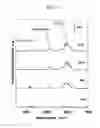
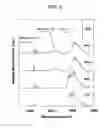
FIG. 1 shows the state of C3H6 adsorbed on the exhaust gas purifying catalyst of Example 1 in the case of heating to 300° C.
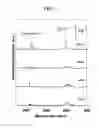
FIG. 2 shows the state of C3H6 adsorbed on the exhaust gas purifying catalyst of Comparative Example 1 in the case of heating to 300° C.
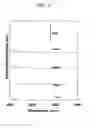
FIG. 3 shows the state of C3H6 adsorbed on the exhaust gas purifying catalyst of Comparative Example 2 in the case of heating to 300° C.
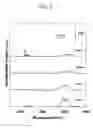
FIG. 4 shows the state of C3H6 adsorbed on the exhaust gas purifying catalyst of Example 1 in the case of heating to 400° C.
FIG. 5 shows the state of C3H6 adsorbed on the exhaust gas purifying catalyst of Comparative Example 1 in the case of heating to 400° C.
FIG. 6 shows the state of C3H6 adsorbed on the exhaust gas purifying catalyst of Comparative Example 2 in the case of heating to 400° C.
MODES FOR CARRYING OUT THE INVENTION
Embodiments of the present invention will next be described in detail.
The exhaust gas purifying catalyst of the present invention comprises:
a composite oxide having an apatite structure and represented by the following formula:
(Aa-w-xMwM′x)(Si6-yNy)O27-z
wherein A is a cation of at least one element selected from the group consisting of La and Pr; M is a cation of at least one element selected from the group consisting of Ba, Ca, and Sr; M′ is a cation of at least one element selected from the group consisting of Nd, Y, Al, Pr, Ce, Sr, Li, and Ca; N is a cation of at least one element selected from the group consisting of Fe, Cu, and Al; and the following relations are satisfied: 6≦a≦10, 0<w<5, 0≦x<5, 0<w+x≦5, 0≦y≦3, 0≦z≦3, A≠M′, and x≠0 when A is a cation of La; and
a noble metal ingredient which forms a solid solution with the composite oxide or is supported on the composite oxide.
When A is a cation of La, the composite oxide forming the exhaust gas purifying catalyst of the present invention is represented by the following formula:
(Laa-w-xMwM′x)(Si6-yNy)O27-z
wherein M is a cation of at least one element selected from the group consisting of Ba, Ca, and Sr; M′ is a cation of at least one element selected from the group consisting of Nd, Y, Al, Pr, Ce, Sr, Li, and Ca; N is a cation of at least one element selected from the group consisting of Fe, Cu, and Al; and the following relations are satisfied: 6≦a≦10, 0<w<5, 0<x<5, 0<w+x≦5, 0<y≦3, and 0≦z≦3.
When A is a cation of Pr, the composite oxide forming the exhaust gas purifying catalyst of the present invention is represented by the following formula:
(Pra-w-xMwM′x)(Si6-yNy)O27-z
wherein M is a cation of at least one element selected from the group consisting of Ba, Ca, and Sr; M′ is a cation of at least one element selected from the group consisting of Nd, Y, Al, Ce, Sr, Li, and Ca; N is a cation of at least one element selected from the group consisting of Fe, Cu, and Al; and the following relations are satisfied: 6≦a≦10, 0<w<5, 0≦x<5, 0<w+x≦5, 0≦y≦3, and 0≦z≦3.
When the composite oxide represented by the aforementioned formula (Aa-w-xMwM′x) (Si6-yNy)O27-z and having an apatite structure has a stoichiometric composition, a is 10, whereas when the composite oxide has a non-stoichiometric composition, a is smaller than 10. In a practically and readily available composite oxide represented by the aforementioned formula and having a non-stoichiometric composition, a satisfies the following relation: 6≦a<10. Therefore, the exhaust gas purifying catalyst of the present invention employs a composite oxide wherein 6≦a≦10, preferably 7≦a<10.
The exhaust gas purifying catalyst of the present invention employs a composite oxide in which, the following relations are satisfied: preferably 0.1≦w≦4, more preferably 0.5≦w≦3.5; preferably 0.1≦x≦4, more preferably 0.5≦x≦3.5 when A is La; preferably 0≦x≦4, more preferably 0≦x≦3.5 when A is Pr; preferably 0.1≦w+x≦4, more preferably 0.5≦w+x≦3.5; and (or) preferably 0≦y≦2.5, more preferably 0≦y≦2; and preferably 0≦z≦2.5.
The exhaust gas purifying catalyst of the present invention exhibits sufficiently high catalytic activity even at a relatively low temperature immediately after starting of an engine of, for example, an automobile, attains excellent exhaust gas purification performance in a low temperature range, and exhibits excellent heat resistance in a high temperature range. Thus, the exhaust gas purifying catalyst attains consistent exhaust gas purification performance over a low to high temperature range. Therefore, the exhaust gas purifying catalyst is suitably employed for purification of exhaust gas discharged from an internal combustion engine of, for example, an automobile.
The noble metal component of the exhaust gas purifying catalyst of the present invention is preferably, for example, rhodium, palladium, or platinum, more preferably platinum or palladium.
The noble metal component of the exhaust gas purifying catalyst of the present invention may form a solid solution with the composite oxide forming the catalyst, or may be supported on the composite oxide. Incorporation of the noble metal component into the composite oxide may be carried out through, for example, a process wherein the composite oxide in the form of powder or slurry is immersed in or mixed with a solution containing the noble metal (basic or acidic noble metal salt solution) to thereby adsorb the noble metal component onto the composite oxide, and the resultant product is fired; a process wherein the noble metal component is mixed with a slurry of the composite oxide during production of the composite oxide, and the resultant mixture is fired; or a process wherein a carrier (e.g., an oxide) on which the noble metal component has been supported is mixed with the composite oxide, and the resultant mixture is subjected to firing or a similar treatment.
The exhaust gas purifying catalyst product of the present invention may be in the form of an exhaust gas purifying catalyst containing the aforementioned composite oxide and noble metal component. However, generally, the exhaust gas purifying catalyst product is formed of a carrier made of a ceramic or metallic material, and a layer of the exhaust gas purifying catalyst supported on the carrier.
In the aforementioned exhaust gas purifying catalyst product, no particular limitation is imposed on the form of the carrier made of a ceramic or metallic material. However, the carrier is generally in the form of, for example, honeycomb, plate, or pellet, and is preferably in a honeycomb form. Examples of the material of the carrier include ceramic materials such as alumina (Al2O3), mullite (3Al2O3-2SiO2), and cordierite (2MgO-2Al2O3-5SiO2); and metallic materials such as stainless steel.
The exhaust gas purifying catalyst product including such a carrier and a layer of the exhaust gas purifying catalyst supported thereon may be produced through, for example, a process wherein a slurry of the composite oxide with which the noble metal component forms a solid solution or on which the noble metal component is supported is applied to a carrier to thereby form a precursor layer of the exhaust gas purifying catalyst, and the precursor layer is fired; a process wherein a slurry of the composite oxide is applied to a carrier to thereby form a layer of the composite oxide, and the carrier having the composite oxide layer is immersed in a solution containing the noble metal component to thereby adsorb the noble metal component onto the composite oxide layer, followed by firing of the resultant product; or a process wherein an oxide on which the noble metal component has been supported is mixed with the aforementioned composite oxide to thereby prepare a slurry, and the slurry is applied to a carrier to thereby form a precursor layer of the exhaust gas purifying catalyst, followed by firing of the precursor layer.
EXAMPLES
The present invention will next be described with reference to Examples and Comparative Examples.
Example 1
Firstly, lanthanum nitrate, barium nitrate, neodymium nitrate, and colloidal silica were weighed so as to attain a composition of La7.33BaNdSi6O25.50 and added to pure water, and the resultant mixture was stirred, to thereby prepare a transparent solution. The transparent solution was added dropwise to a solution mixture of aqueous ammonia and ammonium carbonate, to thereby produce a precipitate. The precipitate was aged at 40° C. for 24 hours and then washed with water, followed by filtration, and drying at 100° C., to thereby produce a precursor. The precursor was fired at 900° C. for six hours, to thereby produce La7.33BaNdSi6O25.50 of interest. Subsequently, the thus-produced La7.33BaNdSi6O25.50 was impregnated with dinitrodiammine platinum so that the amount of Pt was 1 mass % with respect to the La7.33BaNdSi6O25.50, followed by evaporation to dryness. The resultant product was fired at 600° C. for three hours, to thereby produce an exhaust gas purifying catalyst formed of Pt (1 mass %)/La7.33BaNdSi6O25.50.
Example 2
Firstly, lanthanum nitrate, barium nitrate, neodymium nitrate, iron nitrate, and colloidal silica were weighed so as to attain a composition of La7.33BaNdSi4.5Fe1.5O24.75 and added to pure water, and the resultant mixture was stirred, to thereby prepare a transparent solution. The transparent solution was added dropwise to a solution mixture of aqueous ammonia and ammonium carbonate, to thereby produce a precipitate. The precipitate was aged at 40° C. for 24 hours and then washed with water, followed by filtration, and drying at 100° C., to thereby produce a precursor. The precursor was fired at 900° C. for six hours, to thereby produce La7.33BaNdSi4.5Fe1.5O24.75 of interest. Subsequently, the thus-produced La7.33BaNdSi4.5Fe1.5O24.75 was impregnated with dinitrodiammine platinum so that the amount of Pt was 1 mass % with respect to the La7.33BaNdSi4.5Fe1.5O24.75, followed by evaporation to dryness. The resultant product was fired at 600° C. for three hours, to thereby produce an exhaust gas purifying catalyst formed of Pt (1 mass %)/La7.33BaNdSi4.5Fe1.5O24.75.
Example 3
The procedure of Example 1 was repeated, except that neodymium nitrate was replaced with yttrium nitrate, to thereby produce an exhaust gas purifying catalyst formed of Pt (1 mass %)/La7.33BaYSi6O25.50.
Example 4
The procedure of Example 1 was repeated, except that neodymium nitrate was replaced with praseodymium nitrate, to thereby produce an exhaust gas purifying catalyst formed of Pt (1 mass %)/La7.33BaPrSi6O25.83.
Example 5
The procedure of Example 2 was repeated, except that neodymium nitrate was replaced with yttrium nitrate, to thereby produce an exhaust gas purifying catalyst formed of Pt (1 mass %)/La7.33BaYSi4.5Fe1.5O24.75.
Example 6
The procedure of Example 2 was repeated, except that neodymium nitrate was replaced with praseodymium nitrate, to thereby produce an exhaust gas purifying catalyst formed of Pt (1 mass %)/La7.33BaPrSi4.5Fe1.5O25.08.
Comparative Example 1
Activated alumina was impregnated with dinitrodiammine platinum so that the amount of Pt was 1 mass % with respect to the activated alumina, followed by evaporation to dryness. The resultant product was fired at 600° C. for three hours, to thereby produce a comparative exhaust gas purifying catalyst formed of Pt (1 mass %)/Al2O3.
Comparative Example 2
Firstly, lanthanum nitrate, barium nitrate, iron nitrate, and colloidal silica were weighed so as to attain a composition of La8.33BaSi4.5Fe1.5O24.75 and added to pure water, and the resultant mixture was stirred, to thereby prepare a transparent solution. The transparent solution was added dropwise to a solution mixture of aqueous ammonia and ammonium carbonate, to thereby produce a precipitate. The precipitate was aged at 40° C. for 24 hours and then washed with water, followed by filtration, and drying at 100° C., to thereby produce a precursor. The precursor was fired at 900° C. for six hours, to thereby produce La8.33BaSi4.5Fe1.5O24.75 of interest. Subsequently, the thus-produced La8.33BaSi4.5Fe1.5O24.75 was impregnated with dinitrodiammine platinum so that the amount of Pt was 1 mass % with respect to the La8.33BaSi4.5Fe1.5O24.75, followed by evaporation to dryness. The resultant product was fired at 600° C. for three hours, to thereby produce a comparative exhaust gas purifying catalyst formed of Pt (1 mass %)/La8.33BaSi4.5Fe1.5O24.75.
<Exhaust Gas Purification Performance Test>
Each of the exhaust gas purifying catalysts of Examples 1 and 2 wherein the noble metal is Pt and A is La and Comparative Examples 1 and 2 was sieved to a portion (20 to 60 mesh), and the catalyst (0.1 g) was charged into a reactor of a fixed-bed flow reaction apparatus. A model gas having a composition shown in Table 1 was caused to flow through the reactor at a rate of 0.5 L/min, and the exhaust gas purification performance of the catalyst was evaluated at a temperature of 200 to 600° C. The results are shown in Tables 2 and 3.
| TABLE 1 |
| Composition of model gas |
| C3H6 | NO | O2 | He |
| 1500 ppm | 1000 ppm | 9000 ppm | Balance |
| TABLE 2 |
| Percent removal of C3H6 (%) |
| Measurement | Comparative | Comparative | ||
| temperature | Example 1 | Example 2 | Example 1 | Example 2 |
| 200° C. | 0.5 | 0.0 | 0.0 | 0.0 |
| 300° C. | 92.5 | 86.2 | 1.1 | 95.1 |
| 350° C. | 99.0 | 97.5 | 8.3 | 99.0 |
| 400° C. | 99.8 | 99.6 | 89.8 | 99.5 |
| 450° C. | 100.0 | 99.9 | 99.4 | 99.8 |
| 500° C. | 100.0 | 100.0 | 100.0 | 99.9 |
| 550° C. | 100.0 | 100.0 | 100.0 | 100.0 |
| 600° C. | 100.0 | 100.0 | 100.0 | 100.0 |
| TABLE 3 |
| Percent removal of NOx (%) |
| Measurement | Comparative | Comparative | ||
| temperature | Example 1 | Example 2 | Example 1 | Example 2 |
| 200° C. | 0.0 | 0.0 | 0.0 | 0.0 |
| 300° C. | 56.0 | 54.7 | 2.4 | 53.0 |
| 350° C. | 45.7 | 44.5 | 14.3 | 38.7 |
| 400° C. | 38.9 | 36.8 | 28.9 | 30.6 |
| 450° C. | 31.9 | 31.2 | 20.1 | 23.4 |
| 500° C. | 26.6 | 28.3 | 17.0 | 19.2 |
| 550° C. | 22.4 | 19.7 | 15.7 | 19.1 |
| 600° C. | 21.1 | 19.4 | 15.2 | 19.1 |
As is clear from data shown in Tables 2 and 3, the exhaust gas purifying catalysts of Examples 1 and 2 (i.e., the catalysts of the present invention) exhibit excellent C3H6 and NOx removal performance at a temperature of about 300° C. or lower, and also exhibit consistent C3H6 and NOx removal performance in a high temperature range, as compared with the exhaust gas purifying catalyst of Comparative Example 1. The exhaust gas purifying catalysts of Examples 1 and 2 (i.e., the catalysts of the present invention) exhibit C3H6 removal performance almost comparable to that of the exhaust gas purifying catalyst of Comparative Example 2, but exhibit high NOx removal performance in a high temperature range exceeding 350° C., as compared with the catalyst of Comparative Example 2.
Example 7
Firstly, praseodymium nitrate, calcium nitrate, and colloidal silica were weighed so as to attain a composition of Pr7.33Ca2Si6O25.00 and added to pure water, and the resultant mixture was stirred, to thereby prepare a transparent solution. The transparent solution was added dropwise to a solution mixture of aqueous ammonia and ammonium carbonate, to thereby produce a precipitate. The precipitate was aged at 40° C. for 24 hours and then washed with water, followed by filtration, and drying at 100° C., to thereby produce a precursor. The precursor was fired at 900° C. for six hours, to thereby produce Pr7.33Ca2Si6O25.00 of interest. Subsequently, the thus-produced Pr7.33Ca2Si6O25.00 was impregnated with dinitrodiammine platinum so that the amount of Pt was 1 mass % with respect to the Pr7.33Ca2Si6O25.00, followed by evaporation to dryness. The resultant product was fired at 600° C. for three hours, to thereby produce an exhaust gas purifying catalyst formed of Pt (1 mass %)/Pr7.33Ca2Si6O25.00.
Example 8
The procedure of Example 7 was repeated, except that calcium nitrate was replaced with strontium nitrate, to thereby produce an exhaust gas purifying catalyst formed of Pt (1 mass %)/Pr7.33Sr2Si6O25.00.
Example 9
The procedure of Example 7 was repeated, except that calcium nitrate was replaced with barium nitrate, to thereby produce an exhaust gas purifying catalyst formed of Pt (1 mass %)/Pr7.33Ba2Si6O25.00.
Example 10
Firstly, praseodymium nitrate, barium nitrate, neodymium nitrate, and colloidal silica were weighed so as to attain a composition of Pr6.33Ba2NdSi6O25.00 and added to pure water, and the resultant mixture was stirred, to thereby prepare a transparent solution. The transparent solution was added dropwise to a solution mixture of aqueous ammonia and ammonium carbonate, to thereby produce a precipitate. The precipitate was aged at 40° C. for 24 hours and then washed with water, followed by filtration, and drying at 100° C., to thereby produce a precursor. The precursor was fired at 900° C. for six hours, to thereby produce Pr6.33Ba2NdSi6O25.00 of interest. Subsequently, the thus-produced Pr6.33Ba2NdSi6O25.00 was impregnated with dinitrodiammine platinum so that the amount of Pt was 1 mass % with respect to the Pr6.33Ba2NdSi6O25.00, followed by evaporation to dryness. The resultant product was fired at 600° C. for three hours, to thereby produce an exhaust gas purifying catalyst formed of Pt (1 mass %)/Pr6.33Ba2NdSi6O25.00.
Example 11
The procedure of Example 10 was repeated, except that neodymium nitrate was replaced with yttrium nitrate, to thereby produce an exhaust gas purifying catalyst formed of Pt (1 mass %)/Pr6.33Ba2YSi6O25.00.
<Exhaust Gas Purification Performance Test>
Each of the exhaust gas purifying catalysts of Examples 7 to 11 wherein the noble metal is Pt and A is Pr was sieved to a portion (20 to 60 mesh), and the catalyst (0.1 g) was charged into a reactor of a fixed-bed flow reaction apparatus. The model gas having a composition shown in said Table 1 was caused to flow through the reactor at a rate of 0.5 L/min, and the exhaust gas purification performance of the catalyst was evaluated at a temperature of 200 to 600° C. The results are shown in Tables 4 and 5.
| TABLE 4 |
| Percent removal of C3H6 (%) |
| Measurement | Exam- | Exam- | Exam- | Exam- | Exam- |
| temperature | ple 7 | ple 8 | ple 9 | ple 10 | ple 11 |
| 200° C. | 0.0 | 0.0 | 0.0 | 0.0 | 0.0 |
| 300° C. | 7.2 | 80.0 | 97.8 | 97.6 | 98.0 |
| 350° C. | 88.6 | 99.8 | 100.0 | 100.0 | 100.0 |
| 400° C. | 99.8 | 100.0 | 100.0 | 100.0 | 100.0 |
| 450° C. | 100.0 | 100.0 | 100.0 | 100.0 | 100.0 |
| 500° C. | 100.0 | 100.0 | 100.0 | 100.0 | 100.0 |
| 550° C. | 100.0 | 100.0 | 100.0 | 100.0 | 100.0 |
| 600° C. | 100.0 | 100.0 | 100.0 | 100.0 | 100.0 |
| TABLE 5 |
| Percent removal of NOx (%) |
| Measurement | Exam- | Exam- | Exam- | Exam- | Exam- |
| temperature | ple 7 | ple 8 | ple 9 | ple 10 | ple 11 |
| 200° C. | 0.0 | 0.0 | 0.0 | 0.0 | 0.0 |
| 300° C. | 1.3 | 50.0 | 55.4 | 55.1 | 56.1 |
| 350° C. | 21.6 | 42.0 | 35.8 | 36.4 | 40.8 |
| 400° C. | 35.5 | 31.2 | 22.2 | 30.7 | 32.5 |
| 450° C. | 28.6 | 21.8 | 18.9 | 27.5 | 26.1 |
| 500° C. | 22.5 | 22.4 | 20.0 | 23.6 | 23.6 |
| 550° C. | 28.6 | 28.4 | 22.5 | 28.3 | 29.4 |
| 600° C. | 32.1 | 28.6 | 23.0 | 29.5 | 30.0 |
As is clear from data shown in Tables 4 and 5, the exhaust gas purifying catalysts of Examples 7 to 11 (i.e., the catalysts of the present invention) exhibit excellent C3H6 and NOx removal performance at a temperature of about 350° C. or lower, and also exhibit consistent C3H6 and NOx removal performance in a high temperature range, as compared with the exhaust gas purifying catalyst of Comparative Example 1. The exhaust gas purifying catalysts of Examples 8 to 11 (i.e., the catalysts of the present invention) exhibit C3H6 removal performance almost comparable to that of the exhaust gas purifying catalyst of Comparative Example 2, but exhibit high NOx removal performance in a high temperature range exceeding 350° C., as compared with the catalyst of Comparative Example 2.
Example 12
The procedure of Example 1 was repeated, except that the La7.33BaNdSi6O25.50 was impregnated with palladium nitrate so that the amount of Pd was 1 mass % with respect to the La7.33BaNdSi6O25.50, to thereby produce an exhaust gas purifying catalyst formed of Pd (1 mass %)/La7.33BaNdSi6O25.50.
Example 13
The procedure of Example 1 was repeated, except that neodymium nitrate was replaced with yttrium nitrate and the La7.33BaYSi6O25.50 was impregnated with palladium nitrate so that the amount of Pd was 1 mass % with respect to the La7.33BaNdSi6O25.50, to thereby produce an exhaust gas purifying catalyst formed of Pd (1 mass %)/La7.33BaYSi6O25.50.
Example 14
The procedure of Example 7 was repeated, except that calcium nitrate was replaced with barium nitrate and the Pr7.33Ba2Si6O25.50 was impregnated with palladium nitrate so that the amount of Pd was 1 mass % with respect to the Pr7.33Ba2Si6O25.50, to thereby produce an exhaust gas purifying catalyst formed of Pd (1 mass %)/Pr7.33Ba2Si6O25.50.
Comparative Example 3
The procedure of Comparative Example 1 was repeated, except that dinitrodiammine platinum was replaced with palladium nitrate, to thereby produce an exhaust gas purifying catalyst formed of Pd (1 mass %)/Al2O3.
Comparative Example 4
Firstly, lanthanum nitrate and colloidal silica were weighed so as to attain a composition of La9.33Si6O26.00 and added to pure water, and the resultant mixture was stirred, to thereby prepare a transparent solution. The transparent solution was added dropwise to a solution mixture of aqueous ammonia and ammonium carbonate, to thereby produce a precipitate. The precipitate was aged at 40° C. for 24 hours and then washed with water, followed by filtration, and drying at 100° C., to thereby produce a precursor. The precursor was fired at 900° C. for six hours, to thereby produce La9.33Si6O26.00 of interest. Subsequently, the thus-produced La9.33Si6O26.00 was impregnated with palladium nitrate so that the amount of Pt was 1 mass % with respect to the La9.33Si6O26.00, followed by evaporation to dryness. The resultant product was fired at 600° C. for three hours, to thereby produce a comparative exhaust gas purifying catalyst formed of Pd (1 mass %)/La9.33Si6O26.00.
<Exhaust Gas Purification Performance Test>
Each of the exhaust gas purifying catalysts of Examples 12 to 14 wherein the noble metal is Pd and Comparative Examples 3 and 4 was sieved to a portion (20 to 60 mesh), and the catalyst (0.1 g) was charged into a reactor of a fixed-bed flow reaction apparatus. The model gas having a composition shown in said Table 1 was caused to flow through the reactor at a rate of 0.5 L/min, and the exhaust gas purification performance of the catalyst was evaluated at a temperature of 200 to 600° C. The results are shown in Table 6.
| TABLE 6 |
| Percent removal of NOx (%) |
| Measurement | Exam- | Exam- | Exam- | Comparative | Comparative |
| temperature | ple 12 | ple 13 | ple 14 | Example 3 | Example 4 |
| 200° C. | 3.5 | 5.2 | 0.5 | 2.9 | 0.1 |
| 300° C. | 37.4 | 39.1 | 38.9 | 28.1 | 36.0 |
| 350° C. | 25.6 | 27.2 | 25.0 | 22.9 | 24.8 |
| 400° C. | 13.8 | 14.9 | 9.8 | 15.4 | 10.9 |
| 450° C. | 7.7 | 9.8 | 4.8 | 11.1 | 3.4 |
| 500° C. | 2.9 | 3.0 | 4.0 | 0.0 | 0.7 |
| 550° C. | 1.2 | 3.2 | 2.6 | 0.0 | 0.3 |
| 600° C. | 0.2 | 0.8 | 1.2 | 4. 7 | 0.3 |
As is clear from data shown in Table 6, the exhaust gas purifying catalysts of Examples 12 to 14 (i.e., the catalysts of the present invention) exhibit excellent NOx removal performance at a temperature of about 350° C. or lower as compared with the exhaust gas purifying catalyst of Comparative Examples 3 and 4.
Production of Exhaust Gas Purifying Catalyst Supported on Carrier
Example 15
La7.33BaNdSi6O25.50 produced in a manner similar to that described in Example 1 (45 parts by mass, hereinafter “parts by mass” will be referred to simply as “parts”), CeZrO2 (45 parts), alumina sol (10 parts), and water (130 parts) were mixed by means of a ball mill, to thereby prepare slurry A. Separately, activated alumina (30 parts), CeZrO2 (60 parts), alumina sol (10 parts), and water (150 parts) were mixed by means of a ball mill, to thereby prepare slurry B.
A cordierite honeycomb base structure was immersed in slurry A and taken out therefrom, and then excess slurry was removed from the base structure through blowing. Subsequently, the resultant honeycomb base structure was dried at 90° C. for 10 minutes and fired at 600° C. for three hours, to thereby form a coating layer. The amount of the coating layer was found to be 100 g on the basis of 1 L of the honeycomb base structure. The resultant honeycomb base structure having the coating layer was immersed in a certain concentration of aqueous dinitrodiammine Pt solution and taken out therefrom, and then excess droplets were removed from the base structure through blowing. Thereafter, the honeycomb base structure was dried at 90° C. for 10 minutes and fired at 600° C. for three hours, to thereby support Pt on the coating layer so that the amount of Pt was 0.60 g on the basis of 100 g of the coating layer (corresponding to 1 L of the honeycomb base structure). Thus, a first noble-metal-supported layer was formed.
Subsequently, the honeycomb base structure on which the first noble-metal-supported layer had been formed was immersed in slurry B and taken out therefrom, and then excess slurry was removed from the base structure through blowing. Thereafter, the resultant honeycomb base structure was dried at 90° C. for 10 minutes and fired at 600° C. for three hours, to thereby form a coating layer. The amount of the coating layer was found to be 100 g on the basis of 1 L of the honeycomb base structure. The resultant honeycomb base structure was immersed in a certain concentration of aqueous rhodium nitrate solution and taken out therefrom, and then excess droplets were removed from the base structure through blowing. Thereafter, the honeycomb base structure was dried at 90° C. for 10 minutes and fired at 600° C. for three hours, to thereby support Rh on the coating layer so that the amount of Rh was 0.20 g on the basis of 100 g of the coating layer (corresponding to 1 L of the honeycomb base structure). Thus, a second noble-metal-supported layer was formed, to thereby produce an exhaust gas purifying catalyst product of the present invention including an exhaust gas purifying catalyst layer supported on a carrier.
Example 16
The procedure of Example 15 was repeated, except that La7.33BaNdSi6O25.50 was replaced with La7.33BaYSi6O25.50 produced in a manner similar to that described in Example 3, to thereby produce an exhaust gas purifying catalyst product of the present invention including an exhaust gas purifying catalyst layer supported on a carrier.
Example 17
The procedure of Example 15 was repeated, except that La7.33BaNdSi6O25.50 was replaced with La7.33BaPrSi6O25.83 produced in a manner similar to that described in Example 4, to thereby produce an exhaust gas purifying catalyst product of the present invention including an exhaust gas purifying catalyst layer supported on a carrier.
Example 18
The procedure of Example 15 was repeated, except that La7.33BaNdSi6O25.50 was replaced with La7.33BaNdSi4.5Fe1.5O24.75 produced in a manner similar to that described in Example 2, to thereby produce an exhaust gas purifying catalyst product of the present invention including an exhaust gas purifying catalyst layer supported on a carrier.
Example 19
The procedure of Example 15 was repeated, except that La7.33BaNdSi6O25.50 was replaced with La7.33BaYSi4.5Fe1.5O24.75 produced in a manner similar to that described in Example 5, to thereby produce an exhaust gas purifying catalyst product of the present invention including an exhaust gas purifying catalyst layer supported on a carrier.
Example 20
The procedure of Example 15 was repeated, except that La7.33BaNdSi6O25.50 was replaced with La7.33BaPrSi4.5Fe1.5O25.08 produced in a manner similar to that described in Example 6, to thereby produce an exhaust gas purifying catalyst product of the present invention including an exhaust gas purifying catalyst layer supported on a carrier.
Example 21
The procedure of Example 15 was repeated, except that La7.33BaNdSi6O25.50 was replaced with Pr7.33Ca2Si6O25.00 produced in a manner similar to that described in Example 7, to thereby produce an exhaust gas purifying catalyst product of the present invention including an exhaust gas purifying catalyst layer supported on a carrier.
Example 22
The procedure of Example 15 was repeated, except that La7.33BaNdSi6O25.50 was replaced with Pr7.33Sr2Si6O25.00 produced in a manner similar to that described in Example 8, to thereby produce an exhaust gas purifying catalyst product of the present invention including an exhaust gas purifying catalyst layer supported on a carrier.
Example 23
The procedure of Example 15 was repeated, except that La7.33BaNdSi6O25.50 was replaced with Pr7.33Ba2Si6O25.0 produced in a manner similar to that described in Example 9, to thereby produce an exhaust gas purifying catalyst product of the present invention including an exhaust gas purifying catalyst layer supported on a carrier.
Example 24
The procedure of Example 15 was repeated, except that La7.33BaNdSi6O25.50 was replaced with Pr6.33Ba2NdSi6O25.00 produced in a manner similar to that described in Example 10, to thereby produce an exhaust gas purifying catalyst product of the present invention including an exhaust gas purifying catalyst layer supported on a carrier.
Example 25
The procedure of Example 15 was repeated, except that La7.33BaNdSi6O25.50 was replaced with Pr6.33Ba2YSi6O25.00 produced in a manner similar to that described in Example 11, to thereby produce an exhaust gas purifying catalyst product of the present invention including an exhaust gas purifying catalyst layer supported on a carrier.
Comparative Example 5
Activated alumina (45 parts), CeZrO2 (45 parts), alumina sol (10 parts), and water (130 parts) were mixed by means of a ball mill, to thereby prepare slurry C.
A cordierite honeycomb base structure was immersed in slurry C and taken out therefrom, and then excess slurry was removed from the base structure through blowing. Subsequently, the resultant honeycomb base structure was dried at 90° C. for 10 minutes and fired at 600° C. for three hours, to thereby form a coating layer. The amount of the coating layer was found to be 100 g on the basis of 1 L of the honeycomb base structure. The resultant honeycomb base structure having the coating layer was immersed in a certain concentration of aqueous dinitrodiammine Pt solution and taken out therefrom, and then excess droplets were removed from the base structure through blowing. Thereafter, the honeycomb base structure was dried at 90° C. for 10 minutes and fired at 600° C. for three hours, to thereby support Pt on the coating layer so that the amount of Pt was 0.60 g on the basis of 100 g of the coating layer (corresponding to 1 L of the honeycomb base structure). Thus, a first noble-metal-supported layer was formed.
Subsequently, the honeycomb base structure on which the first noble-metal-supported layer had been formed was immersed in slurry B which had been prepared by mixing activated alumina (30 parts), CeZrO2 (60 parts), alumina sol (10 parts), and water (150 parts) by means of a ball mill. Then, the honeycomb base structure was taken out from the slurry, and excess slurry was removed from the base structure through blowing. Thereafter, the resultant honeycomb base structure was dried at 90° C. for 10 minutes and fired at 600° C. for three hours, to thereby form a coating layer. The amount of the coating layer was found to be 100 g on the basis of 1 L of the honeycomb base structure. The resultant honeycomb base structure was immersed in a certain concentration of aqueous rhodium nitrate solution and taken out therefrom, and then excess droplets were removed from the base structure through blowing. Thereafter, the honeycomb base structure was dried at 90° C. for 10 minutes and fired at 600° C. for three hours, to thereby support Rh on the coating layer so that the amount of Rh was 0.20 g on the basis of 100 g of the coating layer (corresponding to 1 L of the honeycomb base structure). Thus, a second noble-metal-supported layer was formed, to thereby produce an exhaust gas purifying catalyst product including an exhaust gas purifying catalyst layer supported on a carrier.
Comparative Example 6
The procedure of Example 15 was repeated, except that La7.33BaNdSi6O25.50 was replaced with La8.33BaSi4.5Fe1.5O24.75, to thereby produce an exhaust gas purifying catalyst product including an exhaust gas purifying catalyst layer supported on a carrier.
<Exhaust Gas Purification Performance Test>
Each of the exhaust gas purifying catalyst products of Examples 15 to 25 and Comparative Examples 5 and 6 was subjected to durability-imparting treatment in air containing 10 vol. % water vapor by means of an electric furnace at 900° C. for 25 hours, and then the catalyst product was cored (15 cc). Subsequently, each of the exhaust gas purifying catalyst products was separately charged into an evaluation apparatus. While a model exhaust gas having the composition shown in Table 7 was caused to flow through the evaluation apparatus at a space velocity of 100,000/h, the temperature in the apparatus was elevated to 500° C. at a rate of 20 degrees (° C.)/minute, and the percent removal of CO, HC, or NOx was continuously determined. Table 8 shows the temperature at which the model gas is purified by 50% (T50) (° C.) and the percent purification of the model gas at 400° C. (η400) (%).
| TABLE 6 |
| Model exhaust gas |
| A/F | CO | H2 | O2 | NO | C3H6 | CO2 | H2O | N2 |
| 14.6 | 0.50% | 0.17% | 0.50% | 500 ppm | 1200 ppm | 14% | 10% | Bal. |
| TABLE 8 |
| Results of evaluation test using model exhaust gas |
| T50 (° C.) | η400 (%) |
| CO | HC | NOx | CO | HC | NOx | |
| Catalyst product of Ex. 15 | 258 | 290 | 314 | 91.6 | 99.5 | 98.7 |
| Catalyst product of Ex. 16 | 260 | 291 | 318 | 91.4 | 99.3 | 98.6 |
| Catalyst product of Ex. 17 | 254 | 289 | 317 | 91.8 | 99.0 | 98.5 |
| Catalyst product of Ex. 18 | 262 | 293 | 332 | 90.0 | 99.4 | 98.7 |
| Catalyst product of Ex. 19 | 259 | 296 | 325 | 89.7 | 98.9 | 98.7 |
| Catalyst product of Ex. 20 | 262 | 299 | 327 | 88.5 | 99.1 | 98.5 |
| Catalyst product of Ex. 21 | 267 | 292 | 322 | 90.7 | 98.7 | 98.4 |
| Catalyst product of Ex. 22 | 260 | 289 | 320 | 91.0 | 99.0 | 98.3 |
| Catalyst product of Ex. 23 | 255 | 280 | 310 | 91.6 | 99.3 | 98.6 |
| Catalyst product of Ex. 24 | 257 | 285 | 317 | 91.8 | 99.2 | 98.7 |
| Catalyst product of Ex. 25 | 256 | 282 | 314 | 91.2 | 99.3 | 98.4 |
| Catalyst product of | 298 | 326 | 345 | 86.7 | 98.1 | 97.3 |
| Comp. Ex. 5 | ||||||
| Catalyst product of | 268 | 303 | 332 | 88.0 | 99.2 | 98.3 |
| Comp. Ex. 6 | ||||||
As is clear from data shown in Table 8, the exhaust gas purifying catalyst products of Examples 15 to 25 (i.e., the exhaust gas purifying catalyst products of the present invention) are superior to those of Comparative Examples 5 and 6 in terms of both T50 (temperature at which exhaust gas is purified by 50%; i.e., an exhaust gas purifying catalyst product exhibiting low T50 has excellent low-temperature activity) of CO, HC, or NOx and η400 (percent purification of exhaust gas at 400° C.). Thus, the exhaust gas purifying catalyst products of the present invention exhibit high low-temperature activity and excellent heat resistance, and attain consistent exhaust gas purification performance. Comparison between the catalyst products of Examples 15 to 17 and those of Examples 18 to 20 show that when the site A of the composite oxide is ternary, the effect of substitution of the site B by Fe is small.
<Functional Evaluation of Apatite>
Example 26
Pt (1 mass %)/La7.33BaNdSi6O25.50 produced in a manner similar to that described in Example 1 (100 parts), alumina sol (10 parts as reduced to Al2O3 solid content), and water (110 parts) were mixed by means of a ball mill, to thereby prepare a slurry. A honeycomb base structure was immersed in the slurry and taken out therefrom, and then excess slurry was removed from the base structure through blowing. Subsequently, the resultant honeycomb base structure was dried at 90° C. for 10 minutes and fired at 600° C. for three hours, to thereby form a coating layer. Thus, an exhaust gas purifying catalyst product was produced. The amount of the coating layer was found to be 110 g on the basis of 1 L of the honeycomb base structure.
Example 27
The procedure of Example 26 was repeated, except that La7.33BaNdSi6O25.50 was replaced with La7.33BaNdSi4.5Fe1.5O24.75 produced in a manner similar to that described in Example 2, to thereby produce an exhaust gas purifying catalyst product.
Comparative Example 7
The procedure of Example 26 was repeated, except that La7.33BaNdSi6O25.50 was replaced with Al2O3, to thereby produce an exhaust gas purifying catalyst product.
Comparative Example 8
The procedure of Example 26 was repeated, except that La7.33BaNdSi6O25.50 was replaced with La8.33BaSi4.5Fe1.5O24.75 produced in a manner similar to that described in Comparative Example 2, to thereby produce an exhaust gas purifying catalyst product.
<Exhaust Gas Purification Performance Test>
Each of the exhaust gas purifying catalyst products of Examples 26 and 27 and Comparative Examples 7 and 8 was subjected to durability-imparting treatment in air containing 10 vol. % water vapor by means of an electric furnace at 900° C. for 25 hours, and then the catalyst product was cored (15 cc). Subsequently, each of the exhaust gas purifying catalyst products was separately charged into an evaluation apparatus. While a model exhaust gas having the composition shown in Table 9 was caused to flow through the evaluation apparatus at a space velocity of 100,000/h, the temperature in the apparatus was elevated to 500° C. at a rate of 20 degrees (° C.)/minute, and the percent removal of HC was continuously determined. Table 10 shows the temperature at which the model gas is purified by 50% (T50) (° C.) and the percent purification of the model gas at 400° C. (η400) (%).
| TABLE 9 |
| Composition of Model gas |
| C3H6 | O2 | N2 | |
| 1200 ppm | 0.18% | Balance | |
| TABLE 10 |
| Results of evaluation test using model exhaust gas |
| T50 (° C.) | η400 (%) | |
| Catalyst product of Ex. 26 | 313 | 88.8 | |
| Catalyst product of Ex. 27 | 317 | 87.0 | |
| Catalyst product of Comp. Ex. 7 | — | 32.7 | |
| Catalyst product of Comp. Ex. 8 | 325 | 83.7 | |
As is clear from data shown in Table 10, the exhaust gas purifying catalyst product of the present invention employing apatite exhibits strong ability to oxidize HC, and particularly, the exhaust gas purifying catalyst product of Example 26 exhibits high low-temperature activity and excellent heat resistance, and attains consistent exhaust gas purification performance.
<Degree of Noble Metal Dispersion>
For each of the exhaust gas purifying catalysts of Examples 1 and 2 and Comparative Examples 1 and 2, the degree of noble metal dispersion was measured according to the CO pulse adsorption method (i.e., known technique) (T. Takeguchi, S. Manabe, R. Kikuchi, K. Eguchi, T. Kanazawa, S. Matsumoto, Applied Catalysis A: 293 (2005) 91.). The degree of noble metal dispersion is calculated by use of the following formula:
degree of noble metal dispersion=the amount (by mole) of platinum corresponding to the amount of CO adsorbed/the total amount (by mole) of platinum contained in the catalyst of interest.
The results of measurement are shown in Table 11.
| TABLE 11 |
| Degree of noble metal dispersion |
| Catalyst of | Catalyst of | |||
| Catalyst of | Catalyst of | Comparative | Comparative | |
| Example 1 | Example 2 | Example 1 | Example 2 | |
| 0.035 | 0.035 | 0.468 | 0.035 | |
The degree of noble metal dispersion indirectly represents the degree of probability of contact between the noble metal and exhaust gas. The higher the degree of noble metal dispersion, the higher the contact efficiency between the noble metal and exhaust gas. As is clear from data shown in Table 11, the degree of Pt dispersion in each of the catalysts of Examples 1 and 2 and Comparative Example 2 is lower than that in the catalyst of Comparative Example 1.
<Observation of the State of Adsorbed C3H6>
Each of the exhaust gas purifying catalysts of Example 1 and Comparative Examples 1 and 2 was subjected to IR spectrometry by means of FT-720 (product of Horiba, Ltd.). Firstly, while He was caused to flow through a sample chamber of the apparatus charged with a sample at a flow rate of 175 mL/min, the temperature in the chamber was elevated to 400° C. Subsequently, He was replaced with H2, and the sample chamber was maintained at this temperature for 10 minutes. Thereafter, H2 was replaced with He, and the temperature was lowered to 50° C., to thereby remove substances adsorbed on the sample (i.e., pretreatment of the sample). Subsequently, the sample was heated to 300° C. or 400° C. in an He atmosphere for background measurement. Then, He was replaced with a gas mixture of 1% C3H6 and 99% He, and 1 minute, 5 minutes, 10 minutes, and 15 minutes thereafter, the state of C3H6 adsorbed on the surface of the sample was observed.
FIG. 1 shows the state of C3H6 adsorbed on the exhaust gas purifying catalyst of Example 1 in the case of heating to 300° C.; FIG. 2 shows the state of C3H6 adsorbed on the exhaust gas purifying catalyst of Comparative Example 1 in the case of heating to 300° C.; and FIG. 3 shows the state of C3H6 adsorbed on the exhaust gas purifying catalyst of Comparative Example 2 in the case of heating to 300° C.
FIG. 4 shows the state of C3H6 adsorbed on the exhaust gas purifying catalyst of Example 1 in the case of heating to 400° C.; FIG. 5 shows the state of C3H6 adsorbed on the exhaust gas purifying catalyst of Comparative Example 1 in the case of heating to 400° C.; and FIG. 6 shows the state of C3H6 adsorbed on the exhaust gas purifying catalyst of Comparative Example 2 in the case of heating to 400° C.
As is clear from FIGS. 1 to 3, in the case of heating to 300° C., each of the exhaust gas purifying catalysts of Example 1 and Comparative Example 1 exhibits a spectral peak attributed to CO (Pt0—CO) adsorbed on Pt in the vicinity of 2,000 cm−1, but the exhaust gas purifying catalyst of Comparative Example 2 does not exhibit a spectral peak in the vicinity of 2,000 cm−1. The exhaust gas purifying catalyst of Example 1 exhibits a spectral peak attributed to gas-phase CO which is considered to be released from the sample, and the exhaust gas purifying catalyst of Comparative Example 1 exhibits a spectral peak attributed to gas-phase CO2. In the case of the exhaust gas purifying catalyst of Example 1, the intensity of spectral peaks attributed to Pt0—CO and gas-phase CO increases over time. In contrast, in the case of the exhaust gas purifying catalyst of Comparative Example 1, there is a tendency that the intensity of a spectral peak attributed to Pt0—CO decreases over time, but the intensity of a spectral peak attributed to gas-phase CO2 increases over time.
As is clear from FIGS. 4 to 6, in the case of heating to 400° C., each of the exhaust gas purifying catalysts of Example 1 and Comparative Example 1 exhibits spectral peaks similar to those observed in the case of heating to 300° C., and shows a tendency of change over time in spectral peak intensity similar to that in the case of heating to 300° C. The exhaust gas purifying catalyst of Comparative Example 2 exhibits spectral peaks similar to those observed in the exhaust gas purifying catalyst of Example 1, and the intensity of the spectral peaks observed in the catalyst of Comparative Example 2 tends to increase over time.
Oxidation of C3H6 to CO on Pt requires supply of oxygen to Pt. Since oxygen is not present under the aforementioned measurement conditions, observation of a spectral peak attributed to Pt0—CO demonstrates that oxygen is supplied from the carrier to Pt.
Discussion based on the aforementioned data shows that, in each of the exhaust gas purifying catalysts of Example 1 and Comparative Example 2, lattice oxygen of apatite is continued to be supplied to Pt, and the thus-generated CO is released as is (i.e., partial oxidation reaction), whereas in the exhaust gas purifying catalyst of Comparative Example 1, substantially no oxygen is supplied to Pt, and a small amount of CO adsorbed on Pt is oxidized to CO2 (i.e., complete oxidation reaction).
As described above, in the exhaust gas purifying catalyst of the present invention, despite its low degree of noble metal dispersion, interaction occurs between a noble metal and a composite oxide forming the catalyst; i.e., strong metal-support interaction (SMSI) occurs. Occurrence of the interaction promotes partial oxidation reaction of a hydrocarbon, and also promotes reduction reaction of the thus-generated carbon monoxide and nitrogen oxides. Therefore, the exhaust gas purifying catalyst of the present invention exhibits, over a low to high temperature range, high effect of purifying exhaust gas discharged from an internal combustion engine.
Claims
1. An exhaust gas purifying catalyst, characterized by comprising:
a composite oxide represented by the following formula:
(Aa-w-xMwM′x)(Si6-yNy)O27-z
wherein A is a cation of at least one element selected from the group consisting of La and Pr; M is a cation of at least one element selected from the group consisting of Ba, Ca, and Sr; M′ is a cation of at least one element selected from the group consisting of Nd, Y, Al, Pr, Ce, Sr, Li, and Ca; N is a cation of at least one element selected from the group consisting of Fe, Cu, and Al; and the following relations are satisfied: 6≦a≦10, 0<w<5, 0≦x<5, 0<w+x≦5, 0≦y≦3, 0≦z≦3, A≠M′, and x≠0 when A is a cation of La; and
a noble metal ingredient which forms a solid solution with the composite oxide or is supported on the composite oxide.
2. An exhaust gas purifying catalyst according to claim 1, which comprises:
a composite oxide represented by the following formula:
(Aa-w-xMwM′x)(Si6-yNy)O27-z
wherein A is a cation of La; M is a cation of at least one element selected from the group consisting of Ba, Ca, and Sr; M′ is a cation of at least one element selected from the group consisting of Nd, Y, Al, Pr, Ce, Sr, Li, and Ca; N is a cation of at least one element selected from the group consisting of Fe, Cu, and Al; and the following relations are satisfied: 6≦a≦10, 0<w<5, 0<x<5, 0<w+x≦5, 0<y≦3, and 0≦z≦3, and
a noble metal ingredient which forms a solid solution with the composite oxide or is supported on the composite oxide.
3. An exhaust gas purifying catalyst according to claim 1, which comprises:
a composite oxide represented by the following formula:
(Aa-w-xMwM′x)(Si6-yNy)O27-z
wherein A is a cation of Pr; M is a cation of at least one element selected from the group consisting of Ba, Ca, and Sr; M′ is a cation of at least one element selected from the group consisting of Nd, Y, Al, Ce, Sr, Li, and Ca; N is a cation of at least one element selected from the group consisting of Fe, Cu, and Al; and the following relations are satisfied: 6≦a≦10, 0<w<5, 0≦x<5, 0<w+x≦5, 0≦y≦3, and 0≦z≦3, and
a noble metal ingredient which forms a solid solution with the composite oxide or is supported on the composite oxide.
4. An exhaust gas purifying catalyst product, characterized by comprising a carrier made of a ceramic or metallic material, and a layer of an exhaust gas purifying catalyst as recited in claim 1 supported on the carrier.
5. An exhaust gas purifying catalyst product, characterized by comprising a carrier made of a ceramic or metallic material, and a layer of an exhaust gas purifying catalyst as recited in claim 2 supported on the carrier.
6. An exhaust gas purifying catalyst product, characterized by comprising a carrier made of a ceramic or metallic material, and a layer of an exhaust gas purifying catalyst as recited in claim 3 supported on the carrier.
Images & Drawings included:

Sources:
- United States Patent and Trademark Office - verify current appl. status at the USPTO↗
Similar patent applications:
- » 20140018235
Exhaust gas purifying catalyst, exhaust gas purifying monolith catalyst, and method for manufacturing exhaust gas purifying catalyst - » 20090288401
Composite oxide for exhaust gas purifying catalyst and exhaust gas purifying catalyst, and diesel exhaust gas purifying filter - » 20190193065
Method for producing exhaust gas purifying catalyst and exhaust gas purifying catalyst - » 20090099005
Exhaust gas purifying catalyst, method for recovering exhaust gas purifying catalyst, and catalyst system for exhaust gas purification - » 20070104950
Inorganic oxide, exhaust gas purifying catalyst carrier, and exhaust gas purifying catalyst - » 20240149252
EXHAUST GAS PURIFYING CATALYST COMPOSITION AND EXHAUST GAS PURIFYING CATALYST - » 20140323294
Exhaust gas purifying catalyst composition and exhaust gas purifying catalyst - » 20170157596
Exhaust gas purifying catalyst, exhaust gas purification device and filter, and method for producing said catalyst - » 20240157340
EXHAUST GAS PURIFYING CATALYST COMPOSITION AND EXHAUST GAS PURIFYING CATALYST - » 20240181391
EXHAUST GAS PURIFYING CATALYST COMPOSITION AND EXHAUST GAS PURIFYING CATALYST
Recent applications in this class:
- » 20250269359 2025-08-28
PLATINUM-LOADED FLOWER-LIKE IRON-CERIUM COMPOSITE MATERIAL AND PREPARATION METHOD THEREFOR AND APPLICATION THEREOF IN LOW-TEMPERATURE THERMAL CATALYTIC TREATMENT OF TOLUENE - » 20240416327 2024-12-19
CATALYST FOR REDUCING SOX AND NOX IN FLUE GAS AND PREPARATION METHOD THEREOF, AND METHOD FOR REMOVING SOX AND NOX FROM FLUE GAS - » 20240359166 2024-10-31
LOW-TEMPERATURE NITROGEN OXIDE ADSORBER BASED ON METAL OXIDE-SUPPORTED PLATINUM/GAMMA-ALUMINA CATALYST AND METHOD FOR PREPARING SAME - » 20230415132 2023-12-28
DIRECT CATALYTIC CONVERSION OF ALCOHOLS TO OLEFINS OF HIGHER CARBON NUMBER WITH REDUCED ETHYLENE PRODUCTION - » 20230095076 2023-03-30
Preparation method of Cu—Pd—CeO2/γ—Al2O3@NP catalyst and synthesis method of benzopyrazine compounds - » 20220234031 2022-07-28
Direct catalytic conversion of alcohols to olefins of higher carbon number with reduced ethylene production - » 20200156050 2020-05-21
DEHYDROGENATION CATALYSTS FOR CONVERTING ALKYL AROMATIC COMPOUNDS SUCH AS ETHYLBENZENE - » 20200108372 2020-04-09
Composite materials and methods of making and use thereof - » 20190046961 2019-02-14
SUPPORTED CATALYST - » 20180318804 2018-11-08
Highly active and thermally stable coated gasoline particulate filters
Recent applications for this Assignee:
- » 20250227856 2025-07-10
METHOD FOR PRODUCING PRINTED WIRING BOARD WITH BUILT-IN CAPACITOR AND MULTILAYER PRINTED WIRING BOARD - » 20250227855 2025-07-10
METAL FOIL WITH CARRIER - » 20250220806 2025-07-03
METHOD FOR MANUFACTURING CIRCUIT BOARD - » 20250162290 2025-05-22
HEAT-GENERATING BODY, LAMINATED GLASS, AND DEFROSTER - » 20250106953 2025-03-27
HEAT-GENERATING BODY, LAMINATED GLASS, AND DEFROSTER - » 20250065617 2025-02-27
SHEET FIXING DEVICE, SHEET PEELING DEVICE, AND SHEET PEELING METHOD - » 20250046520 2025-02-06
DOUBLE-SIDED COPPER CLAD LAMINATE, CAPACITOR ELEMENT AND PRINTED WIRING BOARD WITH BUILT-IN CAPACITOR, AND METHOD FOR MANUFACTURING DOUBLE-SIDED COPPER CLAD LAMINATE - » 20240418504 2024-12-19
METHOD FOR MEASURING SURFACE PARAMETER OF COPPER FOIL, AND METHOD FOR SORTING COPPER FOIL - » 20240328779 2024-10-03
Method for measuring surface parameter of copper foil, method for sorting copper foil, and method for producing surface-treated copper foil - » 20240297064 2024-09-05
CIRCUIT BOARD MANUFACTURING METHOD