LUBRICANT BASE OILS AND LUBRICANT COMPOSITIONS AND METHOD FOR MAKING THEM
US20100323936A1
2010-12-23
12/449,621
2008-02-18
Abstract:
A liquid lubricant base oil composition comprising (i) a base stock comprising at least 95% by weight saturated hydrocarbons such as for example a Group II base stock, a Group III base stock and/or a base stock derived from Fischer-Tropsch synthesised, waxy, paraffinic hydrocarbon material and (ii) 0.2 to 30% by weight of an aromatic extract which has a dimethyl sulphoxide extractable polycyclic aromatics content of less than 3 weight % may be made by blending the components together and may be used with one or more additives in a lubricant composition which may be used in applications such as marine engine lubricants.
Inventors:
- John Philip Davies 2 🇬🇧 Berkshire, United Kingdom
- Stephen Bruce Ames 1 🇺🇸 Pepper Pike, OH, United States
- John Philip Liddy 2 🇬🇧 Middlesex, United Kingdom
- Kok-Chye Lim 2 🇬🇧 Cheshire, United Kingdom
Interested in similar patents?
Get notified when new applications in this technology area are published.
Classification:
C10M101/00 » CPC main
Base-Materials
C10M101/00 » CPC main
Lubricating compositions characterised by the base-material being a mineral or fatty oil
C10M101/02 » CPC further
Lubricating compositions characterised by the base-material being a mineral or fatty oil Petroleum fractions
C10M101/025 » CPC further
Lubricating compositions characterised by the base-material being a mineral or fatty oil; Petroleum fractions waxes
C10M107/00 » CPC further
Lubricating compositions characterised by the base-material being a macromolecular compound
C10M107/10 » CPC further
Lubricating compositions characterised by the base-material being a macromolecular compound; Hydrocarbon polymers; Hydrocarbon polymers modified by oxidation containing aliphatic monomer having more than 4 carbon atoms
C10M2203/1006 » CPC further
Organic non-macromolecular hydrocarbon compounds and hydrocarbon fractions as ingredients in lubricant compositions; Petroleum or coal fractions, e.g. tars, solvents, bitumen used as base material
C10M2203/1025 » CPC further
Organic non-macromolecular hydrocarbon compounds and hydrocarbon fractions as ingredients in lubricant compositions; Petroleum or coal fractions, e.g. tars, solvents, bitumen; Aliphatic fractions used as base material
C10M2203/104 » CPC further
Organic non-macromolecular hydrocarbon compounds and hydrocarbon fractions as ingredients in lubricant compositions; Petroleum or coal fractions, e.g. tars, solvents, bitumen Aromatic fractions
C10M2205/0285 » CPC further
Organic hydrocarbon compounds or fractions, whether or not modified by oxidation as ingredients in lubricant compositions containing acyclic monomers containing aliphatic monomers having more than four carbon atoms used as base material
C10M2205/173 » CPC further
Organic hydrocarbon compounds or fractions, whether or not modified by oxidation as ingredients in lubricant compositions; Fisher Tropsch reaction products used as base material
C10N2020/065 » CPC further
Specified physical or chemical properties or characteristics, i.e. function, of component of lubricating compositions; Physico-chemical properties Saturated Compounds
C10N2030/04 » CPC further
Specified physical or chemical properties which is improved by the additive characterising the lubricating composition, e.g. multifunctional additives Detergent property or dispersant property
C10N2030/10 » CPC further
Specified physical or chemical properties which is improved by the additive characterising the lubricating composition, e.g. multifunctional additives Inhibition of oxidation, e.g. anti-oxidants
C10N2030/12 » CPC further
Specified physical or chemical properties which is improved by the additive characterising the lubricating composition, e.g. multifunctional additives Inhibition of corrosion, e.g. anti-rust agents or anti-corrosives
C10N2030/14 » CPC further
Specified physical or chemical properties which is improved by the additive characterising the lubricating composition, e.g. multifunctional additives Metal deactivation
C10N2030/36 » CPC further
Specified physical or chemical properties which is improved by the additive characterising the lubricating composition, e.g. multifunctional additives Seal compatibility, e.g. with rubber
C10N2030/40 » CPC further
Specified physical or chemical properties which is improved by the additive characterising the lubricating composition, e.g. multifunctional additives Low content or no content compositions
C10N2040/252 » CPC further
Specified use or application for which the lubricating composition is intended; Internal-combustion engines Diesel engines
C10M169/04 IPC
Lubricating compositions characterised by containing as components a mixture of at least two types of ingredient selected from base-materials, thickeners or additives, covered by the preceding groups, each of these compounds being essential Mixtures of base-materials and additives
Description
This invention relates to compositions and methods and in particular to lubricant base oils and lubricant compositions and to methods for making them.
Lubricant compositions generally comprise a base oil and one or more additives. According to API standard 1509, “ENGINE OIL LICENSING AND CERTIFICATION SYSTEM”, November 2004 version 15th edition Appendix E, base stocks which are used for base oils are defined as belonging to one of five Groups as set out in Table I below.
| TABLE I | |||||
| Saturated | |||||
| hydrocarbon | Sulphur | ||||
| content | content | Viscosity | |||
| Group | (wt %) | (wt %) | Index | ||
| I | <90 | and/or | >0.03 | and | ≧80 and <120 |
| II | ≧90 | and | ≦0.03 | and | ≧80 and <120 |
| III | ≧90 | and | ≦0.03 | and | ≧120 |
| IV | polyalpha olefins |
| V | all base stocks not in Groups I, II, III or IV |
Group I base stocks are generally preferred to Group II base stocks for the manufacture of lubricant compositions for marine 2-stroke and 4-stroke engines, particularly for engines operating on heavy fuel oil. However, Group II base stocks are becoming increasingly more readily available because older manufacturing capacity for Group I basestock is being closed and new manufacturing capacity tends to manufacture Group II base stock.
Group II base stocks may have some performance disadvantages compared to Group I base stocks when used in some lubricant compositions, for example in marine lubricants. These disadvantages may include poorer dispersancy, poorer seal swell performance, poorer solubility of additives, lower compatibility with fuel oil in marine engine applications (which can lead to deposit formation, for example in cool parts of the engine) and/or in some aspects, poorer oxidative stability.
Hydroprocessed base stocks may have advantages and disadvantages (Deckman, D. E. et al., Hart's Lubricants World, July 1997, pages 46-50) when used in industrial lubricant applications (Deckman D. E. et al., Hart's Lubricants World, September 1997, pages 20-26) and in commercial, personal vehicle and marine engine oils (Deckman D. E. et al., Hart's Lubricants World, September 1997, pages 27-28).
According to Deckman D. E. et al., in Hart's Lubricants World, September 1997, pages 27-28, “Because hydrocracking results in a viscosity loss of the base stocks, marine oils cannot generally be formulated solely with hydrocracked base stocks, but require the use of significant amounts of bright stock. However, the use of bright stock is not desirable because of the presence of oxidatively unstable aromatics”.
Base stocks which are made by hydroprocessing, including Group II and Group III base stocks, have lower aromatics content and lower sulphur content than Group I base stocks.
Base stocks which are polyalphaolefins (Group IV) may also have a high degree of saturation.
Base stocks derived from Fischer-Tropsch synthesised, waxy, paraffinic hydrocarbon materials also have a low aromatics content and so may also exhibit at least some of the poorer performance of Group II and Group III base stocks compared to Group I base stocks. WO 00/14187 and WO 2005/066314 relate to lubricant compositions comprising Fischer Tropsch derived base stock.
There remains a need for a base oil composition which overcomes, or at least mitigates these problems.
It has now been found that the use of 0.2 to 30% by weight of an aromatic extract in a base oil comprising base stock, which base stock comprises at least 95% by weight saturated hydrocarbons, can overcome or at least mitigate these problems.
Thus, according to one aspect of the present invention, there is provided a liquid lubricant base oil composition comprising (i) a base stock comprising at least 95% by weight saturated hydrocarbons and (ii) 0.2 to 30% by weight, preferably 0.2 to 18% or 1 to 30% by weight, more preferably 1.0 to 18% by weight, of an aromatic extract, in which the aromatic extract has a dimethyl sulphoxide extractable polycyclic aromatics content of less than 3 weight %.
According to a second aspect of the present invention, there is provided a method of making a liquid lubricant base oil composition as hereindefined which method comprises blending a base stock comprising at least 95% by weight saturated hydrocarbons with sufficient aromatic extract which has a dimethyl sulphoxide extractable polycyclic aromatics content of less than 3 weight % to make a liquid lubricant base oil composition as hereindefined.
According to a third aspect of the present invention there is provided a liquid lubricant composition comprising a lubricant base oil composition as hereindefined and one or more additives, preferably selected from the group consisting of detergents, dispersants, anti-wear additives, anti-oxidants, anti-foams, corrosion inhibitors, pour point depressants, friction modifiers, tackifiers and viscosity index improvers.
The present invention solves the problem defined above by the use of 0.2 to 30% by weight of an aromatic extract which has a dimethyl sulphoxide extractable polycyclic aromatics content of less than 3 weight % in a liquid lubricant base oil composition which base oil comprises a base stock comprising at least 95% by weight saturated hydrocarbons. This provides a lubricant base oil which overcomes or at least mitigates, at least some of the deficiencies which may be associated with such base stocks.
The lubricant base oil composition of the present invention comprises 0.2 to 30% by weight of an aromatic extract. Preferably, the lubricant base oil composition of the present invention comprises 0.2 to 18% or 1.0 to 30% by weight of the aromatic extract. More preferably, the lubricant base oil composition of the present invention comprises 1.0 to 18% by weight aromatic extract.
Preferably, the base stock comprising at least 95% by weight saturated hydrocarbons comprises a hydroprocessed base stock and/or a base stock derived from Fischer-Tropsch synthesised, waxy, paraffinic hydrocarbon material. The present invention provides a lubricant base oil which overcomes or at least mitigates, at least one of the deficiencies which may be associated with such base stocks, for example those deficiencies selected from the group consisting of poor dispersancy (for example, of soot and/or deposits), poor seal swell performance, poor solubility of additives and low compatibility with fuel oil in marine engine applications (which can lead to deposit formation, for example in cool parts of the engine), and also in some aspects, poor oxidative stability.
Thus, according to a further aspect of the present invention there is provided the use of 0.2 to 30% by weight of an aromatic extract which has a dimethyl sulphoxide extractable polycyclic aromatics content of less than 3 weight % in a liquid lubricant base oil composition which base oil comprises a base stock comprising at least 95% by weight saturated hydrocarbons, to mitigate at least one of the deficiencies of the base stock selected from the group consisting of poor dispersancy, poor seal swell performance, poor solubility of additives and low compatibility with fuel oil in marine engine applications.
In particular, the present invention provides a method which uses a defined amount of aromatic extract, to make a base oil using a hydroprocessed base stock which may comprise for example, a Group II base stock and/or a Group III base stock, and/or using a base stock which may comprise a polyalphaolefin and/or using a base stock derived from Fischer-Tropsch synthesised, waxy, paraffinic hydrocarbon material. This base oil can be used in applications where a Group I base stock has conventionally been used, such as for example, in marine engine applications, for example in 2-stroke marine diesel engine cylinder oils, 2-stroke marine diesel engine system oils and 4-stroke marine diesel engine crankcase lubricant compositions.
The aromatic extract is preferably made by the treatment of at least one refinery process stream in a solvent extraction process. Suitable solvent extraction process include contacting the at least one refinery process stream with a solvent such as furfural, n-methylpyrrolidone, sulphur dioxide, Duo-Sol™ or phenol to selectively extract from the refinery stream, aromatic and heterocyclic materials and to form a solution of these materials in the solvent. The solvent is then recovered from the solution for recycle to the extraction process; the resultant product being the aromatic extract.
The manufacture of aromatic extracts is known in the art and is described for example in “Lubricant base oil and wax processing” A. Sequeira, pages 81-118, pub. Marcel Dekker Inc. New York, 1994.
The aromatic extract may be a residual aromatic extract, which may be made by treatment in an extraction process, of solvent deasphalted vacuum residue (also known as DAO) made using Duo-Sol™, propane, butane or mixtures thereof as the solvent for the deasphalting.
The aromatic extract may be a distillate aromatic extract (DAE) which is an aromatic extract made by treatment in an extraction process, of a distillate stream from a vacuum distillation process. Preferably, the distillate aromatic extract is a treated distillate aromatic extract which is a distillate aromatic extract which has been subjected to at least one further treatment. Suitably, the at least one further treatment is selected from the group consisting of hydrotreatment, hydrogenation, hydrodesulphurisation, clay treatment, acid treatment and further solvent extraction.
The aromatic extract may have an aromatics content of 60 to 85 weight %, which may be measured by ASTM D′2007.
The aromatic extract may have properties such as those described in Concawe Product Dossier 92/101 “Aromatic Extracts”.
The distillate aromatic extract may have a boiling point in the range 250-680° C., which may be measured according to ASTM D 2887. The distillate aromatic extract may have a kinematic viscosity at 40° C. in the range 5-18000 mm2/s, which may be measured according to ASTM D 445. The distillate aromatic extract may have a kinematic viscosity at 100° C. in the range 3-60 mm2/s, which may be measured according to ASTM D 445. The distillate aromatic extract may have an average molecular mass in the range 300-580, which may be measured according to ASTM D 2887. The distillate aromatic extract may have a carbon number range in the range C15-C54, which may be measured according to ASTM D 2887. The distillate aromatic extract may have an aromatic content in the range 65-85 weight %, which may be measured according to ASTM D 2007.
The residual aromatic extract may have a boiling point of greater than 380° C., which may be measured according to ASTM D 2887. The residual aromatic extract may have a kinematic viscosity at 40° C. of greater than 4000 mm2/s, which may be measured according to ASTM D 445. The residual aromatic extract may have a kinematic viscosity at 100° C. in the range 60-330 mm2/s, which may be measured according to ASTM D 445. The residual aromatic extract may have an average molecular mass of greater than 400, which may be measured according to ASTM D 2887. The residual aromatic extract may have a carbon number range of greater than C25, which may be measured according to ASTM D 2887. The residual aromatic extract may have an aromatic content in the range 60-85 weight %, which may be measured according to ASTM D 2007.
Aromatic extracts may comprise polycyclic aromatic compounds (PAC's) some of which are carcinogens. The amount of material (weight %) which can be extracted into dimethyl sulphoxide (DMSO) is used as an indication of the amount of unacceptable material (including polycyclic aromatic compounds) in the aromatic extracts. IP 346 (Institute of Petroleum Test Method 346) is a method used for determining weight % DMSO extract. Aromatic extracts with greater that 3 weight % dimethyl sulphoxide extractable polycyclic aromatics content are classed as carcinogenic and give rise to requirements in several jurisdictions that the material be labelled with certain symbols and risk phrases to identify health, safety and environmental hazards. For this reason at least, the aromatic extract has less than 3 weight % dimethyl sulphoxide extractable polycyclic aromatics content (low PCA extract). More preferably, the aromatic extract is a residual aromatic extract or a treated distillate aromatic extract, with less than 0.3 weight % dimethyl sulphoxide extractable polycyclic aromatics content.
Preferably, the aromatic extract does not contain any significant amount of wax, because if present, wax may deposit in use.
The base stock of the present invention comprising at least 95% by weight saturated hydrocarbons may comprise both a hydroprocessed base stock and a base stock derived from Fischer-Tropsch synthesised, waxy, paraffinic hydrocarbon material. Suitably, base stock of the present invention comprising at least 95% by weight saturated hydrocarbons may comprise a hydroprocessed base stock or a base stock derived from Fischer-Tropsch synthesised, waxy, paraffinic hydrocarbon material.
The hydroprocessed base stock is preferably a Group II and/or Group III base stock, such as defined according to API standard 1509, “ENGINE OIL LICENSING AND CERTIFICATION SYSTEM”, November 2004 version 15th edition Appendix E.
The base stock comprising at least 95% by weight saturated hydrocarbons preferably comprises a Group II and/or Group III base stock, such as defined according to API standard 1509, “ENGINE OIL LICENSING AND CERTIFICATION SYSTEM”, November 2004 version 15th edition Appendix E, comprising at least 95% by weight saturated hydrocarbons.
Preferably, the Group II base stock or Group III base stock is a hydroprocessed base stock which may be made by hydroprocessing, preferably of vacuum distillate or deasphalted vacuum residue, or by hydroisomerising the bottoms stream from a clean fuels hydrocracker. The manufacture of base stock by hydroprocessing is known in the art and is described for example in “Lubricant base oil and wax processing” A. Sequeira, pages 119-152, pub. Marcel Dekker Inc. New York, 1994.
The base stock comprising at least 95% by weight saturated hydrocarbons may comprise one or more polyalphaolefin.
The base stock derived from a Fischer-Tropsch synthesised, waxy, paraffinic hydrocarbon material may be made by any suitable known process for the manufacture of base stock from Fischer Tropsch process. Processes for the manufacture of a base stock derived from Fischer-Tropsch synthesised, waxy, paraffinic hydrocarbon material which may be used, are described for example in U.S. Pat. No. 4,943,672, EP-A-0668342 and EP-A-0776959, the contents of which are hereby incorporated by reference. Thus, the base stock may be made by the steps of (i) producing Syngas, (ii) Fischer-Tropsch synthesis of hydrocarbons from the Syngas, (iii) hydrocracking of the hydrocarbons to produce naphtha and diesel/kerosene fuel process streams together with a waxy paraffinic residue and (iv) hydroisomerising the waxy residue to produce the base stock.
The liquid lubricant base oil composition according to the present invention may be made by blending a base stock comprising at least 95% by weight saturated hydrocarbons with sufficient an aromatic extract to make the lubricant base oil composition. The blending may be performed in a batch blending process or in a continuous blending process. Batch blending may be performed by introducing the base stock and aromatic extract into a blend kettle whilst stirring and/or agitating the blending components. Continuous blending may be performed using an in-line mixer to blend the base stock and aromatic extract. Heating may be necessary during the blending to facilitate handling of the aromatics extracts.
Preferably, the liquid lubricant base oil composition of the present invention has a viscosity in the range 7 to 40 cSt at 100° C.
The liquid lubricant base oil composition of the present invention is particularly useful for the manufacture of 2-stroke marine diesel engine cylinder oils, 2-stroke marine diesel engine system oils or 4-stroke marine diesel engine crankcase lubricant compositions.
The liquid lubricant composition according to the present invention comprises a liquid lubricant base oil composition as hereindefined and one or more additives, preferably selected from the group consisting of detergents, dispersants, anti-wear additives, anti-oxidants, anti-foams, corrosion inhibitors, pour point depressants, friction modifiers, tackifiers and viscosity index improvers.
. The concentrations of additives in the lubricant composition according to the present invention depend upon the use for which the lubricant composition is intended.
One or more anti-oxidants may be present in the lubricant composition at a total concentration by weight of 0 to 1%, usually at a concentration by weight of not greater than 0.5%.
One or more anti-wear additives may be present in the lubricant composition at a total concentration by weight of 0 to 2%, usually at a concentration by weight of not greater than 1%.
One or more high over-based detergents may be present in the lubricant composition at a total concentration by weight of 0 to 40%.
One or more low base detergents may be present in the lubricant composition at a total concentration by weight of 0 to 10%.
One or more neutral detergents may be present in the lubricant composition at a total concentration by weight of 0 to 2%:
One or more dispersants may be present in the lubricant composition at a total concentration by weight of 0 to 10%.
One or more anti-foams may be present in the lubricant composition at a total concentration by weight of 0 to 0.1%.
One or more corrosion inhibitors may be present in the lubricant composition at a total concentration by weight of 0 to 1%.
One or more pour point depressants may be present in the lubricant composition at a total concentration by weight of 0 to 1%.
One or more friction modifiers may be present in the lubricant composition at a total concentration by weight of 0 to 5%.
One or more tackifiers may be present in the lubricant composition at a total concentration by weight of 0 to 15%.
One or more viscosity index improvers may be present in the lubricant composition at a total concentration by weight of 0 to 20%.
The concentration ranges for the additives may be independent of each other. Alternatively, combinations of such concentration ranges may be used for any particular lubricant composition.
The liquid lubricant compositions of the present invention may be used as a 2-stroke marine diesel engine cylinder oil, 2-stroke marine diesel engine system oil or 4-stroke marine diesel engine crankcase lubricant composition.
The concentration ranges for additives for such lubricant compositions according to the present invention are given in the Table II below. Such concentration ranges may be independent of each other. Alternatively, combinations of such concentration ranges may be used for any particular lubricant composition.
| TABLE II |
| Concentration ranges are expressed in % by weight of the liquid lubricant composition. |
| High | Anti- | Viscosity | ||||||||
| Lubricant | overbased | Low base | wear | Neutral | Anti- | Corrosion | Pour Point | Index | Anti- | |
| Composition | detergent | detergent | additive | detergent | Dispersant | foam | inhibitor | Depressant | Improver | oxidant |
| Cylinder oil | 5-40 | 0-10 | 0-2 | 0-2 | 0-4, | 0-0.1 | 0-1 | 0-1 | 0-20 | 0-1 |
| lubricant | preferably | |||||||||
| 0.5-4 | ||||||||||
| 2-stroke | 0-5 | 0-5 | 0-1 | 0-2 | 0-1.5 | 0-0.1 | 0-0.2 | 0-1 | 0-20 | 0-1 |
| crank case | ||||||||||
| lubricant | ||||||||||
| (System Oil) | ||||||||||
| 4-stroke | 3-30 | 0-10 | 0-2 | 0-2 | 0-10, | 0-0.1 | 0-0.2 | 0-1 | 0-20 | 0-1 |
| crank case | preferably | |||||||||
| lubricant | 0.3-10 | |||||||||
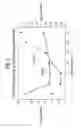
The invention will now be described by way of example only and with reference to FIG. 1 which is a graph of the performance of base oil with various amounts of aromatic extract.
In these experiments a hydroprocessed base stock was a Group II base stock comprising at least 97% by weight saturated hydrocarbons was used. The aromatic extract was a low PCA brightstock extract (less than 3% polycyclic aromatics, brightstock furfural extract) provided by Shell. Properties of these components are given in Table III below.
| TABLE III |
| General properties of components |
| Jurong | Aromatic | ||
| 500N | Extract | ||
| Components | Test Method | Base stock | (AE) |
| Type | Group II | Aromatic | |
| Extract | |||
| KV40, mm2/s (cSt) | IP71 | 91.58 | — |
| KV100, mm2/s (cSt) | IP71 | 10.64 | 71.47 |
| VI | IP226 | 99 | — |
| Density, g/cm3 (15° C.) | IP365 | 0.8746 | 0.9897 |
| Flash point (PMCC), ° C. | IP34 | 232.3 | 284.3 |
| Flash point (COC), ° C. | IP36 | 266 | 308 |
| Pour point, ° C. | IP15 | −18 | −12 |
| Colour | ASTM D1500 | 0.1 | >8 |
| TAN, mg KOH/g | IP1A | <0.05 | 0.09 |
| TBN, mg KOH/g | IP276 | <0.05 | 2.14 |
| Sulphur, % | ASTM D4951 | 0.0037 | 4.13 |
| Nitrogen, % | ASTM D5762 | 0.0027 | 0.11 |
| Demulsibility, secs | IP19 | 75 | — |
| Dialysis, % wt | BAM72 | <0.1 | <0.1 |
| Oxidation IP48 | IP48 | Rams bottom | |
| Viscosity ratio | 3.06 | carbon - | |
| 4.3% | |||
| Carbon before, wt. % | 0.05 | ||
| Carbon after, wt. % | 0.60 | ||
| Carbon, Δ | 0.55 | ||
| Carbon types wt % | BAM76 | Viscosity too | |
| Carbon, aromatic CA | 1.2 | high to permit | |
| Carbon, naphthenic CN | 67.2 | deter- | |
| mination | |||
| Carbon, paraffinic CP | 31.6 | ||
| Hydrocarbon types wt % | D2007 | ||
| Saturates | 97.9 | 11.3 | |
| Aromatics | 2.1 | 80.2 | |
| Polars | <0.1 | 8.5 | |
The base stock and aromatic extract were shown not to contain any significant amounts of waxy materials. Base oil compositions were prepared by blending the aromatic extract (AE) with various amounts of the Group II base stock. Properties of the base oil compositions are given in Table IV below.
| TABLE IV | |||
| Sample | Test Method | Example 1 | Example 2 |
| Base Oil Composition | 88% Group II | 76% Group II | |
| (weight %) | 12% AE | 24% AE | |
| KV40, mm2/s (cSt) | IP71 | 162.4 | |
| KV100, mm2/s (cSt) | IP71 | 12.3 | 14.43 |
| VI | IP226 | 92 | 85 |
| Density, g/cm3 | IP365 | 0.8870 | 0.9005 |
| Flash point (PMCC), | IP34 | 238.3 | 236.1 |
| ° C. | |||
| Flash point (COC), | IP36 | 254 | 264 |
| ° C. | |||
| Pour point, ° C. | IP15 | −15 | −12 |
| Colour | ASTM D1500 | 6.1 | >8 |
| TAN, mg KOH/g | IP1A | <0.05 | <0.05 |
| TBN, mg KOH/g | IP276 | 0.22 | 0.47 |
| Sulphur, wt. % | ASTM D4951 | 0.49 | 0.98 |
| Nitrogen, wt. % | ASTM D5762 | 0.019 | 0.032 |
| Demulsibility, secs | IP19 | 405 | 630 |
| Dialysis, % wt | BAM72 | <0.1 | <0.1 |
| Oxidation IP48 | IP48 | ||
| Viscosity ratio | 1.18 | 1.40 | |
| Carbon before, wt. % | 0.31 | 0.69 | |
| Carbon after, wt. % | 0.87 | 2.37 | |
| Carbon, Δ | 0.56 | 1.68 | |
| Carbon types wt % | BAM76 | ||
| Carbon, aromatic CA | 4.4 | 7.1 | |
| Carbon, naphthenic CN | 63.7 | 63.0 | |
| Carbon, paraffinic CP | 31.9 | 29.9 | |
| Viscosity gravity | ASTM D2501 | 0.799 | 0.902 |
| constant | |||
Further base oils were prepared using the Group II base stock and the aromatic extract in other amounts. Oxidation properties of the base oils were tested according to the Institute of Petroleum procedure IP48 and the results are given in Table V below:
| TABLE V | |||||
| Wt. % | Carbon | ||||
| aromatic | Δ | unoxi- | Carbon | Δ | |
| extract in | viscosity | dized | oxidized | carbon | |
| base oil | Sample | Ratio | % | % | % |
| 0 | Experiment A | 3.06 | 0.05 | 0.60 | 0.55 |
| 3 | Example 3 | 1.18 | 0.12 | 0.33 | 0.21 |
| 6 | Example 4 | 1.11 | 0.20 | 0.37 | 0.17 |
| 12 | Example 1 | 1.18 | 0.31 | 0.87 | 0.56 |
| 18 | Example 5 | 1.30 | 0.52 | 1.35 | 0.83 |
| 24 | Example 2 | 1.40 | 0.69 | 2.37 | 1.68 |
| 30 | Example 6 | 1.60 | 0.87 | 2.76 | 1.89 |
Experiment A is not according to the present invention because it does not contain any aromatic extract.
The results of the change in carbon (Δ carbon) and viscosity ratio at the different concentrations of aromatic extract in the base oil are also shown in FIG. 1.
The results of the Δ carbon and viscosity ratio show that the aromatic extract provides an improvement in Δ carbon at a concentration of aromatic extract up to about 12% by weight and an improvement in viscosity ratio at a concentration of aromatics extract of up to 30% by weight.
These results show the beneficial effect of the presence of 0.2 to 30% by weight of aromatic extract in a base oil composition comprising a base stock comprising at least 95 weight % saturated hydrocarbons.
Lubricant compositions suitable for use in a marine 4-stroke engine using heavy fuel were prepared using a salicylate-rich additive package and base oils comprising different amounts of aromatic extract.
Properties of the formulated lubricant compositions are shown in Table VI below.
| TABLE VI | ||||
| Base oil blend | Test | 88% Group II | 76% Group II | |
| used in lubricant | Methods | 100% Group II | 12% AE | 24% AE |
| Sample | Example 7 | Example 8 | ||
| KV40, mm2/s (cSt) | IP71 | 99.28 | 124.2 | 160.4 |
| KV100, mm2/s (cSt) | IP71 | 11.63 | 13.12 | 15.04 |
| VI | IP226 | 105 | 99 | 93 |
| TBN, mg KOH/g | IP276 | 38.71 | 40.59 | 40.29 |
| Pour Point, ° C. | IP15 | −21 | −18 | −15 |
| Flash point (PMCC), | IP34 | 218.8 | 220.2 | 226.2 |
| ° C. | ||||
| Metals, ppm | ICP | |||
| Ca | 14996 | 13641 | 13667 | |
| P | 565 | 481 | 483 | |
| Zn | 518 | 505 | 503 | |
| Si | 8 | 11 | 12 | |
| Na | 54 | 50 | 50 | |
| Foam, ml/ml | IP146 | |||
| Sequence 1 | 0/0 | 0/0 | 0/0 | |
| Sequence 2 | 280/0 | 350/0 | 390/0 | |
| Sequence 3 | 0/0 | 10/0 | 10/0 | |
| Density, g/cm3 | IP365 | 0.9018 | 0.9123 | 0.9231 |
| ARV, mins | IP313 | 20.6 | 25.1 | 31.7 |
| Demulsibility, ml | ASTM | 1/0/79 | 1/0/79 | 1/0/79 |
| D1401 | (60 mins. 82° C.) | (60 mins. 82° C.) | (60 mins. 82° C.) | |
Oxidation properties of the lubricant compositions were measured. The results are shown in Table VII below.
| TABLE VII | ||||
| Base oil used in | 88% | 76% | ||
| lubricant | Test | Group II | Group II | |
| composition | Method | 100% Group II | 12% AE | 24% AE |
| Sample | Example 7 | Example 8 | ||
| Isothermal | ISOT | |||
| oxidation test | 72 hrs @ | |||
| (ISOT) | 165° C. | |||
| Δ BN, % | −1.42 | −2.60 | −2.87 | |
| Δ KV 40, % | +3.02 | +8.9 | +22.8 | |
| Δ KV100, % | +0.25 | +0.70 | +1.47 | |
| Panel Coker | BEM144 | 68.1 | 121.4 | 137.1 |
| aluminium | ||||
| panels 22 hrs | ||||
| 325° C. | ||||
| Panel Coker | In-house | |||
| Steel panels | method | 107.4/147.7 | 33.3/28.9 | 10.2/9.4 |
| 2 × 4 hrs 320° C. | ||||
| Average | 127.6 | 31.1 | 9.8 | |
| Cu corrosion | ASTM | N/A | 1a slight | 1a slight |
| 3 hrs 120° C. | D130 | tarnish | tarnish | |
| Cu corrosion | ASTM | N/A | 1a slight | 1a slight |
| 3 hrs 150° C. | D130 | tarnish | tarnish | |
| Rusting | IP135B | N/A | No rusting | No rusting |
| characteristics | ||||
The results in Table VII show some improvement is observed within the Panel Coker Test using steel panels undertaken according to the in-house method at 12 and 24% by weight aromatic extract indicating an improvement within the solvency of the lubricant composition when aromatic extract is used.
Wear properties of the lubricant compositions were measured using a Cameron Plint test. The results are shown in Table VIII below.
| TABLE VIII | |||||
| Specific | Mean Wear | ||||
| Wear | Wear Rate | Scar Depth | Pin | ||
| vol. | (SWR) | (MWSD) | wear | ||
| Test | mm3 | m3/Nm | μm | mm | |
| Bad reference | 1074 | 0.0643 | 5.82E−17 | 22.7 | 0.024 |
| Good reference | 1082 | 0.0119 | 7.35E−18 | 12.1 | 0.006 |
| 100% Gp II | 006A/02 | 0.00182 | 1.12E−18 | 18.9 | 0.007 |
| 88% Group II | 010A/01 | 0 | 0.00E+00 | 0 | 0.002 |
| 12% AE | |||||
| 76% Group II | 011A/01 | 0.0254 | 1.57E−17 | 18 | 0.009 |
| 24% AE | |||||
The wear properties were compared against reference lubricant formulations with good and bad wear performance. The results show an exceptionally good wear performance for a lubricant composition with a base oil comprising 12% by weight aromatic extract. However, at the higher concentration of 24% by weight aromatics extract in the base oil, there is no significant improvement in wear performance compared to the composition with 100% Group II base oil. This data implies that there is an optimum concentration of aromatic extract for wear performance.
Claims
1-12. (canceled)
13. A liquid lubricant base oil composition comprising (i) a base stock comprising at least 95% by weight saturated hydrocarbons and (ii) 0.2 to 30% by weight of an aromatic extract, in which the aromatic extract has an aromatics content of 60 to 85% by weight and a dimethyl sulphoxide extractable polycyclic aromatics content of less than 3 weight %.
14. A liquid lubricant base oil composition as claimed in claim 13 which comprises 0.2 to 18% by weight of said aromatic extract.
15. A liquid lubricant base oil composition as claimed in claim 14 which comprises 1 to 18% by weight of said aromatic extract.
16. A liquid lubricant base oil composition as claimed in claim 13 which comprises 1 to 30% by weight of said aromatic extract.
17. A liquid composition as claimed in claim 13 in which the aromatic extract is a residual aromatic extract.
18. A liquid composition as claimed in claim 13 in which the aromatic extract is a distillate aromatic extract.
19. A liquid composition as claimed in claim 18 in which the aromatic extract is a treated distillate aromatic extract which is a distillate aromatic extract which has been subjected to at least one further treatment.
20. A liquid composition as claimed in claim 19 in which the at least one further treatment is selected from the group consisting of hydrogenation, hydrodesulphurisation, clay treatment, acid treatment and further solvent extraction.
21. A liquid lubricant base oil composition as claimed in claim 13 in which the base stock comprising at least 95% by weight saturated hydrocarbons comprises a hydroprocessed base stock and/or a base stock derived from Fischer-Tropsch synthesised, waxy, paraffinic hydrocarbon material.
22. A liquid lubricant base oil composition as claimed in claim 21 in which the hydroprocessed base stock is a Group II base stock and/or a Group III base stock.
23. A liquid lubricant base oil composition as claimed in claim 13 in which the base stock comprises a Group II base stock and/or a Group III base stock.
24. A liquid composition as claimed in claim 13 in which the base stock comprises at least one polyalphaolefin.
25. A method of making a liquid lubricant base oil composition as claimed claim 13 which method comprises blending a base stock comprising at least 95% by weight saturated hydrocarbons with sufficient aromatic extract which has an aromatics content of 60 to 85% by weight and a dimethyl sulphoxide extractable polycyclic aromatics content of less than 3 weight % to make a liquid lubricant base oil composition as claimed in claim 13.
26. A liquid lubricant composition comprising a liquid lubricant base oil composition as claimed in claim 13 and one or more additives.
27. A liquid lubricant composition as claimed in claim 26 in which the one or more additives are selected from the group consisting of detergents, dispersants, anti-wear additives, anti-oxidants, anti-foams, corrosion inhibitors, pour point depressants, friction modifiers, tackifiers and viscosity index improvers.
28. A liquid lubricant composition as claimed in claim 27 when used as a 2-stroke marine diesel engine cylinder oil, 2-stroke marine diesel engine system oil or 4-stroke marine diesel engine crankcase lubricant composition.
29. A liquid lubricant composition comprising a liquid lubricant base oil composition as claimed in claim 19 and one or more additives selected from the group consisting of detergents, dispersants, anti-wear additives, anti-oxidants, anti-foams, corrosion inhibitors, pour point depressants, friction modifiers, tackifiers and viscosity index improvers.
30. A liquid lubricant composition comprising a liquid lubricant base oil composition as claimed in claim 18 and one or more additives selected from the group consisting of detergents, dispersants, anti-wear additives, anti-oxidants, anti-foams, corrosion inhibitors, pour point depressants, friction modifiers, tackifiers and viscosity index improvers.
31. A liquid lubricant composition comprising a liquid lubricant base oil composition as claimed in claim 19 and one or more additives selected from the group consisting of detergents, dispersants, anti-wear additives, anti-oxidants, anti-foams, corrosion inhibitors, pour point depressants, friction modifiers, tackifiers and viscosity index improvers.
32. A liquid lubricant composition comprising a liquid lubricant base oil composition as claimed in claim 20 and one or more additives selected from the group consisting of detergents, dispersants, anti-wear additives, anti-oxidants, anti-foams, corrosion inhibitors, pour point depressants, friction modifiers, tackifiers and viscosity index improvers.
33. A liquid lubricant composition comprising a liquid lubricant base oil composition as claimed in claim 21 and one or more additives selected from the group consisting of detergents, dispersants, anti-wear additives, anti-oxidants, anti-foams, corrosion inhibitors, pour point depressants, friction modifiers, tackifiers and viscosity index improvers.
34. A liquid lubricant composition comprising a liquid lubricant base oil composition as claimed in claim 22 and one or more additives selected from the group consisting of detergents, dispersants, anti-wear additives, anti-oxidants, anti-foams, corrosion inhibitors, pour point depressants, friction modifiers, tackifiers and viscosity index improvers.
35. A liquid lubricant composition comprising a liquid lubricant base oil composition as claimed in claim 23 and one or more additives selected from the group consisting of detergents, dispersants, anti-wear additives, anti-oxidants, anti-foams, corrosion inhibitors, pour point depressants, friction modifiers, tackifiers and viscosity index improvers.
36. A liquid lubricant composition comprising a liquid lubricant base oil composition as claimed in claim 24 and one or more additives selected from the group consisting of detergents, dispersants, anti-wear additives, anti-oxidants, anti-foams, corrosion inhibitors, pour point depressants, friction modifiers, tackifiers and viscosity index improvers.
37. The use of 0.2 to 30% by weight of an aromatic extract which has an aromatics content of 60 to 85% by weight and a dimethyl sulphoxide extractable polycyclic aromatics content of less than 3 weight % in a liquid lubricant base oil composition which base oil comprises a base stock comprising at least 95% by weight saturated hydrocarbons, to mitigate at least one of the deficiencies of the base stock selected from the group consisting of poor dispersancy, poor seal swell performance, poor solubility of additives and low compatibility with fuel oil in marine engine applications.
38. The use as claimed in claim 37 in which the lubricant base oil composition is a liquid lubricant base oil composition comprising (i) a base stock comprising at least 95% by weight saturated hydrocarbons and (ii) 0.2 to 30% by weight of an aromatic extract, in which the aromatic extract has an aromatics content of 60 to 85% by weight and a dimethyl sulphoxide extractable polycyclic aromatics content of less than 3 weight %.
39. The use as claimed in claim 37 in a liquid lubricant composition in which the lubricant base oil composition is a liquid lubricant base oil composition comprising (i) a base stock comprising at least 95% by weight saturated hydrocarbons and (ii) 0.2 to 30% by weight of an aromatic extract, in which the aromatic extract has an aromatics content of 60 to 85% by weight and a dimethyl sulphoxide extractable polycyclic aromatics content of less than 3 weight %.
40. The use as claimed in claim 25 in a liquid lubricant composition in which the one or more additives are selected from the group consisting of detergents, dispersants, anti-wear additives, anti-oxidants, anti-foams, corrosion inhibitors, pour point depressants, friction modifiers, tackifiers and viscosity index improvers.
Images & Drawings included:
Sources:
- United States Patent and Trademark Office - verify current appl. status at the USPTO↗
Similar patent applications:
Recent applications in this class:
- » 20250171704 2025-05-29
LUBRICATING OIL COMPOSITION - » 20250154425 2025-05-15
REFRIGERATING MACHINE OIL, WORKING FLUID COMPOSITION FOR REFRIGERATING MACHINE, LUBRICATING METHOD, AND METHOD FOR PRODUCING REFRIGERATING MACHINE OIL - » 20240343986 2024-10-17
GREASE COMPOSITIONS - » 20230340352 2023-10-26
LUBRICANT USING VEGETABLE OIL AND HAVING A SELF-GENERATING FRICTION FILM - » 20230235239 2023-07-27
Lubricants Having Improved Low Temperature, Oxidation, And Deposit Control Performance - » 20220411710 2022-12-29
Refrigerating machine oil, working fluid composition for refrigerating machine, lubricating method, and method for producing refrigerating machine oil - » 20200199473 2020-06-25
GREASE COMPOSITIONS HAVING IMPROVED PERFORMANCE - » 20160230109 2016-08-11
FISCHER-TROPSCH DERIVED GAS OIL FRACTION - » 20160215230 2016-07-28
FISCHER-TROPSCH DERIVED GAS OIL FRACTION - » 20160215229 2016-07-28
FISCHER-TROPSCH DERIVED GAS OIL FRACTION