METHOD FOR MAKING KEY PANEL AND KEY PANEL THEREOF
US20100330343A1
2010-12-30
12/698,108
2010-02-01
Abstract:
A method for making key panel comprises the following steps: providing a transparent or translucent substrate; forming a plurality of grooves in a surface of the substrate; filling the grooves with ink; and forming a translucent metallic coating on the surface of the substrate and covering the ink. A key panel made by the above mentioned method is also described there.
Inventors:
- YAN-MIN WANG 20 🇨🇳 Shenzhen City, China
- GANG HUANG 27 🇨🇳 Shenzhen City, China
- HONG-BO LI 5 🇨🇳 Shenzhen City, China
Assignee:
- FIH (HONG KONG) LIMITED 1,461 🇭🇰 Kowloon, Hong Kong
- SHENZHEN FUTAIHONG PRECISION INDUSTRY CO., LTD. 1,108 🇨🇳 ShenZhen City, China
Interested in similar patents?
Get notified when new applications in this technology area are published.
Classification:
H01H13/704 » CPC main
Switches having rectilinearly-movable operating part or parts adapted for pushing or pulling in one direction only, e.g. push-button switch having a plurality of operating members associated with different sets of contacts, e.g. keyboard with contacts carried by or formed from layers in a multilayer structure, e.g. membrane switches characterised by the layers, e.g. by their material or structure
H01H2209/016 » CPC further
Layers Protection layer, e.g. for legend, anti-scratch
H01H2209/07 » CPC further
Layers; Properties of the membrane metallic
H01H2219/03 » CPC further
Legends; Printed information in transparent keyboard
H01H2229/012 » CPC further
Manufacturing Vacuum deposition
H01H2229/058 » CPC further
Manufacturing Curing or vulcanising of rubbers
Y10T428/24612 » CPC further
Stock material or miscellaneous articles; Structurally defined web or sheet [e.g., overall dimension, etc.] including variation in thickness Composite web or sheet
B32B3/30 IPC
Layered products comprising a layer with external or internal discontinuities or unevennesses, or a layer of non-planar form ; Layered products having particular features of form characterised by a particular shape of the outline of the cross-section of a continuous layer; characterised by a layer with cavities or internal voids ; characterised by an apertured layer characterised by a layer formed with recesses or projections, e.g. hollows, grooves, protuberances, ribs
B05D3/10 IPC
Pretreatment of surfaces to which liquids or other fluent materials are to be applied; After-treatment of applied coatings, e.g. intermediate treating of an applied coating preparatory to subsequent applications of liquids or other fluent materials by other chemical means
B05D1/36 IPC
Processes for applying liquids or other fluent materials Successively applying liquids or other fluent materials, e.g. without intermediate treatment
B05D3/06 IPC
Pretreatment of surfaces to which liquids or other fluent materials are to be applied; After-treatment of applied coatings, e.g. intermediate treating of an applied coating preparatory to subsequent applications of liquids or other fluent materials by exposure to radiation
Description
CROSS-REFERENCE TO RELATED APPLICATIONS
This application is related to co-pending U.S. patent Application (Attorney Docket No. US27002), entitled “METHOD FOR MAKING KEY PANEL AND KEY PANEL THEREOF”. Such applications has the same assignee as the present application. The above-identified application is incorporated herein by reference.
BACKGROUND
1. Technical Field
The present disclosure relates to methods for making key panels, especially to a method for making key panels having three-dimensional key patterns and metallic appearance, and a key panel.
2. Description of Related Art
Key panels of portable electronic devices are commonly made of plastic. Plastic key panels commonly include key patterns formed on the key panels' surface by printing ink. These key patterns typically cannot present a three-dimensional appearance. Furthermore, the plastic key panels typically do not have metallic appearances. If, however, metal is used to manufacture the key panels having a metallic appearance, the weight of the key panels increases as dose cost.
Therefore, there is room for improvement within the art.
BRIEF DESCRIPTION OF THE FIGURE
Many aspects of the key panel can be better understood with reference to the following FIGURE. The components in the FIGURE are not necessarily drawn to scale, the emphasis instead being placed upon clearly illustrating the principles of the key panel.
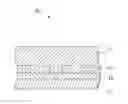
The FIGURE is a cross-sectional view of an exemplary embodiment of a key panel.
DETAILED DESCRIPTION
In an exemplary embodiment, a method for making a key panel may comprise of providing a transparent or translucent substrate; forming a plurality of grooves in a surface of the substrate; filling the grooves with ink; and forming a translucent metallic coating on the surface of the substrate and covering the ink.
Referring to the FIGURE, a substrate 11 is provided. The substrate 11 may be made of transparent or translucent material such as glass, plastic or ceramic. The plastic may be selected from a group consisting of polypropylene (PP), polyamide (PA), polycarbonate (PC), polymethyl methacrylate (PMMA), and polyethylene terephthalate (PET). The thickness of the substrate 11 may be about 0.4-1 mm.
A plurality of grooves 13 are formed in the substrate 11 by ultraviolet laser etching or chemical etching. The grooves 13 may define the shape of the numbers, letters and patterns of the key panel. The depth of each groove may be about 8-12 μm.
The grooves 13 is then filled with ink to form the numbers, letters and patterns of the key panel. The ink may be acrylic resin ink. The ink can be black or colorized. After the grooves 13 have been filled with ink, the numbers, letters and patterns of the key panel can present a three-dimensional appearance (when observed from the surface of the substrate 11 opposite to the grooves 13).
A translucent metallic coating 15 is applied by vacuum deposition on the surface of the substrate 11 and covering the ink filled in the grooves 13. The material used for the metallic coating 15 can be selected from copper or gold to give a golden appearance, or selected from aluminum or indium having an argent appearance. The metallic coating 15 can be translucent and can let light through by choosing the above-mentioned materials and/or by controlling the thickness of the metallic coating 15 to a range of about 20-100 nm.
An optional transparent or translucent protective coating 17 is applied on the exposed surface of the metallic coating 15. The protective coating 17 can be an ultraviolet curing paint coating or a hot curing paint coating formed by spraying, or an ink coating formed by printing. The protective coating 17 can protect the metallic coating 15 from being abrasion.
Referring to the FIGURE, a key panel 10 made by the above mentioned method includes a substrate 11, a translucent metallic coating 15 and a protective coating 17. The substrate 11 may be transparent or translucent. One surface of the substrate 11 has a plurality of grooves 13. The grooves 13 may define the shape of the numbers, letters and patterns of the key panel 10. The grooves 13 are then filled with black or colorized ink to form the numbers, letters and patterns of the key panel 10. The metallic coating 15 is formed on the surface of the substrate 11 and covering the ink. The protective coating 17 may be transparent or translucent, and is formed on the metallic coating 15.
The exemplary method by etching grooves 13 on one surface of the substrate 11 and then filling the grooves 13 with ink to form three dimensional numbers, letters and patterns (key patterns) of the key panel 10, and further applying a metallic coating 15 onto the surface of the substrate 11 and covering the ink filled in the grooves 13, makes the key panel 10 have an attractive metallic appearance (observed from the surface of the substrate 11 opposite to the grooves 13).
It should be understood, however, that even though numerous characteristics and advantages of the present embodiments have been set forth in the foregoing description, together with details of functions of the embodiments, the disclosure is illustrative only, and changes may be made in detail within the principles of the disclosure to the full extent indicated by the broad general meaning of the terms in which the appended claims are expressed.
Claims
What is claimed is:1. A method for making key panel, comprising:
providing a transparent or translucent substrate;
forming a plurality of grooves in a surface of the substrate;
filling the grooves with ink; and
forming a translucent metallic coating on the surface of the substrate and covering the ink.
2. The method as claimed in claim 1, wherein the substrate is made of glass, plastic or ceramic.
3. The method as claimed in claim 1, wherein the grooves are formed by ultraviolet laser etching or chemical etching.
4. The method as claimed in claim 1, wherein the metallic coating is formed by vacuum deposition.
5. The method as claimed in claim 4, wherein the metallic coating has a thickness of about 20-100 nm.
6. The method as claimed in claim 1, wherein the metallic coating is a copper coating, a gold coating, an aluminum coating or an indium coating.
7. The method as claimed in claim 1, wherein each groove has a depth of about 8-12 μm.
8. The method as claimed in claim 1, further comprising forming a protective coating on the metallic coating.
9. The method as claimed in claim 8, wherein the protective coating is a paint coating or an ink coating.
10. A key panel, comprising:
a transparent or translucent substrate, one surface of the substrate having a plurality of grooves, the grooves filled with ink; and
a translucent metallic coating formed on the surface of the substrate and covering the ink.
11. The key panel as claimed in claim 10, wherein the substrate is made of glass, plastic or ceramic.
12. The key panel as claimed in claim 10, wherein the metallic coating is formed by vacuum deposition.
13. The key panel as claimed in claim 12, wherein the metallic coating has a thickness of about 20-100 nm.
14. The key panel as claimed in claim 10, wherein the metallic coating is a copper coating, a gold coating, an aluminum coating or an indium coating.
15. The key panel as claimed in claim 10, wherein each groove has a depth of about 8-12 μm.
16. The key panel as claimed in claim 10, wherein the key panel further includes a protective coating applied on the metallic coating.
17. The key panel as claimed in claim 16, wherein the protective coating is a paint coating or an ink coating.
Images & Drawings included:

Sources:
- United States Patent and Trademark Office - verify current appl. status at the USPTO↗
Similar patent applications:
- » 20100330344
METHOD FOR MAKING KEY PANEL AND KEY PANEL THEREOF
Recent applications in this class:
- » 20250166944 2025-05-22
Composite Elastomeric Structure - » 20250149272 2025-05-08
SWITCH DEVICE - » 20240429004 2024-12-26
PRESSURE SENSITIVE SWITCH DEVICE - » 20240371582 2024-11-07
KEYBOARD DEVICE - » 20240321533 2024-09-26
MECHANICAL KEYBOARD WITH PRINTED MEMBRANE - » 20240312739 2024-09-19
LAYER-STRUCTURED, OPEN-DESIGN KEYBOARD - » 20230395339 2023-12-07
Membrane circuit board and keyboard device using same - » 20230238197 2023-07-27
METHOD FOR MAKING A THREE-DIMENSIONAL LIQUID CRYSTAL POLYMER MULTILAYER CIRCUIT BOARD INCLUDING MEMBRANE SWITCH - » 20220293359 2022-09-15
Key module - » 20220130626 2022-04-28
Keyboard containing recycled and renewable polymeric compositions
Recent applications for this Assignee:
- » 20220140846 2022-05-05
Antenna structure and wireless communication device using same - » 20220094077 2022-03-24
Antenna structure and wireless communication device using same - » 20220059931 2022-02-24
Antenna structure and wireless communication device - » 20220021116 2022-01-20
Single antenna structure capable of operating in multiple band widths - » 20220010948 2022-01-13
Anti-loosing structure and backlight module - » 20200170133 2020-05-28
Housing, electronic device, and method for manufacturing same - » 20200122194 2020-04-23
Frame and surface treatment method for the frame - » 20200060034 2020-02-20
Housing, method for manufacturing the same, and electronic device having the same - » 20200016805 2020-01-16
Housing, electronic device, and method for manufacturing the same - » 20190368052 2019-12-05
COMPOSITE AND METHOD FOR MAKING SAME