Method for producing a condenser
US20110006455A1
2011-01-13
12/922,356
2009-03-14
✅ Patent granted
US 8,128,855 B2
2012-03-06
WO; PCT/DE2009/000356; 20090314
WO; WO2009/121320; 20091008
Edmund H. Lee
2029-03-14
Abstract:
Method for producing a condenser, which is provided with a plurality of pipes extending parallel to each other and disposed in a specified grid, the ends of the pipes being held by a base plate, characterized by the following sequential method steps: providing a pan, the base surface of which has a plurality of bores disposed in a defined grid and pipe sockets aligned with the bores, introducing filling pins into the pipe sockets, introducing thermoplastic granules into the pan, melting the granules in the pan, introducing centering pins into the pipe sockets while pushing out the filling pins, sliding the pan comprising the molten granules onto the free ends of the pipes, cooling the molten granules while forming a base plate receiving the free ends of the pipes in a gas-tight manner, the base plate being made of thermoplastic material, and subsequently pulling the pan and the centering pins off the connection of the base plate and pipes.
Assignee:
- TERRAWATER GMBH 1 🇩🇪 Kiel, Germany
Interested in similar patents?
Get notified when new applications in this technology area are published.
Classification:
F28B1/02 » CPC main
Condensers in which the steam or vapour is separate from the cooling medium by walls, e.g. surface condenser using water or other liquid as the cooling medium
B29C65/70 » CPC further
Joining of preformed parts ; Apparatus therefor by moulding
B29C65/7802 » CPC further
Joining of preformed parts ; Apparatus therefor; Means for handling the parts to be joined, e.g. for making containers or hollow articles, e.g. means for handling sheets, plates, web-like materials, tubular articles, hollow articles or elements to be joined therewith; Means for discharging the joined articles from the joining apparatus Positioning the parts to be joined, e.g. aligning, indexing or centring
B29C66/522 » CPC further
General aspects of processes or apparatus for joining preformed parts; General aspects of joining tubular articles; General aspects of joining long products, i.e. bars or profiled elements; General aspects of joining single elements to tubular articles, hollow articles or bars; General aspects of joining several hollow-preforms to form hollow or tubular articles; Joining tubular articles, profiled elements or bars; Joining single elements to tubular articles, hollow articles or bars; Joining several hollow-preforms to form hollow or tubular articles; Joining tubular articles, bars or profiled elements Joining tubular articles
B29C66/53465 » CPC further
General aspects of processes or apparatus for joining preformed parts; General aspects of joining tubular articles; General aspects of joining long products, i.e. bars or profiled elements; General aspects of joining single elements to tubular articles, hollow articles or bars; General aspects of joining several hollow-preforms to form hollow or tubular articles; Joining tubular articles, profiled elements or bars; Joining single elements to tubular articles, hollow articles or bars; Joining several hollow-preforms to form hollow or tubular articles; Joining single elements to tubular articles, hollow articles or bars; Joining single elements to open ends of tubular or hollow articles or to the ends of bars said single elements being substantially flat said single flat elements being provided with holes facing the tube ends, e.g. for making heat-exchangers
B29C70/84 » CPC further
Shaping composites, i.e. plastics material comprising reinforcements, fillers or preformed parts, e.g. inserts by incorporating or moulding on preformed parts, e.g. inserts or layers, e.g. foam blocks by moulding material on preformed parts to be joined
F28D7/16 » CPC further
Heat-exchange apparatus having stationary tubular conduit assemblies for both heat-exchange media, the media being in contact with different sides of a conduit wall the conduits being arranged in parallel spaced relation
F28F9/162 » CPC further
Casings; Header boxes; Auxiliary supports for elements; Auxiliary members within casings; Header boxes; End plates; Arrangements for sealing elements into header boxes or end plates by permanent joints, e.g. by rolling by using bonding or sealing substances, e.g. adhesives
F28F21/067 » CPC further
Constructions of heat-exchange apparatus characterised by the selection of particular materials of plastics material Details
B01D5/0033 » CPC further
Condensation of vapours; Recovering volatile solvents by condensation Other features
B29C66/112 » CPC further
General aspects of processes or apparatus for joining preformed parts; General aspects dealing with the joint area or with the area to be joined; Particular design of joint configurations particular design of the joint cross-sections; Joint cross-sections comprising a single joint-segment, i.e. one of the parts to be joined comprising a single joint-segment in the joint cross-section Single lapped joints
B29C66/114 » CPC further
General aspects of processes or apparatus for joining preformed parts; General aspects dealing with the joint area or with the area to be joined; Particular design of joint configurations particular design of the joint cross-sections; Joint cross-sections comprising a single joint-segment, i.e. one of the parts to be joined comprising a single joint-segment in the joint cross-section Single butt joints
B29L2031/18 » CPC further
Other particular articles Heat-exchangers or parts thereof
F28F2255/14 » CPC further
Heat exchanger elements made of materials having special features or resulting from particular manufacturing processes molded
B29C43/18 IPC
Compression moulding, i.e. applying external pressure to flow the moulding material; Apparatus therefor of articles of definite length, i.e. discrete articles incorporating preformed parts or layers, e.g. compression moulding around inserts or for coating articles
B29C39/10 IPC
Shaping by casting, i.e. introducing the moulding material into a mould or between confining surfaces without significant moulding pressure; Apparatus therefor for making articles of definite length, i.e. discrete articles incorporating preformed parts or layers, e.g. casting around inserts or for coating articles
Description
The invention relates to a method for producing a condenser, which is provided with a plurality of pipes extending parallel to each other and disposed in a defined grid, the ends of said pipes being held by a base plate.
Such condensers are for example used for water treatment plants where a multiplicity of pipes are provided that extend parallel to each other, are flown around by a carrier gas laden with moisture and that carry a coolant.
Producing such condensers is problematic because the problem presents itself that the free ends of pipes have to be combined in each case by a base plate.
The invention is based on the object of creating a method for producing such a condenser that enables the free ends of the pipes to be connected to a base plate in a simple way.
According to the invention this object is achieved by the features of Claim 1. Claim 2 specifies a preferred design of this method.
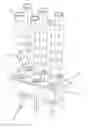
The invention is explained below with reference to a drawing that illustrates the different elements used with the method,
FIG. 1 showing an elevation of these elements and
FIG. 2 a perspective view.
A pan 1 is provided, the base surface of which has a plurality of bores disposed in that grid in which the pipes are arranged. The bores too are arranged with these pipe sockets 2 such that their faces pointing upward are aligned with each other. The outer diameter of these pipe sockets 2 corresponds to the inner diameter of the pipes. Then filling pins 3 whose outer diameter corresponds to the inner diameter of the pipe sockets 2 are introduced. Then thermoplastic granules are filled into the pan 1 and melted.
After melting the granules a mold die can be placed thereon until it rests on the free faces of the pipe sockets 2. This mold die on the one hand has the meaning that it compresses the molten granules, on the other hand it takes care of removing excess material.
Centering pins 4 are then introduced from above into the pipe sockets 2 while pushing out the filling pins 3, the outer diameter of the shaft of the centering pins corresponding to the inner diameter of the pipe sockets 2 and a frusto-conical centering section corresponding to the inner diameter of the pipes.
The pan 1 with the molten granules and the centering pins 4 is then slid onto the free ends of the pipes 5, the frusto-conical centering sections of the centering pins 4 entering into the free ends of the pipes 5. Here the centering sections are preferably formed from a plastic, preferably Teflon, so that the inner diameter of the pipes does not fusion-bond.
This unit can then cool, the molten granules then forming a base plate that sealingly receives the free ends of the pipes 5. After pulling the pan 1 and the centering pins 4 off the base plate that is firmly connected to the pipes 5, the same procedure can be carried out with the other free ends of the pipes, thus producing the condenser.
Claims
1. Method for producing a condenser, which is provided with a plurality of pipes extending parallel to each other and disposed in a specified grid, the ends of said pipes being held by a base plate, characterized by the following sequential method steps:
providing a pan, the base surface of which has a plurality of bores disposed in a defined grid and pipe sockets aligned with the bores,
introducing filling pins into the pipe sockets,
introducing thermoplastic granules into the pan,
melting the granules in the pan,
introducing centering pins into the pipe sockets while pushing out the filling pins,
sliding the pan comprising the molten granules onto the free ends of the pipes,
cooling the molten granules while forming a base plate receiving the free ends of the pipes in a gas-tight manner, said base plate being made of thermoplastic material, and subsequently
pulling the pan and the centering pins off the connection of the base plate and pipes.
2. Method according to claim 1, characterized by applying a mold die onto the base plate after melting the granules so as to compress it and to remove excess material.
Images & Drawings included:

Sources:
- United States Patent and Trademark Office - verify current appl. status at the USPTO↗
Similar patent applications:
- » 20190180892
Condenser bushing, transformer and method for producing a condenser bushing - » 20100222548
METHOD FOR PRODUCING CONDENSATION PRODUCTS FROM N-SUBSTITUTED GLYCINE DERIVATIVES(PEPTOIDS) BY SEQUENTIAL UGI-MULTICOMPONENT REACTIONS - » 20140134312
METHOD FOR PRODUCING CONDENSED SAFFRON - » 20140243492
METHOD FOR PRODUCING CONDENSED POLYCYCLIC AROMATIC COMPOUND, AND CONJUGATED POLYMER - » 20230184378
Condensate draining device, electronic assembly and method for producing a condensate draining device - » 20170191748
Hydrocarbon condensate stabilizer and a method for producing a stabilized hydrocarbon condensate stream - » 20070004936
Method for producing ester condensed product - » 20070023690
Method of producing heat-resistant electrically charged fluororesin material and method of producing electret condenser microphone using heat-resistant electrically charged fluororesin material - » 10854334
Method for producing phenol condensate - » 20080017356
Electronic component with heat transfer by boiling and condensation and method for producing same
Recent applications in this class:
- » 20240377139 2024-11-14
TUNNEL TYPE HYBRID COOLING STEAM RECYCLING APPARATUS - » 20220349654 2022-11-03
Condenser and semiconductor processing machine - » 20220341668 2022-10-27
Cooling systems comprising passively and actively expandable vapor chambers for cooling power semiconductor devices - » 20210063088 2021-03-04
Cooling systems comprising passively and actively expandable vapor chambers for cooling power semiconductor devices - » 20180180359 2018-06-28
WHITE SMOKE GAS REDUCTION DEVICE - » 20160341480 2016-11-24
Condenser and turbine equipment - » 20160327341 2016-11-10
Vertical straight tube countercurrent condenser - » 20160290723 2016-10-06
Condenser for condensing steam from a steam turbine - » 20160252307 2016-09-01
Heat exchange system and method - » 20150316324 2015-11-05
Heat exchange system and method for starting-up such a heat exchange system