Catalyst components based on ferrocenyl complexes used for olefin polymerisation
US20110034652A1
2011-02-10
12/295,464
2007-03-27
✅ Patent granted
US 8,017,541 B2
2011-09-13
WO; PCT/EP2007/052909; 20070327
WO; WO2007/113168; 20071011
Caixia Lu
2027-03-27
Abstract:
The present invention discloses catalyst components based on ferrocenyl ligands, their method of preparation and their use in the polymerization of olefins.
Inventors:
- Olivier LAVASTRE 19 🇫🇷 Gahard, France
- Sabine Sirol 17 🇧🇪 Horrues, Belgium
- Cyril Revault 2 🇫🇷 La Celle Saint Cloud, France
Assignee:
- TOTAL PETROCHEMICALS RESEARCH FELUY 186 🇧🇪 Seneffe (Feluy), Belgium
- Total Petrochemicals Research Feluy 1 🇧🇪 Senefee (Feluy), Belgium
- Centre National de al Recherche Scientifiqaue (CNRS) 1 🇫🇷 Paris, France
Interested in similar patents?
Get notified when new applications in this technology area are published.
Classification:
C07F17/02 » CPC main
of metals of Groups 8, 9 or 10 of the Periodic System
C08F4/61912 » CPC further
Polymerisation catalysts; Metals; Metal hydrides; Metallo-organic compounds; Use thereof as catalyst precursors selected from light metals, zinc, cadmium, mercury, copper, silver, gold, boron, gallium, indium, thallium, rare earths or actinides together with refractory metals, iron group metals, platinum group metals, manganese, rhenium technetium or compounds thereof; Component covered by group containing a transition metal-carbon bond in combination with an organoaluminium compound
C08F110/06 » CPC further
Homopolymers of unsaturated aliphatic hydrocarbons having only one carbon-to-carbon double bond; Monomers containing three or four carbon atoms Propene
C08F2410/03 » CPC further
Features related to the catalyst preparation, the catalyst use or to the deactivation of the catalyst Multinuclear procatalyst, i.e. containing two or more metals, being different or not
C08F4/613 » CPC further
Polymerisation catalysts; Metals; Metal hydrides; Metallo-organic compounds; Use thereof as catalyst precursors selected from light metals, zinc, cadmium, mercury, copper, silver, gold, boron, gallium, indium, thallium, rare earths or actinides together with refractory metals, iron group metals, platinum group metals, manganese, rhenium technetium or compounds thereof; Pretreating the metal or compound covered by group before the final contacting with the metal or compound covered by group; Pretreating with metals or metal-containing compounds with metals covered by group or compounds thereof
C08F10/00 » CPC further
Homopolymers and copolymers
C08F10/00 » CPC further
Homopolymers and copolymers of unsaturated aliphatic hydrocarbons having only one carbon-to-carbon double bond
C08F4/69 » CPC further
Polymerisation catalysts; Metals; Metal hydrides; Metallo-organic compounds; Use thereof as catalyst precursors selected from light metals, zinc, cadmium, mercury, copper, silver, gold, boron, gallium, indium, thallium, rare earths or actinides together with refractory metals, iron group metals, platinum group metals, manganese, rhenium technetium or compounds thereof; Refractory metals or compounds thereof Chromium, molybdenum, tungsten or compounds thereof
C08F10/06 » CPC further
Homopolymers and copolymers of unsaturated aliphatic hydrocarbons having only one carbon-to-carbon double bond; Monomers containing three or four carbon atoms Propene
C08F4/61904 » CPC further
Polymerisation catalysts; Metals; Metal hydrides; Metallo-organic compounds; Use thereof as catalyst precursors selected from light metals, zinc, cadmium, mercury, copper, silver, gold, boron, gallium, indium, thallium, rare earths or actinides together with refractory metals, iron group metals, platinum group metals, manganese, rhenium technetium or compounds thereof; Component covered by group containing a transition metal-carbon bond in combination with another component of
B01J31/12 IPC
Catalysts comprising hydrides, coordination complexes or organic compounds containing organic compounds or metal hydrides containing organo-metallic compounds or metal hydrides
B01J31/22 IPC
Catalysts comprising hydrides, coordination complexes or organic compounds containing coordination complexes Organic complexes
C08F4/80 IPC
Polymerisation catalysts; Metals; Metal hydrides; Metallo-organic compounds; Use thereof as catalyst precursors selected from metals not provided for in group selected from iron group metals or platinum group metals
Description
The present invention discloses catalyst components based on ferrocenyl ligands their method of preparation and their use in the polymerisation of olefins.
In the search for new catalyst components capable of producing highly tunable polymers, some ferrocene complexes have been known to polymerise or co-polymerise ethylene such as for example the ferrocene-substituted bis(imino) pirydine iron and cobalt complexes disclosed by Gibson et al. in Gibson V. C., Long N. J., Oxford, P. J., White A. J. P., and Williams D. J., in Organometallics ASAP article DOI: 10.1021/om0509589 or the ferrocene-substituted bis(imino) nickel and palladium complexes disclosed by Gibson et al. in J. Chem. Soc. Dalton Trans 2003, 918-926.
There is a need to develop new catalyst system having good activity and able to produce polymers tailored to specific needs.
It is an aim of the present invention to prepare new catalyst components that can be used in the polymerisation of olefins.
It is also an aim of the present invention to provide very active catalyst components.
It is another aim of the present invention to provide a method for polymerising or copolymerising olefins.
The present invention reaches, at least partially, any one of those aims.
Accordingly, the present invention discloses a catalyst system that comprises:
-
- a) a metallic component obtained by complexation reaction of a metallic precursor M(Hal)nR′v-n in a solvent, wherein M is a metal Group 6 to 10 of the Periodic Table, each Hal is the same or different and is halogen, each R′ is the same or different and is substituted or unsubstituted hydrocarbyl having from 1 to 20 carbon atoms, substituted or unsubstituted aryloxy or alkoxy, v is the valence of M and n is zero or an integer at most equal to v with a ligand of formula
-
- wherein Cp is a cyclopentadienyl group, unsubstituted or substituted, and wherein Y may have the form Y—Z and Y and Z, if present, may be the same or different and are selected from alkyl, aryl, heterocycle or a non-heterocycle group containing ether, thioether, phosphine, imine, amine or amide and Y and Z.
- b) an activating agent having an ionizing action.
Alternatively, CH2—Y can be replaced by CH2—Z—Y wherein Y is as defined here-above and Z is alkyl, aryl, heterocycle or a non-heterocycle group containing ether, thioether, phosphine, imine, amine or amide. Y and Z may be the same or different.
In a preferred embodiment according to the present invention, Z includes atoms O, N, P, S or groups —CR═CR—, —CR═N—, —N═CR— or —C≡C— wherein R is H, alkyl or aryl groups having at most 20 carbon atoms. The link between Y and Z can include a conjugation or not.
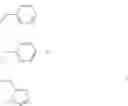
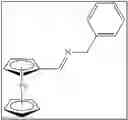
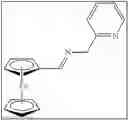
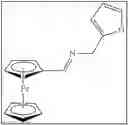
More preferably, Y is phenyl, furyl or pyridine group and CH2—Y is represented by formulas
The ligands of the present invention can be prepared following the method disclosed for example in Gibson et al. ((Chem. Soc. Rev., 2004, 33, 313-328) or in Samuelson et al. (Journal of Organometallic Chemistry, 1999, 575, 108-118) or in Lewkowski et al. (Journal of Organometallic Chemistry, 2001, 631, 105-109) or in Vigota et al. (Inorganica Chimica Acta, 1999, 287, 117-133) or in Wright (Organometallics, 1990, 9, 853-856).
The ferrocenyl ligand is prepared by reacting a precursor of formula
(CHO-Cp)Fe(Cp)
with an amine of formula
NH2—CH2—Y
wherein Cp and Y are as defined previously.
LIST OF FIGURES
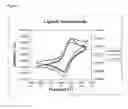
FIG. 1 represents the voltamograms of ferrocene ligand carrying different substituents Y. It is expressed as intensity in Amperes as a function of potential in Volts. Curve a represents the voltamogram of ligand 1 wherein Y is phenyl, curve b represents the voltamogram of ligand 2 wherein Y is pyridine and curve c represents the voltamogram of ligand 3 wherein Y is furyl.
The ligands of the present invention are characterised by a fully reversible status for the ferrocenylimine unit and by a total absence of conjugation between substituent group Y and metal Fe in the ligand. As the ferrocene and functional group Y are not conjugated it is allowed to modify or alter one entity, for example the ferrocene without influencing the other entity, for example the substituent Y. The electrochemical properties of the ferrocenylimines are thus fully reversible, even after modification of substituent Y. This behaviour is confirmed by electrochemical analysis of ferrocene ligands carrying different substituents Y, presented in FIG. 1. Iron has the same electronic potential for all tested substituents Y. There is thus no conjugation between the two entities.
The invention also discloses a metallic complex obtained by metalation of the ferrrocene ligand with a metal salt of formula M(Hal)nR′v-n
wherein M is a metal group 6 to 10 of the Periodic Table,
wherein each Hal is the same or different and is halogen,
wherein each R′ is the same or different and is substituted or unsubstituted hydrocarbyl having from 1 to 20 carbon atoms, substituted or unsubstituted aryloxy or alkoxy,
wherein v is the valence of M and n is zero or an integer at most equal to v.
Preferably M is Ni, Co, Fe, Pd or Cr.
Preferably Hal is chlorine.
Preferably n is equal to v.
The solvent may be selected from dichloromethane or tetrahydrofuran and the complexation reaction is carried out at room temperature or at reflux.
Typically, two types of metallic complexes could be formed, one where the metal is coordinated to one ligand and one where the metal is coordinated to two ligands. The relative amounts of each ligand and metal unit depend upon the nature of ligand and of the metal. The amount of ligand must therefore be of at least one equivalent of ligand per metallic equivalent.
The present invention further discloses an active catalyst system comprising the metallic complex and an activating agent having an ionising action.
Suitable activating agents are well known in the art. The activating agent can be an aluminium alkyl represented by formula AIR′nX3-n wherein R+ is an alkyl having from 1 to 20 carbon atoms and X is a halogen. The preferred alkylating agents are triisobutyl aluminium (TIBAL) or triethyl aluminium (TEAL).
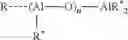
Alternatively, it can be aluminoxane and comprise oligomeric linear and/or cyclic alkyl aluminoxanes represented by formula
for oligomeric, linear aluminoxanes and by formula
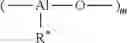
for oligomeric, cyclic aluminoxane,
wherein n is 1-40, preferably 10-20, m is 3-40, preferably 3-20 and R* is a C1-C8 alkyl group and preferably methyl.
The amount of activating is selected to give an AI/M ratio of from 100 to 3000, preferably of about 1000.
Suitable boron-containing activating agents may comprise a triphenylcarbenium boronate such as tetrakis-pentafluorophenyl-borato-triphenylcarbenium as described in EP-A-0427696, or those of the general formula [L′-H]+[B Ar1Ar2X3X4]— as described in EP-A-0277004 (page 6, line 30 to page 7, line 7). The amount of boron-containing activating agent is selected to give BIM ratio of from 0.5 to 5, preferably of about 1.
In another embodiment, according to the present invention, the metallic complex may be deposited on a conventional support impregnated with an activating agent. Preferably, the conventional support is silica impregnated with methylaluminoxane (MAO). Alternatively, it can be an activating support such as fluorinated alumina silica.
The present invention further discloses a method for preparing an active catalyst system that comprises the steps of:
-
- a) providing a ferrocenylimine ligand;
- b) complexing the ligand of step a) with a metallic salt M(Hal)nR′v-n in a solvent;
- c) retrieving a catalyst component;
- d) activating the catalyst component with an activating agent having an ionising action;
- e) optionally adding a scavenger;
- f) retrieving an active oligomerisation or polymerisation catalyst system.
Alternatively, in step d), the catalyst component is deposited on a support impregnated with an activating agent or on an activating support.
The cocatalyst may be selected from triethylaluminium, triisobutylaluminum, tris-n-octylaluminium, tetraisobutyldialuminoxane or diethyl zinc.
The active catalyst system is used in the oligomerisation and in the polymerisation of ethylene and alpha-olefins.
The present invention discloses a method for the oligomerisation or the homo- or co-polymerisation of ethylene and alpha-olefins that comprises the steps of;
-
- a) injecting the active catalyst system into the reactor;
- b) injecting the monomer and optional comonomer;
- c) maintaining under polymerisation conditions;
- d) retrieving the oligomers and/or polymer.
The pressure in the reactor can vary from 0.5 to 50 bars, preferably from 5 to 25 bars.
The polymerisation temperature can range from 10 to 100° C., preferably from 50 to 85° C.
Preferably the monomer and optional comonomer are selected from ethylene, propylene or 1-hexene.
The present invention also discloses the polymers obtained with the new catalyst systems.
EXAMPLES
All reactions were performed using standard Schlenk techniques or in an argon-filled glove-box. The starting materials and reagents, purchased from commercial suppliers, were degassed and purified by distillation under nitrogen using standard drying agents.
Preparation of Ligands
Synthesis of N-ferrocenylidenebenzylamine (1)
All complexes were prepared according to the method described for example in Gibson et al. (Chem Soc Rev., 2004, 33, 313-328) or in Samuelson et al. (Journal of Organometallic Chemistry, 1999, 575, 108-118).
300 mg (1.4 mmol) of solid ferrocenecarboxaldehyde were introduced in a schlenk. 90 μL (2.1 mmol) of benzylamine and 2 mg of p-toluene sulfonic acid were added. The mixture was dissolved in 20 mL of toluene and the homogeneous mixture was stirred and heated at reflux overnight (16 h). The solution was cooled down to room temperature (25° C.) and the solvent was vaporised under vacuum. After drying overnight under vacuum and at a temperature of 50° C., 374.7 mg (1.28 mmol) of orange solid were obtained with a yield of 91%.
RMN1H (200 MHz, CDCl3): δ 8.26 (s, CH═N, 1H); 7.4-7.3 (m, ArH, 5H); 4.73 (m, C5H4, 2H); 4.69 (s, CH2Ph, 2H); 4.31 (m, C5H4, 2H); 4.20 (s, C5H5, 5H)
Synthesis of N-ferrocenylidenepyridinylmethanamine (2)
300 mg (1.4 mmol) of solid ferrocenecarboxaldehyde were introduced in a schlenk. 138 μL (2.1 mmol) of aminomethylpyridine were added. The mixture was dissolved in 20 mL of toluene and the homogeneous mixture was stirred and heated at reflux overnight (16 h). The solution was cooled down to room temperature and the solvent was vaporised under vacuum. After drying overnight under vacuum and at a temperature of 50° C., 379 mg (1.25 mmol) of orange solid were obtained with a yield of 89%.
RMN1H (200 MHz, CDCl3): δ 8.58 (m, Hpyr, 1H); 8.34 (s, CH═N, 1H); 7.68 (m, Hpyr, 1H); 7.38 (m, Hpyr, 1H); 7.17 (m, Hpyr, 1H), 4.80 (s, CH2, 2H); 4.70 (m, C5H4, 2H); 4.40 (m, C5H4, 2H); 4.18 (s, C5H5, 5H).
Synthesis of N-ferrocenylidenefurfurylamine (3)
300 mg (1.4 mmol) of solid ferrocenecarboxaldehyde were introduced in a schlenk. 138 μL (2.1 mmol) of furylamine and 2 mg of p-toluene sulfonic acid were added. The mixture was dissolved in 20 mL of toluene and the homogeneous mixture was stirred and heated at reflux overnight (16 h). The solution was cooled down to room temperature and the solvent was vaporised under vacuum. After drying overnight under vacuum and at a temperature of 50° C., 381 mg (1.30 mmol) of orange solid were obtained with a yield of 93%.
RMN1H (200 MHz, CDCl3): δ 8.20 (s, CH═N, 1H); 7.39 (m, Hfur, 1H); 6.35 (m, Hfur, 1H); 6.26 (m, Hfur, 1H); 4.68 (m, C5H4, 2H); 4.61 (s, CH2, 2H), 4.39 (m, C5H4, 2H); 4.18 (s, C5H5, 5H).
Complexation of Ferrocenyl Ligands with Metallic Precursors
Complexation of Ligand N-Ferrocenylidenebenzylamine (1)
With CrCl2.
2.46 mg (20 μmol) of metallic precursor CrCl2 were introduced in a schlenk. 11.7 mg (40 μmol) of ligand 1 were added. The solids were dissolved in 200 μL of tetrahydrofuran (THF) to reach a concentration of 0.1 mol/L. The solution was stirred at room temperature for a period of time of 3 h and the solvent was vaporised. A dark solid was obtained.
With CrCl3.
7.49 mg (20 μmol) of metallic precursor CrCl3.3THF were introduced in a schlenk. 11.7 mg (40 μmol) of ligand 1 were added. The solids were dissolved in 200 μL of tetrahydrofuran (THF) to reach a concentration of 0.1 mol/L. The solution was stirred at room temperature for a period of time of 3 h and the solvent was vaporised. A dark solid was obtained.
Complexation of Ligand N-Ferrocenylidenepyridinylmethanamine (2)
With CrCl7.
2.46 mg (20 μmol) of metallic precursor CrCl2 were introduced in a schlenk. 11.7 mg (40 μmol) of ligand 2 were added. The solids were dissolved in 200 μL of tetrahydrofuran (THF) to reach a concentration of 0.1 mol/L. The solution was stirred at room temperature for a period of time of 3 h and the solvent was vaporised. A dark solid was obtained.
With CrCl3.
7.49 mg (20 μmol) of metallic precursor CrCl3.3THF were introduced in a schlenk. 11.7 mg (40 μmol) of ligand 2 were added. The solids were dissolved in 200 μL of tetrahydrofuran (THF) to reach a concentration of 0.1 mol/L. The solution was stirred at room temperature for a period of time of 3 h and the solvent was vaporised. A dark solid was obtained.
Complexation of ligand N-ferrocenylidenefurfurylamine (3)
With CrCl2.
2.46 mg (20 μmol) of metallic precursor CrCl2 were introduced in a schlenk. 12.2 mg (40 μmol) of ligand 3 were added. The solids were dissolved in 200 μL of tetrahydrofuran (THF) to reach a concentration of 0.1 mol/L. The solution was stirred at room temperature for a period of time of 3 h and the solvent was vaporised. A dark solid was obtained.
With CrCl3.
7.49 mg (20 μmol) of metallic precursor CrCl3.3THF were introduced in a schlenk. 12.2 mg (40 μmol) of ligand 3 were added. The solids were dissolved in 200 μL of tetrahydrofuran (THF) to reach a concentration of 0.1 mol/L. The solution was stirred at room temperature for a period of time of 3 h and the solvent was vaporised. A dark solid was obtained.
Polymerisation of Ethylene.
The metallic complexes obtained in the previous step were activated with 100 equivalents with respect to metal Cr of methylaluminoxane (MAO) 30% in toluene.
The addition of total MAO was carried out in two steps:
-
- 1. as activator; and
- 2. as scavenger, mixed with toluene.
The catalyst component was deposited in a schlenk and 325 μL of MAO (30%) were added to the schlenk as activating agent. The solution was stirred for 5 minutes and then diluted with 4.7 mL of toluene.
The reactor was dried under nitrogen at a temperature of 110° C. for a period of time of 30 minutes. The temperature was raised to 35° C. and 50 mL of toluene were added to the reactor under nitrogen reflux. A solution of scavenger consisting of 100 μl of MAO at 30% and 4.9 mL of toluene were added to the reactor and the solution was stirred during a few minutes. 20 μmol of the selected catalyst component were added to the reactor under nitrogen reflux. The nitrogen flux was stopped, the reactor was purged and placed under an ethylene pressure of 15 bars. Stirring was continued for a period of time of one hour. The reactor was then purged and the polymerisation was stopped by addition of a 10% solution of MeOH/HCl. The polymer was washed three times with 30 mL of methanol and 30 mL of acetone and dried under vacuum overnight at room temperature. The results are presented in Table I.
| TABLE I | |||||
| Metal | MAO | Activity | DSC | ||
| salt | Ligand | Eq. | Kg(PE)/mol(cata)/h | Tm° C. | |
| CrCl2 | 1 | 100 | 13.1 | 137 | |
| CrCl2 | 3 | 100 | 14.3 | 134 | |
| CrCl3 | 3 | 100 | 8.21 | 132 | |
Claims
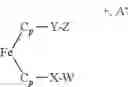
1. An ferrocinium ligand of formula
wherein Cp is a cyclopentadienyl group, unsubstituted or substituted, with chelating arms,
wherein X and Y are the same or different with the restriction that at least one Y or X contains at least one chelating group in direct connection with the ferrocinium, the other of Y or X being optionally present and wherein X and/or Y are each independently selected to include atoms O, N, P, S or groups —CR═CR—, —CR═N—, —N═CR— or —C≡C— wherein R is H, alkyl or aryl groups having at most 20 carbon atoms,
wherein Z and W are each independently selected from alkyl, aryl, heterocycle group or non-heterocycle group containing ether, thioether, phosphine, imine, amine or amide,
wherein iron has been oxidated with an oxidant capable to oxidate FeII into FeIII but mild enough to preserve the ligand, and
wherein A− is an anion associated to FeIII.
2. The oxidised ligand of claim 1 wherein groups Y—Z and/or X—W are each independently selected from CH═N—CH2-Ar wherein Ar is phenyl, furyl or pyridine group.
3. The oxidised ligand of any one of claims 1 to 3 wherein there is only one substituent group Y—Z or X—W, the other being hydrogen.
4. The oxidised ligand of any one of the preceding claims wherein oxidation is carried chemically.
5. The oxidised ligand of claim 4 wherein the oxidant has a potential of from 500 to 900 mV related to calomel reference.
6. A method for preparing the oxidised ligand of any one of claims 1 to 5 that comprises the steps of:
a) dissolving a ferrocene ligand into a solvent;
b) adding iodine to the solution;
c) stirring the mixture at a temperature of from 20 to 80° C. and during a period of time of from a few minutes to 12 hours;
d) evaporating the solvent;
e) washing with appropriate solvent to separate the reduced form of the oxidant and/or excess of the oxidant itself from the oxidised ligand.
f) retrieving the oxidised ligand.
7. A metallic complex obtained by complexation reaction of the oxidised ligand of any one of claims 1 to 5 with a metallic precursor M(Hal)nR′v-n in a solvent, wherein M is a metal Group 6 to 10 of the Periodic Table, each Hal is the same or different and is halogen, each R′ is the same or different and is substituted or unsubstituted hydrocarbyl having from 1 to 20 carbon atoms, substituted or unsubstituted aryloxy or alkoxy, v is the valence of M and n is zero or an integer at most equal to v.
8. The metallic complex of claim 7 wherein M is Ni, Co, Cr, Pd or Fe.
9. The metallic complex of claim 8 wherein M is Cr.
10. The metallic complex of any one of claims 7 to 9 wherein Hal is chlorine.
11. An active catalyst component comprising the metallic complex of any one of claims 7 to 10 and an activating agent having an ionising action.
12. A method for oligomerising or homo- or co-polymerising ethylene and alpha-olefins that comprises the steps of:
a) injecting the active catalyst system of claim 11 into the reactor;
b) injecting the monomer and optional comonomer;
c) maintaining under polymerisation conditions;
d) retrieving the oligomers and/or polymer.
13. The method of claim 12 wherein the monomer and optional comonomer are each selected from ethylene, propylene or hexane.
Images & Drawings included:
Sources:
- United States Patent and Trademark Office - verify current appl. status at the USPTO↗
Recent applications in this class:
- » 20250163089 2025-05-22
Branched Molecules for Redox Flow Batteries - » 20250163088 2025-05-22
HALF-SANDWICH TRANSITION METAL COMPLEXES AND USES THEREOF - » 20250136631 2025-05-01
METHODS FOR PURIFYING BIS (ARENE) NICKEL COMPLEXES AND RELATED PRODUCTS - » 20250002519 2025-01-02
NOVEL PRECATALYST SCAFFOLDS FOR CROSS-COUPLING REACTIONS, AND METHODS OF MAKING AND USING SAME - » 20240317788 2024-09-26
PRECIOUS METAL COMPLEXES WITH DIHYDROAZULENYL LIGANDS AND USE THEREOF - » 20240300990 2024-09-12
ORGANIC COMPOUND AND ORGANIC LIGHT-EMITTING DEVICE INCLUDING THE SAME - » 20240287115 2024-08-29
SOLID SOLUTION APPROACH FOR REDOX ACTIVE METAL ORGANIC FRAMEWORKS WITH TUNABLE REDOX CONDUCTIVITY - » 20240254154 2024-08-01
SILANE FUNCTIONAL STABILIZERS FOR EXTENDING LONG-TERM ELECTRICAL POWER CABLE PERFORMANCE - » 20240199671 2024-06-20
NOVEL FERROCENE-BASED UNSYMMETRICAL LIGANDS BEARING BULKY DI(ADAMANTLY)PHOSPHINO MOTIF AND THEIR METAL CATALYSTS - » 20230382938 2023-11-30
Electrochromic devices having a buffer system
Recent applications for this Assignee:
- » 20140155665 2014-06-05
Steamcracking bio-naphtha produced from complex mixtures of natural occurring fats and oils - » 20140150494 2014-06-05
Method for optimizing energy efficiency in a polymerization process - » 20140114105 2014-04-24
Process for the steamcracking of bio-naphtha produced from complex mixtures of natural occurring fats and oils - » 20140094575 2014-04-03
Process for monomer recovery from a polymerization process - » 20140088272 2014-03-27
Reactor and process for preparing polyolefin - » 20140008844 2014-01-09
Caps and closures - » 20130345374 2013-12-26
Double loop technology - » 20130338419 2013-12-19
Production of Olefins - » 20130317269 2013-11-28
Process for Obtaining Catalyst Composites MeAPO and Their Use in Conversion of Organics to Olefins - » 20130287634 2013-10-31
System and reactor for improved polymer homogeneity