FOOTWEAR
US20110041364A1
2011-02-24
12/735,506
2009-01-26
Abstract:
The invention relates to a footwear (20) comprising a shoe sole (21) in the area of the ball of the foot (12) and the toes (11), a heel (23) in the area of the heel ridge (14) and a connecting piece (22) which is disposed therebetween and extends in the arch region (13) exclusively above the foot sole and/or along only one side of the foot sole.
Interested in similar patents?
Get notified when new applications in this technology area are published.
Classification:
A43B7/06 » CPC main
Footwear with health or hygienic arrangements ventilated
A43B3/0036 » CPC further
Footwear characterised by the shape or the use characterised by a special shape or design
A43B7/142 » CPC further
Footwear with health or hygienic arrangements with foot-supporting parts with pads or holes on one or more locations, or having an anatomical or curved form characterised by the location under the foot situated under the medial arch, i.e. under the navicular or cuneiform bones
A43B13/16 » CPC further
Soles; Sole-and-heel integral units characterised by the constructive form Pieced soles
A43B13/14 » CPC further
Soles; Sole-and-heel integral units characterised by the constructive form
Description
The disclosure relates to footwear suitable for the streets with ventilation-dependent sole design.
For the purpose of reducing the appropriate components of footwear, it is feasible to dispense with the shoe sole in the region of the foot arch if the foot sole in the region of the foot arch is raised by the heel and optionally a platform at least to such an extent that this does not touch the ground even with the usual unevennesses. The statics of the footwear and the stability of the heel should now be ensured by a new, preferably minimalist configuration of a connecting piece between the remainder of the sole and the heel. Such a connecting piece should run in the region of the foot arch above the foot sole, for example, along one side of the foot or alternatively along merely one side of the foot sole. That means that here the foot sole is not covered at all or either from the lateral or medial side at most as far as the middle and that on the respectively other side of the foot sole, no component of the footwear is disposed between the same and the floor.
For static reasons, rigid materials or possibly an arrangement of two-dimensionally articulated members are preferred for the connecting piece. An advantageous configuration of the connecting piece is, for example, a profile, but a construction of rods, for example, is also feasible. The connecting piece can be flexibly connected to the sole and rigidly connected to the heel. Preferably, however, the choice of material, design, configuration, fastening, arrangement or number of connecting pieces or other components is not a restriction within the framework of the invention.
The invention is explained in representational form and as an example with reference to the figures.
DESCRIPTION OF THE FIGURES
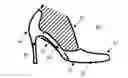
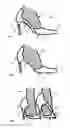
FIG. 1 shows a lateral side view of the footwear 20: the shoe sole 21 protects the area of the ball of the foot 12 and the toes 11. The heel 23 in the region of the heel ridge 14 raises the foot sole in the region of the foot arch 13 to such an extent that it does not touch the ground even with large unevennesses. The connecting piece 22 runs in the region of the foot arch 13 along the lateral side of the foot 10 and thus connects the shoe sole 21 with the heel 23. The foot sole remains uncovered in the area of the foot arch 13. The uncovered parts of the foot 10 are shown hatched.
FIG. 2 shows a medial side view of the footwear 20: the shoe sole 21 protects the region of the ball of the foot 12 and the toes 11. The heel 23 in the region of the heel ridge 14 raises the foot sole in the region of the foot arch 13 to such an extent that it does not touch the ground even with large unevennesses. The medial side of the foot 10 and the foot sole remain uncovered in the area of the arch of the foot 13. The uncovered parts of the foot 10 are shown hatched.
FIG. 3 shows a posterior perspective view of the footwear 20: the shoe sole 21 protects the region of the ball of the foot 12 and the toes 11. The heel 23 in the region of the heel ridge 14 raises the foot sole in the region of the foot arch 13 to such an extent that it does not touch the ground even with large unevennesses. The connecting piece 22 runs in the region of the arch of the foot 13 along the lateral side of the foot 10 and in the area of the ball of the foot 12 from laterally to medially and thus connects the shoe sole 21 to the heel 23. The medial side of the foot 10 and the foot sole remain uncovered in the area of the arch of the foot 13. The uncovered parts of the foot 10 are shown hatched.
Claims
1. Footwear (20) comprising a shoe sole (21) in the area of the ball of the foot (12) and the toes (11), a heel (23) in the area of the heel ridge (14) and at least one connecting piece (22) which is disposed therebetween, characterised in that the connecting piece (22) runs in the region of the foot arch (13) exclusively above the foot sole and/or along only one side of the foot sole.
2. The footwear (20) according to claim 1, characterised in that the connecting piece (22) consists of at least one rigid material.
3. The footwear (20) according to claim 1 or 2, characterised in that the connecting piece (22) consists of at least one profile.
Images & Drawings included:
Sources:
- United States Patent and Trademark Office - verify current appl. status at the USPTO↗
Similar patent applications:
- » 20170337608
Replacement footwear, process for addition of footwear to a user's footwear collection, footwear vending machine, footwear distribution process and footwear replacement process - » 20140041255
Footwear, footwear vamp, footwear vamp fastening element, footwear-vamp assembly and processes of production and/or assembly of footwear - » 20170340064
METHOD FOR MANUFACTURING FOOTWEAR, FOOTWEAR PRODUCED USING SAID METHOD, AND MACHINE FOR MANUFACTURING FOOTWEAR - » 20160255906
FOOTWEAR SOLE, MORE PARTICULARLY SPORTS FOOTWEAR SOLE, AND FOOTWEAR PROVIDED WITH SUCH A SOLE - » 20060059713
Footwear products, methods for making footwear products, and structures used in making footwear products - » 20100050481
Footwear products, methods for making footwear products, and structures used in making footwear products - » 20150289592
NON-SEWING MATERIAL FOR A FOOTWEAR UPPER, FOOTWEAR UPPER AND FOOTWEAR USING THE SAME - » 20160302514
INSERT FOR THE CUSTOMIZATION OF A FOOTWEAR, CUSTOMIZABLE FOOTWEAR AND METHOD FOR THE CUSTOMIZATION OF A FOOTWEAR - » 20150315400
Primer for footwear constituting members, method for producing same, footwear constituting member, and footwear - » 20170342612
FOOTWEAR KNITTING METHOD, FOOTWEAR MANUFACTURING METHOD, AND FOOTWEAR
Recent applications in this class:
- » 20250057284 2025-02-20
Upper for Article of Footwear with Forefoot Airflow Features - » 20240188674 2024-06-13
Upper for article of footwear with forefoot airflow features - » 20240081471 2024-03-14
Upper for article of footwear with forefoot airflow features - » 20240081470 2024-03-14
Upper for article of footwear with forefoot airflow features - » 20230079373 2023-03-16
Ventilated shoes - » 20230067504 2023-03-02
SELF-VENTILATING FOOTWEAR ASSEMBLY AND METHOD EMPLOYED THEREOF - » 20160073728 2016-03-17
Item of footwear with ventilation in the bottom region of the shaft, and air-permeable spacer structure which can be used for this purpose - » 20160073727 2016-03-17
Item of footwear with ventilation in the bottom region of the shaft, and air-permeable spacer structure which can be used for this purpose - » 20160007675 2016-01-14
Shoe, sole assembly for a shoe, method for manufacturing a sole assembly, and method for manufacturing a shoe - » 20150237952 2015-08-27
Ventilated Wellington Boots