Toy Construction Assembly
US20110059673A1
2011-03-10
12/920,861
2009-04-22
Abstract:
The invention provides a toy construction assembly, comprising elongate members which may be interconnected and using which an infinite number of rigid spatial structures may be erected. The elongate members comprise a rigid central part and two opposite flexible ends, wherein the connection between different elongate members is realized, without separate connectors, by interconnecting the flexible ends of different elongate members or by connecting a flexible end of one elongate member to the rigid central part of at least one other elongate member.
Assignee:
- HASPEL PRODUCTONTWIKKELING B.V. 1 🇳🇱 Rotterdam, Netherlands
Interested in similar patents?
Get notified when new applications in this technology area are published.
Classification:
A63H33/065 » CPC main
Other toys; Building blocks, strips, or similar building parts to be assembled without the use of additional elements using elastic deformation
A63H33/06 IPC
Other toys; Building blocks, strips, or similar building parts to be assembled without the use of additional elements
Description
The invention relates to a toy construction assembly, comprising elongate members which may be interconnected, and especially intended for children and for constructing three-dimensional spatial constructions.
Such a construction assembly is known from European patent specification EP-B-0490033. Using this construction assembly which comprises rod-like struts and specially designed connectors, it is possible to construct rigid spatial structures. The angle between the elements of the assembly can not be chosen freely and only the ends of the struts may be interconnected.
It is an object of the invention to provide such a construction assembly which does not require separate connectors, in which the number of degrees of freedom of the connections is unlimited and in which not only the ends of the elongate members may be interconnected, but wherein also an arbitrary location on one elongate member may be connected to an end of another elongate member.
According to the invention this may be realized in that the elongate members comprise a rigid central part and two opposite flexible ends, wherein the connection between different elongate members is realized, without separate connectors, by interconnecting the flexible ends of different elongate members or by connecting a flexible end of one elongate member to the rigid central part of at least one other elongate member.
The interconnection of the elongate members is realized simply by knotting together the flexible ends. Because the flexible ends are attached (directly or indirectly) to the rigid rod-like part, no separate connectors are needed. Because the ends are flexible, the number of degrees of freedom for the interconnection of the elongate members is infinite. Because a flexible end of an elongate member may be knotted to another elongate member at any arbitrary location, also around the rigid part thereof, the connection not necessarily is limited to the outer ends of the elongate member. This ultimate feature allows, among others, to assemble one longer elongate member from two elongate members.
Said connections may be realized by the formation of a knot, such as a half hitch, in a respective flexible end.
The elongate member may comprise a flexible elongate body constrained in, and projecting from both opposite ends of a stiffer and shorter tube-like body. For example, the flexible elongate body may comprise a rope, flexible tube or alike. Here the flexible ends are attached indirectly to the central part.
The toy construction assembly according to the invention further may be characterized by a flexible outer sheath surrounding the rigid central part and opposite flexible ends.
In a special embodiment with such an outer sheath the opposite flexible ends are omitted, such that the parts of the outer sheath projecting beyond the opposite ends of the central part will define such flexible ends themselves (which, again, are attached indirectly to the central part).
The flexible outer sheath may comprise a woven or braided material.
In one embodiment the flexible outer sheath is filled with a flexible fibre structure which is locally stiffened to a composite by the application of a chemically hardening material or a thermally hardening material. Generally the locally stiffening provides at least the rigid central part of the elongate member.
When the elongate member is manufactured from a single material and when the desired difference in rigidity between the rigid central part and the two opposite flexible ends is realized through a difference in diameter, a simple construction is obtained.
The elongate members may have different lengths and the rigid central parts may have different rigidities, such that an infinite number of small and large structures may be assembled.
The planes of an erected construction, which is limited by elongate members, may comprise a cloth or foil with holes or eyes with a dimensional system tuned to the elongate members, wherein this cloth or foil is fixed by knotting the flexible ends of the elongate members through the holes or eyes.
The rigid central part between the two opposite flexible ends may have an arbitrary shape. Preferably, however, the rigid central part will have an elongate shape.
Hereinafter the invention will be elucidated while referring to the drawing, in which:
FIG. 1 shows schematically a first embodiment of an elongate member according to the invention;
FIG. 2 shows schematically a second embodiment of an elongate member according to the invention;
FIG. 3 shows schematically a third embodiment of an elongate member according to the invention;
FIG. 4 shows the interconnection of two flexible ends of two elongate members;
FIG. 5 shows the connection of the flexible end of one elongate member to the rigid part of another elongate member;
FIG. 6 shows two elongate members which are knotted together in a parallel manner for realizing an elongate member having a greater length, and
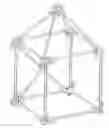
FIG. 7 shows an example of a structure made with the toy construction assembly according to the invention.
The toy construction assembly comprises elongate members which may be interconnected. According to FIG. 1 the elongate members comprise a rigid central part 1 and two opposite flexible ends 2 directly attached thereto. According to FIG. 2 the elongate member comprises a flexible elongate body 3 (for example a rope, flexible tube or alike) constrained in, and projecting from both opposite ends of a stiffer and shorter tube-like body 4.
The connection between different elongate members is realized, without separate connectors, by interconnecting the flexible ends 2,3 of different elongate members or by connecting a flexible end 2,3 of one elongate member to the rigid central part 1,4 of at least one other elongate member, see FIGS. 4 and 5.
The material properties of the flexible ends 2,3 are such, that these may be knotted manually.
FIG. 3 shows another embodiment of the construction element according to the invention, characterized by a flexible outer sheath 5 surrounding the rigid central part 1 (not visible) and opposite flexible ends 2 (not visible).
As an alternative to FIG. 3 the opposite flexible ends 2 may be omitted, such that the parts of the outer sheath 5 projecting beyond the opposite ends of the central part 1 will define such flexible ends themselves (which, again, are attached indirectly to the central part).
The flexible outer sheath 5 may comprise a woven or braided material. Further the flexible outer sheath 5 may be filled with a flexible fibre structure which is locally stiffened to a composite by the application of a chemically hardening material or a thermally hardening material, for example for defining the rigid central part 1 and flexible ends 2.
FIG. 6 shows two elongate members according to FIG. 1 which by means of the flexible ends 2 are knotted together in a parallel manner for realizing an elongate member having a greater length.
FIG. 7 shows an example of a structure made with the toy construction assembly according to the invention, wherein eighteen elongate members are assembled to a house-like construction.
Each elongate member may be manufactured from a single material. The desired difference in rigidity between the rigid central part 1,4 and the two opposite flexible ends 2,3 may be realized then through a difference in diameter of said parts.
Further it is possible that the elongate members have different lengths and that the rigid central parts 1,4 have different rigidities, such that an infinite number of small and large structures may be assembled.
The planes of an erected construction (see for example the planes of the construction according to FIG. 7), which is limited by elongate members, may comprise a cloth or foil with holes or eyes with a dimensional system tuned to the elongate members, wherein this cloth or foil is fixed by knotting the flexible ends 2,3 of the elongate members through the holes or eyes.
The invention is not limited to the embodiments described before which may be varied widely within the scope of the invention as defined by the appending claims.
Claims
1-12. (canceled)
13. A toy construction assembly, comprising a plurality of elongate members which may be interconnected, wherein the elongate members comprise a rigid central part and two opposite flexible ends, wherein the connection between different elongate members is realized, without separate connectors, by interconnecting the flexible ends of different elongate members or by connecting a flexible end of one elongate member to the rigid central part of at least one other elongate member.
14. The toy construction assembly of claim 13, wherein said connections are realized by the formation of a knot in a respective flexible end.
15. The toy construction assembly of claim 13, wherein the elongate member comprises a flexible elongate body constrained in, and projecting from both opposite ends of a stiffer and shorter tube-like body.
16. The toy construction assembly of claim 15, wherein the flexible elongate body comprises at least one of a rope and a flexible tube.
17. The toy construction assembly of claim 13, further comprising a flexible outer sheath surrounding the rigid central part and opposite flexible ends.
18. The toy construction assembly of claim 17, wherein the opposite flexible ends are omitted.
19. The toy construction assembly of claim 17, wherein the flexible outer sheath comprises a woven or braided material.
20. The toy construction assembly of claim 17, wherein the flexible outer sheath is filled with a flexible fibre structure which is locally stiffened to a composite by the application of a chemically hardening material or a thermally hardening material.
21. The toy construction assembly of claim 13, wherein the elongate member is manufactured from a single material and that the desired difference in rigidity between the rigid central part and the two opposite flexible ends is realized through a difference in diameter.
22. The toy construction assembly of claim 13, wherein said elongate members have different lengths and rigid central parts have different rigidities.
23. The toy construction assembly of claim 13, wherein the planes of an erected construction, which is limited by elongate members, comprise a cloth or foil with holes or eyes with a dimensional system tuned to the elongate members, and wherein the cloth or foil is fixed by knotting the flexible ends of the elongate members through the holes or eyes.
24. The toy construction assembly of claim 13, wherein the rigid central part between the two opposite flexible ends has an arbitrary shape.
25. The toy construction assembly of claim 14, wherein the knot is a half-hitch.
26. The toy construction assembly of claim 14, wherein the elongate member comprises a flexible elongate body constrained in, and projecting from both opposite ends of a stiffer and shorter tube-like body.
27. The toy construction assembly of claim 18, wherein the flexible outer sheath is filled with a flexible fibre structure which is locally stiffened to a composite by the application of a chemically hardening material or a thermally hardening material.
28. The toy construction assembly of claim 19, wherein the flexible outer sheath is filled with a flexible fibre structure which is locally stiffened to a composite by the application of a chemically hardening material or a thermally hardening material.
29. The toy construction assembly of claim 14, wherein the elongate member is manufactured from a single material and that the desired difference in rigidity between the rigid central part and the two opposite flexible ends is realized through a difference in diameter.
30. The toy construction assembly of claim 15, wherein the elongate member is manufactured from a single material and that the desired difference in rigidity between the rigid central part and the two opposite flexible ends is realized through a difference in diameter.
31. The toy construction assembly of claim 16, wherein the elongate member is manufactured from a single material and that the desired difference in rigidity between the rigid central part and the two opposite flexible ends is realized through a difference in diameter.
32. The toy construction assembly of claim 17, wherein the elongate member is manufactured from a single material and that the desired difference in rigidity between the rigid central part and the two opposite flexible ends is realized through a difference in diameter.
Images & Drawings included:

Sources:
- United States Patent and Trademark Office - verify current appl. status at the USPTO↗
Similar patent applications:
- » 20100248580
Jet propulsion construction toy assembly - » 20100248583
POWER-DRIVEN CONSTRUCTION TOY ASSEMBLY WITH A TOUCH-CONTROL REMOTE CONTROLLER - » 20210339157
TOY CONSTRUCTION SET AND A METHOD OF ASSEMBLING SUCH A TOY CONSTRUCTION SET - » 20110263177
Apparatus and Method for Bonding Three Dimensional Construction Toys when Assembled - » 20120309260
BUILDING BLOCKS FOR TOY CONSTRUCTION FASTENING ASSEMBLY - » 20090233516
Construction Pieces for 3D-Assembly Toys
Recent applications in this class:
- » 20250025802 2025-01-23
Toy Block Construction Set Made from Elastomeric Material - » 20210339157 2021-11-04
TOY CONSTRUCTION SET AND A METHOD OF ASSEMBLING SUCH A TOY CONSTRUCTION SET - » 20190381417 2019-12-19
ELASTIC TOY BUILDING BRICKS - » 20190038988 2019-02-07
CONSTRUCTIONAL TOY ELEMENTS - » 20180015382 2018-01-18
AN ERASER AND A TOY BUILDING SET WITH AN ERASER - » 20170120157 2017-05-04
ASSEMBLED BLOCK SET, ASSEMBLED BLOCK OPERATION DEVICE, AND WEB SYSTEM - » 20170065900 2017-03-09
Modular Flexible Model Toy System - » 20160279534 2016-09-29
Building Components - » 20160184728 2016-06-30
DISPLAY FOR TOY BUILDING ELEMENTS - » 20150343320 2015-12-03
Block studying tool for infant