IONIC LIQUID
US20110070486A1
2011-03-24
12/991,817
2009-05-01
Abstract:
An object of the invention is to provide an ionic liquid having a low viscosity and low melting point, and having a high electrical conductivity and thermal stability. The ionic liquid comprises fluorosulfonyl(trifluoromethylsulfonylamide) (FTA) as an anion and a cation selected from N1111, N1112, N1113, N1122, N1133, N2221, N1224, DEME, N2222, N3333, N4444, N5555, AS44, DMI, PMI, BMI, Py11, Py12, Py14, PP11, PP12, PP13, PP14, P2222, and PS44.
Inventors:
- Hajime MATSUMOTO 7 🇯🇵 Osaka, Japan
- Hikari Sakaebe 8 🇯🇵 Osaka, Japan
- Naohiro Terasawa 2 🇯🇵 Osaka, Japan
- Seiji Tsuzuki 2 🇯🇵 Ibaraki, Japan
Assignee:
- National Institute of Advanced Industrial Science and Technology 1,714 🇯🇵 Tokyo, Japan
Interested in similar patents?
Get notified when new applications in this technology area are published.
Classification:
H01G9/038 » CPC further
Electrolytic capacitors, rectifiers, detectors, switching devices, light-sensitive or temperature-sensitive devices; Processes of their manufacture; Details; Electrolytes; Absorbents Electrolytes specially adapted for double-layer capacitors
H01G11/62 » CPC further
Hybrid capacitors, i.e. capacitors having different positive and negative electrodes; Electric double-layer [EDL] capacitors; Processes for the manufacture thereof or of parts thereof; Electrolytes; Liquid electrolytes characterised by the solute, e.g. salts, anions or cations therein
H01M8/1016 » CPC further
Fuel cells; Manufacture thereof; Fuel cells with solid electrolytes characterised by the electrolyte material
H01M14/005 » CPC further
Electrochemical current or voltage generators not provided for in groups - ; Manufacture thereof Photoelectrochemical storage cells
H01M2300/0025 » CPC further
Electrolytes; Non-aqueous electrolytes Organic electrolyte
H01M2300/0045 » CPC further
Electrolytes; Non-aqueous electrolytes; Organic electrolyte Room temperature molten salts comprising at least one organic ion
Y02E60/10 » CPC further
Enabling technologies; Technologies with a potential or indirect contribution to GHG emissions mitigation Energy storage using batteries
Y02E60/10 » CPC further
Enabling technologies; Technologies with a potential or indirect contribution to GHG emissions mitigation Energy storage using batteries
Y02E60/13 » CPC further
Enabling technologies; Technologies with a potential or indirect contribution to GHG emissions mitigation Energy storage using capacitors
Y02E60/13 » CPC further
Enabling technologies; Technologies with a potential or indirect contribution to GHG emissions mitigation Energy storage using capacitors
Y02E60/50 » CPC further
Enabling technologies; Technologies with a potential or indirect contribution to GHG emissions mitigation; Hydrogen technology Fuel cells
Y02E60/50 » CPC further
Enabling technologies; Technologies with a potential or indirect contribution to GHG emissions mitigation; Hydrogen technology Fuel cells
H01M10/0564 » CPC further
Secondary cells; Manufacture thereof; Accumulators with non-aqueous electrolyte characterised by the materials used as electrolytes, e.g. mixed inorganic/organic electrolytes the electrolyte being constituted of organic materials only
H01G9/035 » CPC main
Electrolytic capacitors, rectifiers, detectors, switching devices, light-sensitive or temperature-sensitive devices; Processes of their manufacture; Details; Electrolytes; Absorbents Liquid electrolytes, e.g. impregnating materials
Description
TECHNICAL FIELD
The present invention relates to ionic liquids, and more particularly to ionic liquids having low viscosities and low melting points, and having high electrical conductivities.
BACKGROUND ART
Ionic liquids have attracted special attention for the past several years because of their potential uses as electrolytes for a variety of electrochemical devices, such as lithium secondary batteries, dye-sensitized solar cells, actuators, and electric double-layer capacitors; reaction media; and catalysts for organic syntheses. Compared with known organic liquid electrolytes, ionic liquids as electrolytes have the main advantages of non-flammability, non-volatility and high thermal stability. With regard to most of the ionic liquids so far reported, tetrafluoroborate (BF4−) and bistrifluoromethylsulfonylamide([(CF3SO2)2N]−, abbr. [TFSA]−, is the same as the ionic liquid previously named “bistrifluoromethylsulfonylimide”, abbr. TFSI; however, it is classified as an amide in this specification, as recently recommended by IUPAC.) have attracted attention as anions for ionic liquids because of their high electrochemical stabilities and thermal stabilities (Patent Literatures 1 and 2). [TFSA]− salts, in particular, can easily form ionic liquids even with cations such as aliphatic quaternary ammonium that do not easily form ionic liquids because of their low charge dispersibility; and also have a high electrochemical stability compared with conventional imidazolium salts (Patent Literature 3). For these reasons, [TFSA]− salts have enabled electrodeposition of lithium; however, they have not realized charging/discharging at a significantly increased charge/discharge current density when used in, for example, Li/LiCoO2 cells. Bisfluoromethylsulfonylamide([(FSO2)2N]−; [FSA]−), which is also an amide anion, has recently been reported to exhibit excellent basic physical properties and battery characteristics. However, because lithium salts (Non-Patent Literature 1) and ionic liquids (Non-Patent Literature 2) of Bisfluoromethylsulfonylamide have a low thermal stability, there is a need for ionic liquids that have higher thermal decomposition temperatures and provide improved battery characteristics.
Patent Literature 4 discloses salts containing fluorosulfonyl(trifluoromethylsulfonylamide) (FTA). However, Patent Literature 4 fails to disclose the melting points of the salts obtained in its Examples; therefore, the fact that these salts are ionic liquids is not established.
CITATION LIST
Patent Literature
- PTL 1: Japanese Unexamined Patent Publication No. 2002-099001
- PTL 2: Japanese Unexamined Patent Publication No. 2003-331918
- PTL 3: Japanese Patent No. 2981545 PTL 4: Japanese Unexamined Patent Publication No. 2005-200359
Non-Patent Literature
- NPL 1: K. Kubota, T. Nohira, T. Goto, R. Hagiwara, Electrochem. Commun., 10 (2008), pp. 1886-1888.
- NPL 2: W. Yadong, K. Zaghib, A. Guerfi, F. F. C. Bazito, R. M. Torresi, J. R. Dahn, Electrochim. Acta, 52 (2007), p. 6346.
SUMMARY OF INVENTION
Technical Problem
An object of the present invention is to provide ionic liquids having low viscosities and low melting points, and having high electrical conductivities and high thermal stabilities.
Solution to Problem
As a result of extensive research in view of the foregoing problems, the present inventors found that an ionic liquid comprising fluorosulfonyl(trifluoromethylsulfonylamide) (FTA) as an anion and a specific cation exhibits a low viscosity, a low melting point, a high electrical conductivity at low temperatures, and a relatively high thermal stability.
In summary, the present invention provides the following ionic liquids.
Item 1. An ionic liquid comprising fluorosulfonyl(trifluoromethylsulfonylamide) (FTA) as an anion and a cation selected from the following cations:
- tetramethylammonium (N1111);
- ethyltrimethylammonium (N1112);
- n-propyltrimethylammonium (N1113);
- diethyldimethylammonium (N1122);
- di-n-propyldimethylammonium (N1133);
- triethylmethylammonium (N2221);
- n-butyldiethylmethylammonium (N1224);
- N,N-diethyl-N-methyl-N-(2-methoxyethyl)ammonium (DEME);
- tetraethylammonium (N2222);
- tetra-n-propylammonium (N3333);
- tetra-n-butylammonium (N4444);
- tetra-n-pentylammonium (N5555);
- 5-azoniaspiro[4.4]nonane (AS44);
- dimethylimidazole (DMI);
- propylmethylimidazole (PMI);
- butylmethylimidazole (BMI);
- N,N-dimethylpyrrolidinium (Py11);
- N-methyl-N-ethylpyrrolidinium (Py12);
- N-methyl-N-butylpyrrolidinium (Py14);
- N,N-dimethyl-piperidinium (PP11);
- N-methyl-N-ethyl-piperidinium (PP12);
- N-methyl-N-propyl-piperidinium (PP13);
- N-methyl-N-butyl-piperidinium (PP14);
- tetraethylphosphonium (P2222); and
- 5-phosphoniaspiro[4,4]nonane (PS44).
Item 2. The ionic liquid according to Item 1, wherein the cation is tetraethylammonium (N2222) or triethylmethylammonium (N2221).
Item 3. The ionic liquid according to Item 1, wherein the cation is tetramethylammonium (N1111), ethyltrimethylammonium (N1112), or n-propyltrimethylammonium (N1113).
Item 4. The ionic liquid according to Item 1, wherein the cation is N,N-diethyl-N-methyl-N-(2-methoxyethyl)ammonium (DEME).
Item 5. The ionic liquid according to Item 1, wherein the cation is tetraethylphosphonium (P2222).
Item 6. The ionic liquid according to Item 1, wherein the cation is N-methyl-N-propyl-piperidinium (PP13).
Item 7. The ionic liquid according to Item 1, wherein the cation is 5-azoniaspiro[4.4]nonane (AS44).
ADVANTAGEOUS EFFECTS OF INVENTION
The ionic liquids of the present invention are suitable for use in electrochemical devices, such as lithium secondary batteries, fuel cells, dye-sensitized solar cells, and electric double-layer capacitors; as solvents for chemical reactions; and as lubricants.
DESCRIPTION OF EMBODIMENTS
The structures of cations used in the invention are schematically shown below:
The structure of the anion used in the invention and the structures of anions for comparison are shown below:
The ionic liquids provided by the invention have melting points of 120° C. or less, preferably 80° C. or less, more preferably 50° C. or less, still more preferably 25° C. or less, even more preferably 0° C. or less, and most preferably −20° C. or less. For example, for use in fuel cells, a wide range of ionic liquids having melting points of 80° C. or less can be used. For use in energy device such as solar cells, lithium cells, and capacitors, and electrochemical devices such as electrochromic devices and electrochemical sensors, ionic liquids having melting points of preferably not more than room temperature (25° C.), and more preferably 0° C. or less, can be used.
Even if the melting points of ionic liquids used in the invention are not clearly observable, ionic liquids having glass transition temperatures of −70° C. or less, preferably −80° C. or less, more preferably −90° C. or less, and still more preferably −100° C. or less, can be considered equal to ionic liquids having melting points of the same temperatures.
In the invention, fluorosulfonyl(trifluoromethylsulfonylamide) (FTA; [(FSO2)(CF3SO2)N]−) is used as an anion component of ionic liquids. This anion is a known compound, and can be produced according to, for example, Patent Literature 3.
An ionic liquid of the invention can be produced by mixing FTA ([(FSO2)(CF3SO2)N]−) and a salt of a cation component such as an alkali metal ion (Na+, K+, Li+, Cs+, etc.), an alkaline earth metal ion (Ca2+, Mg2+, Ba2+ etc.), or Bu3Sn+ with a salt containing a specific cation of the invention, followed by separation of the ionic liquid. For example, an ionic liquid containing FTA and a cation of the invention can be preferably obtained by mixing the salt of FTA([FSO2)(CF3SO2)N]−)H+, which is obtained by passage through an ion exchange resin, with a salt of (any of the cations of the invention)+(OH)−, followed by removal of the resulting water. When a desired molten salt is extractable, a salt-exchange reaction for obtaining the ionic liquid can be carried out by solvent extraction.
The cation component for an ionic liquid of the invention is selected from the following cations:
- tetramethylammonium (N1111);
- ethyltrimethylammonium (N1112);
- n-propyltrimethylammonium (N1113);
- diethyldimethylammonium (N1122);
- di-n-propyldimethylammonium (N1133);
- triethylmethylammonium (N2221);
- n-butyldiethylmethylammonium (N1224);
- N,N-diethyl-N-methyl-N-(2-methoxyethyl)ammonium (DEME);
- tetraethylammonium (N2222);
- tetra-n-propylammonium (N3333);
- tetra-n-butylammonium (N4444);
- tetra-n-pentylammonium (N5555);
- 5-azoniaspiro[4.4]nonane (AS44);
- dimethylimidazole (DMI);
- propylmethylimidazole (PMI);
- butylmethylimidazole (BMI);
- N,N-dimethylpyrrolidinium (Py11);
- N-methyl-N-ethylpyrrolidinium (Py12);
- N-methyl-N-butylpyrrolidinium (Py14);
- N,N-dimethyl-piperidinium (PP11);
- N-methyl-N-ethyl-piperidinium (PP12);
- N-methyl-N-propyl-piperidinium (PP13);
- N-methyl-N-butyl-piperidinium (PP14);
- tetraethylphosphonium (P2222); and
- 5-phosphoniaspiro[4,4]nonane (PS44).
All of these cations are known, and are available or can be produced according to known methods.
The molecular weight of FTA, which is the anion used in the invention, is between the molecular weights of TFSA ([(CF3SO2)2N]−) and FSA ([(FSO2)2N]−), which are anions having symmetric structures. Therefore, the physical properties of FTA, such as viscosity, electrical conductivity, and diffusion coefficient, are also expected to be intermediate between the physical properties of TFSA and FSA. However, because the FTA anion has an asymmetric structure, FTA is expected to have a dramatically lower melting point. The present inventors found that, particularly when FTA is combined with a specific cation of the invention, the resulting ionic liquid has a melting point that is lower than expected, and has an electrical conductivity closer to that of FSA salts than an intermediate between the conductivities of TFSA and FSA. Furthermore, with respect to thermal stability, which has been a drawback in FSA, the ionic liquid was found to exhibit a thermal stability generally higher than that of FSA.
The present inventors ascertained that the FTA anion used in the invention exhibits a high electrochemical stability comparable to that of known anions. The present inventors are the first to obtain ionic liquids containing N2222, AS44, and PS44, which have high symmetry, and whose salts generally have high melting points. The fact that a liquid was formed using the cation (N2222), from which ionic liquids could not heretofore be produced, indicates that the resulting ionic liquid is an amide salt that exhibits the highest oxidation stability of all the previously known amide salts.
The twenty-five cation components used in the invention (N1111, N1112, N1113, N1122, N1133, N2221, N1224, DEME, N2222, N3333, N4444, N5555, AS44, DMI, PMI, BMI, Py11, Py12, Py14, PP11, PP12, PP13, PP14, P2222, and PS44) may be used alone; however, a combination of two cations or more can further reduce the melting point and viscosity of the ionic liquid.
While FTA is used as an anion for ionic liquids, other anions may be additionally used as long as FTA is used as the main anion component.
EXAMPLES
The present invention will be described in more detail below with reference to Examples.
Example 1
Methods
For compound identification, 1H NMR (500.2 MHz), 19F NMR (470.6 MHz), and 11B NMR (160.5 MHz) spectra were measured using a JEOL ECA-500 FT-NMR spectrometer. FAB-MS spectra were measured using a JEOL JMS-HX110/110A spectrometer.
Density:
The density of an ionic liquid was determined by measuring the weight of 1.0 mL of the ionic liquid at 25° C. three times.
Specific Conductivity:
The ionic conductivity (K) of a neat (solvent-free) ionic liquid was determined in a sealed conductivity cell by using a conductivity meter (Radiometer Analytical, model CDM230).
Viscosity:
The viscosity of a 0.6 mL sample at 25° C. was measured using a viscometer (Brookfield model DV-III+).
Thermogravimetric Analysis (TGA):
TGA was performed using a thermal analysis system (Seiko Instruments, TG/DTA 6200). A sample with an average weight of 5 mg was placed in a platinum pan and heated to about 40 to 600° C. at a rate of 10° C./min under a nitrogen stream. The beginning of decomposition was defined as the decomposition temperature (Td).
Differential Scanning Calorimetry (DSC):
DSC was performed as follows: A liquid nitrogen cooler was connected to a thermal analysis system (Perkin/Elmer Pyris 1), measurement was conducted at a temperature of −150 to 250° C. in a helium stream at 10° C./min, and the resulting phase transition temperature was determined as the melting point. In the case of a melting point above room temperature, a melting phenomenon was visually observed at around the measurement temperature.
Synthesis
All of the raw materials used were commercially available, and used in unpurified form. The syntheses of compounds were performed according to the methods described in Reference Documents 1 to 3.
Synthesis of K[CF3SO2NH]
A solution of KOtBu (36.9 g, 0.33 mol) in anhydrous MeOH (150 ml) was added dropwise to a stirred solution of CF3SO2NH2 (49.3 g, 0.33 mol) in anhydrous MeOH (250 ml). The reaction mixture was stirred at 50° C. for 2 hours. The stirred mixture was evaporated for 24 hours at 0.02 Torr to give a white solid (60.53 g, 96.4%).
19F NMR (D2O, CFCl3, 470.6 MHz) δ −78.0 (s, 3F); MS m/z (%) 149 (100) [CF3SO2NH]−; Anal. Calcd. for CF3O2SNK: C, 6.4; H, 0.5; N, 7.5; Found: C, 6.3; H, 0.7; N, 7.7.
Synthesis of K[CF3SO2NSO2F]
(FSO2)2O1)) (69.5 g, 0.38 mol) was added dropwise to a stirred solution of K[CF3SO2NH] (60.0 g, 0.32 mol) in anhydrous Et2O (980 ml) over a period of 30 minutes at −20° C.
The mixture was stirred for 3 hours at −20° C., and filtered.
The crude product (21.5 g) was washed with MeOH and filtered. After removing the solvent under vacuum, the residue was recrystallized from acetone/CHCl3 to give a product.
19F NMR (CD3OD, CFCl3, 470.6 MHz) δ 56.8 (s, 1F), −78.0 (s, 3F); MS m/z (%) 230 (100) [CF3SO2NSO2F]−; Anal. Calcd. for CF4O4S2NK: C, 4.5; N, 5.2; Found: C, 4.3; N, 5.4.
Equimolar amounts of the thus-obtained potassium salt of FTA and each of various ammonium bromides were mixed, and unwanted FTA ionic liquid in the resulting water was extracted with dichloromethane. After washing the extracted product with water several times, the dichloromethane was distilled off to give an ionic liquid.
DEME[FTA] (0.65 g, 80.3%)
1H NMR (CD3OD, TMS, 500.2 MHz) δ 1.33 (m, 6H), 3.04 (s, 3H), 3.38 (s, 3H), 3.43 (q, J=7.3 Hz, 4H), 3.51 (t, J=4.5 Hz, 2H), 3.78 (m, 2H); 19F NMR (CD3OD, CFCl3, 470.6 MHz) δ 56.6 (s, F), −78.2 (s, 3F); MS m/z (%) 146 (100) [DEME], 230 (100) [FTA]−; A nal. Calcd. for C9H20N2F4O5S2: C, 28.7; H, 5.4; N, 7.4; F, 20.2; Found: C, 28.8; H, 5.1; N, 7.5; F, 20.2.
PP13[FTA] (2.30 g, 88.2%)
1H NMR (CD3OD, TMS, 500.2 MHz) δ 1.02 (t, J=7.3 Hz, 3H), 1.62-1.76 (m, 2H), 1.77-1.84 (m, 2H), 1.90 (m, 4H), 3.04 (s, 3H), 3.27-3.31 (m, 2H), 3.35 (t, J=5.8 Hz, 4H); 19F NMR (CD3OD, CFCl3, 470.6 MHz) δ 56.9 (s, F), −78.1 (s, 3F); MS m/z (%) 142 (100) [PP13]+, 230 (100) [FTA]−; Anal. Calcd. for C10H20N2F4O4S2: C, 32.3; H, 5.4; N, 7.5; F, 20.4; Found: C, 32.4; H, 5.2; N, 7.6; F, 20.4.
N1111[FTA]
N1111Br (0.54 g, 3.5 mmol) was added to a stirred solution of K[CF3SO2NSO2F] (0.94 g, 3.5 mmol) in CH3CN (10 ml) at room temperature. The mixture was stirred for another 3 hours. After distilling off the solvent, the white solid was dissolved in CH2Cl2, followed by filtration. The solvent was removed under vacuum. The resulting liquid was dried at 80° C. for 24 hours at 0.02 Torr (1.06 g, 99.5%).
1H NMR (CD3OD, TMS, 500.2 MHz) δ 3.19 (s, 12H); 19F NMR (CD3OD, CFCl3, 470.6 MHz) δ 56.6 (s, F), −78.2 (s, 3F); MS m/z (%) 74 (100) [N1111]+, 230 (100) [FTA]−; Anal. Calcd. for C5H12N2F4O1S2: C, 19.7; H, 4.0; N, 9.2; F, 25.0; Found: C, 19.9; H, 3.9; N, 9.3; F, 24.8.
N2221[FTA]
MS m/z (%) 116 (100) [N2221]+, 230 (100) [FTA]−; Anal. Calcd. for C8H18N2F4O4S2: C, 27.7; H, 5.2; N, 8.1; F, 21.9; Found: C, 27.8; H, 5.2; N, 8.2; F, 21.9.
N1112[FTA] (0.51 g, 22.3%)
1H NMR (CD3OD, TMS, 500.2 MHz) δ 1.39 (t, J=7.5 Hz, 3H), 3.10 (s, 9H), 3.41 (q, J=7.2 Hz, 2H); 19F NMR (CD3OD, CFCl3, 470.6 MHz) δ 56.6 (s, F), −78.1 (s, 3F); MS m/z (%) 88 (100) [N1112]+, 230 (100) [FTA]; Anal. Calcd. for C6H14N2F4O4S2: C, 22.6; H, 4.4; N, 8.8; F, 23.9; Found: C, 22.4; H, 4.4; N, 8.9; F, 24.0.
N1113[FTA] (1.46 g, 62.9%)
1H NMR (CD3OD, TMS, 500.2 MHz) δ 1.02 (t, J=7.3 Hz, 3H), 1.78-1.86 (m, 2H), 3.12 (s, 9H), 3.26-3.32 (m, 2H); 19F NMR (CD3OD, CFCl3, 470.6 MHz) δ 56.8 (s, F), −78.1 (s, 3F); MS m/z (%) 102 (100) [N1113]+, 230 (100) [CF3SO2NSO2F]−; Anal. Calcd. for C7H16N2F4O4S2: C, 25.3; H, 4.9; N, 8.4; F, 22.9; Found: C, 25.5; H, 4.8; N, 8.5; F, 22.7.
N2222[FTA] (2.13 g, 84.4%)
1H NMR (CD3OD, TMS, 500.2 MHz) δ 1.29 (t, J=7.5 Hz, 12H), 3.29 (q, J=7.2 Hz, 8H); 19F NMR (CD3OD, CFCl3, 470.6 MHz) δ 56.7 (s, F), −78.1 (s, 3F); MS m/z (%) 130 (100) [N2222]+, 230 (100) [FTA]; Anal. Calcd. for C9H20N2F4O4S2: C, 30.0; H, 5.6; N, 7.8; F, 21.1; Found: C, 29.8; H, 5.5; N, 7.8; F, 21.1.
P2222[FTA] (2.38 g, 90.1%)
1H NMR (CD3OD, TMS, 500.2 MHz) δ 1.22-1.28 (m, 12H), 2.21-2.28 (m, 8H); 19F NMR (CD3OD, CFCl3, 470.6 MHz) δ 56.6 (s, F), −78.1 (s, 3F); MS m/z (%) 147 (100) [P2222]+, 230 (100) [FTA]−; Anal. Calcd. for C9H20NPF4O4S2: C, 28.7; H, 5.3; N, 3.7; F, 20.1; Found: C, 28.7; H, 5.2; N, 3.7; F, 19.7.
Comparative Example 1
Compounds corresponding to those obtained in Example 1 were synthesized in the same manner as above, except that TFSA or FSA was used instead of FTA.
Comparative Example 2
An ionic liquid consisting of a salt of FTA and EMI (1-ethyl-3-methylimidazolium) was prepared in the same manner as above.
Example 2
The ionic liquids shown below were produced. All of the raw materials used were commercially available, and used in unpurified form. The syntheses of the compounds were performed according to the method described in Reference Document 1-7.
Py13[FTA] (2.17 g, 86.5%)
1H NMR (CD3OD, TMS, 500.2 MHz) δ 1.02 (t, J=7.3 Hz, 3H), 1.80-1.87 (m, 2H), 2.22 (s 4H), 3.05 (s, 3H), 3.28-3.32 (m, 2H), 3.47-3.56 (m, 4H); 19F NMR (CD3OD, CFCl3, 470.6 MHz) δ 56.8 (s, F), −78.1 (s, 3F); MS m/z (%) 128 (100) [Py13]+, 230 (100) [CF3SO2N SO2F]−; Anal. Calcd. for C9H18N2F4O4S2: C, 30.2; H, 5.1; N, 7.8; F, 21.2; Found: C, 30.1; H, 4.9; N, 7.7; F, 21.2.
DEME[FSA]
MS m/z (%) 146 (100) [DEME]+, 180 (100) [FSA]−; Anal. Calcd. for C8H20N2F2O5S2: C, 29.4; H, 6.2; N, 8.6; F, 11.6; Found: C, 29.4; H, 6.2; N, 8.5; F, 11.6.
N2221[FSA]
MS m/z (%) 116 (100) [N2221]+, 180 (100) [FSA]−; Anal. Calcd. for C7H18N2F2O4S2: C, 28.4; H, 6.1; N, 9.5; F, 12.8; Found: C, 28.2; H, 6.0; N, 9.4; F, 12.7.
N1113[FSA]
MS m/z (%) 102 (100) [N1113]+, 180 (100) [FSA]−; Anal. Calcd. for C6H16N2F2O4S2: C, 25.5; H, 5.7; N, 9.9; F, 13.5; Found: C, 25.5; H, 5.6; N, 10.0; F, 13.5.
N1112[FSA]
MS m/z (%) 88 (100) [N1112]+, 180 (100) [FSA]−; Anal. Calcd. for C5H14N2F2O4S2: C, 22.4; H, 5.3; N, 10.4; F, 14.2; Found: C, 22.3; H, 5.2; N, 10.4; F, 14.0.
N2222[FSA]
MS m/z (%) 130 (100) [N2222]+, 180 (100) [FSA]−; Anal. Calcd. for C8H20N2F2O4S2: C, 31.0; H, 6.5; N, 9.0; F, 12.2; Found: C, 30.8; H, 6.4; N, 9.0; F, 12.2.
N1111[FSA]
MS m/z (%) 74 (100) [N1111]+, 180 (100) [FSA]−; Anal. Calcd. for C4H12N2F2O4S2: C, 18.9; H, 4.8; N, 11.0; F, 14.9; Found: C, 18.8; H, 4.7; N, 11.0; F, 14.9.
P2222[TFSA]
MS m/z (%) 147 (100) [P2222]+, 280 (100) [TFSA]−; Anal. Calcd. for C10H20NPF6O4S2: C, 28.1; H, 4.7; N, 3.3; F, 26.7; Found: C, 28.0; H, 4.6; N, 3.2; F, 25.6.
P2222[FSA]
MS m/z (%) 147 (100) [P2222]+, 180 (100) [FSA]−; Anal. Calcd. for C8H20NPF2O4S2: C, 29.4; H, 6.2; N, 4.3; F, 11.6; Found: C, 29.2; H, 6.1; N, 4.1; F, 11.4.
PP14[FTA]
MS m/z (%) 156 (100) [PP14]+, 230 (100) [CF3SO2NSO2F]−; Anal. Ca lcd. for C11H22N2F4O4S2: C, 34.2; H, 5.7; N, 7.3; F, 19.7; Found: C, 33.9; H, 5.7; N, 7.1; F, 19.7.
PP14[FSA]
MS m/z (%) 156 (100) [PP14]+, 180 (100) [FSA]−; Anal. Calcd. for C10H22N2F2O4S2: C, 35.7; H, 6.6; N, 8.3; F, 11.3; Found: C, 35.6; H, 6.6; N, 8.3; F, 11.4.
PP14[TFSA]
MS m/z (%) 156 (100) [PP14]+, 280 (100) [TFSA]; Anal. Calcd. for C12H22N2F6O4S2: C, 33.02; H, 5.08; N, 6.42; F, 26.12; Found: C, 32.7; H, 5.0; N, 6.2; F, 26.3.
PP11[FTA]
MS m/z (%) 114 (100) [PP11]+, 230 (100) [FTA]−; Anal. Calcd. for C8H16N2F4O4S2: C, 27.9; H, 4.7; N, 8.1; F, 22.1; Found: C, 27.7; H, 4.5; N, 8.2; F, 22.1.
PP11[FSA]
MS m/z (%) 114 (100) [PP11]+, 180 (100) [FSA]; Anal. Calcd. for C7H16N2F2O4S2: C, 28.6; H, 5.5; N, 9.5; F, 12.9; Found: C, 28.4; H, 5.3; N, 9.6; F, 12.9.
N5555[FSA]
MS m/z (%) 298 (100) [N5555]+, 180 (100) [FSA]−; Anal. Calcd. for C20H44N2F2O4S2: C, 50.2; H, 9.3; N, 5.9; F, 7.9; Found: C, 50.0; H, 9.3; N, 5.8; F, 7.9.
N4444[FSA]
MS m/z (%) 242 (100) [N4444]+, 180 (100) [FSA]−; Anal. Calcd. for C16H36N2F2O4S2: C, 45.5; H, 8.6; N, 6.6; F, 9.0; Found: C, 45.2; H, 8.7; N, 6.6; F, 9.1.
N3333[FSA]
MS m/z (%) 186 (100) [N3333]+, 180 (100) [FSA]−; Anal. Calcd. for C12H28N2F2O4S2: C, 39.3; H, 7.7; N, 7.6; F, 10.4; Found: C, 39.2; H, 7.5; N, 7.8; F, 10.4.
PMI[FSA]
MS m/z (%) 125 (100) [PMI], 180 (100) [FSA]−; Anal. Calcd. for C7H13N3F2O4S2: C, 27.5; H, 4.3; N, 13.8; F, 12.4; Found: C, 27.7; H, 4.2; N, 13.7; F, 12.5.
PMI [TFSA]
MS m/z (%) 125 (100) [PMI], 280 (100) [TFSA]; Anal. Calcd. for C9H13N3F6O4S2: C, 26.7; H, 3.3; N, 10.4; F, 28.1; Found: C, 26.7; H, 3.2; N, 10.5; F, 27.9.
N1224[TFSA]
MS m/z (%) 144 (100) [N1224]+, 280 (100) [TFSA]−; Anal. Calcd. for C11H22N2F6O4S2: C, 31.1; H, 5.2; N, 6.6; F, 26.9; Found: C, 31.0; H, 5.0; N, 6.6; F, 26.9.
DMI[TFSA]
MS m/z (%) 97 (100) [DMI]+, 280 (100) [TFSA]−; Anal. Calcd. for C7H9N3F6O4S2: C, 22.3; H, 2.4; N, 11.1; F, 30.2; Found: C, 22.1; H, 2.5; N, 11.4; F, 30.0.
DMI[FSA]
MS m/z (%) 97 (100) [DMI]+, 180 (100) [FSA]−; Anal. Calcd. for C5H9N3F2O4S2: C, 21.7; H, 3.3; N, 15.2; F, 13.7; Found: C, 21.7; H, 3.3; N, 15.2; F, 13.7.
N1224[FSA]
MS m/z (%) 144 (100) [N1224]+, 280 (100) [TFSA]−; Anal. Calcd. for C9H22N2F2O4S2: C, 33.3; H, 6.8; N, 8.6; F, 11.7; Found: C, 33.3; H, 6.6; N, 8.8; F, 11.9.
N1133[FSA]
MS m/z (%) 130 (100) [N1133]+, 180 (100) [FSA]−; Anal. Calcd. for C8H20N2F2O4S2: C, 31.0; H, 6.5; N, 9.0; F, 12.2; Found: C, 30.7; H, 6.2; N, 9.0; F, 12.2.
N1133[TFSA]
MS m/z (%) 130 (100) [N1133]+, 280 (100) [FSA]−; Anal. Calcd. for C10H20N2F6O4S2: C, 29.3; H, 4.9; N, 6.8; F, 27.8; Found: C, 29.1; H, 4.6; N, 6.8; F, 27.6.
N1224[FTA]
MS m/z (%) 144 (100) [N1224]+, 230 (100) [FTA]−; Anal. Calcd. for C10H22N2F4O4S2: C, 32.1; H, 5.9; N, 7.5; F, 20.3; Found: C, 32.2; H, 5.7; N, 7.6; F, 20.3.
N3333[FTA]
MS m/z (%) 186 (100) [N3333]+, 230 (100) [FTA]−; Anal. Calcd. for C13H28N2F4O4S2: C, 37.5; H, 6.8; N, 6.7; F, 18.3; Found: C, 37.4; H, 6.5; N, 6.8; F, 18.3.
N4444[FTA]
MS m/z (%) 242 (100) [N4444]+, 230 (100) [FTA]−; Anal. Calcd. for C17H36N2F4O4S2: C, 43.2; H, 7.7; N, 5.9; F, 16.1; Found: C, 43.3; H, 7.5; N, 6.0; F, 15.9.
N5555[FTA]
MS m/z (%) 296 (100) [N5555]−, 230 (100) [FTA]−; Anal. Calcd. for C21H44N2F4O4S2: C, 47.7; H, 8.4; N, 5.3; F, 14.4; Found: C, 47.3; H, 8.5; N, 5.3; F, 14.2.
PP12[FSA]
MS m/z (%) 128 (100) [PP12]+, 180 (100) [FSA]; Anal. Calcd. for C8H16N2F2O4S2: C, 31.2; H, 5.9; N, 9.1; F, 12.3; Found: C, 30.9; H, 5.6; N, 9.1; F, 12.3.
Py12[FTA]
MS m/z (%) 114 (100) [Py12]+, 230 (100) [FTA]−; Anal. Calcd. for C8H16N2F2O4S2: C, 27.9; H, 4.7; N, 8.1; F, 22.1; Found: C, 27.9; H, 4.7; N, 8.3; F, 21.9.
Py14[FTA]
MS m/z (%) 142 (100) [Py14]+, 230 (100) [FTA]−; Anal. Calcd. for C10H20N2F4O4S2: C, 32.25; H, 5.41; N, 7.52; F, 20.41; Found: C, 32.11; H, 5.16; N, 7.61; F, 20.43.
Py14[FSA]
MS m/z (%) 142 (100) [Py14]+, 180 (100) [FSA]−; Anal. Calcd. for C9H20N2F2O4S2: C, 33.53; H, 6.25; N, 8.69; F, 11.79; Found: C, 33.29; H, 6.00; N, 8.80; F, 11.78.
BMI [FTA]
MS m/z (%) 139 (100) [BMI]+, 230 (100) [FTA]−; Anal. Calcd. for C9H15N3F4O4S2: C, 29.3; H, 4.1; N, 11.4; F, 20.6; Found: C, 29.1; H, 4.1; N, 11.4; F, 20.4.
PMI[FTA]
MS m/z (%) 125 (100) [PMI]+, 230 (100) [FTA]−; Anal. Calcd. for C9H13N3F4O4S2: C, 27.0; H, 3.7; N, 11.8 F, 21.4; Found: C, 27.1; H, 3.6; N, 11.9; F, 21.3.
DMI [FTA]
MS m/z (%) 97 (100) [DMI]+, 230 (100) [FTA]−; Anal. Calcd. for C6H9N3F4O4S2: C, 22.0; H, 2.8; N, 12.8 F, 22.3; Found: C, 22.1; H, 2.8; N, 13.1; F, 23.3.
BMI [FTA]
MS m/z (%) 139 (100) [BMI]+, 230 (100) [FTA]; Anal. Calcd. for C9H15N3F4O4S2: C, 29.3; H, 4.1; N, 11.4; F, 20.6; Found: C, 29.1; H, 4.1; N, 11.4; F, 20.4.
Py12[FSA]
MS m/z (%) 114 (100) [Py12]+, 180 (100) [FSA]−; Anal. Calcd. for C7H16N2F2O4S2: C, 28.6; H, 5.5; N, 9.5; F, 12.9; Found: C, 28.4; H, 5.3; N, 9.6; F, 12.9.
AS44[FTA]
MS m/z (%) 126 (100) [AS44]+, 230 (100) [FTA]−; Anal. Calcd. for C9H16N2F4O4S2: C, 30.3; H, 4.5; N, 7.9; F, 21.3; Found: C, 30.1; H, 4.5; N, 7.7; F, 21.2.
AS44[TFSA]
MS m/z (%) 126 (100) [AS44]+, 280 (100) [TFSA]−; Anal. Calcd. for C10H16N2F6O4S2: C, 29.6; H, 4.0; N, 6.9; F, 28.1; Found: C, 29.1; H, 3.9; N, 6.8; F, 28.1.
AS44[FSA]
MS m/z (%) 126 (100) [AS44]+, 180 (100) [FSA]−; Anal. Calcd. for C8H16N2F2O4S2: C, 31.4; H, 5.3; N, 9.1; F, 12.4; Found: C, 31.0; H, 9.2; N, 12.4; F, 31.1.
PS44[FTA]
MS m/z (%) 143 (100) [PS44]+, 230 (100) [FTA]−; Anal. Calcd. for C9H16NPF4O4S2: C, 29.0; H, 4.3; N, 3.8; F, 20.0; Found: C, 39.2; H, 4.1; N, 3.9; F, 19.6.
PS44[FSA]
MS m/z (%) 143 (100) [PS44]+, 180 (100) [FSA]−; Anal. Calcd. for C8H16NPF2O4S2: C, 29.7; H, 5.0; N, 4.4; F, 11.8; Found: C, 29.7; H, 4.8; N, 4.3; F, 11.5.
PS44 [TFSA]
MS m/z (%) 143 (100) [PS44]+, 280 (100) [TFSA]−; Anal. Calcd. for C10H16NPF6O4S2: C, 28.4; H, 3.8; N, 3.3; F, 26.5; Found: C, 28.5; H, 3.7; N, 3.4; F, 26.9.
Test Example 1
Tables 1 to 6 show the melting points, electrical conductivities, glass transition points, thermal decomposition temperatures, viscosities, and densities of the compounds obtained in the Examples and Comparative Examples above.
| TABLE 1 |
| Melting Point/° C. |
| FTA | FSA | TFSA | |
| N1111 | 117 | >300 | 133 | |
| N1112 | 63 | 263 | 110 | |
| N1113 | −28 | 42 | 19 | |
| N1122 | −13 | 200 | 98 | |
| N1133 | Tg only | 6 | 39 | |
| N2221 | 3.6 | 130 | 97 | |
| N1224 | Tg only | −16 | 9.4 | |
| DEME | Tg only | −22 | Tg only | |
| N2222 | 8.5 | 40 | 96 | |
| N3333 | 105 | 142 | 106 | |
| N4444 | 60 | 99 | 89 | |
| N5555 | 18 | 96 | 28 | |
| AS44 | 21 | 195 | 114 | |
| PS44 | −18.5 | 67.2 | 95.9 | |
| DMI | 9.9 | 57 | 23 | |
| PMI | Tg only | Tg only | Tg only | |
| BMI | −16.5 | Tg only | −2 | |
| P2222 | 44 | 73 | 115 | |
| Py11 | 118 | 230 | 134 | |
| Py12 | −12 | 203 | 88 | |
| Py14 | Tg only | −16 | −18 | |
| PP11 | 95 | 277 | 124 | |
| PP12 | −8.1 | 152 | 86 | |
| PP13 | Tg only | 3 | 12 | |
| PP14 | Tg only | Tg only | Tg only | |
| TABLE 2 |
| Conductivity (25° C.) mS/cm |
| FTA | FSA | TFSA | |
| N1111 | solid | solid | solid | |
| N1112 | solid | solid | solid | |
| N1113 | 5.4 | solid | 2.9 | |
| N1122 | solid | solid | solid | |
| N1133 | 3.7 | 5.6 | solid | |
| N2221 | 4.3 | solid | solid | |
| N1224 | 2.8 | 4.5 | 1.6 | |
| DEME | 4.1 | 5.6 | 2.6 | |
| N2222 | 3.3 | solid | solid | |
| N3333 | solid | solid | solid | |
| N4444 | solid | solid | solid | |
| N5555 | 0.16 | solid | 0.15 | |
| AS44 | 7.0 | solid | solid | |
| PS44 | 5.0 | solid | solid | |
| DMI | 12.1 | solid | 9.0 | |
| PMI | 8.0 | 10.6 | 5.5 | |
| BMI | 6.0 | 7.8 | 4.2 | |
| P2222 | solid | solid | solid | |
| Py11 | solid | solid | solid | |
| Py12 | 3.4 | solid | solid | |
| Py14 | 4.6 | 6.2 | 2.6 | |
| PP11 | solid | solid | solid | |
| PP12 | 3.4 | solid | solid | |
| PP13 | 2.6 | 3.7 | 1.5 | |
| PP14 | 2.1 | 2.7 | 1.1 | |
| TABLE 3 |
| Glass Transition Temperature/° C. |
| FTA | FSA | TFSA | |
| N1111 | — | — | — | |
| N1112 | — | — | — | |
| N1113 | −103 | — | — | |
| N1122 | — | — | — | |
| N1133 | −101 | — | — | |
| N2221 | — | — | — | |
| N1224 | −110 | −113 | −92 | |
| DEME | −107 | −112 | −94.6 | |
| N2222 | — | — | — | |
| N3333 | — | — | — | |
| N4444 | — | — | — | |
| N5555 | — | — | −69 | |
| AS44 | — | — | — | |
| PS44 | −93 | — | — | |
| DMI | — | — | — | |
| PMI | −104 | −103 | −90 | |
| BMI | −101 | −100 | −89 | |
| P2222 | — | — | — | |
| Py11 | — | — | — | |
| Py12 | — | — | — | |
| Py14 | −106 | — | −88 | |
| PP11 | — | — | — | |
| PP12 | — | — | — | |
| PP13 | −94 | — | — | |
| PP14 | −92 | −94 | −78 | |
| TABLE 4 |
| Viscosity (25° C.) cP |
| FTA | FSA | TFSA | |
| N1111 | solid | solid | solid | |
| N1112 | solid | solid | solid | |
| N1113 | 47 | solid | 82 | |
| N1122 | solid | solid | solid | |
| N1133 | 64 | 58 | solid | |
| N2221 | 57 | solid | solid | |
| N1224 | 81 | 80 | 129 | |
| DEME | 53 | 46 | 70 | |
| N2222 | 80 | solid | solid | |
| N3333 | solid | solid | solid | |
| N4444 | solid | solid | solid | |
| N5555 | 632 | solid | 554 | |
| AS44 | 44.0 | solid | solid | |
| PS44 | 57.1 | solid | solid | |
| DMI | 26 | solid | 39 | |
| PMI | 34 | 30 | 46 | |
| BMI | 38 | 34 | 52 | |
| P2222 | solid | solid | solid | |
| Py11 | solid | solid | solid | |
| Py12 | 77 | solid | solid | |
| Py14 | 55 | 56 | 76 | |
| PP11 | solid | solid | solid | |
| PP12 | 77 | solid | solid | |
| PP13 | 96 | 95 | 150 | |
| PP14 | 117 | 123 | 182 | |
| TABLE 5 |
| Thermal Decomposition Temperature/° C. |
| FTA | FSA | TFSA | |
| N1111 | 291 | 289 | 420 | |
| N1112 | 317 | 331 | 410 | |
| N1113 | 326 | 310 | 405 | |
| N1122 | 297 | 323 | 407 | |
| N1133 | 259 | 292 | 403 | |
| N2221 | 314 | 297 | 394 | |
| N1224 | 274 | 298 | 398 | |
| DEME | 299 | 293 | 380 | |
| N2222 | 305 | 312 | 400 | |
| N3333 | 252 | 289 | 376 | |
| N4444 | 350 | 292 | 375 | |
| N5555 | 354 | 297 | 371 | |
| AS44 | 304 | 308 | 437 | |
| PS44 | 306 | 333 | 423 | |
| DMI | 306 | 308 | 428 | |
| PMI | 329 | 323 | 416 | |
| BMI | 311 | 272 | 424 | |
| P2222 | 350 | 316 | 415 | |
| Py11 | 291 | 293 | 414 | |
| Py12 | 361 | 294 | 417 | |
| Py14 | 370 | 299 | 423 | |
| PP11 | 275 | 294 | 421 | |
| PP12 | 321 | 313 | 418 | |
| PP13 | 366 | 291 | 424 | |
| PP14 | 365 | 291 | 420 | |
| TABLE 6 |
| Density (25° C.)/g/mL |
| FTA | FSA | TFSA | |
| N1111 | solid | solid | solid | |
| N1112 | solid | solid | solid | |
| N1113 | 1.41 | solid | 1.43 | |
| N1122 | solid | solid | solid | |
| N1133 | 1.34 | 1.28 | solid | |
| N2221 | 1.37 | solid | solid | |
| N1224 | 1.31 | 1.24 | 1.36 | |
| DEME | 1.37 | 1.27 | 1.42 | |
| N2222 | 1.38 | solid | solid | |
| N3333 | solid | solid | solid | |
| N4444 | solid | solid | solid | |
| N5555 | 1.14 | solid | 1.16 | |
| AS44 | 1.46 | solid | solid | |
| PS44 | 1.48 | solid | solid | |
| DMI | 1.51 | solid | 1.56 | |
| PMI | 1.38 | 1.40 | 1.49 | |
| BMI | 1.43 | 1.33 | 1.46 | |
| P2222 | solid | solid | solid | |
| Py11 | solid | solid | solid | |
| Py12 | 1.42 | solid | solid | |
| Py14 | 1.38 | 1.32 | 1.41 | |
| PP11 | solid | solid | solid | |
| PP12 | 1.42 | solid | solid | |
| PP13 | 1.39 | 1.34 | 1.41 | |
| PP14 | 1.39 | 1.30 | 1.39 | |
Test Example 2
Reduction limit potential, oxidation limit potential, and potential window were measured for the various ionic liquids of the Examples and Comparative Examples. The results are shown in Table 7 and FIG. 1. The values indicated by “*” in Table 7 were cited from the cited document*:
- Cited document*: Hajime MATSUMOTO et al., Journal of Power Sources, Vol. 160, Issue 2 (2006), pp. 1308-1313
Measurement Results of Potential Windows
25° C.
Scan speed: 50 mV/s
Working electrode: glassy carbon electrode
Counter electrode: platinum
Reference electrode:
The reference electrode was a platinum wire immersed in an iodine redox containing 60 mM tetrapropylammonium iodide and 15 mM iodine in EMI [TFSI], which was placed in a glass tube sealed with porous vycor glass at its end (the redox potential of ferrocene in each ionic liquid was measured as an internal standard).
Measurement results of potential windows for N2222[FTA], N122.102[FTA], EMI [FTA], and AS44[FTA] are shown in FIG. 1.
Note that N122.102[FTA] denotes DEME[FTA].
The reduction limit potential and oxidation limit potential shown in Table 7 were measured at 1 mA/cm2.
| TABLE 7 | ||||
| Reduction | Oxidation | |||
| Limit | Limit | |||
| Potential/V | Potential/V | Potential | ||
| vs Fc/Fc+ | vs Fc/Fc+ | Window/V | ||
| PP13[TFSA] | −3.4 | 2.5 | 5.9 | * |
| PP13[FSA] | −3.2 | 2.4 | 5.6 | * |
| N2222[FTA] | −3.2 | 2.6 | 5.8 | |
| N122.1O2[TFSA] | −3.3 | 2.3 | 5.6 | |
| N122.1O2[FTA] | −3.2 | 2.3 | 5.5 | |
| EMI[TFSA] | −2.5 | 2.1 | 4.6 | * |
| EMI[FSA] | −2.5 | 2.0 | 4.5 | * |
| EMI[FTA] | −2.5 | 2.0 | 4.5 | |
These results revealed that the FTA anion exhibits a high electrochemical stability comparable to that of the known TFSA and FSA.
In particular, the FTA anion allows the use of N2222 as a cation, and has the most positive oxidation limit potential of the existing amide anions.
Test Example 3
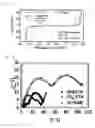
Li/LiCoO2 cells were prepared according to the same method as described in Reference Document 8, using ethylene carbonate/dimethyl carbonate (EC/DMC) solutions each containing EMI [FTA], AS44[FTA], or 1M Li—PF6. After a rate test, each cell was charged at 4.2 V, and the AC impedance was measured.
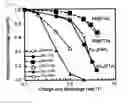
Moreover, the relationship between discharge capacity and C rate was measured for each of the Li/LiCoO2 cells prepared using AS44[FTA], EMI [FTA], EMI [FSA], EMI [TFSA], Py13[TFSA], and Py13[FSA]. The measurement results for each cell are shown in FIGS. 2 and 3. Lithium electrolytes were prepared by dissolving a lithium salt, Li-TFSA (0.5 M), in the ionic liquids. The cells were constructed based on Reference Document 9.
From the results shown in FIG. 2, it is observed that the interfacial resistance for EMI-FTA is not very high, even in comparison with that of EC+DMC, and, thus, is relatively low. Further, from the results shown in FIG. 3, it is observed that the cell using EMI [FTA] exhibits performance substantially equivalent to that of the cell using EMI [FSA], and that the cell using AS44[FTA] exhibits performance substantially equivalent to that of the cell using Py13[FSA] with a lower viscosity. This confirmed that TFSA enables charging/discharging at 1 C (0.2 mA/cm2) or more, which has not been made possible by using any low-viscosity systems. According to the AC impedance measurement, the FTA-based ionic liquids exhibit low values of apparent interfacial charge transfer resistance, which are close to those of the FSA-based ionic liquids. This indicates that the presence of —FSO2 groups in the anions causes the interfacial resistance to decrease, which is believed to be a cause of the high rate characteristics.
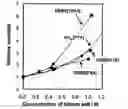
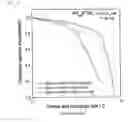
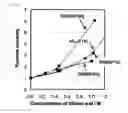
The effects of separator thickness and Li-salt concentration upon the charge/discharge rate characteristics (25° C.) of the Li/LiCoO2 cell using AS44 [FTA] were investigated, and cell optimization was performed. As a result, it was observed, as shown in FIG. 4, that the cell using AS44 [FTA] exhibited charge/discharge rate characteristics as high as those of known organic solvent electrolytes. This high performance can be attributed to the following reasons: increasing the lithium salt concentration reduced the interfacial charge transfer resistance at the positive and negative electrodes; and, as shown in FIG. 5, while the addition of approximately 1 M lithium salt increased the viscosity of the known TFSA ionic liquid significantly, i.e., seven-fold or more, the viscosities of the FTA ionic liquids did not significantly change, as with the FSA ionic liquid.
- Reference Document 1: S. Kongpricha, W. C. Preusse, R. Schwarer, J. K. Ruff, Inorganic Syntheses, 8, 151-155.
- Reference Document 2: Z. B. Zhou, M. Takeda, M. Ue, J Fluorine Chem., 123 (2003), 127-131.
- Reference Document 3: Z. B. Zhou, H. Matsumoto, K. Tatsumi, Chem. Eur. J., 10 (2004), 6581-6591.
- Reference Document 4: Zhi-bin Zhou, Hajime Matsumoto, Kuniaki Tatsumi, Chem. Eur. J., 11 (2005), 752-766.
- Reference Document 5: Zhi-bin Zhou, Hajime Matsumoto, Kuniaki Tatsumi, Chem. Eur. J., 12 (2006), 2196-2212.
- Reference Document 6: V. Braun, Chemische Berichte, 49 (1916), 970.
- Reference Document 7: N. Ya Derkach, A. V. Kirsanov, Zhurnal Obshchei Khimii, 38 (2) (1968), 331-7.
- Reference Document 8: H. Sakaebe et al., Electrochim. Acta, 53 (2007), 1048.
- Reference Document 9: H. Sakaebe, H. Matsumoto, Electrochem. Commun., 5 (7) (2003), 594.
BRIEF DESCRIPTION OF DRAWINGS
FIG. 1 shows a linear sweep voltammogram at 25° C. of N2222[FTA], DEME[FTA], EMI [FTA], and AS44[FTA].
FIG. 2 shows the measurement results of AC impedances (a Cole-Cole plot) of Li/LiCoO2 cells, each using an electrolyte obtained by adding approximately 0.5 M Li[TFSA] to EMI [FTA] or AS44[FTA], or using an EC/DMC (1:1) solution containing 1 M L1-PF6; the AC impedances were determined after subjecting the cells to a rate test, followed by charging at 4.2 V.
FIG. 3 shows the relationship between charge/discharge capacity and C rate measured for Li/LiCoO2 cells prepared using EMI [FTA], AS44[FTA], EMI [FSA], and EMI [TFSA].
FIG. 4 shows the effects of the Li-salt concentration and separator thickness upon the rate characteristics of a Li/LiCoO2 cell using AS44[FTA] as an electrolyte.
FIG. 5 shows the coexisting Li-salt concentration dependencies upon the viscosities of ionic liquids.
Claims
1. An ionic liquid comprising fluorosulfonyl(trifluoromethylsulfonylamide) (FTA) as an anion and a cation selected from the following cations:
tetramethylammonium (N1111);
ethyltrimethylammonium (N1112);
n-propyltrimethylammonium (N1113);
diethyldimethylammonium (N1122);
di-n-propyldimethylammonium (N1133);
triethylmethylammonium (N2221);
n-butyldiethylmethylammonium (N1224);
N,N-diethyl-N-methyl-N-(2-methoxyethyl)ammonium (DEME);
tetraethylammonium (N2222);
tetra-n-propylammonium (N3333);
tetra-n-butylammonium (N4444);
tetra-n-pentylammonium (N5555);
5-azoniaspiro[4.4]nonane (AS44);
dimethylimidazole (DMI);
propylmethylimidazole (PMI);
butylmethylimidazole (BMI);
N,N-dimethylpyrrolidinium (Py11);
N-methyl-N-ethylpyrrolidinium (Py12);
N-methyl-N-butylpyrrolidinium (Py14);
N,N-dimethyl-piperidinium (PP11);
N-methyl-N-ethyl-piperidinium (PP12);
N-methyl-N-propyl-piperidinium (PP13);
N-methyl-N-butyl-piperidinium (PP14);
tetraethylphosphonium (P2222); and
5-phosphoniaspiro[4,4]nonane (PS44).
2. The ionic liquid according to claim 1, wherein the cation is tetraethylammonium (N2222) or triethylmethylammonium (N2221).
3. The ionic liquid according to claim 1, wherein the cation is tetramethylammonium (N1111), ethyltrimethylammonium (N1112), or n-propyltrimethylammonium (N1113).
4. The ionic liquid according to claim 1, wherein the cation is N,N-diethyl-N-methyl-N-(2-methoxyethyl)ammonium (DEME).
5. The ionic liquid according to claim 1, wherein the cation is tetraethylphosphonium (P2222).
6. The ionic liquid according to claim 1, wherein the cation is N-methyl-N-propyl-piperidinium (PP13).
7. The ionic liquid according to claim 1, wherein the cation is 5-azoniaspiro[4.4]nonane (AS44).
Images & Drawings included:
Sources:
- United States Patent and Trademark Office - verify current appl. status at the USPTO↗
Similar patent applications:
- » 20170179530
IONIC LIQUIDS, ELECTROLYTE SOLUTIONS INCLUDING THE IONIC LIQUIDS, AND ENERGY STORAGE DEVICES INCLUDING THE IONIC LIQUIDS - » 20130089793
Ionic liquids, electrolyte solutions including the ionic liquids, and energy storage devices including the ionic liquids - » 20160056506
IONIC LIQUIDS, ELECTROLYTE SOLUTIONS INCLUDING THE IONIC LIQUIDS, AND ENERGY STORAGE DEVICES INCLUDING THE IONIC LIQUIDS - » 20080045723
Method of preparation of halogen-free ionic liquids and ionic liquids prepared in this manner - » 20070026295
Ionic liquids and ionic liquid acids with high temperature stability for fuel cell and other high temperature applications, method of making and cell employing same - » 20120111796
Boron selective ionic liquids and polymeric ionic liquids, methods of making and methods of use thereof - » 20130331305
Synergistic mixtures of ionic liquids with other ionic liquids and/or with ashless thiophosphates for antiwear and/or friction reduction applications - » 20150274614
Method for recovering entrained ionic liquid from an ionic liquid immiscible phase - » 20090288992
Desulfurization of hydrocarbons by ionic liquids and preparation of ionic liquids - » 20130118955
DESULFURIZATION OF HYDROCARBONS BY IONIC LIQUIDS AND PREPARATION OF IONIC LIQUIDS
Recent applications in this class:
- » 20250174410 2025-05-29
ELECTROLYTIC CAPACITOR AND MANUFACTURING METHOD THEREFOR - » 20250166930 2025-05-22
ELECTROLYTIC CAPACITOR - » 20250104929 2025-03-27
HYBRID POLYMER CAPACITOR - » 20240290549 2024-08-29
ELECTROLYTIC CAPACITOR, NEGATIVE ELECTRODE BODY, AND METHOD FOR MANUFACTURING ELECTROLYTIC CAPACITOR - » 20240177941 2024-05-30
ELECTROLYTIC CAPACITOR AND LIQUID COMPONENT FOR ELECTROLYTIC CAPACITOR - » 20240145178 2024-05-02
Solid electrolytic capacitor with small equivalent series resistance and method for manufacturing the same - » 20230377807 2023-11-23
Electrolytic capacitor - » 20230368982 2023-11-16
Electrolytic capacitor - » 20230360861 2023-11-09
Method for manufacturing electrolytic capacitor - » 20230360860 2023-11-09
ELECTROLYTIC CAPACITOR
Recent applications for this Assignee:
- » 20250173399 2025-05-29
ARITHMETIC PROCESSING APPARATUS - » 20250145739 2025-05-08
METHOD OF DECOMPOSING CROSSLINKED RUBBER - » 20250140580 2025-05-01
WET PROCESSING APPARATUS - » 20250136530 2025-05-01
METHOD OF DECOMPOSING CROSSLINKED RUBBER - » 20250136529 2025-05-01
METHOD OF DECOMPOSING CROSSLINKED RUBBER - » 20250115732 2025-04-10
METHOD FOR DECOMPOSING CROSSLINKED RUBBER - » 20250104267 2025-03-27
LOADED ATTITUDE STATE DETECTING DEVICE - » 20250095337 2025-03-20
METHOD FOR CREATING MACHINE LEARNING MODEL FOR OUTPUTTING FEATURE MAP - » 20250095041 2025-03-20
NEGOTIATION APPARATUS, NEGOTIATION METHOD, AND NON-TRANSITORY COMPUTER-READABLE STORAGE MEDIUM - » 20250093326 2025-03-20
METHOD FOR EVALUATING CARDIOMYOCYTES USING RAMAN SCATTERING