Automatic geared variator for changing gear ratio without disengaging gears and without control devices or therewith
US20110245015A1
2011-10-06
13/063,664
2008-12-01
✅ Patent granted
US 8,905,893 B2
2014-12-09
WO; PCT/RU2008/000735; 20081201
WO; WO2010/030205; 20100318
Justin Holmes
Harris Beach PLLC
2030-04-27
Abstract:
An automatic toothed variable-speed gearbox is provided, comprising two or more stages of planetary mechanisms, wherein each stage of planetary mechanisms comprises sun gears, a carrier gear and planetary gears, which can be optionally bilateral. The planetary mechanisms comprise two or more power-transfer flows. In one embodiment, the carrier gear of the first stage can be integrated with the sun wheel gear of the second stage, wherein the sun wheel gear of the first stage can be integrated with the carrier gear of the second stage, wherein the transmission ratio is changed without disengaging gears and without using control devices by initially stopping at least one gear in a stop position or in a position adjacent to the stop position, depending on equality or closeness of forces which are originated from different power flows, and which are opposite in terms of orientation, and which are applied thereto from different sides and from main power flow gears split by gears of the cinematic chains, wherein the forces are further determined by the load, ratio between diameters of the gears, center-to-center distances, which are further determined by quantity of teeth thereof and by pitch modules, and due to movability of said gear which is determined by change in load, forces, the gears' circular and relative velocities in such a way that such an equality is reestablished due to the tendency of the forces to balance and to set the gears into the initial balanced position.
Assignee:
- Automatic Transmissions, Ltd. 1 🇷🇺 Moscow, Russian Federation
Applicant:
Interested in similar patents?
Get notified when new applications in this technology area are published.
Classification:
F16H3/46 IPC
Toothed gearings for conveying rotary motion with variable gear ratio or for reversing rotary motion using gears having orbital motion Gearings having only two central gears, connected by orbital gears
F16H3/74 » CPC main
Toothed gearings for conveying rotary motion with variable gear ratio or for reversing rotary motion using gears having orbital motion Complexes, not using actuable speedchanging or regulating members, e.g. with gear ratio determined by free play of frictional or other forces
F16H37/06 IPC
Combinations of mechanical gearings, not provided for in groups - comprising essentially only toothed or friction gearings with a plurality of driving or driven shafts; with arrangements for dividing torque between two or more intermediate shafts
Description
CROSS REFERENCE TO RELATED APPLICATIONS
This application is a National Stage filing under 35 U.S.C. §371 of PCT Application No. PCT/RU08/000,735, filed on Dec. 1, 2008 which claims priority to Russian Patent Application No. 2008136621, filed Sep. 11, 2008.
FIELD OF THE INVENTION
The invention relates to engineering industry and can be used in other industries for driving machines and mechanisms; particularly, the invention can be used as an automatic toothed variable-speed gearbox with stepless variable gear ratio without disengaging gears in the absence of control devices.
The invention has no analogues.
BACKGROUND OF THE INVENTION
Known types of gearings, including planet, differential, wave and other types of gearings fail to provide automatic change of gear ratio without disengaging gears and in the absence of control devices (see V. N. Kudryavtsev “Planetary Gearings. Reference Book”. M.: Mashinostroenie, 1977; Yu. N. Kirdyashev “Multiengine Differential Gears”. L.: Mashinostroenie, 1981; A. Krainev “Machines Mechanics. Basic Dictionary”. M.: Mashinostroenie, 2000).
SUMMARY OF THE INVENTION
Thus, it is an object of the invention to provide an automatic toothed variable-speed gearbox capable of varying gear ratio without disengaging gears in the absence of control devices, under varying load applied to a driving shaft and/or driven shaft.
The problem is solved according to the invention by providing an automatic toothed variable-speed gearbox comprising at least two stages of planetary gear-trains, wherein the gearbox comprises kinematic chains with at least three degrees of freedom, has at least two power-transfer flows, and provides the possibility of initial stopping of at least one gear or placing it in a position close to the stop position, wherein other gears remain movable. The said initial stop is executed due to the action of forces applied to the gear from different sides and from different power flows, wherein the forces are initially equal or have similar values in terms of magnitude and opposite in terms of orientation, and wherein the forces depend on the load, the choice of gears' diameters, and center-to-center distances therebetween.
Whereas, the power is transferred through another kinematic chain having movable gears. The gear ratio is changed when the load applied to the driving gears and/or driven gears is changed due to changing balance of the opposite forces, and, as a consequence, movability of the stopped gear, that automatically pull together the gears' circular and relative velocities till they completely match each other and vice versa without disengaging gears, automatically.
The above described initial stop of the gear in a stop position or adjacent to the stop position functions as stopping gears in known types of gearings, such as planetary, differential, wave, etc, where stopping is effected by fasteners, control devices, or by other means. Thus, the gear's movability due to the change in the ratio of forces determines automatic change of gear ratio due to change in the gears circular and relative velocities.
The initial balance of forces depends on the following:
-
- particular diameters of gearwheels and center-to-center distances;
- structural embodiments of kinematic chains;
- distribution of power-transfer flows.
The automatic toothed variable-speed gearbox comprises at least two stages of planetary gear trains, sun gears, planet gears which can be bilateral, and, optionally, one or more carrier gears.
Further, the automatic toothed variable-speed gearbox possesses not less than three degrees of freedom, thus allowing redistribution of the load, including situations when a driven gear or another gear is stopped; not less than two power-transfer flows; and provides the possibility of stopping one or more gears when other gears remain movable, wherein:
-
- at least one sun gears can be made flexible;
- any gear can be used for power input and power output;
- one or more sun gears, can be used for internal gearing and/or external gearing;
- a satellite gear of the first and/or second stage can be made bilateral (to split or join the power-transfer flows);
- a carrier gear of the first stage can be integrated with the sun gear of the second stage or with a carrier gear of the second stage;
- in particular operation modes, at least one control device can be coupled to any gear;
- power can be transferred in forward or opposite direction;
- the kinematic chains can be configured integrally in any order.
Advantageously, the automatic toothed variable-speed gearbox provides:
-
- redistribution of the load and a smooth and discrete change of gear ratio, in relation to driving gears and driven gears, varying from maximum difference up to complete match thereof, wherein the gears are not disengaged, power flow is not disrupted, no control devices are used;
- high efficiency factor almost close to one, when difference in rotations of the driving gears and driven gears is decreasing;
- high motor capacity;
- low material-, labor-, and power consumption during manufacture process;
- high processability during manufacture process;
- high operational characteristics;
- optimum conditions for drive (motor) operation in different modes, thus reducing fuel consumption and exhaust emissions;
- compact size and light weight;
- simple construction;
- low costs of production.
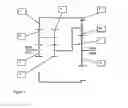
Unlimited examples of the kinematic chains in the toothed variable-speed gearbox can be seen in FIG. 1-40, wherein:
-
- 1—sun gear of the first stage;
- 2—first satellite gear of the first stage;
- 3—second satellite gear of the first stage, integrated with satellite gear 2 of the first stage;
- 4—carrier gear of the first stage;
- 5—external sun gear of the first stage;
- 6—internal sun gear of the first stage;
- 7—external sun gear of the second stage;
- 8—internal sun gear of the second stage;
- 9—carrier gear of the second stage;
- 10—first satellite gear of the second stage;
- 11—second satellite gear of the second stage;
- 12—sun gear of the second stage;
- 13—gear train of the first stage.
DETAILED DESCRIPTION OF THE INVENTION
Sun gear 1 of the first stage can function as a driving gear, while sun gear 12 of the second stage can function as a driven gear, or visa versa. By mating any suitable gears, the kinematic chains can be configured integral with further kinematic chains.
The automatic toothed variable-speed gearbox provides at least two power-transfer flows. As illustrated in FIG. 1, one power-transfer flow is external and flows from sun gear 1, through the first satellite gear 2 of the first stage, then through sun gear 5 of the first stage and sun gear 7 of the second stage, wherein sun gears 5 and 7 are integrated with each other, then the flow flows through satellite gear 10 of the second stage, and finally to sun gear 12 which is a driven gear; the other power-transfer flow is internal and flows from sun gear 1, through the first satellite gear 2 and through satellite gear 3 of the first stage, the gear 3 being integrated with gear 2, then the flow flows through the second sun gear 6 of the first stage, through carrier gear 9 of the second stage, through satellite gear 10 of the second stage, and finally to sun gear 12.
Principle of Operation
Stop of a gear in a stop position or adjacently to the stop position is achieved via balance of forces which are applied to the gear from different sides and which are originated from different power flows, wherein the forces are equal or similar in terms of magnitude and opposite in terms of orientation.
As illustrated in FIG. 1, forces originated from the external power-transfer flow and applied to sun gear 5 integrated with sun gear 7, are balanced by forces originated from the internal power-transfer flow and applied to gear 7; as according to the kinematic chains between the gears, the forces originated from these power flows are opposite in terms of orientation, thus allowing initial balance or stop of sun gears 5 and 7 integrated with each other in a position adjacent to the stop position thereof.
Further, such balance can be achieved for other gears, for example, for carrier gear 4 of the first stage and sun gear 7 of the second stage (see FIGS. 6, 8, 9) etc.
Magnitude of these balance forces are determined by appropriate geometrics of the gears and center-to-center distances therebetween, which are further determined by quantity of teeth thereof and gears engagement modules and by taking into account input power.
Automatic operation of the toothed variable-speed gearbox is based on initial correlation between forces as follows:
−F71=F72=F9/2, (1)
where
F71—force applied to the sun gear of the first stage as originated from the external power-transfer flow;
F72—force applied to the sun gear of the second stage as originated from the internal power-transfer flow, wherein this force is equal to half of force F9/2 applied to the carrier gear of the same stage.
Thus, an opposite orientation of these forces, i.e. of force −F71 as originated from the external power-transfer flow and of force F72 as originated from the internal power-transfer flow, results in mutual balancing thereof and creating conditions to initially stop gear 7 in a stop position or adjacently to the stop position, thus practically resulting in stopping power transfer via the external power-transfer flow, wherein the power is operationally transferred via another power-transfer flow, e.g. via the internal power-transfer flow. Conditions as expressed by formula (1) can be created for other gears of the automatic toothed variable-speed gearbox.
Changing the load applied to the driving shaft and/or driven shaft results in changing the initial balance condition, thus resulting in re-distribution of power between the power-transfer flows, which in turn results in changing positions of the gears and, thereby, in changing gear ratio determined by difference and match of the gears' circular and relative velocities varying from intermediate values to full match and visa versa; herewith, the forces applied to the gears are not equal:
−F71≠F72≠F9/2 (2)
Therefore, when the load is lowered, the forces applied to the gears tend to the balance position, and when the load is increased, the balance becomes disturbed, thus enabling automatic change of gear ratio without disengaging gears, wherein the change is assisted or not assisted by use of control devices.
Claims
1. Automatic toothed variable-speed gearbox comprising two or more stages of planetary mechanisms, sun gears, planetary gears or a gear train, wherein the gears can be bilateral, installed or not installed on axes of a carrier gear, the gearbox further comprising at least one carrier gear or alternatively comprising no carrier gear, the gearbox having at least three degrees of freedom and at least two power-transfer flows, wherein the carrier gear of the first stage can be integrated with the sun gear of the second stage or with the carrier gear of the second stage, wherein the sun gear of the first stage can be integrated with the carrier gear of the second stage or with the sun gear of the second stage, wherein the gearbox can change gear ratio without disengaging the gears and in absence of control devices by initially stopping at least one gear in a stop position or adjacent to the stop position, depending on equality or closeness of forces which are originated from different power flows, and which are equal or similar in terms of magnitude and opposite in terms of orientation, and which are applied thereto from different sides and from main power flow split by gears of kinematic chains, the forces being further determined by the load, ratios between diameters of the gears, center-to-center distances therebetween, which are further determined by quantity of teeth thereof and by engagement modules, and owing to movability of said gear which is determined by change in load, forces, the gears' circular and relative velocities in such a way that such an equality is recovered by the tendency of the forces to balance and to set the gears into initial balanced position thereof.
2. Automatic toothed variable-speed gearbox as claimed in claim 1, characterized in that at least one of the sun gears is made flexible.
3. Automatic toothed variable-speed gearbox as claimed in claim 2, characterized in that at least one of the sun gears comprises both internal and external teeth.
4. Automatic toothed variable-speed gearbox as claimed in claim 3, characterized in that any gear thereof is used for power input and/or power output.
5. Automatic toothed variable-speed gearbox as claimed in claim 4, characterized in that at least one control device is used.
6. Automatic toothed variable-speed gearbox as claimed in claim 5, characterized in that the kinematic chains are integrally configured in any order.
Images & Drawings included:



Sources:
- United States Patent and Trademark Office - verify current appl. status at the USPTO↗
Recent applications in this class:
- » 20200224750 2020-07-16
Differential Deceleration and Continuously Variable Transmission Gear Box with Self-locking Functional Small Tooth Number Difference Planetary Gear - » 20190178352 2019-06-13
SIVRT GEARTRAIN - » 20130065726 2013-03-14
CONTINUOUSLY VARIABLE TORQUE TRANSMISSION DEVICE - » 20120220419 2012-08-30
DRIVING BODY ACCELERATION DEVICE USING ELASTICITY - » 20120021868 2012-01-26
Automatic multi-speed gear system - » 20110256979 2011-10-20
GEAR SHIFT METHOD FOR AN AUTOMATIC STEP GEARBOX OF A VEHICLE - » 20050233855 2005-10-20
Gear-type continuously variable transmission