Echinacea plant named 'Firebird'
US20110252531P1
2011-10-13
12/798,837
2010-04-12
Abstract:
A new and distinct Echinacea plant named ‘Firebird’ characterized by medium, red orange flowers in a shuttlecock shape, well-branched flower stalks, a low habit, and excellent vigor.
Interested in similar patents?
Get notified when new applications in this technology area are published.
Classification:
A01H5/00 IPC
Products
A01H5/00 IPC
Angiosperms, i.e. flowering plants, characterised by their plant parts; Angiosperms characterised otherwise than by their botanic taxonomy
Description
BOTANICAL DENOMINATION
Echinacea spp.
VARIETY DESIGNATION
‘Firebird’
The present invention relates to a new and distinct cultivar of Echinacea and given the cultivar name ‘Firebird’. Echinacea is in the family Asteraceae. This new cultivar originated as a fourth generation seedling from a planned breeding program using the unpatented parents Echinacea paradoxa and Echinacea purpurea ‘Ruby Giant’ for the initial cross. The exact parents of this selection are unnamed proprietary, unreleased plants.
Compared to Echinacea paradoxa, an unpatented plant and the original pollen parent in the breeding line, the new variety is much shorter and has red orange rather than yellow inflorescences.
Compared to Echinacea ‘Tiki Torch’, U.S. Plant Pat. No. 18,839, the new variety is shorter and has red orange rather than bright orange flowers.
This new Echinacea cultivar is distinguished by:
1. medium, red orange flowers in a shuttlecock shape
2. well-branched flower stalks
3. short habit
4. excellent vigor
This new cultivar has been reproduced only by asexual propagation (division and tissue culture). Each of the progeny exhibits identical characteristics to the original plant. Asexual propagation by division and tissue culture using standard micropropagation techniques with terminal and lateral shoots, as done in Canby, Oreg., shows that the foregoing characteristics and distinctions come true to form and are established and transmitted through succeeding propagations. The present invention has not been evaluated under all possible environmental conditions. The phenotype may vary with variations in environment without a change in the genotype of the plant.
BRIEF DESCRIPTION OF THE DRAWING
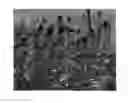
The photograph shows nine-month-old plants of Echinacea ‘Firebird’ growing in the ground in the trial field in full sun in the field in late June in Canby, Oreg.
DETAILED PLANT DESCRIPTION
The following is a detailed description of the new Echinacea cultivar based on observations of 18-month old specimens growing in the ground in the field in full sun in the trial bed under typical outdoor conditions in Canby, Oreg. The plants had been moved from one trial field to another the fall before. Canby is in Zone 8 on the USDA Hardiness map Temperatures range from a high of 95 degrees F. in August to an average of 32 degrees F. in January. Normal rainfall in Canby is 42.8 inches per year in the trial fields in Canby, Oreg. The color descriptions are all based on The Royal Horticultural Society Colour Chart, fifth edition.
- Plant:
-
- Type.—herbaceous perennial.
- Hardiness.—USDA Zones 4 to 9.
- Size.—grows to 41 cm wide and 60 cm tall to top of flowers.
- Form.—basal clump.
- Vigor.—excellent.
- Roots.—roots develop easily from cuttings from the crown.
-
- Stem (flowering):
-
- Type.—ascending.
- Size.—branching up to 6 times to 39 cm tall (to the upper most leaves) and 7 mm wide at base.
- Number of stems from the crown.—12.
- Internode length.—2 cm to 6 cm.
- Surface texture.—strigose.
- Color.—Yellow Green 145B mottled with Yellow Green 147B.
-
- Leaf (basal):
-
- Type.—simple.
- Shape.—lanceolate.
- Arrangement.—basal.
- Blade size.—grows to 22 cm long and 8 cm wide.
- Margins.—entire, undulate.
- Apex.—acute.
- Base.—attenuate.
- Surface texture.—strigose on both sides.
- Venation.—pinnate.
- Color.—topside, Green 137A with the vein Yellow Green 147C and bottom side closest to Yellow Green 147B with the vein Yellow Green 147C.
- Petiole description.—grows to 21 cm long and 3 mm wide, strigose, Yellow Green 147C except base which is Greyed Purple 187A.
-
- Leaf (stem):
-
- Type.—simple.
- Shape.—ovate to lanceolate.
- Arrangement.—alternate.
- Blade size.—grows to 12.5 cm long and 5 cm wide.
- Margins.—coarsely serrate to entire, undulate.
- Apex.—acute.
- Base.—attenuate, continuing down petiole, clasping.
- Surface texture.—strigose on both sides.
- Venation.—pinnate.
- Color.—topside, Yellow Green 146A with the vein Yellow Green 145C and bottom side closest to Yellow Green 147B with the vein Yellow Green 145C.
- Petiole description.—grows to 2.5 cm long and 6 mm wide, strigose, Yellow Green 146D except top side base Greyed Purple 187A.
-
- Inflorescence:
-
- Type.—composite on terminal stalked heads.
- Number of flowering stems per plant in summer.—16 from the crown, most branching.
- Flowering stem.—grows to 54 cm tall from the base of the plant to the terminal flower and can grow to 23 cm long from the top leaf to the base of a flower head; branched, 1 to 6 inflorescences per stem; diameter growing to 10 mm wide near the flower head; strigose, Yellow Green 145B mottled with Yellow Green 147B.
- Size.—grows to 9 cm wide and 8 cm deep as disc enlarges.
- Form.—ray florets held mostly perpendicular to the stem when first opening then dropping down at a 30 to 40 degree angle; mature disc is conic.
- Immature inflorescence.—3.8 cm wide and 2.2 cm deep, ray florets held at a 40 degree angle and rolled up so only the back color shows, Greyed Purple 183A, disc Greyed Purple 187A.
- Ray florets.—without pistil or stamen, 17 to 30 in number, oblanceolate with the tip 3 toothed (each acute), entire margins, base attenuate, grows to 5 cm long and 11 mm wide, glabrous on both sides; topside a bicolor with the top half between Orange Red 31 A and Orange Red 35A and bottom half darkening to Red 45A (base Red Purple 59A), older flowers fade to Red Purple 61A at the base and blends into Greyed Orange 173C near the tip; bottom side Greyed Purple 184A fading to Greyed Red 182A.
- Disc florets.—about 450 in number, with pistil and stamen, 11 mm long and 2 mm wide, each with one persistent, very stiff bract (14 mm long and Greyed Purple 187A on top ⅓ to Yellow Green 146A on middle ⅓, White 155A on bottom ⅓); corolla 5 mm long and 2 mm wide, 5 lobed, glabrous, Yellow Green 146B with Greyed Purple 187A on lobes and base, pistil 11 mm long, ovary 1.5 mm long, White 155A, style 6 mm long, Greyed Purple 187A with an extruding, 2-branched stigma spreading 2 mm wide, Greyed Purple 187; stamen 4 in number, 4.5 mm long, anthers 3 mm long and Greyed Purple N186A, filaments 1.5 mm long, Yellow Green 146C, pollen Yellow Orange 20A.
- Phyllaries.—in 4 leafy series, area 32 mm wide and 8 mm deep, lobes lanceolate in shape, reflexed, grow to 7 mm long and 3 mm wide, margins strigose, tip acute, Yellow Green 147A.
- Receptacle.—grows to 12 mm wide and 25 mm deep, White 155B.
- Bloom period.—July through October in Canby, Oreg.
- Fragrance.—light, floral.
- Lastingness.—each inflorescence lasts about two weeks in Canby, Oreg.
-
- Seeds: average number of 10 seeds/head, each 5 mm long and 2.5 mm wide, oval, Greyed Brown N199A
-
- Fertility.—low.
-
- Disease and pests: Echinacea are susceptible to leaf miners, powdery mildew, bacterial spots, and gray mold. None of these have been observed on plants grown under commercial conditions in Canby, Oreg. No resistance is known.
- Comparisons to similar echinacea: Compared to Echinacea ‘Tomato Soup’ (U.S. Plant Pat. No. 19,427), the new cultivar has more orange in the flower and fades to a bicolor rather than being red and fading to a dull red. The new cultivar has inflorescences that are shaped like a shuttlecock, rather than having petals perpendicular to the stem.
Claims
I claim:1. A new and distinct Echinacea plant as herein illustrated and described.
Images & Drawings included:

Sources:
- United States Patent and Trademark Office - verify current appl. status at the USPTO↗
Recent applications in this class:
- » 20240292771 2024-08-29
Campanula plant named 'Twilight' - » 20240251691 2024-07-25
HYDRANGEA PLANT NAMED 'HYLV17520' - » 20240251690 2024-07-25
Vaccinium Plant Named 'BWPBLUE02' - » 20240251689 2024-07-25
BLUEBERRY PLANT NAMED 'FC13-113' - » 20240251688 2024-07-25
BLUEBERRY PLANT NAMED 'FCM14-057' - » 20240237567 2024-07-11
PONGAMIA VARIETIES - » 20240224827 2024-07-04
PELARGONIUM PLANT NAMED 'PEQZ0103' - » 20240215470 2024-06-27
Agapanthus plant named 'Monsapho' - » 20240215469 2024-06-27
plant named ‘LOCORA3519’ - » 20240206359 2024-06-20
CORYLUS PLANT NAMED 'BWM01'