Ventilated toilet
US20110252553A1
2011-10-20
12/799,099
2010-04-19
Abstract:
Ventilated systems for toilets include extractor fan and pipe adopted for easy connection, to draw odour air from the toilet bowl. Ventilator draws odour directly from toilet bowl to air intake duck trough a pipe and outside the room. Could be connected to a soil pipe. Ventilator has build in a aperture so odour air can not go back—could go only in one direction.
The pipe (FIG. 9) is created to flush water from a cistern and also ventilate air from the toilet. That air could be ventilated in the same time when we flush the toilet and that not affect ventilated process.
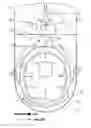
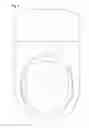
First type of toilet (FIG. 1) is made to ventilate odour air from the toilet. Odour air go in the toilet bowl same way, which the water going out. Then to separate air intake duck, from there going through plastic pipe and through ventilator go outside.
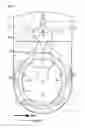
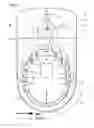
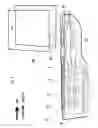
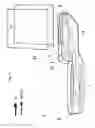
Second type of toilet (FIG. 5) is made to ventilate odour air from the toilet. There are visible holes are created to suck the air in to the toilet bowl. That air goes in air intake duck, from there going through plastic pipe and through ventilator go outside. Their holes are created also to have direct access for liquid like bleach or different one, which smell nice. That liquid will be storage on the bottom and around on this channel (FIG. 6 , point L), where little tiny holes created (FIG. 6 point J), so that liquid could be released slowly by gravitation to channel (FIG. 6. point K). When we flash toilet water going around in channel (FIG. 6 point K), rinse some of the liquid, which is on top channel K and provide nice fresh smell every time we flush water.
Interested in similar patents?
Get notified when new applications in this technology area are published.
Classification:
E03D9/052 » CPC main
Sanitary or other accessories for lavatories ; Devices for cleaning or disinfecting the toilet room or the toilet bowl; Devices for eliminating smells; Special arrangement or operation of ventilating devices ventilating the bowl using incorporated fans
E03D9/032 » CPC further
Sanitary or other accessories for lavatories ; Devices for cleaning or disinfecting the toilet room or the toilet bowl; Devices for eliminating smells; Devices adding a disinfecting, deodorising, or cleaning agent to the water while flushing consisting of a separate container with an outlet through which the agent is introduced into the flushing water, e.g. by suction ; Devices for agents in direct contact with flushing water Devices connected to or dispensing into the bowl
E03D2009/028 » CPC further
Sanitary or other accessories for lavatories ; Devices for cleaning or disinfecting the toilet room or the toilet bowl; Devices for eliminating smells; Devices adding a disinfecting, deodorising, or cleaning agent to the water while flushing using a liquid substance
E03D9/05 IPC
Sanitary or other accessories for lavatories ; Devices for cleaning or disinfecting the toilet room or the toilet bowl; Devices for eliminating smells; Special arrangement or operation of ventilating devices ventilating the bowl
Description
DESCRIPTIONS FOR ALL DRAWINGS
FIG. 1.
1. Show ventilation toilet view from the top.
FIG. 2.
Show toilet view from the top. The broken line shows invisible elements.
- A. From that place all ventilated air is going out from a toilet. In this place plastic pipe will be fitting in horizontally. Then will go outside the toilet in few different directions:
- a), b), c)—are not shown on this drawings but I shortly describe:
- a) Strait to the wall, connected to ventilator, strait outside.
- b) Strait to the wall, up vertically, connected to a ventilator, horizontally outside wall.
- c) Right or left in, or before wall, up connected to a ventilator, then to soil pipe, or outside. So if we don't want to channel a wall, we have possibility run the pipes on the wall, make those connections visible, and box it.
- B. These holes are to connect toilet bowl and cistern together.
- C. These holes are to connect toilet bowl and toilet seat together.
- D. These holes are created on level 2 (F), to suck the air in to the toilet. bowl. That air goes in channel L shown on (FIG. 3), which is located. between level 2 and top of the toilet bowl. This air will go to point A where will go outside. There way are marks by their air arrows.
- E. Level 1, where the holes (I) are located. There are made to the release flush water from the cistern to the inside toilet bowl.
- F. Level 2 of this toilet—invisible from outside (mark by the broken line). Their holes D are located on this level.
- G. Top of the toilet.
- H. Place where water coming from the cistern to the toilet. Water direction shown by the water arrow.
- I. Holes made around level 1. There are made to the release flush water from the cistern to inside the toilet bowl. Air going in to the toilet trough the I holes. Then trough the holes D.
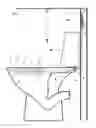
FIG. 3.
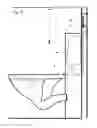
This drawing shows left side of the ventilated toilet. Points A, B, C, D, E, F, G, H, I are described above. B, and C not shown on this draw to make this picture more clearly.
- K. That is channel between level 1 and 2. In this place water running from point H to I points.
- L. This is channel between level 2 and top of the toilet. Ventilated air coming from toilet bowl to I holes. Then to holes D, and from holes D to the point A where going outside to ventilator S or O.
- M. Cistern, from where water going to the toilet bowl.
- O. Extractor fan. Size of this extractor has the same diameter like pipe fitting in the wall. There are easy to connect together by slide rings. Easy to replace as well. Pull switch (T) fitting to the ceiling to switch on or off the extractor fan.
- P. Pipe fitting in the wall to ventilate the air outside the wall.
- S. This extractor fan has bigger power then extractor O. Size of this connected parts of this extractor has the same diameter like the pipe fitting in the wall, but middle part are bigger. There are easy fit, and easy to connect together with a pipe by slide rings. Easy to replace as well. We fitting one of these extractors depend of power needed. Pull switch (T) fitting to the ceiling to switch on or off the extractor fan.
- W. Wall.
FIG. 4
This drawing shows left side of the ventilated toilet. Points A, B, C, D, E, F, G, H, I are described above. B, and C not shown on this draw to make this picture more clearly.
- K. That is channel between level 1 and 2. In this place water running from point H to I points.
- L. This is channel between level 2 and top of the toilet. Ventilated air coming from toilet bowl to I holes. Then to holes D, and from holes D to the point A where going outside to ventilator S or O.
- M. Cistern, from where water going to the toilet bowl.
FIG. 5
Show ventilation toilet view from the top.
FIG. 6
Show toilet view from the top. The broken line shows invisible elements.
- A. From that place all ventilated air is going out from a toilet. In this place plastic pipe will be fitting in horizontally. Then will go outside the toilet in few different directions:
- a), b), c)—are not shown on this drawings but I shortly describe:
- a) Strait to the wall, connected to ventilator, strait outside.
- b) Strait to the wall, up vertically, connected to a ventilator, horizontally outside wall.
- c) Right or left in, or before wall, up connected to a ventilator, then to soil pipe, or outside. So if we don't want to channel a wall, we have possibility run the pipes on the wall, make those connections visible, and box it.
- B. These holes are to connect toilet bowl and cistern together.
- C. These holes are to connect toilet bowl and toilet seat together.
- D. These holes are created between level 2 (F), and top of the toilet G, to suck the air in to the toilet bowl. That air goes in channel L shown on (FIG. 3), which is located between level 2 and top of the toilet bowl. This air will go to point A where will go outside. There way are marks by their air arrows. On this drawing holes D are visible. There are created also to have direct access for liquid like bleach or different one, which smell nice. That liquid will be storage in channel L around holes J.
- E. Level 1, where the holes (I) are located. There are made to the release flush water from the cistern to the inside toilet bowl.
- F. Level 2 of this toilet—invisible from outside (mark by the broken line). Their holes D are located on this level.
- G. Top of the toilet.
- H. Place where water coming from the cistern to the toilet. Water direction shown by the water arrow.
- I. Holes made around level 1. There are made to the release flush water from the cistern to the inside toilet bowl.
- J. Little tiny holes created, so that liquid could be released slowly to channel K. When we flash toilet water going around in channel K, rains some of the liquid which is on top channel K and provide nice fresh smell every time we flush water.
So in toilet (FIG. 1) we don't see any holes and our toilet is ventilated. In toilet (FIG. 5) we see ventilated holes around and we have storage for smell liquid.
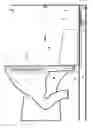
FIG. 7
- This drawing shows left side of the ventilated toilet. Points A, B, C, D, E, F, G, H, I, J are described above in draw (FIG. 6). B, and C not shown on this draw to make this picture more clearly.
- K. That is channel between level 1 and 2. In this place water running from point H to I points.
- L. This is channel between level 2 and top of the toilet. Ventilated air coming from toilet bowl to I holes. Then to holes D, and from holes D to the point A where going outside to ventilator S or O.
- M. Cistern, from where water going to the toilet bowl.
- O. Extractor fan. Size of this extractor has the same diameter like pipe fitting in the wall. There are easy to connect together by slide rings. Easy to replace as well. Pull switch (T) fitting to the ceiling to switch on or off the extractor fan.
- P. Pipe fitting in the wall to ventilate the air outside the wall.
- S. This extractor fan has bigger power then extractor O. Size of this connected parts of this extractor has the same diameter like the pipe fitting in the wall, but middle part are bigger. There are easy fit, and easy to connect together with a pipe by slide rings. Easy to replace as well. We fitting one of these extractors depend of power needed. Pull switch (T) fitting to the ceiling to switch on or off the extractor fan.
- W. Wall.
FIG. 8
This drawing shows left side of the ventilated toilet. Points A, B, C, D, E, F, G, H, I, J are described above. B, and C not shown on this draw to make this picture more clearly.
- K. That is channel between level 1 and 2. In this place water running from point H to I points.
- L. This is channel between level 2 and top of the toilet. Ventilated air coming from toilet bowl to I holes. Then to holes D, and from holes D to the point A where going outside to ventilator S or O.
- M. Cistern, from where water going to the toilet bowl.
FIG. 9
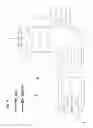
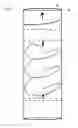
This drawing shows pipe, which is created to flush water from a cistern and also ventilate air from the toilet. That air could be ventilated in the same time when we flush the toilet and that not affect ventilated process. This pipe could be used for all kind of existing toilets connected with cistern by plastic pipes, which is shown on (FIGS. 13, 14, 15.) If we fit and use for flushing first to see how it works without connect to another pipe—water not going to leak from the back. Connection with another pipe could be done any time after.
To make this works like flushing and ventilating we need to connect the pipe by sliding rings with another pipe, which is connected with extractor fun in that wall or on the wall.
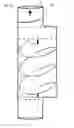
What kind of extractor fun we can use shows on (FIGS. 10, 10A, 11, 12)
If we have toilets like on (FIGS. 13, 14, 15), we don't need to spend money for new toilets to have them ventilated. What we need? We need only this pipe and extractor fun shows on (FIGS. 11, 12)
- A. Show the way where the air going in to the pipe from the toilet.
- C. Show the way where air will go outside from this pipe and will be connected with another.
- B. Show the way where water going through this pipe from the cistern to the toilet.
There are air and water arrows to help understand better these drawings.
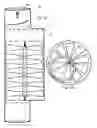
FIGS. 10, 10A, 11, 12
Extractor fun created in the tube.
- A. Direction of air.
- B. Flexible rubber, which is open when extractor fun is on. When extractor fun is off the rubber is getting strait and closing way for the air to come back.
- C. Motor area.
- D. Rotated parts.
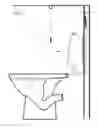
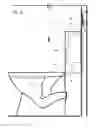
FIGS. 13, 14, 15.
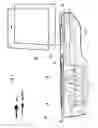
Those drawings shows how we can use and connected pipe R, which is described on (FIG. 9), for many different types of toilets. All those toilets could be converting to be ventilated by fitting this pipe R and connected to extractor funs. (FIGS. 10, 10A, 11, 12)
Elements A, I, O, P, S, T, W are described on (FIGS. 2 and 3).
FIG. 16
This drawing shows left side of the ventilated toilet. Points A, B, C, D, E, H, I are described above but this time F is the top of the toilet. B, and C not shown on this draw to make this picture more clearly.
- K. That is channel between level 1 and 2. In this place water running from point H to I points.
- L. This is channel between level 2 and top of the toilet. Ventilated air coming from toilet bowl to I holes. Then to holes D, and from holes D to the point A where going outside to ventilator S or O.
- M. Cistern, from where water going to the toilet bowl.
Claims
1. A ventilated toilet bowl, comprising:
a first channel fluidly connectable to a cistern and having apertures on the underside of the first channel to release flush water receivable from the cistern into the toilet bowl; and
a second channel located above the first channel and being connectable to an extractor to extract air from the toilet bowl, in use,
wherein a plurality of connecting apertures are provided between the first and second channels.
2. A ventilated toilet bowl according to claim 1, configured such that, air extracted from the toilet bowl passes through the apertures provided on the underside of the first channel and then through the connecting apertures into the second channel.
3. A ventilated toilet bowl according to claim 1, wherein the second channel is further provided with ventilation apertures in the side wall of the second channel facing into the toilet bowl.
4. A ventilated toilet bowl according to claim 3, wherein the connecting apertures between the first and second channels are small, and the second channel is operable to receive a supply of cleaning fluid such that, when flush water passes through the first channel, some of the cleaning fluid is added to the flush water.
5. A ventilated toilet bowl according to claim 1, comprising a first port connectable to a cistern to allow fluid connection between the cistern and the first channel.
6. A ventilated toilet bowl according to claim 1, comprising a second port connectable to an extractor to allow fluid connection between the second channel and the extractor.
7. A ventilated toilet system including a ventilated toilet bowl according to claim 1, further comprising a cistern and an extractor connected to the toilet bowl.
8. A ventilated toilet system according to claim 7, wherein the extractor comprises a housing having an inlet port and an outlet port, wherein the inlet and outlet ports are smaller than the extractor housing.
9. A ventilated toilet system according to claim 8, wherein the inlet and outlet ports are offset from the centre of the extractor housing.
10. (canceled)
11. A ventilated toilet system according to any of claim 7, wherein the cistern and extractor are connected to the toilet bowl by a single connecting pipe, the connecting pipe comprising two concentric pipes defining two conduits.
Images & Drawings included:
Sources:
- United States Patent and Trademark Office - verify current appl. status at the USPTO↗
Similar patent applications:
- » 20060085898
Toilet ventilation system - » 20050081285
Ventilated toilet system - » 20050050621
Toilet ventilation system and method - » 20050166305
Ventilated toilet seat - » 20050273917
Toilet ventilation system - » 20060021119
Toilet ventilation system - » 20060031980
Toilet ventilation - » 20050138720
Toilet ventilation systems and methods - » 20060085897
Toilet ventilation system - » 20060179556
VENTILATED TOILET SYSTEM AND METHOD
Recent applications in this class:
- » 20250116098 2025-04-10
PORTABLE AIR FILTRATION ASSEMBLY FOR TOILETS - » 20250067038 2025-02-27
SMART DEODORIZATION DEVICE WITH COVER PLATE - » 20250043558 2025-02-06
Odor Removal Assembly - » 20250019955 2025-01-16
APPARATUS FOR FACILITATING A FLOW OF A FLUID - » 20250012067 2025-01-09
TOILET DEVICE - » 20250012066 2025-01-09
VENTILATION SYSTEM OF THE TOILET VESSEL CAVITY - » 20240426093 2024-12-26
TOILET DEVICE - » 20240376701 2024-11-14
Toilet bowl odor extractor system - » 20240328137 2024-10-03
Systems and methods of controlling closure of a toilet seat and ventilation of a toilet bowl - » 20240218650 2024-07-04
Toilet Deodorizing Apparatus