Cotyloid element of a hip prosthesis, and total hip prosthesis comprising same
US20110264231A1
2011-10-27
12/935,117
2009-03-27
✅ Patent granted
US 8,486,151 B2
2013-07-16
WO; PCT/FR2009/000341; 20090327
WO; WO2009/130406; 20091029
Thomas J Sweet | Rebecca Preston
McCarter & English, LLP
2029-06-10
Abstract:
The invention relates to a cotyloid component of a hip prosthesis, said cotyloid component being hollow and in the form of a cup whose outer part has a thread allowing it to be fixed in the iliac bone, said thread being a discontinuous self-cutting double thread (20, 21), and said cotyloid component having a flattened upper pole (1), a coating that promotes osseointegration on its outer face (10), and a concave, substantially hemispherical and polished inner surface (11), characterized in that: (a) the pitch of the threads (20, 21) decreases from the upper pole (1) towards the equatorial periphery (3) of the cotyloid component, (b) the thicknesses of the threads (20, 21) increase from the upper pole (1) of the cotyloid component towards its periphery (3), (c) the crest of the threads (20, 21) is sharp towards the pole (1) of the cotyloid component and rounded or substantially trapezoidal towards the equatorial periphery (3) of the cotyloid component.
Inventors:
- Boris Theillez 1 🇫🇷 Bourg de Peage, France
- Nicolas Chanzy 1 🇫🇷 Boulogne Billancourt, France
- Frédéric Farizon 1 🇫🇷 Chamond, France
- Philippe Adam 1 🇫🇷 Quatzenheim, France
- Rémi Philippot 1 🇫🇷 Saint Etienne, France
- Eric Favre 1 🇫🇷 Chamery, France
- Rodolphe Limonzin 1 🇫🇷 Rodez, France
- Gilles Provost 1 🇫🇷 Certines, France
- Serge Doycinovich 1 🇫🇷 Bourg en Bresse, France
- Jean-Philippe Camilleri 1 🇫🇷 Lyon, France
- Frederic Farizon 1 🇫🇷 St. Chamond, France
- Rodophe Limozin 1 🇫🇷 Rodez, France
- Jean-Philippe Camilleri 1 🇫🇷 Lyons, France
Applicant:
Interested in similar patents?
Get notified when new applications in this technology area are published.
Classification:
A61F2/4609 » CPC further
Filters implantable into blood vessels; Prostheses, i.e. artificial substitutes or replacements for parts of the body; Appliances for connecting them with the body; Devices providing patency to, or preventing collapsing of, tubular structures of the body, e.g. stents; Prostheses implantable into the body; Joints; Special tools or methods for implanting or extracting artificial joints, accessories, bone grafts or substitutes, or particular adaptations therefor for insertion or extraction of endoprosthetic joints or of accessories thereof of acetabular cups
A61F2/30767 » CPC further
Filters implantable into blood vessels; Prostheses, i.e. artificial substitutes or replacements for parts of the body; Appliances for connecting them with the body; Devices providing patency to, or preventing collapsing of, tubular structures of the body, e.g. stents; Prostheses implantable into the body; Joints Special external or bone-contacting surface, e.g. coating for improving bone ingrowth
A61F2/3094 » CPC further
Filters implantable into blood vessels; Prostheses, i.e. artificial substitutes or replacements for parts of the body; Appliances for connecting them with the body; Devices providing patency to, or preventing collapsing of, tubular structures of the body, e.g. stents; Prostheses implantable into the body; Joints Designing or manufacturing processes
A61F2002/30322 » CPC further
Filters implantable into blood vessels; Prostheses, i.e. artificial substitutes or replacements for parts of the body; Appliances for connecting them with the body; Devices providing patency to, or preventing collapsing of, tubular structures of the body, e.g. stents; Prostheses implantable into the body; Joints; Additional features of subject-matter classified in , and subgroups thereof; The prosthesis having different structural features at different locations within the same prosthesis; Connections between prosthetic parts; Special structural features of bone or joint prostheses not otherwise provided for; The prosthesis having different structural features at different locations within the same prosthesis differing in surface structures
A61F2002/30324 » CPC further
Filters implantable into blood vessels; Prostheses, i.e. artificial substitutes or replacements for parts of the body; Appliances for connecting them with the body; Devices providing patency to, or preventing collapsing of, tubular structures of the body, e.g. stents; Prostheses implantable into the body; Joints; Additional features of subject-matter classified in , and subgroups thereof; The prosthesis having different structural features at different locations within the same prosthesis; Connections between prosthetic parts; Special structural features of bone or joint prostheses not otherwise provided for; The prosthesis having different structural features at different locations within the same prosthesis differing in thickness
A61F2002/30331 » CPC further
Filters implantable into blood vessels; Prostheses, i.e. artificial substitutes or replacements for parts of the body; Appliances for connecting them with the body; Devices providing patency to, or preventing collapsing of, tubular structures of the body, e.g. stents; Prostheses implantable into the body; Joints; Additional features of subject-matter classified in , and subgroups thereof; The prosthesis having different structural features at different locations within the same prosthesis; Connections between prosthetic parts; Special structural features of bone or joint prostheses not otherwise provided for; Connections or couplings between prosthetic parts, e.g. between modular parts; Connecting elements made by longitudinally pushing a protrusion into a complementarily-shaped recess, e.g. held by friction fit
A61F2002/30685 » CPC further
Filters implantable into blood vessels; Prostheses, i.e. artificial substitutes or replacements for parts of the body; Appliances for connecting them with the body; Devices providing patency to, or preventing collapsing of, tubular structures of the body, e.g. stents; Prostheses implantable into the body; Joints; Additional features of subject-matter classified in , and subgroups thereof; Features concerning an interaction with the environment or a particular use of the prosthesis; Means for preventing migration of particles released by the joint, e.g. wear debris or cement particles Means for reducing or preventing the generation of wear particulates
A61F2002/30827 » CPC further
Filters implantable into blood vessels; Prostheses, i.e. artificial substitutes or replacements for parts of the body; Appliances for connecting them with the body; Devices providing patency to, or preventing collapsing of, tubular structures of the body, e.g. stents; Prostheses implantable into the body; Joints; Special external or bone-contacting surface, e.g. coating for improving bone ingrowth applied in original prostheses, e.g. holes or grooves; Grooves Plurality of grooves
A61F2002/3085 » CPC further
Filters implantable into blood vessels; Prostheses, i.e. artificial substitutes or replacements for parts of the body; Appliances for connecting them with the body; Devices providing patency to, or preventing collapsing of, tubular structures of the body, e.g. stents; Prostheses implantable into the body; Joints; Special external or bone-contacting surface, e.g. coating for improving bone ingrowth applied in original prostheses, e.g. holes or grooves with a threaded, e.g. self-tapping, bone-engaging surface, e.g. external surface
A61F2002/30851 » CPC further
Filters implantable into blood vessels; Prostheses, i.e. artificial substitutes or replacements for parts of the body; Appliances for connecting them with the body; Devices providing patency to, or preventing collapsing of, tubular structures of the body, e.g. stents; Prostheses implantable into the body; Joints; Special external or bone-contacting surface, e.g. coating for improving bone ingrowth applied in original prostheses, e.g. holes or grooves with a threaded, e.g. self-tapping, bone-engaging surface, e.g. external surface Multiple threadings
A61F2002/30858 » CPC further
Filters implantable into blood vessels; Prostheses, i.e. artificial substitutes or replacements for parts of the body; Appliances for connecting them with the body; Devices providing patency to, or preventing collapsing of, tubular structures of the body, e.g. stents; Prostheses implantable into the body; Joints; Special external or bone-contacting surface, e.g. coating for improving bone ingrowth applied in original prostheses, e.g. holes or grooves with a threaded, e.g. self-tapping, bone-engaging surface, e.g. external surface Threads interrupted by grooves or sidewalls, e.g. flat sidewalls
A61F2002/30859 » CPC further
Filters implantable into blood vessels; Prostheses, i.e. artificial substitutes or replacements for parts of the body; Appliances for connecting them with the body; Devices providing patency to, or preventing collapsing of, tubular structures of the body, e.g. stents; Prostheses implantable into the body; Joints; Special external or bone-contacting surface, e.g. coating for improving bone ingrowth applied in original prostheses, e.g. holes or grooves with a threaded, e.g. self-tapping, bone-engaging surface, e.g. external surface having threaded portions of different pitches
A61F2002/30866 » CPC further
Filters implantable into blood vessels; Prostheses, i.e. artificial substitutes or replacements for parts of the body; Appliances for connecting them with the body; Devices providing patency to, or preventing collapsing of, tubular structures of the body, e.g. stents; Prostheses implantable into the body; Joints; Special external or bone-contacting surface, e.g. coating for improving bone ingrowth applied in original prostheses, e.g. holes or grooves with a threaded, e.g. self-tapping, bone-engaging surface, e.g. external surface Rounded threads
A61F2002/30871 » CPC further
Filters implantable into blood vessels; Prostheses, i.e. artificial substitutes or replacements for parts of the body; Appliances for connecting them with the body; Devices providing patency to, or preventing collapsing of, tubular structures of the body, e.g. stents; Prostheses implantable into the body; Joints; Special external or bone-contacting surface, e.g. coating for improving bone ingrowth applied in original prostheses, e.g. holes or grooves with a threaded, e.g. self-tapping, bone-engaging surface, e.g. external surface Trapezoidal threads
A61F2002/30873 » CPC further
Filters implantable into blood vessels; Prostheses, i.e. artificial substitutes or replacements for parts of the body; Appliances for connecting them with the body; Devices providing patency to, or preventing collapsing of, tubular structures of the body, e.g. stents; Prostheses implantable into the body; Joints; Special external or bone-contacting surface, e.g. coating for improving bone ingrowth applied in original prostheses, e.g. holes or grooves with a threaded, e.g. self-tapping, bone-engaging surface, e.g. external surface Threadings machined on non-cylindrical external surfaces
A61F2002/30929 » CPC further
Filters implantable into blood vessels; Prostheses, i.e. artificial substitutes or replacements for parts of the body; Appliances for connecting them with the body; Devices providing patency to, or preventing collapsing of, tubular structures of the body, e.g. stents; Prostheses implantable into the body; Joints; Special external or bone-contacting surface, e.g. coating for improving bone ingrowth having at least two superposed coatings
A61F2002/3208 » CPC further
Filters implantable into blood vessels; Prostheses, i.e. artificial substitutes or replacements for parts of the body; Appliances for connecting them with the body; Devices providing patency to, or preventing collapsing of, tubular structures of the body, e.g. stents; Prostheses implantable into the body; Joints for the hip Bipolar or multipolar joints, e.g. having a femoral head articulating within an intermediate acetabular shell whilst said shell articulates within the natural acetabular socket or within an artificial outer shell
A61F2002/3446 » CPC further
Filters implantable into blood vessels; Prostheses, i.e. artificial substitutes or replacements for parts of the body; Appliances for connecting them with the body; Devices providing patency to, or preventing collapsing of, tubular structures of the body, e.g. stents; Prostheses implantable into the body; Joints for the hip; Acetabular cups having a number of shells different from two Single cups
A61F2002/3456 » CPC further
Filters implantable into blood vessels; Prostheses, i.e. artificial substitutes or replacements for parts of the body; Appliances for connecting them with the body; Devices providing patency to, or preventing collapsing of, tubular structures of the body, e.g. stents; Prostheses implantable into the body; Joints for the hip; Acetabular cups having a non-hemispherical convex outer surface, e.g. quadric-shaped ellipsoidal or having a flattened polar region
A61F2220/0033 » CPC further
Fixations or connections for prostheses classified in groups - or or or or subgroups thereof; Connections or couplings between prosthetic parts, e.g. between modular parts; Connecting elements made by longitudinally pushing a protrusion into a complementary-shaped recess, e.g. held by friction fit
A61F2250/0026 » CPC further
Special features of prostheses classified in groups - or or or or subgroups thereof having different values of a given property or geometrical feature, e.g. mechanical property or material property, at different locations within the same prosthesis differing in surface structures
A61F2250/0036 » CPC further
Special features of prostheses classified in groups - or or or or subgroups thereof having different values of a given property or geometrical feature, e.g. mechanical property or material property, at different locations within the same prosthesis differing in thickness
A61F2310/00017 » CPC further
Prostheses classified in or - being constructed from or coated with a particular material; The prosthesis being constructed from a particular material; Metals or alloys Iron- or Fe-based alloys, e.g. stainless steel
A61F2310/00029 » CPC further
Prostheses classified in or - being constructed from or coated with a particular material; The prosthesis being constructed from a particular material; Metals or alloys Cobalt-based alloys, e.g. Co-Cr alloys or Vitallium
A61F2310/00407 » CPC further
Prostheses classified in or - being constructed from or coated with a particular material; The prosthesis being coated or covered with a particular material; Coating or prosthesis-covering structure made of metals or of alloys Coating made of titanium or of Ti-based alloys
A61F2310/00796 » CPC further
Prostheses classified in or - being constructed from or coated with a particular material; The prosthesis being coated or covered with a particular material; Coating or prosthesis-covering structure made of ceramics or of ceramic-like compounds Coating or prosthesis-covering structure made of a phosphorus-containing compound, e.g. hydroxy(l)apatite
A61F2/34 » CPC main
Filters implantable into blood vessels; Prostheses, i.e. artificial substitutes or replacements for parts of the body; Appliances for connecting them with the body; Devices providing patency to, or preventing collapsing of, tubular structures of the body, e.g. stents; Prostheses implantable into the body; Joints for the hip Acetabular cups
A61F2/32 » CPC further
Filters implantable into blood vessels; Prostheses, i.e. artificial substitutes or replacements for parts of the body; Appliances for connecting them with the body; Devices providing patency to, or preventing collapsing of, tubular structures of the body, e.g. stents; Prostheses implantable into the body; Joints for the hip
Description
FIELD OF THE INVENTION
The invention relates to hip prostheses, and more specifically to the acetabular elements of hip prostheses intended to be implanted without cement.
PRIOR ART
Hip prostheses are implants commonly used in human surgery to treat fractures of the upper end of the femur, as well as advanced rheumatic conditions of the hip. They can be uniquely femoral, i.e. comprise only one element intended to replace the upper end of the femur and provided at the end with a spherical head intended to be inserted into the patient's acetabular cavity. They can be total, i.e. comprise, in addition to the femoral element, an artificial acetabulum that the surgeon implants in the patient's hip bone, in place of the patient's natural cavity.
In total hip prostheses, the femoral element normally comprises:
-
- a substantially rectilinear stem anchored in the femur and ending with a conical distal end (neck) for insertion of the spherical head of variable diameter,
- and a spherical head placed at the end of the prosthetic neck.
The acetabular element normally comprises a portion attached in the natural cavity of the hip bone. This portion attached in the bone is provided with a sliding surface having the shape of a hemispherical cavity.
According to the type of prosthesis, the acetabular element can consist of a single part made of metal, ceramic or polyethylene. However, to enable the attachment without cement of the acetabular cup in the hip bone, many models, in particular those referred to as having “dual mobility” consist of the following elements:
-
- a metal shell, generally in the form of a cap, attached in the bone,
- a polyethylene insert, placed in the shell and in which the spherical prosthetic head of the femoral element is pivotably connected.
The main problems encountered in surgical practice are wear on the surfaces between the femoral head and the acetabular part, associated with stress friction, and the attachment of the metal shell in the bone.
A number of modes of attachment of the metal shell are currently used, in particular sealing (a), impaction (b), expansion (c) and screwing (d), described in detail below.
a) Sealing consists of placing, between the bone and the shell, an acrylic-based polymerizable cement that is anchored in the bone and ensures the primary and secondary attachment of the shell. However, loosening can occur between the bone and the shell more or less over the long term in particular due to properties of the bone and the cement.
b) Impaction consists of inserting the metal shell into the bony acetabulum prepared by hemispherical drills calibrating the bone to a diameter smaller than the diameter of the metal shell. A coating and surface protuberances located at the periphery of the shell improve the primary attachment and increase bone regrowth. This mechanical strength depends on the bone preparation, but also and mainly on the quality of the bone. Many models propose complementary attachments, for example with pins or screws, positioned in holes provided in the metal shell.
This technique has in particular the following disadvantages: micromobility is possible between the screws or the pins, and poor impaction of the pins or screws increases wear.
c) Expansion consists of using a metal shell designed so as to be open in the bone cavity previously prepared as in b). There are two types of expansion shells:
a. shells provided with petals distributed symmetrically over the periphery of the shell and held by a ring that is removed during insertion of the shell to ensure expansion;
b. an insert screwed inside the metal shell and of which the screwing ensures expansion.
The expansion shells have in particular the following disadvantages: the plastic insert must absorb all of the stress and not be deformed so as to durably ensure expansion; in the case of the shell provided with petals, slots increase the bone/plastic portion contact due to the creeping phenomenon, which promotes osteolysis.
d) In screwed shells, a metal shell having a threading on its external surface is screwed directly into the hip bone. The external portion of the shell can be covered with materials promoting bone regrowth.
This type of acetabulum is known and described in many prior art documents. For example, patent FR 2 622 432 relates to a screwable acetabulum ring for a hip prosthesis. The ring described in this patent has a frustoconical shape, and is provided with a self-tapping screw thread. Patent application FR 2 639 822 describes a substantially hemispherical acetabulum provided with an external screw thread. In this document, the anchoring of the prosthesis in the bone is facilitated by the presence of tabs that are resiliently deformable so as to be pushed after screwing of the acetabulum into the bone by attached means capable of cooperating with at least one selected tab. U.S. Pat. No. 6,146,425 relates to an acetabulum provided with an external self-tapping screw thread of which the edges have a particular angular orientation and a variable step for facilitated screwing and better anchoring in the hip bone.
Such a device is also known from the French patent FR 2 585 946. This patent describes an acetabular component including a titanium hemispherical cap having, on its external surface, a self-tapping screw thread with an interrupted double thread.
The disadvantages of the screwed acetabula as described in the aforementioned prior art documents are the following: poor positioning during installation increases the rate of dislocation, promotes wear, and adversely affects osteointegration. Moreover, repositioning of the prosthesis is difficult due to the existence of the screw thread.
This invention is intended to overcome these specific disadvantages, so as to provide the following advantages:
-
- optimal mechanical strength regardless of the bone quality,
- precise and easy positioning,
- reduced wear at the joint,
- the possibility of placing a mobile polyethylene insert or a metal pivoting head with a large diameter directly in the shell.
Subject Matter of the Invention
The invention first relates to an acetabular component of a hip prosthesis, in which said acetabular component is hollow and has a shell shape, of which the external portion has a screw thread for enabling said acetabular component to be attached in the acetabular cavity of the suitably prepared hip bone, said screw thread comprising an interrupted self-tapping double thread (20, 21), said acetabular component being provided with a cleared upper pole (1), said acetabular component being provided on its external face (10) with a osteointegration-promoting coating (typically a porous titanium coating associated with a calcium hydroxyapatite coating), said acetabular component being provided with a substantially hemispherical concave polished internal surface (11), and said acetabular component being characterized in that:
-
- the pitch of the screw threads (20, 21) decreases from the upper pole (1) to the equatorial periphery (3) of the acetabular component,
- the thicknesses of the threads (20, 21) increase from the upper pole (1) of the acetabular component to the periphery (3) thereof,
- the edge of the threads (20, 21) is cutting on the side of the pole (1) of the acetabular component and rounded or substantially trapezoidal on the side of the equatorial periphery (3) of the acetabular component, and the profile of said edge varies continuously and regularly from the pole (1) to the equatorial periphery (3).
Advantageously, the osteointegration-promoting coating is absent over a crown of height h of between 2 and 5 mm on the equatorial periphery of the acetabulum, and preferably over a height h of between 3 and 4 mm.
This invention also relates to a plate enabling the positioning by screwing and removal by unscrewing of the acetabulum according to the invention in the hip bone by gripping by means of screwing/unscrewing notches (4), characterized in that the plate comprises protuberances (9) intended to cooperate with the notches (4) of said acetabular component so as to enable the acetabular component to be gripped and screwed or unscrewed.
The invention finally relates to a total hip prosthesis including a acetabular component according to the invention.
DESCRIPTION OF THE FIGURES
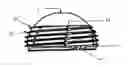
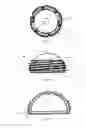
FIGS. 1a, 1b and 1c respectively show a top view, a side view and a transverse cross-section of an acetabulum according to the invention.
FIG. 2 shows an enlarged cross-section view of the screw thread of the acetabulum according to the invention.
FIG. 2a shows an enlarged cross-section view of the portion first coming into contact with the bone in the direction of screwing. FIG. 2b shows an enlarged cross-section view of the portion last coming into contact with the bone in the direction of screwing.
FIGS. 3a, 3b, 3c and 3d respectively show a front view, a cross-section view according to line AA, a bottom view and a side view of a plate for holding the acetabulum according to the invention.
LIST OF REFERENCES
-
- 1. Upper pole
- 20, 21. Double screw thread
- 3. Equatorial periphery of the acetabular component
- 4. Screwing and unscrewing notches
- 5. Height h without osteointegration-promoting coating
- 6, 61, 62. Thread portions located near the upper pole
- 7, 71, 72. Thread portions located near the equatorial periphery
- 8. Bearing face of the plate
- 9. Protuberances
- 10. External face of the acetabulum
- 11. Internal face of the acetabulum
- 12. Interruption of the screw thread.
DESCRIPTION OF THE INVENTION
The invention first relates to an artificial hollow acetabular element (also called acetabulum) in the form of a shell.
The acetabulum according to the invention is preferably made of metal or a metal alloy such as stellites (chromium-cobalt alloys) or stainless steel.
The external portion of the acetabulum according to the invention comprises a screw thread enabling it to be attached in the hip bone. This screw thread is self-tapping.
The screw thread of the acetabulum according to the invention is a screw thread with a double thread 20, 21, as shown in FIGS. 1a, 1b and 1c. The main advantage of such a screw thread with a double thread 20, 21 is that it enables the screw thread pitch to be increased, and therefore the number screwing turns is less than the usual number needed for screwed acetabula of the prior art, thereby enabling quick attachment of the acetabulum in the bone. The acetabulum according to the invention also enables precise attachment of the acetabulum in the bone, owing to the fact that the double screw thread has threads 20, 21 beginning at 180° from one another on pole of the acetabulum as shown in FIG. 1a, thereby facilitating the precise positioning of the acetabulum at the beginning of the screwing.
The threads 20, 21 are interrupted by non-threaded portions 12, so that bone can be removed during tapping caused by positioning of the acetabulum, and so that the bone is again attacked by a cutting edge of the screw thread. There are advantageously 6 non-threaded portions 12, regularly spaced apart over the periphery of the acetabulum as shown in FIGS. 1a and 1b. There may, however, be more or fewer without changing the scope of the invention. Advantageously, the non-threaded portions correspond to more than 25% of the screw thread, measured over the external diameter of the screw thread.
The threads do not have a constant thickness, but have a thickness that increases in the direction of the screwing, from the upper pole 1 to the equatorial periphery 3 of the acetabulum. In addition, as shown in FIG. 2, the thread portions 6 located near the upper pole 1 have sharp substantially triangular cutting edges, and the thread portions 7 located near the equatorial periphery 3 have edges with a rounded or trapezoidal cross-section. The thickness of the threads also increases in the direction of screwing in each of the threaded portions 13 located between the non-threaded portions 12, as shown in FIGS. 2a and 2b. FIG. 2a shows an enlarged cross-section view of the portion first coming into contact with the bone in the direction of screwing. FIG. 2b shows an enlarged cross-section view of the portion last coming into contact with the bone in the direction of screwing.
The fact of having a thin thread with a sharp cutting edge on the side of the pole 1, i.e. on the portion of the screw thread that comes into contact with the bone at the beginning of the screwing of the acetabulum, and also a more cutting portion on the side of each threaded portion 13 first coming into contact with the bone in the direction of screwing, enables effective self-tapping of the bone by the acetabulum according to the invention. The fact of having a thread with a thicker edge on the side of the equator, i.e. at the end of screwing, and also a less cutting portion on the side of each threaded portion 13 last coming into contact with the bone in the direction of screwing, enables better attachment of the acetabulum according to the invention in the bone because, in this way, the threads have a large surface in contact with the bone, and the less cutting shape of the threads produces less mechanical stress in the bone.
The pitch of the screw threads 20, 21 decreases from the upper pole 1 to the equatorial periphery 3 of the acetabular component. The pitch of the threads 20, 21 is between 2 and 5 mm, and preferably between 3 and 4 mm.
The acetabulum according to the invention, generally with an approximately hemispherical shape, is further provided with a cleared upper pole 1, shown in FIGS. 1a, 1b and 1c, so as to prevent problems of hyperpressure in the positioning of the acetabulum in the acetabular cavity of the hip bone.
The acetabulum according to the invention is further provided on its external face 10 with an osteointegration-promoting coating, such as a porous titanium coating associated with a calcium hydroxyapatite coating (not shown). Indeed, calcium hydroxyapatite is a mineral component of the bone that can be chemically produced. The adjacent bone identifies hydroxyapatite as one of its constituents and quickly grows on the coating of the prosthesis, thus ensuring good attachment of the acetabulum in the bone. The role of the titanium is, on the one hand, to form a barrier to the hydroxyapatite, which, without it, would tend to spread into the metal forming the acetabulum, and, on the other hand, to create micro-reliefs ensuring the bony surface anchoring. The calcium hydroxyapatite coating can be obtained by plasma spraying or any other suitable technique known to a person skilled in the art. Similarly, the titanium coating can be obtained by any technique known to a person skilled in the art, such as, for example, plasma spraying, or vapor deposition.
In a strongly preferred embodiment of the acetabular component according to the invention, the osteointegration-promoting coating, such as a titanium and calcium hydroxyapatite coating, is absent over a crown 5 of height h on the equatorial periphery 3 of the acetabulum, so as to prevent a release of material that may cause possible wear by forming a third body in the friction areas. The height h is between 2 and 5 mm, and preferably between 3 and 4 mm.
Finally, the concave internal surface 11 of the acetabulum according to the invention is substantially hemispherical and has a mirror-type polish, obtained by any technique known to a person skilled in the art.
The acetabulum according to the invention can receive either a prosthetic head with a diameter equal to the internal diameter of the shell, or, preferably, a mobile insert, that can be comprised of any material capable of limiting the friction coefficient of the head on the acetabulum and capable of resisting wear, this material preferably being polyethylene. This mobile insert is preferably a substantially hemispherical shell with an external diameter equal to the internal diameter of the shell and an internal diameter equal to that of the prosthetic head received by said insert.
The attachment of the acetabulum according to the invention in the patient's hip bone is performed by means of a plate that enables easy and precise screwing and unscrewing of the acetabulum. The plate is shown in FIG. 3. In addition, screwing and unscrewing notches 4 are present at the periphery of the acetabulum according to the invention, as shown in FIG. 1.
The plate enables the gripping and positioning of the acetabulum in the hip bone. It includes a surface 8 for engagement against the edge of the acetabulum; it also includes projections 9 intended to be engaged and locked in the screwing and unscrewing notches 4 of the acetabulum, so as to enable good gripping of the acetabulum by the plate and effective tightening by screwing or loosening by unscrewing of said acetabulum by means of the plate.
The acetabulum according to the invention is preferably used in association with a femoral element normally comprising a substantially rectilinear stem anchored in the femur and ending with a conical distal end for insertion of the spherical head of variable diameter, and a spherical head placed at the end of the prosthetic neck.
Claims
1. Acetabular component of a hip prosthesis, in which said acetabular component is hollow and has a shell shape, of which the external portion has a screw thread for enabling said acetabular component to be attached in the acetabular cavity of the suitably prepared hip bone, said screw thread comprising an interrupted self-tapping double thread (20, 21), said acetabular component being provided with a cleared upper pole (1), said acetabular component being provided on its external face (10) with an osteointegration-promoting coating, said acetabular component being provided with a substantially hemispherical concave polished internal surface (11), and said acetabular component being characterized in that:
the pitch of the screw threads (20, 21) decreases from the upper pole (1) to the equatorial periphery (3) of the acetabular component,
the thicknesses of the threads (20, 21) increase from the upper pole (1) of the acetabular component to the periphery (3) thereof,
the edge of the threads (20, 21) is cutting on the side of the pole (1) of the acetabular component and rounded or substantially trapezoidal on the side of the equatorial periphery (3) of the acetabular component, and the profile of said edge varies continuously and regularly from the pole (1) to the equatorial periphery (3).
2. Acetabular component according to claim 1, characterized in that said osteointegration-promoting coating is a porous titanium coating associated with a calcium hydroxyapatite coating.
3. Acetabular component according to claim 1 or 2, characterized in that said osteointegration-promoting coating is absent over a crown (5) of height h of between and 5 mm on the equatorial periphery (3) of the acetabulum, and preferably over a height h of between 3 and 4 mm.
4. Acetabular component according to any one of claims 1 to 3, characterized in that it is made of a metal alloy, and preferably a cobalt chromium or stainless steel alloy.
5. Acetabular component according to any one of claims 1 to 4, characterized in that the pitch of the threads (20, 21) is between 2 and 5 mm, and preferably between 3 and 4 mm.
6. Acetabular component according to any one of claims 1 to 5, characterized in that screwing and unscrewing notches (4) are present at the periphery so as to enable the screwing and unscrewing of said acetabulum in the bone by means of a plate.
7. Acetabular component according to any one of claims 1 to 6, characterized in that it also comprises a mobile insert made of a material capable of limiting the friction coefficient of the head on the acetabulum and resisting wear, said material being preferably polyethylene.
8. Plate enabling the positioning by screwing and the removal by unscrewing of the acetabulum according to any one of claims 1 to 7 in the hip bone by gripping by means of screwing/unscrewing notches (4), characterized in that the plate comprises projections (9) intended to cooperate with the notches (4) of said acetabular component so as to enable the acetabular component to be gripped and screwed or unscrewed.
9. Total hip prosthesis including an acetabular component according to any one of claims 1 to 7.
Images & Drawings included:


Sources:
- United States Patent and Trademark Office - verify current appl. status at the USPTO↗
Recent applications in this class:
- » 20250195232 2025-06-19
RESURFACING CUP FOR ACETABULUM HEMIARTHROPLASTY OF THE HIP JOINT - » 20250195231 2025-06-19
IMPLANT COMPONENTS AND METHODS - » 20250152367 2025-05-15
HIP JOINT DEVICE AND METHOD - » 20250143886 2025-05-08
Cemented Sheath For Joint Implant - » 20250120817 2025-04-17
ARTIFICIAL HIP JOINT - » 20250090331 2025-03-20
ACETABULAR CUP AND HIP JOINT PROSTHESIS ASSEMBLY - » 20250082475 2025-03-13
DUAL MOBILITY ACETABULAR COMPONENT - » 20250032263 2025-01-30
ARTIFICIAL ACETABULAR CUP AND MANUFACTURING METHOD THEREOF - » 20250017736 2025-01-16
APPARATUS AND METHOD FOR INSTALLING AN ACETABULAR LINER ON AN ACETABULAR CUP - » 20250017735 2025-01-16
NON-IMPINGING DUAL MOBILITY HIP PROSTHESIS