Neurostimulation method to induce relaxation or sleep
US20110282129A1
2011-11-17
13/101,495
2011-05-05
✅ Patent granted
US 8,702,584 B2
2014-04-22
-
-
John Lacyk
Reinhart Boerner Van Deuren P.C.
2031-12-08
Abstract:
The present invention relates to a method for inducing relaxation or sleep comprising the steps of:
-
- placing electrodes in contact with the forehead skin in the supraorbital region;
- generating an electrical signal with a signal generator and applying said signal to the electrodes so as to produce external, i.e. non invasive, neurostimulation of the upper branch of the trigeminal nerve.
Inventors:
- Pierre-Yves Muller 17 🇨🇭 Collonge-Bellerive, Switzerland
- Pierre Rigaux 17 🇧🇪 Liege, Belgium
Assignee:
- STX-Med Sprl 3 🇧🇪 Liege, Belgium
- Cefaly Technology SPRL 2 🇧🇪 Herstal, Belgium
Applicant:
Interested in similar patents?
Get notified when new applications in this technology area are published.
Classification:
A61N1/0456 » CPC main
Electrotherapy; Circuits therefor; Details; Electrodes for external use; Use-related aspects Specially adapted for transcutaneous electrical nerve stimulation [TENS]
A61N1/36025 » CPC further
Electrotherapy; Circuits therefor; Applying electric currents by contact electrodes alternating or intermittent currents for stimulation; External stimulators, e.g. with patch electrodes for treating a mental or cerebral condition
A61N1/36 IPC
Electrotherapy; Circuits therefor; Applying electric currents by contact electrodes alternating or intermittent currents for stimulation
A61M21/00 IPC
Other devices or methods to cause a change in the state of consciousness; Devices for producing or ending sleep by mechanical, optical, or acoustical means, e.g. for hypnosis
A61N1/00 IPC
Electrotherapy; Circuits therefor
Description
CROSS-REFERENCE TO RELATED PATENT APPLICATIONS
This patent application claims the benefit of U.S. Provisional Patent Application No. 61/333,884, filed May 12, 2010, the entire teachings and disclosure of which are incorporated herein by reference thereto.
FIELD OF THE INVENTION
The present invention pertains to the field of neurostimulation. Neurostimulation is a well-known technique which consists in using electrical impulses to generate action potential on nerves. The devices are usually implantable systems similar to pacemakers.
STX-Med Company has developed a specific device to apply external neurostimulation on the head in order to treat and prevent headaches and migraines. This technique is known as external cranial neurostimulation and is the subject of 2 patent submissions: WO 2006/063417 and US 2009/0210028.
PROBLEM TO BE SOLVED AND PRIOR ART
Generally neurostimulation devices, either implantable or external, are used to treat pain or to obtain muscle contractions. Some implantable systems are used as well for the stimulation of the vagus nerve against epilepsy. The vagal neurostimulation with the implantable systems is known to carry out some hypnotic effect and thus to induce sleep.
Traditional drug therapies intended to induce sleep are associated with drug side effects and tolerance leading sometimes to addiction.
Therefore using a safe technique without side effect to induce or enhance relaxation and/or sleep would be of great advantage. Neurostimulation of the vagus nerve has shown such property but it needs implantable systems, as the vagus nerve is not easily accessible with external neurostimulation.
U.S. Pat. No. 5,540,734 reports an invention in order to stimulate one or both of the trigeminal nerve and the glossopharyngeal nerve. However, this stimulation requires a surgically implantable system.
U.S. Pat. No. 6,954,668 reports an invention in order to stimulate the trigeminal nerve thanks to an apparatus for intra-oral stimulation. But such kind of apparatus is not convenient and easy to use for patients.
AIMS OF THE INVENTION
The invention aims at finding an easy and simple neurostimulation means that can induce relaxation and/or sleep.
Additionnally the invention aims at providing external neurostimulation.
SUMMARY OF THE INVENTION
The present invention relates to a method for inducing relaxation or sleep comprising the steps of:
placing electrodes in contact with the forehead skin in the supraorbital region;
generating an electrical signal with a signal generator and applying said signal to the electrodes so that to produce external, i.e. non invasive, neurostimulation of the upper branch of the trigeminal nerve.
The method according to the invention may further comprise one or a suitable combination of the following characteristics:
the signal generator generates rectangular biphasic impulses having a impulse width between 10 and 500 μs, an impulse frequency between 1 and 150 Hz and an intensity between 1 and 25 mA, said intensity being progressively increased with a slope lower than 40 μA/sec;
the impulse width is about 250 μs;
the impulse frequency is about 120 Hz;
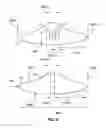
the method is carried out by use of two contact electrodes supported by an elongated symmetrical element, each electrode being in contact with a self-adhesive conductive gel substantially covering the face of the support intended to be applied to the skin (see FIG. 2);
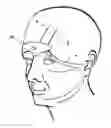
the method is carried out with an electrode support having a shape and size selected so that to allow the excitation of the afferent paths of the supratrochlear and supraorbital nerves of the upper branch of the trigeminal nerve (see FIG. 1).
SHORT DESCRIPTION OF THE DRAWINGS
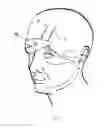
FIG. 1 schematically represents how to stimulate the afferent paths of the supratrochlear and supraorbital nerves of the upper branch of the trigeminal nerve.
FIG. 2 represents more detailed views of a preferred embodiment, reducing constructively the invention to practice.
DETAILED DESCRIPTION OF THE INVENTION AND PREFERRED EMBODIMENTS
According to the present invention, the objective of inducing relaxation and/or sleep is specifically achieved by external, i.e. non invasive, neurostimulation of the trigeminal nerve 1 (supratrochlear nerve 2 and supraorbital nerve 3, see FIG. 1).
Cefaly® device (STX-Med, Herstal, Belgium) uses external supraorbital neurostimulation of the trigeminal nerve thanks to a specifically designed electrode applied on the forehead. A series of experiments and clinical tests was conceived to see if that could induce relaxation and sleep and to establish the appropriate parameters of neurostimulation in the upper branch of the trigeminal nerve.
The device used is a generator of electrical impulses connected with electrodes applied to the forehead skin. Preferred embodiments of this electrode are described in WO 2006/063417 and US 2009/0210028.
According to a preferred embodiment of the invention, the impulses emitted by the generator have the following specific characteristics:
rectangular biphasic impulses with an impulse width between 10 and 500 μs with an optimum at 250 μs;
impulse frequency between 1 and 150 Hz with an optimum at 120 Hz;
intensity between 1 and 25 mA;
progressive increase of the intensity with a slope lower than 40 μA/sec.
According to a preferred embodiment of the invention, the method is carried out with an electrode support 10 designed as a single self adhesive patch 12 with two conductive areas 11 which are the two electrodes. These two electrodes have the size as depicted in FIG. 2.
Claims
1. Method for inducing relaxation or sleep comprising the steps of:
placing electrodes in contact with the forehead skin in the supraorbital region;
generating an electrical signal with a signal generator and applying said signal to the electrodes so as to produce external, i.e. non invasive, neurostimulation of the upper branch of the trigeminal nerve.
2. Method according to claim 1, wherein the signal generator generates rectangular biphasic impulses having a impulse width between 10 and 500 μs, an impulse frequency between 1 and 150 Hz and an intensity between 1 and 25 mA, said intensity being progressively increased with a slope lower than 40 μA/sec.
3. Method according to claim 2, wherein the impulse width is about 250 μs.
4. Method according to claim 2, wherein the impulse frequency is about 120 Hz.
5. Method according to claim 1, wherein it is carried out by use of two contact electrodes supported by an elongated symmetrical element, each electrode being in contact with a self-adhesive conductive gel substantially covering the face of the support intended to be applied to the skin.
6. Method according to claim 5, wherein the electrode support has a shape and size selected so as to allow the excitation of the afferent paths of the supratrochlear and supraorbital nerves of the upper branch of the trigeminal nerve.
Images & Drawings included:
Sources:
- United States Patent and Trademark Office - verify current appl. status at the USPTO↗
Recent applications in this class:
- » 20250269169 2025-08-28
METHODS FOR TRANSCUTANEOUS FACIAL NERVE STIMULATION AND APPLICATIONS THEREOF - » 20250262430 2025-08-21
PREDICTIVE THERAPY NEUROSTIMULATION SYSTEMS - » 20250262429 2025-08-21
APPARATUS AND METHOD FOR CAUSING VASOCONSTRICTION BY ELECTRICAL STIMULATION - » 20250177728 2025-06-05
SELECTIVE NEUROMODULATION APPARATUS - » 20250161665 2025-05-22
WEARABLE, ERGONOMIC NEUROSTIMULATION SYSTEM - » 20250161664 2025-05-22
SYSTEMS AND METHODS FOR PERIPHERAL NERVE STIMULATION - » 20250161663 2025-05-22
DEVICES AND METHODS FOR CONTROLLING TREMOR - » 20250144405 2025-05-08
NON-INVASIVE BRAIN STIMULATION - » 20250135190 2025-05-01
"SMART" ELECTRODE ASSEMBLY FOR TRANSCUTANEOUS ELECTRICAL NERVE STIMULATION (TENS) - » 20250135189 2025-05-01
SYSTEMS AND METHODS FOR PERIPHERAL NERVE STIMULATION
Recent applications for this Assignee:
- » 20140324146 2014-10-30
STAND-ALONE ELECTRONIC APPARATUS AND DEVICE FOR FASTENING THE LATTER TO AN ELECTRODE LOCATED ON THE HEAD OF A PATIENT FOR USE WHEN THE PATIENT IS LYING DOWN - » 20130282095 2013-10-24
Headband for external occipital neurostimulation - » 20070276451 2007-11-29
Apparatus for electro-inhibition of facial muscles