High speed optical interconnects
US20110299813A1
2011-12-08
13/134,328
2011-06-03
Abstract:
An optical interconnect that uses silver, gold, copper or other materials whose refractive index n is less than unity as the transmitting media has been conceived. This optical interconnect will transfer information over short distances faster than electrical conduction and faster than free-space optical transmission. The transfer speed is many times the free-space speed of light.
Interested in similar patents?
Get notified when new applications in this technology area are published.
Classification:
G02B6/43 » CPC main
Light guides; Coupling light guides; Coupling light guides with opto-electronic elements Arrangements comprising a plurality of opto-electronic elements and associated optical interconnections
G02B6/122 » CPC further
Light guides of the optical waveguide type of the integrated circuit kind Basic optical elements, e.g. light-guiding paths
G02B6/4293 » CPC further
Light guides; Coupling light guides; Coupling light guides with opto-electronic elements the light guide being disconnectable from the opto-electronic element, e.g. mutually self aligning arrangements hybrid electrical and optical connections for transmitting electrical and optical signals
G02B6/26 IPC
Light guides; Coupling light guides Optical coupling means
Description
CROSS-REFERENCE TO RELATED APPLICATIONS
Provisional application No. 61/396,894 filed on Jun. 04, 2010.
STATEMENT REGARDING FEDERALLY SPONSORED RESEARCH OR DEVELOPMENT
This invention was made with Government support under contract F36615-03-D-5408 awarded by U.S. Air Force to General Dynamics Information Technology, Inc. who subcontracted to Table Mountain Optics under Task Order No. USAF-5408-23-SC-0010-1 Modification #001. The Government has certain rights in the invention.
FIELD OF THE INVENTION
This invention relates to optical interconnects for chip-to-chip communication. In particular it relates to the use of materials that propagate light faster than the speed of light in optical fibers or even faster than free-space light transmission.
BACKGROUND OF THE INVENTION
As described by Li in U.S. Pat. No. 6,661,943, state of the art microelectronic systems commonly employ multichip modules. A multichip module includes an array of integrated circuit chips that require signal interconnections between the chips. Next-generation computational systems require ever increasing speeds. Using shorter interconnect path lengths and increasing the speed of information over that path are ways to enhance speed.
BRIEF SUMMARY OF THE INVENTION
An optical interconnect that passes information between chips faster than electrical or optical fibers or waveguides has been invented. This interconnect uses silver or some other metal or Nitride to transmit the light between chips. It has been discovered that light travels faster than c, which is the speed of light in a vacuum, when traveling through silver, gold, copper, and some other metals.
BRIEF DESCRIPTION OF THE DRAWINGS
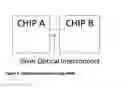
FIG. 1 shows a metal optical interconnection between two chips.
FIG. 2 shows an optical interconnection consisting of metal and dielectric layers.
DESCRIPTION OF THE INVENTION
As described in the book Thin-Film Optical Filters by H. Angus Macleod, third edition, Taylor & Francis, New York (2001) Ch. 2, light energy is transferred as a wave with a velocity v according to the refractive index n of the optical material following the relation v=c/n. It turns out that n for silver is less than unity. This would mean that light travels faster than c in silver. However, silver is a metal that also absorbs light, so it is not clear in the literature that the speed of light in silver would be faster than c. In fact there is a strongly held belief that light and especially information cannot travel faster than c. I have discovered theoretically that although the light is being attenuated, it does not slow down when propagating through small distances in silver and actually speeds up to many times faster than in air. With the ever decreasing distances on chips it has or will become feasible to use silver as an optical interconnect. Light in silver travels eight times faster than in air or vacuum.
Claims
The following claims are made for this invention:1. A method for transferring signals using light propagating through certain optically absorbing materials.
2. The method of claim 1 wherein the material is a metal whose refractive index n is less than unity.
3. The method of claim 1 wherein the material is a nitride whose refractive index n is less than unity.
4. A multichip module that includes an array of integrated circuit chips that uses optical absorbing materials as optical interconnects between the chips.
5. A multichip module of claim 4 wherein the optical interconnect is a metal whose refractive index is less than unity.
6. A multichip module of claim 4 wherein the optical interconnect is a nitride or other material whose refractive index is less than unity.
7. An optical interconnect using metal and dielectric layers as the transmitting media.
8. An optical interconnect that also conducts electrical signals.
Images & Drawings included:


Sources:
- United States Patent and Trademark Office - verify current appl. status at the USPTO↗
Similar patent applications:
- » 20230356655
Decorative light guide as high-speed optical interconnect - » 20100133551
High-speed optical interconnection device - » 20230254048
METHODS AND APPARATUS FOR HIGH-SPEED COHERENT OPTICAL INTERCONNECTS - » 20100322554
Optical interconnection methods for high-speed data-rate optical transport systems - » 20140281199
Optical interconnect in high-speed memory systems - » 20100316391
Optical interconnection arrangement for high speed, high density communication systems - » 20110231618
Optical interconnect in high-speed memory systems - » 20160172020
Optical interconnect in high-speed memory systems - » 20120288233
Optical interconnection assemblies and systems for high-speed data-rate optical transport systems - » 20100322562
Optical interconnection assemblies and systems for high-speed data-rate optical transport systems
Recent applications in this class:
- » 20250172777 2025-05-29
CO-PACKAGED OPTICS DEVICE AND OPTO-ELECTRONIC MODULE - » 20250164723 2025-05-22
APPARATUS AND METHOD FOR SUPPORTING OPTICAL ALIGNER - » 20250130384 2025-04-24
PHOTONICS PACKAGE INTEGRATION - » 20250123458 2025-04-17
Photonic Semiconductor Device and Method of Manufacture - » 20250116831 2025-04-10
OPTICAL COUPLING STRUCTURE AND METHOD FOR MANUFACTURING THE SAME, AND OPTICAL COMMUNICATION SYSTEM - » 20250110303 2025-04-03
APPARATUS AND METHODS FOR OPTICAL INTERCONNECTS - » 20250093600 2025-03-20
INTEGRATION OF OE DEVICES WITH ICS - » 20250085496 2025-03-13
PHOTONIC INTEGRATED CIRCUIT CHIP - » 20250076601 2025-03-06
OPTICAL RECEIVING MODULE ASSEMBLY - » 20250044537 2025-02-06
TUNABLE EDGE-COUPLED INTERFACE FOR SILICON PHOTONIC INTEGRATED CIRCUITS (PICs) AND METHOD FOR MAKING SAME