Method and arrangement for the imaging representation of information, particularly for use with communication terminals
US20120002802A1
2012-01-05
13/063,988
2009-09-18
✅ Patent granted
US 8,520,819 B2
2013-08-27
WO; PCT/EP2009/006769; 20090918
WO; WO2010/034437; 20100401
Alexander Jamal
Buchanan Ingersoll & Rooney PC
2029-11-13
Abstract:
The invention relates to a method and to an arrangement for the imaging representation of information, particularly for use with communication terminals. The arrangement comprises an image output device having at least one first partial region and at least one second partial region, wherein the first partial region is designed such that the representation of the information is optimized for high-quality imaging and the second partial region is designed such that it is optimized for lower-quality imaging. According to the method, the first partial region is activated when data is present for output using high-quality imaging, while the second partial region is always actively operated.
Inventors:
- Stephan Schaade 22 🇩🇪 Buchloe, Germany
- Karl Klug 33 🇩🇪 Miesbach, Germany
- Jurgen Brieskorn 12 🇩🇪 Geltendorf, Germany
- Edmund ERNST 6 🇩🇪 München, Germany
Assignee:
- Siemens Enterprise Communications GmbH &Co. KG 149 🇩🇪 Munich, Germany
Applicant:
Interested in similar patents?
Get notified when new applications in this technology area are published.
Classification:
G06F3/1423 » CPC main
Input arrangements for transferring data to be processed into a form capable of being handled by the computer; Output arrangements for transferring data from processing unit to output unit, e.g. interface arrangements; Digital output to display device ; Cooperation and interconnection of the display device with other functional units controlling a plurality of local displays, e.g. CRT and flat panel display
H04W52/027 » CPC further
Power management, e.g. TPC [Transmission Power Control], power saving or power classes; Power saving arrangements in terminal devices managing power supply demand, e.g. depending on battery level by controlling user interface components by controlling a display operation or backlight unit
G09G3/342 » CPC further
Control arrangements or circuits, of interest only in connection with visual indicators other than cathode-ray tubes for presentation of an assembly of a number of characters, e.g. a page, by composing the assembly by combination of individual elements arranged in a matrix no fixed position being assigned to or needed to be assigned to the individual characters or partial characters by control of light from an independent source; Control of illumination source using several illumination sources separately controlled corresponding to different display panel areas, e.g. along one dimension such as lines
G09G2320/103 » CPC further
Control of display operating conditions; Special adaptations of display systems for operation with variable images Detection of image changes, e.g. determination of an index representative of the image change
G09G2330/021 » CPC further
Aspects of power supply; Aspects of display protection and defect management; Details of power systems and of start or stop of display operation Power management, e.g. power saving
G09G2330/022 » CPC further
Aspects of power supply; Aspects of display protection and defect management; Details of power systems and of start or stop of display operation; Power management, e.g. power saving in absence of operation, e.g. no data being entered during a predetermined time
G09G2340/0407 » CPC further
Aspects of display data processing; Changes in size, position or resolution of an image Resolution change, inclusive of the use of different resolutions for different screen areas
G09G2360/04 » CPC further
Aspects of the architecture of display systems Display device controller operating with a plurality of display units
H04M1/0266 » CPC further
Substation equipment, e.g. for use by subscribers; Constructional features of telephone sets; Portable telephone sets, e.g. cordless phones, mobile phones or bar type handsets; Details of the structure or mounting of specific components for a display module assembly
H04M2250/16 » CPC further
Details of telephonic subscriber devices including more than one display unit
Y02D30/70 » CPC further
Reducing energy consumption in communication networks in wireless communication networks
Y02D30/70 » CPC further
Reducing energy consumption in communication networks in wireless communication networks
H04M1/00 IPC
Substation equipment, e.g. for use by subscribers
H04M3/42 IPC
Automatic or semi-automatic exchanges Systems providing special services or facilities to subscribers
Description
CROSS-REFERENCE TO RELATED APPLICATIONS
This application is the United States national phase under 35 U.S.C. §371 of PCT International Patent Application No. PCT/EP2009/006769, filed on Sep. 18, 2009 and claiming priority to German Patent Application No. 10 2008 048 447.4, filed on Sep. 23, 2008.
BACKGROUND OF THE INVENTION
1. Field of the Invention
Embodiments relate to a system for the imaging representation of information, particularly for use with communication terminals as well as a method for the imaging representation of information, particularly for use with communication terminals.
2. Background of the Related Art
It is known that communication devices include screens for representing information. Operating these screens increases the energy consumption of the communication device.
Energy production and use are increasingly being addressed, however, not only due to the cost, but recently also in the context of discussions about global warming and generally about the efficient use of resources.
This in the meantime has also led to legal regulations, but also to a change in purchasing behavior which further requires optimization of energy requirements.
For this reason, the issue of energy savings has become increasingly important with regard to communication systems as well, in particular for devices in this field with power cords.
BRIEF SUMMARY OF THE INVENTION
Embodiments of the invention provide an arrangement and a method to improve the energy requirements of electronic devices, in particular devices related to communication technology.
In a preferred embodiment for imaging representation of information, in particular for use with communication terminals, the arrangement comprises an image output device having at least one first partial region and at least one second partial region, wherein the first partial region is designed such that the representation of the information is optimized for high-quality imaging and the second partial region is designed such that it is optimized for lower-quality imaging.
Embodiments are based on the knowledge that many devices, especially in an office environment, sometimes use energy unnecessarily, when the user is not present.
It was also recognized that, in particular for telephones, the constant development of new functions was increasing the requirements for information representation, necessitating higher-resolution displays for various applications. Such displays are driving power consumption even higher. The invented arrangement reduces this effect, because it allows the imaging device, in particular a display, to be divided into regions with two different representation concepts.
This makes it possible to save energy by selectively optimizing screen usage depending on the current use. For example, data that are often or even permanently displayed, such as date and time or the direct dial number assigned to the terminal, can be shown in the region that offers lower resolution.
In an advantageous further embodiment of the invention, the first partial region is designed such that optimization for high-quality imaging is produced through a first type of backlighting, and the second partial region is designed such that optimization for lower-quality imaging is achieved through a second type of backlighting. This involves discerning between content that can be presented almost or even entirely without backlighting, simply using the contrast of the display output against the background, such as display outputs of alphanumeric characters and symbols on monochromatic LCDs, and content whose details would be more difficult to recognize without backlighting, such as graphics, pictures, and combinations of these with alphanumeric characters.
According to an additional embodiment of the invention, the first partial region is designed such that the brightness of the backlighting can be reduced automatically. This can involve a control function that adjusts the lighting without input from a user and reduces the brightness after the display has not changed for a preset length of time, for example.
Preferably, an embodiment can further include having the first partial region designed such that it can be switched on and off according to a power-saving regimen. This would involve flexible and adaptive power-saving processes with preset or adjustable scenarios that could be optimized for the type of use and/or environment.
In another preferred embodiment, the first partial region is designed such that the power-saving regimen involves at least partial shutdown of at least part of the first partial region. This guarantees maximum power savings. These measures can be incorporated, for example, by a power regimen when the usage log for functions that require a higher-quality image output shows that they have not been used for a long period of time or that the displayed content has not changed for a long period of time.
In an alternative or expanded further embodiment, the first partial region is designed such that optimization to high-quality imaging is produced through a first type of high-resolution display for image content, and the second partial region is designed such that optimization to lower-quality imaging is achieved through a second type of low-resolution display. This allows a greater amount of freedom in setting the power requirement, with simultaneous consideration of the required display quality.
With an embodiment of the invented method for imaging representation of information, in particular for use with communication terminals, in an image output device having at least one first partial region and at least one second partial region, the first partial region is activated when data suited to output with high-quality imaging are present, while the second partial region is always actively operated.
An embodiment allows energy savings while simultaneously guaranteeing the availability of a minimum information display, of often used or current information, for example, that is displayed by communication terminals.
If the first partial region is at least partially deactivated after outputting the relevant data, the high-quality display can be switched on or off as needed.
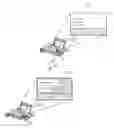
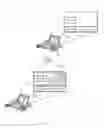
Additional advantages and details about embodiments of the invention are explained using the exemplary embodiments of the invention shown in the following figure. Shown in the figure is a diagram of an example of the invention in two situations according to the invention.
BRIEF DESCRIPTION OF THE FIGURE
The figure shows a diagram of an example of the invented method and the invented arrangement.
DETAILED DESCRIPTION OF THE INVENTION
The FIGURE shows a telephone P with a display. This display is divided into a first segment S1_1, S1_2 and a second segment S2_1, S2_2.
According to an embodiment of the invention, the first segment S1_1, S1_2 is suitable for outputting information that requires a higher level of quality for its display.
For this example, the figure shows a menu, from which other menus could be made to appear by selecting one of the items, for example, so that the sequence would branch more and more finely and therefore generate higher display quality requirements. According to embodiments of the invention, this type of data would be appropriate for outputting in the first segment S1_1, S1_2.
Here, at a first point in time Ti at which the menu is called up, the first segment is brought from an unlit status (S1_1) to a status in which the display lighting is switched on (S1_2).
The figure also shows the fact that both before and after the first point in time T1, the second segment S2_1, S2_2 is outputting information with unchanged quality. According to the example, this information consists of the time, date, and telephone number of the telephone P. This information can be displayed with lower resolution and does not require any backlighting. Here it is assumed that the arrangement according to the second segment S2_1, S2_2 according to the example consists of a monochromatic LCD screen.
If the menu is not used for a longer period of time, the first segment S1_1, S1_2 goes back to its original status at a second point in time T2. This means that the backlighting is switched off for the first segment S1_1, S1_2.
It is also conceivable that the user could actively induce that status. As an alternative or addition, the display can also be controlled such that various energy-saving regimens are preset, so that a wide variety of circumstances can be preset to trigger the backlighting being switched on or off.
In addition, the energy-saving regimen can include gradual reduction of the display lighting. This allows the user to react before the screen lighting is completely switched off. A timer can also be set for this, so that power is reduced during operation pauses but a minimum operating comfort level is still guaranteed, wherein the user does not have to wait for the backlighting to switch on and does not have to do anything other than make the next menu selection in order to activate it.
The invention-related advantage is based on the assumption that in many cases when the telephone is in standby status, it is sufficient for it to display only a few items of important information.
A fundamental element of the invention is therefore the segmentation of the display for this purpose. According to the invention, the arrangement example involves a division into the first segment S1_1, S1_2 using standard commercially available backlighting, to which energy-saving technology such as switching off or dimming can be added, and the second segment S2_1, S2_2 using alternative backlighting based on LED technology or monochromatic LCD with lower power consumption. The latter segment then shows the display content, as explained, which must always be present based on the user's wishes or factory settings, such as date, time, caller and/or that phone's number, etc.
The segments can be arranged in a device either together or separated by space. For example, the lower-quality display can be integrated into the speaker while the display with higher-quality output is in the device. As an alternative, they can also both be in one unit with sufficient space.
In addition to branching menus, if brighter graphic content is needed or required, the portion of the display in energy-saving mode is also reactivated, so that according to the invention the otherwise customary high power consumption is limited just to this use time, which drastically reduces energy requirements.
Claims
1. A system for imaging representation of information, for use with communication terminals, comprises an image output device having at least one first partial region and at least one second partial region, wherein the first partial region is optimized for representation of information through high-quality imaging and the second partial region is optimized for representation of information through lower-quality imaging.
2. The system of as in claim 1, wherein the first partial region has a first type of backlighting, and wherein the second partial region has a second type of backlighting.
3. The system of claim 2, wherein the first partial region is designed such that the brightness of the first type of backlighting can be reduced automatically.
4. The system of claim 1, wherein the first partial region is switched on and off according to an energy-saving regimen.
5. The system of claim 4, wherein the energy-saving regimen involves at least partial shutdown of at least part of the first partial region.
6. The system of claim 4, wherein the first partial region comprises a first type of high-resolution image content display, and the second partial region comprises a second type of lower-resolution display.
7. A method for imaging representation of information, in particular for use with communication terminals comprising, in an image output device having at least one first partial region and at least one second partial region, activating the first partial region when data suited to output with high-quality imaging are present, and continuously operating the second partial region.
8. The method of claim 7, comprising at least partially deactivating the first partial region after the output of data.
Images & Drawings included:
Sources:
- United States Patent and Trademark Office - verify current appl. status at the USPTO↗
Recent applications in this class:
- » 20250291537 2025-09-18
DISPLAY APPARATUS FOR VEHICLES WITH ENHANCED DATA TRANSMISSION EFFICIENCY - » 20250291536 2025-09-18
MULTIPLE DISPLAYS IN A FULL-FACE RESPIRATORY PROTECTED FACEPIECE - » 20250284446 2025-09-11
DISPLAY CONTROL DEVICE, DISPLAY CONTROL SYSTEM, DISPLAY CONTROL METHOD, AND RECORDING MEDIUM - » 20250284445 2025-09-11
VEHICLE DISPLAY CONTROL DEVICE AND VEHICLE DISPLAY CONTROL METHOD - » 20250278231 2025-09-04
Data Display Method and System, and Electronic Device - » 20250272042 2025-08-28
TECHNIQUES FOR COORDINATING THE DISPLAY OF INFORMATION BETWEEN A PLURALITY OF ELECTRONIC DEVICES, AND SYSTEMS AND METHODS OF USE THEREOF - » 20250265029 2025-08-21
ELECTRONIC SYSTEM FOR PRODUCING A COORDINATED OUTPUT USING WIRELESS LOCALIZATION OF MULTIPLE PORTABLE ELECTRONIC DEVICES - » 20250265028 2025-08-21
VEHICLE-MOUNTED DEVICE, IMAGE DISPLAY METHOD, AND STORAGE MEDIUM - » 20250251892 2025-08-07
METHOD FOR SWITCHING DISPLAY DEVICE TO PRESET MODE, AND ASSOCIATED DEVICES THEREOF - » 20250244940 2025-07-31
COUPLING STATE DETECTION METHOD, DISPLAY SYSTEM, AND DISPLAY DEVICE
Recent applications for this Assignee:
- » 20150036690 2015-02-05
Apparatus and method for communications involving a legacy device - » 20140294171 2014-10-02
Multi-node predictive dialing for scalability - » 20140129947 2014-05-08
Method, device, and system for providing indicia on a display - » 20140122093 2014-05-01
Method for carrying out an audio conference, audio conference device, and method for switching between encoders - » 20140046762 2014-02-13
Marketing Method and Communication System for Implementing the Marketing Method - » 20140040426 2014-02-06
METHOD FOR CALLING UP A MEDIA FILE IN A TELECOMMUNICATION SYSTEM, COMPUTER PROGRAM PRODUCT FOR EXECUTING THE METHOD, AND TELECOMMUNICATION SYSTEM FOR CALLING UP THE MEDIA FILE - » 20140016455 2014-01-16
Method, device, and system for providing a survivability gateway service - » 20130242808 2013-09-19
Method, terminal and voice memory for storing voice messages in a communication network - » 20130185554 2013-07-18
METHOD FOR ANALYZING CODED DATA STREAMS SIMULTANEOUSLY TRANSMITTED IN IP NETWORKS - » 20130185425 2013-07-18
Method for optimizing network performance after a temporary loss of connection