Equipment bag and skate/shoe tying stool combination
US20120006866A1
2012-01-12
12/690,581
2010-07-08
Abstract:
Hockey bag meets shoe-fitting stool. This invention is an equipment bag that converts to a stool with a ramped platform intended to aid an adult in the process of tying a child's skates. No assembly is required, the exterior bag material is built around the interior stool and ramped platform. The adult sitting on the stool facing the child can comfortably help put on and tie the child's skates. This device is intended to work for adults tying children's skates' the way a shoe salesman aids in tying a customer's shoes. This is a one-unit device; all parts are contained in the skeleton of the bag.
Inventors:
- John Joseph Creamer 1 🇺🇸 Wilmette, IL, United States
- Mark Gerard Creamer 1 🇺🇸 Wilmette, IL, United States
Interested in similar patents?
Get notified when new applications in this technology area are published.
Classification:
A45C9/00 » CPC main
Luggage or bags convertible into objects for other use Purses,
A45C2009/002 » CPC further
Luggage or bags convertible into objects for other use Purses, into a seat
A45F4/02 IPC
Travelling or camp articles which may be converted into articles for other use; Sacks or packs carried on the body and convertible into other articles or into objects for other use Sacks or packs convertible into other articles or into objects for other use
Description
The invention is an equipment-carrying bag with a shoe-fitting stool type device contained within the bag. This invention has two purposes: one, to carry sports equipment, and two, to aid an adult in the tying of a child's skates (or shoes). After the bag is emptied of equipment and flipped upside down the adult sits on the stool structure of the invention and the child sitting on a bench or chair opposite and facing the adult places his/her feet with untied skates or shoes on the ramped platform. The adult then ties the skates or shoes similar to how a shoe salesman uses a shoe-fitting stool when helping a costumer try on shoes. The philosophy behind this invention is to aid the adult in the process of tying a child's skates.
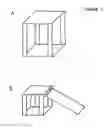
The stool-structure is composed of four equal sized legs with a solid plank on both the top and bottom (see FIG. 1 A.) A flat plank (which acts as the ramped platform where the child's feet rest) is sewn into the base of the bag. The stool and ramp are connected simply as a byproduct of being bottom of the bag. There is a stitched seam between the two that acts as a hinge. The stool structure is encased in its own pieces of bag fabric and the plank is encased in its own pieces. There are fabric flap extensions at the point where the two independent structures meet which will be sewn together and the seam will act as a hinge. This hinge provides the necessary angle for the platform that the child rests his/her feet on. The stool and plank units are encased completely within the bag. These are then sown to the interior of the bag and the design is complete and one unit. The bag opens and closes with a zipper along the top of the, like a typical hockey bag. The exterior of the bag has two shoulder/carrying straps and different versions of the bag would have wheels on the bottom and a handle bar extension for easier carrying.
DIAGRAM KEY
-
- A. An independent view of the stool structure
- B. A view of the stool structure plus ramped platform independent from the bag
-
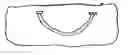
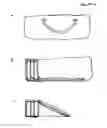
- A. An exterior view of the bag with shoulder straps
- B. An x-ray image to see the inner workings of the bag
- C. The bag flipped upside down to show how the platform is ramped and to portray the essence and function of the invention.
Note: Dashed lines resemble stitching.
Claims
1. There is no equipment bag (or any carrying bag) in existence with an interior structural design containing a ramped platform and a stool-like seat.
2. The intention of this invention is to make it easier for an individual to put on and tie a child's skates. There is no such bag in existence designed to aid in the process of applying sports equipment, particular to this case, ice/roller skates.
Images & Drawings included:
Sources:
- United States Patent and Trademark Office - verify current appl. status at the USPTO↗
Recent applications in this class:
- » 20250082077 2025-03-13
MULTIPURPOSE BAG TABLE APPARATUS - » 20240381989 2024-11-21
BULLETPROOF, STAB-PROOF, AND CUT-PROOF BAG - » 20240341426 2024-10-17
LUGGAGE SYSTEM WITH REMOVABLE CARRYING BAG AND COMPRESSION SYSTEM - » 20240335017 2024-10-10
Briefcase table assembly - » 20240306781 2024-09-19
SPORTS BALL BIN WITH SEAT - » 20240298764 2024-09-12
PORTABLE HOME CARE ORGANIZATION SYSTEM AND METHOD - » 20240298763 2024-09-12
CONVERTIBLE SUITCASE STROLLER APPARATUS - » 20240298762 2024-09-12
LUGGAGE CASE - » 20240188697 2024-06-13
CONTAINMENT MAT THAT CONVERTS TO LUGGAGE WITH SECURE SEAL - » 20240172848 2024-05-30
MULTI-FUNCTION ARTICLE INCLUDING TOTE BAG