BUILDING CONSTRUCTION PART AND ITS USE, AS WELL AS THE METHOD TO MANUFACTURE THE PART
US20120114911A1
2012-05-10
13/376,234
2010-06-02
Abstract:
A building construction part which includes several dimensionally exact pieces made by milling, sawing, cutting or otherwise removing, which are free-form in appearance and attached on top of each other to form a structurally rigid construction part. A method to manufacture the building construction part is also described.
Interested in similar patents?
Get notified when new applications in this technology area are published.
Classification:
E04B1/18 » CPC main
Constructions in general; Structures which are not restricted either to walls, e.g. partitions, or floors or ceilings or roofs Structures comprising elongated load-supporting parts, e.g. columns, girders, skeletons
B27M3/0053 » CPC further
Manufacture or reconditioning of specific semi-finished or finished articles of composite or compound articles characterised by oblong elements connected laterally using glue
B27M3/08 » CPC further
Manufacture or reconditioning of specific semi-finished or finished articles of specially shaped wood laths or strips
E04B2/702 » CPC further
Walls, e.g. partitions, for buildings; Wall construction with regard to insulation; Connections specially adapted to walls walls of framework or pillarwork Load-bearing ; Walls incorporating load-bearing elongated members with elongated members of wood with integrated supporting and obturation function with longitudinal horizontal elements
Y10T428/24612 » CPC further
Stock material or miscellaneous articles; Structurally defined web or sheet [e.g., overall dimension, etc.] including variation in thickness Composite web or sheet
Y10T428/24628 » CPC further
Stock material or miscellaneous articles; Structurally defined web or sheet [e.g., overall dimension, etc.] Nonplanar uniform thickness material
B32B21/04 IPC
Layered products comprising a layer of wood, e.g. wood board, veneer, wood particle board comprising wood as the main or only constituent of a layer, next to another layer of a
B32B21/14 IPC
Layered products comprising a layer of wood, e.g. wood board, veneer, wood particle board comprising wood board or veneer
B32B3/28 IPC
Layered products comprising a layer with external or internal discontinuities or unevennesses, or a layer of non-planar form ; Layered products having particular features of form characterised by a particular shape of the outline of the cross-section of a continuous layer; characterised by a layer with cavities or internal voids ; characterised by an apertured layer characterised by a layer comprising a deformed thin sheet, i.e. the layer having its entire thickness deformed out of the plane , e.g. corrugated, crumpled
B27M1/00 IPC
Working of wood not provided for in subclasses - , e.g. by stretching
Description
A building construction part and its use, as well as the method to manufacture the part
The object of this patent is a method to manufacture a building construction part or a building element as well as a building element made using this method and how it can be used.
The known wooden building construction parts: the walls, ceiling or floor usually have structures which have a separate supporting structure with covering and insulating structures which are attached to the supporting structure with fastening systems. In addition to this, due to the manufacturing methods and measuring of wooden construction standard parts, these building construction parts are mainly rectangular building construction parts, made of straight boards or other rectangular building construction parts of different strengths. If a free-form building construction part is required, it is made of a separate frame and bent wooden boards or battens.
The object of this invention is to remove this restriction and to achieve a wooden building element, which has a wave shaped appearance and which is at the same time supporting and rigid without a separate supporting or stiffening structure.
This object can be achieved when the building element is made of wooden pieces being exactly dimensioned wave shaped pieces separated from a wooden board, especially a Kerto, i.e. a laminated veneer lumber (LVL) board by milling, sawing, cutting or in any other way, which pieces when attached on top of each other form a structurally rigid building element, which can be used as a supporting outer wall or partition wall, a roof, an intermediate floor or a base floor of a builidng, or as another building construction part, in such a way that it is either rigid and supporting or only rigid due to its manufacture, in which case it can be attached to the supporting frame of the building. The shaped pieces, which form a building element after they are attached to each other, can be of the same shape or of a different shape. Attached on top of each other in this application means that the straight level surfaces of the shaped pieces are attached to each other horizontally. The rigidity and supportiveness required with the manufacturing process is achieved by using wave shaped curved shapes and by increasing the material thickness of the construction piece at required places.
The material thickness of a building element or a piece in this application means the measure of the building element or piece vertically against the board's cutting direction when level with the sheet, and it is hereby called horizontal material thickness or material thickness on a horizontal level. The wave shaped pieces are attached to each other mainly by gluing or using other fastening systems.
The glue being used is determined according to the purpose of use of the building element and according to the wooden board being used. Due to this method the shape of the building element is wave shaped. Usually the wooden board to be used is plywood, adhesive wooden board, Kerto i.e laminated veneer lumber (LVL) or a woodchip board. The board thicknesses vary between 20 mm and 75 mm depending on the board. The building construction part in this invention can be either a separately designed and measured unique piece, or a standardised part.
The characteristics for the building element according to the invention are presented in the characterizing part of the claim 1, and for the method according to the invention in the characterizing part of the claim 6.
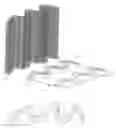
The following describes the invention in more detail by referring to the FIGS. 1, 2 and 3, which describe three different applications for the building element.
FIG. 1: the building element, here a wall (3), is made of 60 pieces milled from 51 mm thick Kerto boards (2), which are pieces (1) of similar shape of an even material strength and which are glued together. The curvature of the milling form is sufficient to make sure that the structure is rigid and supportive. The calculated definition for the bearing capacity and rigidity must be always performed separately for each building element in order to achieve the sufficient and satisfactory standard.
FIG. 2: the building element, here a wall (3), is made of 60 pieces milled from 51 mm thick Kerto boards (2), which are pieces of similar shape (1) and glued together. The milling shape curvature and the increases (4) made to the material thickness used as additional reinforcement at required points, are sufficient to ensure that the structure is rigid and supportive. The calculated definition for the bearing capacity and rigidity must be always performed separately for each building element in order to achieve the sufficient and satisfactory standard.
FIG. 3: the building element, here a wall (3), is made of 60 pieces milled from 51 mm thick Kerto boards (2), which are pieces of similar shape (1) and glued together. The curvature and the cell-like structure of the milling shape with attachment points (4) binding the outer and inner frame are sufficient to ensure that the structure is rigid and supportive. The calculated definition for the bearing capacity and rigidity must be always performed separately for each building element in order to achieve the sufficient and satisfactory standard.
The building elements of the invention can have openings, smaller drillings and lead-ins, which serve house construction requirements, for example, and can be openings such as those for a window or a door. With cell-structure the cell can be used separately as a place for insulation material.
Claims
1-9. (canceled)
10. A building element (3) comprising a plurality of wooden pieces (1) attached on top of each other, characterized in that said wooden pieces (1) are exactly dimensioned wave shaped pieces (1) separated from a wooden board (2), especially a Kerto, i.e. a laminated veneer lumber (LVL) board by milling, sawing, cutting or in any other way, which pieces (1) when attached on top of each other form a structurally rigid building element (3).
11. A building element according to the claim 10, characterized in having an increased horizontal material thickness at required places.
12. A building element according to claim 11, characterized in that the exactly dimensioned piece (1) has a cellular structure, whereby the places (4) having an increased material thickness are bars connecting the outer and inner walls of the piece (1).
13. A building element according to claim 10, characterized in that the exactly dimensioned pieces (1) have been attached to each other by gluing.
14. A building element according to claim 11 characterized in that the exactly dimensioned pieces (1) have been attached to each other by gluing.
15. A method for manufacturing a building element according to claim 10, characterized in that exactly dimensioned wave shaped pieces (1) are milled, sawn, cut or otherwise removed from a wooden board (2), especially a Kerto, i.e. a laminated veneer lumber (LVL) board , and attached on top of each other to form a structurally supportive building element (3).
16. A method according to claim 15, characterized in that the exactly dimensioned pieces (1) are selected in such a way that the pieces (1), when attached on top of each other, increase the horizontal material thickness of the building element (3) at required places.
17. A method according to claim 15, characterized in that the exactly dimensioned pieces (1) are attached to each other by gluing.
18. A method according to claim 16, characterized in that the exactly dimensioned pieces (1) are attached to each other by gluing.
Images & Drawings included:
Sources:
- United States Patent and Trademark Office - verify current appl. status at the USPTO↗
Recent applications in this class:
- » 20220228358 2022-07-21
Interior Construction Structures and Systems - » 20180023283 2018-01-25
Building construction - » 20160201313 2016-07-14
High-rise architectural structure and maintenance method therefor - » 20140196394 2014-07-17
MODULAR THERMAL ISOLATION BARRIER FOR DATA PROCESSING EQUIPMENT STRUCTURE - » 20130333322 2013-12-19
Counteracting uplift in building superstructures - » 20130255184 2013-10-03
Double axis frame strut - » 20130239515 2013-09-19
Hybrid top chord bearing framing system - » 20130067747 2013-03-21
METHOD OF MARKING TRUSS SYSTEMS - » 20120198783 2012-08-09
Systems of modular ready to assemble structures and relevant finished buildings - » 20110107712 2011-05-12
Factory building assembly structure and method for assembling factory building using the same