Method for classifying an object as an obstacle
US20120130628A1
2012-05-24
13/258,694
2010-01-14
✅ Patent granted
US 8,731,816 B2
2014-05-20
WO; PCT/DE2010/000028; 20100114
WO; WO2010/121584; 20101028
Thomas Tarcza | Harry Oh
W. F. Fasse
2030-07-28
Abstract:
A method for classifying objects into obstacles and non-obstacles for a vehicle is described. The vehicle comprises a sensor for covering the surroundings that detects stationary and moving objects in a scene in front of a vehicle. Where required, the path of the motion of the objects is tracked. The method provides one or several observers, wherein one observer classifies an object according to predetermined features and contributes to an overall classification result when there are several observers. An observer detects the path of the motion of vehicles in the surroundings of at least one stationary object and classifies the stationary object in dependence thereon.
Inventors:
- Martin Randler 19 🇩🇪 Immenstaad, Germany
- Tobias STEPHAN 3 🇩🇪 Wasserburg, Germany
- Philippe Dintzer 1 🇩🇪 Lindau, Germany
- Nele Hanel 1 🇩🇪 Bodolz, Germany
Assignee:
- CONTI TEMIC MICROELECTRONIC GMBH 83 🇩🇪 Nuernberg, Germany
- CONTI TEMIC MICROELECTRONIC GMBH 261 🇩🇪 Nuremberg, Germany
Applicant:
Interested in similar patents?
Get notified when new applications in this technology area are published.
Classification:
G01S13/52 » CPC main
Systems using the reflection or reradiation of radio waves, e.g. radar systems; Analogous systems using reflection or reradiation of waves whose nature or wavelength is irrelevant or unspecified; Systems using reflection of radio waves, e.g. primary radar systems; Analogous systems; Systems of measurement based on relative movement of target Discriminating between fixed and moving objects or between objects moving at different speeds
G01S13/931 » CPC further
Systems using the reflection or reradiation of radio waves, e.g. radar systems; Analogous systems using reflection or reradiation of waves whose nature or wavelength is irrelevant or unspecified; Radar or analogous systems specially adapted for specific applications for anti-collision purposes of land vehicles
G08G1/165 » CPC further
Traffic control systems for road vehicles; Anti-collision systems for passive traffic, e.g. including static obstacles, trees
G08G1/166 » CPC further
Traffic control systems for road vehicles; Anti-collision systems for active traffic, e.g. moving vehicles, pedestrians, bikes
G01S17/931 » CPC further
Systems using the reflection or reradiation of electromagnetic waves other than radio waves, e.g. lidar systems; Lidar systems specially adapted for specific applications for anti-collision purposes of land vehicles
G08G1/16 IPC
Traffic control systems for road vehicles Anti-collision systems
G06F17/10 IPC
Digital computing or data processing equipment or methods, specially adapted for specific functions Complex mathematical operations
G06G7/78 IPC
Devices in which the computing operation is performed by varying electric or magnetic quantities; Analogue computers for specific processes, systems or devices, e.g. simulators for direction-finding, locating, distance or velocity measuring, or navigation systems
Description
The invention relates to a method for object classification for the use in a vehicle with a driver assistance system.
Motor vehicles are being increasingly equipped with driver assistance systems that cover the surroundings by means of sensor systems, detect traffic situations and support the driver, e.g., by a braking intervention or a steering intervention or by outputting a warning. The correct classification of surrounding objects for ensuring that the driver assistance system only reacts to real obstacles is particularly important.
The object of the invention is to describe a method for classifying objects into obstacles and non-obstacles.
This object is basically achieved by means of a method according to the features of claim 1.
A method for classifying objects into obstacles and non-obstacles for a vehicle with a sensor for covering the surroundings is claimed, wherein said sensor for covering the surroundings detects stationary and moving objects in a scene in front of a vehicle. A sensor for covering the surroundings is, e.g., a radar sensor or a lidar sensor or a camera sensor. The method for the automatic classification of objects from sensor data is preferably provided in an evaluation unit in the vehicle. Since an object staying in the covered region for a corresponding period of time is detected several times, the path of the motion of an object is recorded where required (the object is tracked). The method provides at least one observer. In an advantageous realization, more than one observer contribute to the overall classification result. One observer classifies an object according to predetermined features, thus confirming the classification result of other observers where required.
In an advantageous realization of the invention, an observer detects the path of the motion of an object that has been identified as a vehicle, in particular in the surroundings of at least one stationary object. In dependence thereon, the stationary object is classified. If there is, e.g., a stationary object on the path of a vehicle driving ahead and if the vehicle still passes this object, it must be possible to drive over or under this object. In a further exemplary embodiment, the course of the velocity of a vehicle driving ahead is evaluated. An intensive slowing-down of the vehicle in the immediate surroundings of the object indicates that the object is an obstacle.
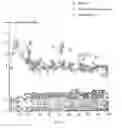
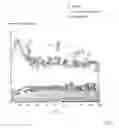
A further realization of the invention provides an observer that describes the distribution of a mean maximum confirmation density of an object in dependence on the longitudinal distance between the object and the sensor for covering the surroundings. For this purpose, the various reflections from an object are accumulated over time and incremented. Said accumulation is called “confirmation density” and stored in a tracker. In this way, said confirmation density is connected to the object position. The observer will be explained in greater detail on the basis of an exemplary embodiment and of FIG. 1. The sensor for covering the surroundings detects an object that is located in front of the sensor vehicle and transversely to the roadway and has a shape and a width that could correspond to a vehicle on the roadway (obstacle) or to a guide sign gantry (non-obstacle). The FIGURE shows the mean maximum confirmation density over the object distance for a guide sign gantry above the roadway and for a vehicle on the roadway. A distinct separating line is formed over the distance. Said separating line enables obstacles to be separated from non-obstacles. If the object is a vehicle (obstacle on the roadway), the confirmation density is comparatively high and increases when distance values are small. Conversely, if the object is a guide sign gantry (non-obstacle above the roadway), the mean maximum confirmation density is comparatively low and decreases when distance values are small. In a preferred realization of the invention, all accumulations belonging to an object are collected in one box on the basis of grid pattern recognition, whereafter the shape and the size of the box are analyzed. The values of the confirmation densities are analyzed within said box. For each line, the maximum confirmation density is searched for. After that, the mean of the found maxima is taken. In this way, the so-called mean maximum confirmation density is determined.
In an advantageous realization, one observer classifies an object on the basis of its shape, e.g., by means of a pattern recognition method. A stationary, laterally extended, coherent object extending beyond the roadside border lines can be classified as a potential bridge or guide sign gantry and thus as a non-obstacle. The feature mentioned last distinguishes a bridge from, e.g., the end of a traffic jam because the end of a traffic jam concentrates within the roadside border lines.
If a first observer indicates that it is possible to drive under the object and a second observer classifies the object as a bridge, the overall classification result is “non-obstacle”.
A particular realization of the invention provides an observer that classifies a stationary object having a small dispersion or extension as a potential non-obstacle. For example, a coke can or a post has a small dispersion compared with a vehicle. It is possible to drive over a coke can, i.e., it is a non-obstacle, whereas a stationary vehicle represents an obstacle. In an advantageous realization of the invention, small objects that can be driven over are implicitly suppressed. For example, if the tracked area of an object is too small for indicating any similarity with a typical obstacle (e.g., a vehicle), the object is suppressed. The length/width ratio and/or the covered area are taken into consideration for suppression. If necessary, the distance between the object and the ego-vehicle is taken into consideration when evaluating the object area.
An advantageous realization of the invention provides a further observer that classifies stationary roadside border objects. Roadside border objects can be recognized, e.g., on the basis of their special shape (crash barriers) or their periodical appearance (traffic lines, reflectors). Only those objects which are located between the roadside border objects, i.e., on the roadway, are classified as obstacles.
Claims
1-5. (canceled)
6. A method of classifying an object as an obstacle for a subject vehicle with a sensor for monitoring a surrounding environment of the subject vehicle, comprising
using the sensor, detecting stationary objects and moving objects in a scene in the surrounding environment in front of the subject vehicle, and when required tracking a respective path of motion of at least one of the moving objects, and
using an observer arrangement that includes at least one observer, detecting a path of motion of at least one other vehicle approaching a first one of the stationary objects in the surrounding environment, and classifying the first one of the stationary objects as an obstacle or a non-obstacle for the subject vehicle dependent on the path of motion of the other vehicle.
7. The method according to claim 1, further comprising
using the sensor, determining roadside border lines, and
using the observer arrangement, classifying at least one of the stationary objects as an obstacle or a non-obstacle dependent on a shape of the respective stationary object, wherein particularly if the respective stationary object is a coherent object extending laterally beyond the roadside border lines then the respective stationary object is classified as a potential bridge and thus as a non-obstacle.
8. The method according to claim 1, further comprising,
using the observer arrangement, classifying at least one of the stationary objects as a non-obstacle if the respective stationary object has a significantly smaller dispersion or extension than a typical obstacle, particularly a vehicle.
9. The method according to claim 1, further comprising,
using the sensor, determining roadside border lines,
using the observer arrangement, classifying at least one of the stationary objects as a non-obstacle if the respective stationary object is located along one of the roadside border lines and is recognized as a roadway boundary object, and
using the observer arrangement, classifying as obstacles only respective ones of the objects that are located on a roadway between the roadside border lines.
10. The method according to claim 1, further comprising
determining a distribution of a mean maximum confirmation density of the objects relative to a longitudinal distance of the objects from the sensor, and classifying at least one of the objects as an obstacle or as a non-obstacle dependent on the distribution of the mean maximum confirmation density of the respective object.
Images & Drawings included:
Sources:
- United States Patent and Trademark Office - verify current appl. status at the USPTO↗
Recent applications in this class:
- » 20250271568 2025-08-28
PARTITION TRAJECTORY TARGET SENSING METHOD, COMMUNICATION DEVICE AND STORAGE MEDIUM - » 20250155566 2025-05-15
Method and Apparatus for Detecting Falling Objects via a Wireless Communication Network - » 20240377523 2024-11-14
TARGET DETECTION DEVICE AND METHOD, AND RADAR DEVICE INCLUDING THE SAME - » 20240111043 2024-04-04
System and method for radar static-dynamic segmentation - » 20240012126 2024-01-11
Integration of Radar Detection for Prediction - » 20230417894 2023-12-28
METHOD AND DEVICE FOR IDENTIFYING OBJECT - » 20230266455 2023-08-24
RADAR CONTROL DEVICE AND METHOD - » 20230204751 2023-06-29
OBJECT DETECTION DEVICE, RADAR DEVICE, AND OBJECT DETECTION METHOD - » 20220082679 2022-03-17
Communications signals as radar using synchoronized time delays of multipath reflections - » 20210405175 2021-12-30
Method and device for tracking a movable target
Recent applications for this Assignee:
- » 20220334246 2022-10-20
Object tracking method - » 20220325815 2022-10-13
Actuator unit for a valve, valve, valve assembly and adjusting device - » 20220319042 2022-10-06
Detection, 3D reconstruction and tracking of multiple rigid objects moving in relation to one another - » 20220299616 2022-09-22
ULTRASONIC SENSOR SYSTEM, METHOD FOR OPERATING ULTRASONIC SENSORS AND MOTOR VEHICLE - » 20220299339 2022-09-22
DRIVING PROFILE ESTIMATION IN AN ENVIRONMENT MODEL - » 20220262107 2022-08-18
Method and system for processing image information with an artificial neural network - » 20220260615 2022-08-18
Apparatus and method for measuring a current flowing through a PWM-controlled inductive load - » 20220244349 2022-08-04
Radar system with monitoring of the frequency modulation of a sequence of similar transmission signals - » 20220236406 2022-07-28
Radar system with monitoring of the frequency position of a sequence of similar transmission signals - » 20220222947 2022-07-14
Method for generating an image of vehicle surroundings, and apparatus for generating an image of vehicle surroundings