Nail puncture test device having temperature measurement function
US20120134388A1
2012-05-31
13/383,110
2009-07-10
✅ Patent granted
US 8,950,936 B2
2015-02-10
WO; PCT/JP2009/063133; 20090710
WO; WO2011/004506; 20110113
Gail Kaplan Verbitsky
Pearne & Gordon LLP
2030-07-23
Abstract:
In a prior-art nail puncture test, it has been difficult to measure the temperature at a short-circuiting portion, which is closely related to the scale of an accident which occurs. As a solution, A nail puncture test device having a temperature measurement function, a sheath thermocouple, and a fixing portion 6 of the sheath thermocouple, wherein a bottomed hole through which the sheath thermocouple is inserted is bored in the axial direction from a head portion to the vicinity of the distal end at the center part of the outer frame, and the sheath thermocouple is fixed to the outer frame by the fixing portion 6 in a state where the sheath thermocouple is inserted into the bottomed hole and the distal end thereof having a temperature measurement point is in contact with the bottom of the hole is provided.
Inventors:
- Masaru Yamana 7 🇯🇵 Hyogo, Japan
- Naoki Maruno 4 🇯🇵 Saitama, Japan
- Masaji Sawa 1 🇯🇵 Saitama, Japan
Assignee:
- OKAZAKI MANUFACTURING COMPANY 4 🇯🇵 Kobe-shi, Hyogo, Japan
- OKAZAKI MANUFACTURING COMPANY 10 🇯🇵 Hyogo, Japan
- HONDA MOTOR COMPANY LIMITED 2 🇯🇵 Tokyo, Japan
- HONDA MOTOR COMPANY LIMITED 1 🇯🇵 Minato-ku, Tokyo, Japan
Applicant:
Interested in similar patents?
Get notified when new applications in this technology area are published.
Classification:
H01M10/00 IPC
Secondary cells; Manufacture thereof
G01K7/02 » CPC further
Measuring temperature based on the use of electric or magnetic elements directly sensitive to heat ; Power supply therefor, e.g. using thermoelectric elements using thermoelectric elements, e.g. thermocouples
H01M10/48 IPC
Secondary cells; Manufacture thereof; Methods or arrangements for servicing or maintenance of secondary cells or secondary half-cells Accumulators combined with arrangements for measuring, testing or indicating the condition of cells, e.g. the level or density of the electrolyte
G01R31/36 IPC
Arrangements for testing electric properties; Arrangements for locating electric faults; Arrangements for electrical testing characterised by what is being tested not provided for elsewhere Arrangements for testing, measuring or monitoring the electrical condition of accumulators or electric batteries, e.g. capacity or state of charge [SoC]
G01R31/385 » CPC further
Arrangements for testing electric properties; Arrangements for locating electric faults; Arrangements for electrical testing characterised by what is being tested not provided for elsewhere; Arrangements for testing, measuring or monitoring the electrical condition of accumulators or electric batteries, e.g. capacity or state of charge [SoC] Arrangements for measuring battery or accumulator variables
G01R31/52 » CPC further
Arrangements for testing electric properties; Arrangements for locating electric faults; Arrangements for electrical testing characterised by what is being tested not provided for elsewhere; Testing of electric apparatus, lines, cables or components for short-circuits, continuity, leakage current or incorrect line connections Testing for short-circuits, leakage current or ground faults
Y02E60/10 » CPC further
Enabling technologies; Technologies with a potential or indirect contribution to GHG emissions mitigation Energy storage using batteries
Y02E60/10 » CPC further
Enabling technologies; Technologies with a potential or indirect contribution to GHG emissions mitigation Energy storage using batteries
H01M10/486 » CPC main
Secondary cells; Manufacture thereof; Methods or arrangements for servicing or maintenance of secondary cells or secondary half-cells; Accumulators combined with arrangements for measuring, testing or indicating the condition of cells, e.g. the level or density of the electrolyte for measuring temperature
G01K1/14 » CPC further
Details of thermometers not specially adapted for particular types of thermometer Supports; Fastening devices; Arrangements for mounting thermometers in particular locations
Description
TECHNICAL FIELD
The present invention relates to a nail puncture test device having a temperature measurement function.
BACKGROUND ART
If electrical short-circuit occurs inside a battery with high energy density such as a lithium ion battery, abnormal heat generation is caused depending on the structure, and an accident such as a burn, a fire or the like can occur.
Thus, in a battery with high energy density such as a lithium ion battery, such a test is conducted that the battery is punctured by a nail made of metal so as to destroy an insulating bulkhead inside and to cause internal short-circuit and to check that heat generation or ignition resulting in the accident does not occur. This test is called a nail puncture test.
Citation List
Patent Literature
Patent Document 1: Japanese Patent Laid-Open No. 2005-327616
SUMMARY OF INVENTION
Technical Problem
In the prior-art nail puncture test, as described above, a battery to be tested is punctured by a nail made of metal so as to cause short-circuit inside the battery. In this test, in many cases, a temperature sensor such as a thermocouple is installed on the battery to be tested in order to measure the amount of heat generated at the time of short-circuit, but if the sensor is installed inside the battery to be tested, the sensor itself might become a source of the short-circuit. Also, since the internal structure of the battery to be tested changes, an installed position of the temperature sensor is limited to the surface of the battery or the like. Thus, it has been difficult to measure the temperature at a short-circuiting portion, which is closely related to the scale of an accident which occurs.
Solution to Problem
In order to facilitate measurement of a temperature at a short-circuiting portion, which is closely related to the scale of the accident which occurs, the present invention provides a nail puncture test device having a temperature measurement function, comprising an outer frame 3 made of a high-hardness metal or ceramic and having the external shape of a nail, a sheath thermocouple 4, and a fixing portion 6 of the sheath thermocouple 4, wherein a bottomed hole 5 through which the sheath thermocouple 4 is inserted is bored in an axial direction from a head portion to the vicinity of a distal end at a center part of the outer frame 3, and the sheath thermocouple 4 is fixed to the outer frame 3 through the fixing portion 6 in a state where the sheath thermocouple 4 is inserted into the bottomed hole 5 and a distal end thereof having a temperature measurement point is in contact with the bottom of the hole.
Also, the present invention is the nail puncture test device having a temperature measurement function described in claim 1, specifically in which the fixing portion 6 of the sheath thermocouple 4 is fixed by silver brazing, fixed by using an elastic resin plug having the sheath thermocouple 4 inserted through a central hole thereof as the fixing portion 6 and pressing it into the outer frame 3, or fixed by inorganic cement.
Advantageous Effects of Invention
Since the nail and the temperature sensor are constructed integrally in the present invention which is the nail puncture test device having a temperature measurement function, comprising the outer frame 3 made of high-hardness metal or ceramic and having the external shape of a nail, the sheath thermocouple 4, and the fixing portion 6 of the sheath thermocouple 4, wherein the bottomed hole 5 into which the sheath thermocouple 4 is inserted is bored in the axial direction from the head portion to the vicinity of the distal end at the center part of the outer frame 3, and the sheath thermocouple 4 is fixed to the outer frame 3 by the fixing portion 6 in the state where the sheath thermocouple 4 is inserted into the bottomed hole 5 and the distal end thereof having a temperature measurement point is in contact with the bottom of the hole, internal short-circuit in the battery to be tested can be made to occur and the temperature of the short-circuiting portion can be measured with only one testing device of the present invention.
Also, in the present invention, the temperature measurement of the internal short-circuiting portion of the battery to be tested is made possible in the nail puncture test by constructing the nail and the temperature sensor integrally.
Moreover, in the present invention, since a sheath thermocouple wire is contained in the sheath through an insulating article, the sheath thermocouple is not affected by the electric potential of the external battery to be tested and the electric potential of the outer frame made of metal. Therefore, the temperature can be accurately measured.
Furthermore, the sheath thermocouple 4 can be attached in the bottomed hole 5 reliably and easily since the present invention is a nail puncture test device having a temperature measurement function described in claim 1, where the fixing portion 6 of the sheath thermocouple 4 is fixed by silver brazing, fixed by using an elastic resin plug having the sheath thermocouple 4 inserted through a central hole thereof as the fixing portion 6 and pressing it into the outer frame 3, or fixed by inorganic cement.
BRIEF DESCRIPTION OF DRAWINGS
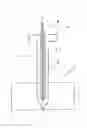
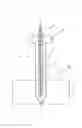
FIG. 1 is a longitudinal sectional diagram illustrating a state where a nail puncture test device of the present invention is inserted into a battery to be tested.
REFERENCE SIGNS LIST
3 outer frame
4 sheath thermocouple
6 fixing portion
5 bottomed hole
1 nail puncture test device
DESCRIPTION OF EMBODIMENTS
The present invention is a nail-shaped test device used for a nail puncture test, in which a nail and a temperature sensor are constructed integrally, thus easy measurement of a temperature at a short-circuiting portion of a battery to be tested, which has been difficult, is enabled.
FIG. 1 illustrates a sectional structure thereof. Reference numeral 1 denotes a nail puncture test device according to the present invention, and a dotted line 2 denotes a battery to be tested which is punctured by the nail puncture test device 1.
The nail puncture test device 1 is formed of an outer frame 3 having the external shape of a nail, a sheath thermocouple 4, and a fixing portion 6 of the sheath thermocouple 4, wherein a bottomed hole 5 into which the sheath thermocouple 4 is inserted is bored in the axial direction from a head portion to the vicinity of the distal end at the center part of the outer frame 3, and the sheath thermocouple 4 is fixed to the outer frame 3 by the fixing portion 6 in a state where the sheath thermocouple 4 is inserted into the bottomed hole 5 and the distal end thereof having a temperature measurement point is in contact with the bottom of the hole.
As the material of the outer frame 3, high-hardness metal or ceramic is used in order to prevent deformation at puncture.
Fixing of the sheath thermocouple 4 at the fixing portion 6 may be fixing by means of silver brazing, fixing by means of using an elastic resin plug having the sheath thermocouple 4 inserted through a central hole thereof as the fixing portion 6 and pressing it into the outer frame 3, or fixing by means of inorganic cement.
The sheath thermocouple 4 contains a pair of thermocouple wires interposing an inorganic insulating material powder such as magnesia, alumina, or the like between them inside a metal pipe called sheath, and the pair of thermocouple wires are bonded inside the sheath distal end to form the temperature measurement point. Though not shown in FIG. 1, at a rear end of the sheath thermocouple 4, the thermocouple wires of the sheath thermocouple 4 and compensating lead wires are connected. The compensating lead wires are connected to an instrument which converts a thermoelectromotive force of the sheath thermocouple 4 to a temperature and records/displays it, and this temperature is the temperature of the short-circuiting portion in the battery to be tested which is measured by the sheath thermocouple 4.
The puncture of the nail puncture test device 1 into the battery 2 to be tested is performed manually by applying an impact to the head portion by means of a hammer or the like or by applying a downward force to the head portion by an exclusive device as in the past, and the hammer or the exclusive device having the shape not interfering with the portion of the sheath thermocouple 4 outside the outer frame 3 made of metal is used.
EXAMPLE 1
According to FIG. 1, an example of the nail puncture test device 1 according to the present invention will be described below.
The outer frame 3 is made of high-hardness high-speed steel SKH51 in order to prevent deformation at puncture and to allow repeated use. The shape has a puncturing-part outer diameter of Φ2.5 mm, a head-portion outer diameter of Φ8.0 mm, an apex angle of a distal-end conical part of 30°, a length from the head portion to the distal end of 42 mm, and a diameter of the sheath thermocouple insertion hole 5 of 0.35 mm.
The sheath thermocouple 4 having the sheath material of NCF 600, a sheath outer diameter of Φ0.3 mm, and a thermocouple wire of K type is used.
Also, the fixing portion 6 of the sheath thermocouple 4 to the outer frame 3, made of metal, is fixed by silver brazing.
It was confirmed that by means of the nail puncture test device 1, occurrence of short-circuit inside the battery to be tested and accurate measurement of the temperature at the short-circuiting portion can be repeatedly performed.
INDUSTRIAL APPLICABILITY
The present invention is a nail puncture test device to puncture the battery to be tested and can be used for a subject to be tested whose internal structure changes.
Claims
1. A nail puncture test device having a temperature measurement function, comprising an outer frame 3 made of high-hardness metal or ceramic and having the external shape of a nail, a sheath thermocouple 4, and a fixing portion 6 of the sheath thermocouple 4, wherein a bottomed hole 5 into which the sheath thermocouple 4 is inserted is bored in an axial direction from a head portion to the vicinity of a distal end at a center part of the outer frame 3, and the sheath thermocouple 4 is fixed to the outer frame 3 by the fixing portion 6 in a state where the sheath thermocouple 4 is inserted into the bottomed hole 5 and a distal end thereof having a temperature measurement point is in contact with the bottom of the hole.
2. The nail puncture test device having a temperature measurement function described in claim 1, wherein
the fixing portion 6 of the sheath thermocouple 4 is fixed by silver brazing, fixed by using an elastic resin plug having the sheath thermocouple 4 inserted through a central hole thereof as the fixing portion 6 and pressing it into the outer frame 3, or fixed by inorganic cement.
Images & Drawings included:
Sources:
- United States Patent and Trademark Office - verify current appl. status at the USPTO↗
Recent applications in this class:
- » 20250260080 2025-08-14
APPARATUS AND METHOD FOR INSPECTING A SECONDARY CELL - » 20250233219 2025-07-17
BATTERY CELL, BATTERY, AND ELECTRIC APPARATUS - » 20250226469 2025-07-10
BATTERY MODULE AND BATTERY PACK - » 20250226468 2025-07-10
METHOD AND APPARTATUS FOR ASSESSING INTERNAL TEMPERATURE DISTRIBUTION OF BATTERY CELL, AND DEVICE AND STORAGE MEDIUM - » 20250219172 2025-07-03
TEMPERATURE SAMPLING ASSEMBLY, BATTERY, AND ELECTRIC APPARATUS - » 20250210741 2025-06-26
Battery Cell, Battery Module, and Battery Pack - » 20250210740 2025-06-26
BATTERY PACK - » 20250201953 2025-06-19
STORAGE BATTERY, BATTERY UNIT AND BATTERY MONITORING DEVICE - » 20250183396 2025-06-05
BATTERY MODULE AND DEVICE INCLUDING THE SAME - » 20250183395 2025-06-05
BUSBAR HOLDER ASSEMBLY, BATTERY MODULE INCLUDING SAME, AND METHOD OF MANUFACTURING SAME
Recent applications for this Assignee:
- » 20230120376 2023-04-20
PLATING APPARATUS, PLATING METHOD, AND METHOD FOR PRODUCING WIRE ROD HAVING THE SURFACE PLATED - » 20210333155 2021-10-28
Sheathed thermocouple and method for manufacturing sheathed thermocouple - » 20210333155 2021-10-28
Sheathed thermocouple and method for manufacturing sheathed thermocouple - » 20190368943 2019-12-05
PAD-EQUIPPED THERMOCOUPLE AND METHOD FOR PRODUCING SHEATH THERMOCOUPLE USED THEREIN - » 20190234804 2019-08-01
Pad-equipped thermocouple and method for producing sheath thermocouple used therein - » 20170052053 2017-02-23
WATER LEVEL SENSOR - » 20160252404 2016-09-01
Terminal head of sheath type temperature sensor - » 20160236743 2016-08-18
LED headlight structure for motorcycle - » 20160134047 2016-05-12
Method for producing structure for end of MI cable - » 20160018268 2016-01-21
Temperature sensor for high temperature