Method of designing spokes of non-pneumatic tire
US20120144674A1
2012-06-14
13/189,459
2011-07-22
✅ Patent granted
US 8,578,607 B2
2013-11-12
-
-
Sarang Afzali
Blakely, Sokoloff, Taylor & Zafman LLP
2031-11-26
Abstract:
Disclosed herein is a method of designing spokes of a non-pneumatic tire which randomly arranges spokes around a circumference to optimize noise dispersion. The method of designing spokes of a non-pneumatic tire includes placing a plurality of spokes (2) holding and supporting a tread (1) to be radially installed around a circumference of the tire on a circular spoke support (3) under the tread (1) to be in contact with the ground, wherein the spokes (2) are arranged at three angles on the circular spoke support (3) around the circumference of the tire, the three angles being divided into a small angle (a), a medium angle (b) and a large angle (c), and the spokes (2) are arranged at irregular angles under a condition that a ratio (q) of the large angle (c) to the small angle (a) is greater than a ratio (p) of the medium angle (b) to the small angle (a).
Assignee:
- HANKOOK TIRE CO., LTD. 52 🇰🇷 Seoul, South Korea
Applicant:
Interested in similar patents?
Get notified when new applications in this technology area are published.
Classification:
B60C7/00 IPC
Non-inflatable or solid tyres
B60C7/18 » CPC main
Non-inflatable or solid tyres characterised by means for increasing resiliency using springs of helical or flat coil form disposed radially relative to wheel axis
B60C17/061 » CPC further
Tyres characterised by means enabling restricted operation in damaged or deflated condition; Accessories therefor utilising additional non-inflatable supports which become load-supporting in emergency resilient comprising lateral openings
B60C7/107 » CPC further
Non-inflatable or solid tyres characterised by means for increasing resiliency comprising lateral openings
Y10T29/49481 » CPC further
Metal working; Method of mechanical manufacture Wheel making
Y10T29/49513 » CPC further
Metal working; Method of mechanical manufacture; Wheel making; Land wheel Compression, e.g., nontension, spoke type wheel making
Y10T29/49515 » CPC further
Metal working; Method of mechanical manufacture; Wheel making; Land wheel; Compression, e.g., nontension, spoke type wheel making Joining spokes to rim and hub
Y10T29/49517 » CPC further
Metal working; Method of mechanical manufacture; Wheel making; Land wheel; Compression, e.g., nontension, spoke type wheel making Joining spokes to rim
Y10T29/49519 » CPC further
Metal working; Method of mechanical manufacture; Wheel making; Land wheel; Compression, e.g., nontension, spoke type wheel making Joining spokes to hub
B21D53/26 IPC
Making other particular articles wheels or the like
B21K1/34 IPC
Making machine elements wheels; discs wheels with spokes
B60B9/00 IPC
Wheels of high resiliency, e.g. with conical interacting pressure-surfaces
Description
BACKGROUND OF TFM INVENTION
1. Field of the Invention
The present invention relates to a method of designing spokes of a non-pneumatic tire. More particularly, the present invention relates to a method of designing spokes of a non-pneumatic tire which randomly arranges spokes around a circumference of the tire to optimize noise dispersion.
2. Description of the Related Alt
Generally, a non-pneumatic tire includes spoke members which are arranged at regular intervals and at an angle in a certain range between inner and outer cylindrical members. The non-pneumatic tire has empty support spaces between the spoke members and the support spaces are discontinuously arranged by the spoke members, thereby causing substantial noise during driving of a vehicle.
For the non-pneumatic tire, although the spoke member serves an important role in view of supporting a vehicle, a spoke supporting load has a narrow area, so that impact to a tire contacting the road is entirely transmitted to an axle of the vehicle during driving of the vehicle.
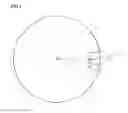
In order to overcome such a disadvantage, non-pneumatic tires as shown in FIGS. 3 and 4 are conventionally suggested. A non-pneumatic tire of FIG. 3 has spokes 102 designed into two parts, wherein the number of spokes 102 on an outer circular spoke support 103a, which is in contact with a tread 101, is about two times more than the number of spokes on an inner circular spoke support 103b disposed inside the outer circular spoke support 103a. In this case, excitation frequency occurring by rotation of the tire can be doubled, while reducing the extent of force applied through the wad 101 by half.
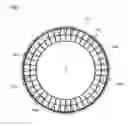
A non-pneumatic tire of FIG. 4 also has spokes 102 designed into two parts, wherein the number of spokes 102 on an outer circular spoke support 103a and the number of spokes 102 on an inner circular spoke support s 103b are the same, but the spokes on the outer circular spoke support 103a are designed in three parts in a transverse direction, so that force imparted to the tire contacting the ground is dispersed in view of frequency.
These conventional non-pneumatic tires disperse impact by changing the number of spokes which contact the ground.
SUMMARY OF THE INVENTION
The present invention is directed to solving the problems of the related art as described above, and an object of the present invention is to provide a method of designing spokes of a non-pneumatic tire, which arranges spokes at irregular angles around a circumference of the tire instead of changing the number of spokes, thereby dispersing impact when the tire contacts the ground.
In accordance with an aspect of the present invention, a method of designing spokes of a non-pneumatic lire includes: placing a plurality of spokes holding and supporting a tread to be radially installed around a circumference of the tire on a circular spoke support under the tread to be in contact with the ground, wherein the spokes are arranged at three angles on the circular spoke support around the circumference of the tire, the three angles being divided into a small angle (a), a medium angle (b), and a large angle (c), and the spokes are arranged at irregular angles under a condition that a ratio (q) of the large angle (c) to the small angle (a) is greater than a ratio (p) of the medium angle (b) to the small angle (a).
BRIEF DESCRIPTION OF THE DRAWINGS
The above and other aspects, features and other advantages of the present invention will be more clearly understood from the following detailed description taken in conjunction with the accompanying drawings:
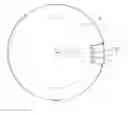
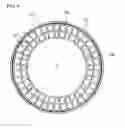
FIG. 1 is a schematic cross-sectional view of a tire illustrating a method of designing spokes of a non-pneumatic tire according to one embodiment of the present invention.
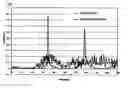
FIG. 2 is a graph illustrating relation of noise dispersion between conventional arrangement of spokes at a regular angle and arrangement of spokes according to the present invention.
FIGS. 3 and 4 are cross-sectional views of conventional non-pneumatic tires having spoke members.
DESCRIPTION OF THE EMBODIMENTS
Hereinafter, embodiments of the present invention will be described in detail with reference to the accompanying drawings.
FIG. 1 illustrates a method of designing spokes of a non-pneumatic tire according to one embodiment of the present invention. The method of designing spokes of a non-pneumatic tire includes placing a plurality of spokes 2 holding and supporting a tread 1 to be radially installed around a circumference of the tire on a circular spoke support 3 under the tread 1 to be in contact with the ground. In this method, the spokes 2 are arranged at three angles on the circular spoke support 3 around the circumference of the tire. Here, the three angles may be divided into a small angle (a), a medium angle (b), and a large angle (c). Further, the spokes 2 are arranged at irregular angles under a condition that a ratio (q) of the large angle (c) to the small angle (a) is greater than a ratio (p) of the medium angle (b) to the small angle (a).
That is, the spokes 2 are properly arranged around the circumference of the tire between the circular spoke support 3 and the tread 1 at the small angle (a), the medium angle (b), and the large angle (c) only, thereby optimizing noise dispersion.
This arrangement provides effective dispersion of noise based on the same principle as optimal dispersion of pattern noise using a pitch sequence on the tire tread 1. The spokes 2 are properly arranged at the small angle (a), the medium angle (b), and the large angle (c) around the circumference of the tire, thereby obtaining such effect.
EXAMPLE
Under a condition that the small angle (a) of 4.388 degrees is defined as “1,” the medium angle (b) of 5.524 degrees is defined as “2,” and the large angle (c) of 6.588 degrees is defined as “3,” when a total of 69 spokes 2 is placed around the circumference of the tire, an optimal arrangement in consideration of noise dispersion is as follows, and effects are illustrated in the graph of FIG. 2.
The total 69 spokes 2 are arranged at angles of “2 1 1 1 2 2 2 2 1 2 3 2 2 2 3 21 1 2 2 2 1 2 2 1 1 1 2 3 3 3 2 1 1 1 2 3 3 2 2 3 2 1 1 1 1 2 2 2 1 1 2 3 2 1 2 3 2 2 1 1 1 1 2 2 1 1 1 1” around the circumference of the tire.
As described above, the method of designing spokes of the non-pneumatic tire according to the invention irregularly arranges the spokes at three angles around the circumference of the tire to reduce noise of the non-pneumatic tire, thereby optimizing noise dispersion.
It should be understood that the embodiments and the accompanying drawings have been described for illustrative purposes, and the present invention is limited only by the following claims. Further, those skilled in the art will appreciate that various modifications, additions and substitutions are possible without departing from the scope and spirit of the invention according to the accompanying claims.
Claims
1. A method of designing spokes of a non-pneumatic tire, comprising: placing a plurality of spokes holding and supporting a tread to be radially installed around a circumference of the tire on a circular spoke support under the tread to be in contact with the ground,
wherein the spokes are arranged at three angles on the circular spoke support around the circumference of the tire, the three angles being divided into a small angle, a medium angle and a large angle, and the spokes are arranged at irregular angles under a condition that a ratio of the large angle to the small angle is greater than a ratio of the medium angle to the small angle.
Images & Drawings included:
Sources:
- United States Patent and Trademark Office - verify current appl. status at the USPTO↗
Similar patent applications:
Recent applications in this class:
- » 20250187376 2025-06-12
NON-PNEUMATIC TIRE COMPRISING SPOKES - » 20240100882 2024-03-28
TIRE BAND WITH FILAMENTS HAVING A NON-CIRCULAR CROSS SECTION - » 20230013412 2023-01-19
AIRLESS TIRE - » 20220227174 2022-07-21
TIRE - » 20220194130 2022-06-23
Tire - » 20210387476 2021-12-16
Tire rim assembly having inner and outer rim components - » 20210291591 2021-09-23
Resilient composite structural support - » 20210268838 2021-09-02
NON-PNEUMATIC TIRE - » 20210268837 2021-09-02
NON-PNEUMATIC TIRE - » 20210237511 2021-08-05
NON-PNEUMATIC WHEEL HAVING A MOLDABLE REINFORCED THERMOPLASTIC POLYURETHANE SPOKE AND A PROCESS FOR PREPARING THE SAME
Recent applications for this Assignee:
- » 20200331304 2020-10-22
Tire sensor installation structure and manufacturing method thereof - » 20200047563 2020-02-13
Tire with reduced noise - » 20190381839 2019-12-19
BEAD REINFORCING DEVICE FOR PNEUMATIC TIRES - » 20190329600 2019-10-31
Tire for preventing irregular tread wear - » 20190329598 2019-10-31
Tire with enhanced wet grip - » 20190291514 2019-09-26
Tire having V-shaped kerfs - » 20190283507 2019-09-19
Tire with main kerfs and sub-kerfs - » 20190160895 2019-05-30
Container structure for attaching sensors to tires and method of manufacturing tire container structure - » 20180327571 2018-11-15
Rubber composition for protecting sidewall of tire from ozone and tire manufactured using the same - » 20180326801 2018-11-15
Tire including contact charging type self-power generation module