Antimycotic pharmaceutical composition
US20120149745A1
2012-06-14
13/389,071
2010-07-29
✅ Patent granted
US 8,952,044 B2
2015-02-10
WO; PCT/JP2010/063230; 20100729
WO; WO2011/024620; 20110303
Ernst V Arnold | Kyung Sook Chang
Knobbe, Martens, Olson & Bear LLP
2030-10-21
Abstract:
A pharmaceutical composition which comprises 1) a compound represented by the following general formula (1) and/or a salt thereof; and 2) a ketone such as methyl ethyl ketone. Preferably, the compound represented by the following general formula (1) is luliconazole, where R1═R2=a chlorine atom: where R1 and R2 each independently represents a hydrogen atom or a halogen atom, and at least one of R1 and R2 represents a halogen atom. The present invention provides a preparation excellent in solubilization stability for a compound represented by the general formula (1) and/or a salt thereof in low-temperature or high-temperature storage.
Inventors:
- Nobuo Kubota 7 🇯🇵 Yokohama-shi, Japan
- Hirokazu Kobayashi 10 🇯🇵 Yokohama-shi, Japan
- Hirokazu Kobayashi 9 🇯🇵 Yokohama, Japan
- Nobuo Kubota 11 🇯🇵 Yokohama, Japan
Assignee:
- Pola Pharma Inc. 15 🇯🇵 Shinagawa-ku, Tokyo, Japan
- Nihon Nohyaku Co., Ltd. 16 🇯🇵 Chuo-ku, Tokyo, Japan
Applicant:
Interested in similar patents?
Get notified when new applications in this technology area are published.
Classification:
A61P17/00 » CPC further
Drugs for dermatological disorders
A61P31/10 » CPC further
Antiinfectives, i.e. antibiotics, antiseptics, chemotherapeutics Antimycotics
C07D409/06 IPC
Heterocyclic compounds containing two or more hetero rings, at least one ring having sulfur atoms as the only ring hetero atoms containing two hetero rings linked by a carbon chain containing only aliphatic carbon atoms
A61K9/0014 » CPC further
Medicinal preparations characterised by special physical form; Galenical forms characterised by the site of application Skin, i.e. galenical aspects of topical compositions
A01N43/10 IPC
Biocides, pest repellants or attractants, or plant growth regulators containing heterocyclic compounds having rings with one or more oxygen or sulfur atoms as the only ring hetero atoms with one hetero atom five-membered rings with sulfur as the ring hetero atom
A01N25/00 IPC
Biocides; Pest repellants or attractants; Plant growth regulators
A01N25/00 IPC
Biocides, pest repellants or attractants, or plant growth regulators, characterised by their forms, or by their non-active ingredients or by their methods of application, e.g. seed treatment or sequential application ; Substances for reducing the noxious effect of the active ingredients to organisms other than pests
A61K31/4178 » CPC main
Medicinal preparations containing organic active ingredients; Heterocyclic compounds having nitrogen as a ring hetero atom, e.g. guanethidine or rifamycins having five-membered rings with two or more ring hetero atoms, at least one of which being nitrogen, e.g. tetrazole 1,3-Diazoles not condensed 1,3-diazoles and containing further heterocyclic rings, e.g. pilocarpine, nitrofurantoin
A61K9/00 IPC
Medicinal preparations characterised by special physical form
A61K47/08 » CPC further
Medicinal preparations characterised by the non-active ingredients used, e.g. carriers or inert additives; Targeting or modifying agents chemically bound to the active ingredient; Organic compounds, e.g. natural or synthetic hydrocarbons, polyolefins, mineral oil, petrolatum or ozokerite containing oxygen, e.g. ethers, acetals, ketones, quinones, aldehydes, peroxides
Description
TECHNICAL FIELD
The present invention relates to a pharmaceutical composition, and more specifically, to a pharmaceutical composition, which is useful as an antimycotic agent.
BACKGROUND ART
A compound having a structure represented by the general formula (1), such as luliconazole (in the general formula (1), R1═R2=chlorine atom), has excellent antimycotic activity, and it has been suggested that the compound may be applied to a treatment for a mycosis of the nail, which has been considered to be untreatable by external application (e.g., see Patent Document 1). Such preparation for treating the mycosis of the nail is desired to have an increased content of the compound represented by the general formula (1). However, because of its high crystallinity, solvents which can be used for producing a preparation containing the compound at a high concentration are very limited. That is, some solvents may cause disadvantages such as crystallization under a low temperature condition (such as 5° C.) and crystallization by application. In addition, in a solution of a compound represented by the general formula (1) which has stereoisomers, such as luliconazole, an stereoisomer such as an SE form is easily formed in some cases, and as solvents capable of preventing formation of such stereoisomers, only crotamiton, propylene carbonate, and N-methyl-2-pyrrolidone are known (e.g., see Patent Document 2). However, in some cases, blending of such solvents is restricted because of drug efficacy of the solvents, such as the anti-inflammatory effect of the solvents, and it has been desired to develop a novel solvent for a preparation of luliconazole or the like which substitutes for the solvents. In particular, in the case of a liquid preparation, the pharmacological effect significantly decreases by crystallization or the like, and hence such solubilization technology is an important factor for formulation. In addition, there may be a situation where a stereoisomer such as a Z form should be considered.
Lanoconazole (in the general formula (1), R1=hydrogen atom, and R2=chlorine atom), which is a compound represented by the general formula (1), is known as a useful antimycotic agent. However, also in the case of the compound, there are large problems in production technologies, such as crystallization caused by using the compound at a low temperature and decrease in the content caused by storage at a high temperature.
On the other hand, a ketone such as methyl ethyl ketone is widely used as a solvent excellent in solubilization ability. However, there is no known pharmaceutical preparation containing 1) a compound represented by the following general formula (1) and/or a salt thereof and 2) a ketone represented by the general formula (2).
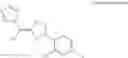
(In the formula, R1 and R2 each independently represents a hydrogen atom or a halogen atom, and at least any one of R1 and R2 represents a halogen atom.)
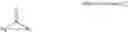
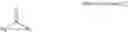
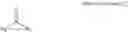
(In the formula, R3 and R4 each independently represents an alkyl group or alkenyl group which may have an aromatic group, or an aromatic group, and the sum of the number of carbon atoms in R3 and R4 is 3 or more.)
Further, a hydroxyalkylbenzene such as benzyl alcohol or phenethyl alcohol is widely used as a solvent for solubilizing poorly-soluble components in the drug or quasi-drug field (e.g., see Patent Document 3). However, there is no example of the use of the hydroxyalkylbenzene for solubilization of the compound represented by the general formula (1) and/or the salt thereof. Moreover, there is no example of the use of the hydroxyalkylbenzene as a solvent for solubilization in a pharmaceutical composition containing the compound or the like and the ketone represented by the general formula (2).
- [Patent Document 1] WO/2007/102241
- [Patent Document 2] WO/2007/102242
- [Patent Document 3] JP 2006-232856 A
SUMMARY OF INVENTION
Technical Problem
The present invention has been made in view of the above-mentioned circumstances, and an object of the present invention is to provide a preparation excellent in solubilization stability for a compound represented by the general formula (1) and/or a salt thereof in low-temperature or high-temperature storage.
Solution to Problems
In consideration of the above-mentioned circumstances, the inventors of the present invention have made intensive studies and efforts in search of a preparation component which has an effect of enhancing solubilization stability of the compound represented by the general formula (1) and/or the salt thereof and is capable of substituting for crotamiton, propylene carbonate, or N-methyl-2-pyrrolidone. As a result, the inventors have finally completed the invention by finding out that a ketone represented by the general formula (2), such as methyl ethyl ketone, has such properties. In other words, the present invention is as follows.
[1] A pharmaceutical composition comprising: 1) a compound represented by the following general formula (1) and/or a salt thereof; and 2) a ketone represented by the following general formula (2):
where R1 and R2 each independently represents a hydrogen atom or a halogen atom, and at least one of R1 and R2 represents a halogen atom; and
where R3 and R4 each independently represents an alkyl group or alkenyl group which may have an aromatic group, or an aromatic group, and a sum of a number of carbon atoms in R3 and R4 is 3 or more.
[2] The pharmaceutical composition according to [1], wherein the compound represented by the general formula (1) is luliconazole, where R1═R2=a chlorine atom.
[3] The pharmaceutical composition according to [1] or [2], wherein the ketone represented by the general formula (2) is methyl ethyl ketone, methyl isobutyl ketone, or benzophenone.
[4] The pharmaceutical composition according to any one of [1] to [3], further comprising a hydroxyalkylbenzene.
[5] The pharmaceutical composition according to [4], wherein the hydroxyalkylbenzene is benzyl alcohol.
[6] The pharmaceutical composition according to any one of [1] to [5], further comprising an α-hydroxy acid and/or phosphoric acid.
[7] The pharmaceutical composition according to any one of [1] to [6], which is a drug for treating tinea unguium.
[8] A method of producing a pharmaceutical composition comprising: 1) a compound represented by the following general formula (1) and/or a salt thereof; 2) a ketone represented by the following general formula (2); and 3) a hydroxyalkylbenzene, the method comprising: mixing, as a solubilizing agent, the hydroxyalkylbenzene with the compound represented by the general formula (1) and/or the salt thereof; and mixing, as a dilution medium, the ketone represented by the general formula (2) with the resultant mixture:
where R1 and R2 each independently represents a hydrogen atom or a halogen atom, and at least one of R1 and R2 represents a halogen atom; and
where R3 and R4 each independently represents an alkyl group or alkenyl group which may have an aromatic group, or an aromatic group, and a sum of a number of carbon atoms in R3 and R4 is 3 or more.
Advantageous Effects of Invention
According to the present invention, it is possible to provide a preparation excellent in solubilization stability for the compound represented by the general formula (1) and/or the salt thereof in low-temperature or high-temperature storage.
DESCRIPTION OF EMBODIMENTS
<1> Essential Component of Pharmaceutical Composition of the Present Invention: Compound Represented by General Formula (1) and/or salt thereof.
A pharmaceutical composition of the present invention contains a compound represented by the general formula (1), such as luliconazole or lanoconazole, and/or a salt thereof. Luliconazole is a compound having a chemical name of (R)-(−)-(E)-[4-(2,4-dichlorophenyl)-1,3-dithiolan-2-ylidene]-1-imidazolylacetonitrile, and lanoconazole is a compound having a chemical name of (±)-(E)-[4-(2-chlorophenyl)-1,3-dithiolan-2-ylidene]-1-imidazol ylacetonitrile. Methods of producing such compounds have been known (for example, JP 09-100279 A).
The pharmaceutical composition of the present invention contains the compound represented by the general formula (1) and/or the salt thereof at a concentration of usually 0.5 to 20% by mass, or preferably 1 to 10% by mass with respect to the total amount of the pharmaceutical composition. The compound represented by the general formula (1), such as luliconazole, and/or the salt thereof has high crystallinity. Therefore, even if crystallization is suppressed by adding a hydroxycarboxylic acid such as lactic acid, the compound and/or the salt thereof may cause crystallization when the compound and/or the salt thereof at a concentration of 4% by mass or more is stored at a low temperature (such as 5° C.). In the present invention, such crystallization is suppressed in a preparation containing the below-described ketone such as methyl ethyl ketone, and crystallization is further suppressed by a combination of preparations containing a hydroxyalkylbenzene and the ketone such as methyl ethyl ketone. In addition, in the case of a compound represented by the general formula (1), such as luliconazole, and/or a salt thereof, which has stereoisomers, the concentration of the compound serving as an active ingredient may decrease in high-temperature storage (such as 40° C.) because of stereoisomerization. In the present invention, such stereoisomerization is suppressed in the preparation containing the below-described ketone such as methyl ethyl ketone. The effect enhances the bioavailability of the preparation, in particular, transference into the nail, and hence enhances the therapeutic effect on tinea unguium. For a usual mycosis of the foot or a mycosis of the body, an enough effect is exerted by a treatment using a composition containing the compound represented by the general formula (1) and/or the salt thereof at a concentration of about 1 to 5% by mass. However, for a mycosis of the nail such as tinea unguium, a treatment using a pharmaceutical composition containing the compound represented by the general formula (1) and/or the salt thereof at a concentration of 5% by mass or more is required. In other words, the nail is an organ where transference into the tissue is difficult, and in order to transfer an effective amount of the composition, the content of the compound represented by the general formula (1) and/or the salt thereof is preferably 5% by mass or more, or more preferably 6% by mass or more with respect to the total amount of the pharmaceutical composition. In addition, in view of suppression of crystallization at low-temperature, the content is preferably 10% by mass or less. In view of the foregoing, the content in a pharmaceutical composition for the nail is preferably about 6 to 10% by mass.
The above-mentioned “salt thereof” is not particularly limited as long as the salt is physiologically acceptable. Preferred examples of the salt include: mineral acid salts such as a hydrochloride, a nitrate, a sulfate, and a phosphate; organic acid salts such as a citrate, an oxalate, a glycolate, a lactate, and an acetate; and sulfuric acid-containing salts such as a mesilate and a tosilate. Of those, the mineral acid salts such as the phosphate and the α-hydroxy acid salts such as the glycolate and the lactate are particularly preferred.
<2> Essential Component of Pharmaceutical Composition of the present invention: ketone represented by general formula (2)
The pharmaceutical composition of the present invention contains the ketone represented by the general formula (2) as an essential component. In the ketone represented by the general formula (2), R3 and R4 each independently represents an alkyl group or alkenyl group which may have an aromatic group, or an aromatic group, and the sum of the number of carbon atoms in R3 and R4 is 3 or more. In terms of a solvent property to solubilize the compound represented by the general formula (1), the number of the carbon atoms in the substituents R3 and R4 is usually 15 or less, or preferably 13 or less.
Examples of the alkyl group which may have an aromatic group include a methyl group, an ethyl group, a propyl group, an isopropyl group, a butyl group, an isobutyl group, and a benzyl group.
Examples of the alkenyl group which may have an aromatic group include a butenyl group.
Examples of the aromatic group include a phenyl group.
Specific preferred examples of the ketone include methyl ethyl ketone, diethyl ketone, methyl propyl ketone, methyl isopropyl ketone, methyl isobutyl ketone, ethyl propyl ketone, propyl butyl ketone, and benzophenone. Of those, methyl ethyl ketone, methyl isobutyl ketone, and benzophenone are particularly preferred. This is because such ketones each has excellent ability to suppress formation of a stereoisomer in high-temperature storage while the ketones each dissolves the compound represented by the general formula (1) and/or the salt thereof at a high concentration. Such ketones represented by the general formula (2) may be products which are usually commercially available as solvents, and one kind of the ketones may be used alone, or two or more kinds of them may be used in combination.
The content of the ketone is, for example, 5 to 99% by mass, or preferably 10 to 80% by mass in total with respect to the total amount of the pharmaceutical composition. In addition, the content ratio (mass ratio) of the compound represented by the general formula (1) and/or the salt thereof and the ketone represented by the general formula (2) is usually 1:200 to 1:0.1, preferably 1:150 to 1:0.5, or more preferably 1:100 to 1:0.6.
It is preferred that the compound represented by the general formula (1) and/or the salt thereof, or preferably the salt is solvated with the below-mentioned hydroxyalkylbenzene, and then the ketone represented by the general formula (2) is gradually added to the solution with stirring to solubilize the compound represented by the general formula (1) and/or the salt thereof as a dilution medium. According to such production method, a highly-concentrated preparation can be obtained.
<3> Pharmaceutical Composition of the Present Invention
The pharmaceutical composition of the present invention contains the above-mentioned essential components and an optional component for formulation. Preferred examples of the optional component for formulation include: a lower alcohol such as ethanol or isopropanol; a higher alcohol such as isostearyl alcohol or oleyl alcohol; a polyvalent alcohol such as polyethylene glycol, glycerin, 1,3-butylene glycol, erythritol, sorbitol, xylitol, maltitol, gluconolactone, propylene glycol, dipropylene glycol, diglycerin, isoprene glycol, 1,2-pentanediol, 2,4-hexanediol, 1,2-hexanediol, 1,2-octanediol, polypropylene glycol, or 2-ethyl-1,3-hexanediol; a ketone such as acetone; a non-ionic surfactant such as a polyoxyethylene alkyl ether, a polyoxyethylene hardened castor oil, or a polyoxyethylene sorbitan fatty acid; a thickener such as hydroxypropyl cellulose or ethyl cellulose; a dibasic acid diester such as diethyl sebacate, dipropyl sebacate, or diethyl adipate; a hydroxyalkyl benzene such as benzyl alcohol, phenethyl alcohol, or phenyl propanol; a solvent such as an alkylene carbonate, for example, ethylene carbonate or propylene carbonate, N-methyl-2-pyrrolidone (hereinafter, referred to as “NMP”), or crotamiton; and a stabilizer such as an α-hydroxy acid, for example, lactic acid, glycolic acid, or citric acid, or a mineral acid, for example, phosphoric acid. Of those, the hydroxyalkylbenzene is particularly preferably contained because the compound acts together with the ketone represented by the general formula (2) to exert excellent effect of solubilizing the compound represented by the general formula (1) and/or the salt thereof and excellent effect of suppressing stereoisomerization of the compound and/or the salt thereof.
The alkyl group in the hydroxyalkylbenzene preferably has 1 to 4 carbon atoms, and specific preferred examples of such hydroxyalkylbenzene include benzyl alcohol, phenethyl alcohol, and phenyl propanol. One kind of the components may be contained alone, or two or more kinds of them may be used in combination. The hydroxyalkylbenzene is more preferably benzyl alcohol or phenethyl alcohol, or particularly preferably benzyl alcohol.
The component is contained in an amount of preferably 1 to 99% by mass, or more preferably 10 to 99% by mass in total with respect to the total amount of the pharmaceutical composition. If the component is contained at such content, it is possible to stabilize the dissolution state and to prevent crystallization when the compound represented by the general formula (1) and/or the salt thereof is stored at a low temperature, for example, at about 5° C. Moreover, the component exerts an effect of suppressing stereoisomerization of the compound represented by the general formula (1) and/or the salt thereof when stored at a high temperature of 40° C. or higher. In addition, the content ratio (mass ratio) of the ketone represented by the general formula (2) and the hydroxyalkylbenzene is usually 20:1 to 1:1, preferably 15:1 to 2:1, or more preferably 10:1 to 3:1. In particular, the hydroxyalkylbenzene suppresses crystallization at a low temperature, and hence the compound is preferably used as a solubilizing agent for the compound represented by the general formula (1) and/or the salt thereof. The pharmaceutical composition of the present invention is preferably produced using such solubilizing agent. The pharmaceutical composition of the present invention is preferably produced by solvating the compound represented by the general formula (1) and/or the salt thereof, or preferably the salt thereof, with the hydroxyalkylbenzene and adding the ketone represented by the general formula (2), such as methyl ethyl ketone, as a dilution medium with stirring to dissolve the compound and/or the salt.
In the present invention, the ketone represented by the general formula (2), such as methyl ethyl ketone, and a combination of the ketone and the hydroxyalkylbenzene, such as benzyl alcohol, may substitute for propylene carbonate, NMP, or crotamiton, and hence formulation can be performed without using the compounds. However, to supplement the technology of the effect of maintaining steric structure stability, preparations containing such compounds are also preferred. In addition, the preparations using such compounds fall within the technical scope of the present invention. In the case where the alkylene carbonate such as propylene carbonate, NMP, or crotamiton is contained, the content is preferably 1 to 30% by mass, or more preferably 2 to 15% by mass with respect to the total amount of the pharmaceutical composition.
Further, to improve the stability of the pharmaceutical composition of the present invention and the effect of suppressing crystallization after application, a stabilizer such as an α-hydroxy acid, for example, lactic acid, glycolic acid, or citric acid, or a mineral acid, for example, phosphoric acid is preferably contained at a concentration of preferably 0.1 to 20% by mass, or more preferably 1 to 10% by mass with respect to the total amount of the pharmaceutical composition. In addition, to improve the solubility and stability, a higher alcohol which is in a liquid form at 1 atm and 25° C., such as isostearyl alcohol, is preferably contained at a concentration of preferably 10 to 30% by mass, or more preferably 15 to 25% by mass. Moreover, to improve the solubility, a polyvalent alcohol such as propylene glycol is preferably contained at a concentration of preferably 1 to 30% by mass, or more preferably 5 to 20% by mass with respect to the total amount of the pharmaceutical composition.
The pharmaceutical composition of the present invention can be produced by treating such essential components and optional components in accordance with a conventional method. In particular, a production method using the hydroxyalkylbenzene as a solubilizing agent and the ketone represented by the general formula (2) as a dilution medium is particularly preferably exemplified. To be specific, such method of producing the pharmaceutical composition of the present invention is preferably a method involving: adding the hydroxyalkylbenzene to the compound represented by the general formula (1) or the salt thereof to solvate the compound or salt; and adding the ketone represented by the general formula (2) to dilute/solubilize the compound or salt. The solvation/solubilization process is performed preferably while heating to 30 to 90° C. The pharmaceutical composition of the present invention can be obtained by performing such processes and further treating the resultant product in accordance with a conventional method.
The pharmaceutical composition of the present invention may have any dosage form without particular limitation as long as the form is a form used for pharmaceutical compositions. Examples of the form include: oral administration preparations such as tablet, capsule, granule, film-coated agent, powder, and syrup; and parenteral administration preparations such as injection, suppository, inhalation, liniment, patch, aerosol, transdermal absorption agent, eye-drops, and nasal drops. Of those, skin preparations for external use such as liniment, patch, aerosol, and transdermal absorption agent are preferably exemplified. Preferred examples of the dosage form of the skin preparation for external use include lotion, emulsion, gel, cream, aerosol, nail enamel, and hydrogel patch. The lotion is particularly preferred.
The pharmaceutical composition of the present invention is preferably used for treatment of mycotic diseases or prevention of progression of the diseases by using characteristics of luliconazole or the like. For the mycotic diseases, there may be exemplified: tinea pedis such as athlete's foot; tinea corporis such as candida and pityriasis versicolor; and tinea on a hard keratin portion, such as tinea unguium. Because of remarkable effects, it is particularly preferred to use the pharmaceutical composition of the present invention for treatment of the hard keratin portion, such as tinea unguium. The effect of the pharmaceutical composition of the present invention is particularly suitably expressed on the nail, and such effect is also expressed on typical dermatomycosis. Therefore, a pharmaceutical composition for dermatomycosis, which satisfies the configuration of the present invention, also falls within the technical scope of the present invention. For such dermatomycosis, there may be exemplified tinea such as tinea pedis, or particularly hyperkeratotic tinea which appears on the heels or the like. It is preferred to apply the pharmaceutical composition of the present invention to hyperkeratotic tinea, on which the conventional medicaments hardly exert their effects, in the above-mentioned dermatomycosis, because the effect of the present invention is remarkably expressed.
The use aspect may be appropriately selected in consideration of patient's body weight, age, sex, symptom, etc. In the case of adults, the compound represented by the general formula (1) and/or the salt thereof is generally preferably administered in an amount of 0.01 to 1 g per day. In addition, the amount may be determined by reference to the amount of a compound represented by the general formula (1) and/or a salt thereof which is usually used for a disease caused by a fungus.
For example, the pharmaceutical composition for external use is applied to a diseased site one or several times a day at a preferred amount, and the treatment is preferably carried out day after day. In particular, for tinea unguium, luliconazole or the like as an effective component may be transferred into the nail in an amount that cannot be attained by a normal formulation. As a result, tinea unguium may be treated by simple external application without taking an antimycotic agent over a long period of time. In addition, recurrence and reinfection are being a major problem for tinea unguium. However, the recurrence and reinfection may be prevented by application of the pharmaceutical composition for external use of the present invention for 1 to 2 weeks after abatement of the symptom. The pharmaceutical composition of the present invention exerts a preventive effect in such a mode.
As described above, the pharmaceutical composition of the present invention may be a preparation component which has an effect of enhancing solubilization stability and steric stability of the compound represented by the general formula (1) and/or the salt thereof in low-temperature or high-temperature storage. The pharmaceutical composition of the present invention may be a preparation having the following properties 2) and 3). Further, when the compound represented by the general formula (1) and/or the salt thereof has a stereoisomer, the pharmaceutical composition may be a preparation having the following properties 1) to 3):
1) the amount of a stereoisomer of the compound and/or a salt thereof produced under a preservation condition of 40° C. or more for 3 weeks or more is 1% by mass or less, preferably 0.5% by mass or less with respect to the total mass of the compound and/or a salt thereof at the beginning;
2) no crystal is deposited when the preparation is preserved at 60° C. for 3 weeks;
3) no crystal is deposited when the preparation is preserved at 5° C. for 4 weeks.
The characteristic 1) may be determined by, for example, preserving a preparation at 40° C. for example, preferably at 60° C. for 3 weeks for example, preferably for 4 weeks after manufacture, performing liquid chromatography using an optically-active stationary phase which may separate a compound of interest from optical isomers thereof to optically resolve the compound from the optical isomers, and calculating the amount of the isomers by peak areas of the optical isomers in the resultant chart.
The characteristic 2) may be assessed by, for example, preserving a preparation at 60° C. for 3 weeks after manufacture, and observing the preparation with the naked eye and/or under a microscope. When no crystal deposition is confirmed with the naked eye and/or under a microscope, or a crystal is confirmed only with a microscope or through observation under a microscope and the time-dependent growth of the crystal is not confirmed, the assessment of no crystal deposition is given. (It should be noted that, hereinafter, such state may be referred to as “a small amount of crystal deposition was confirmed.”)
The characteristic 3) may be assessed by, for example, preserving a preparation at 5° C. for 4 weeks after manufacture, and observing the preparation with the naked eye and/or under a microscope. When no crystal deposition is confirmed with the naked eye and/or under a microscope, or a crystal is confirmed only with a microscope or through observation under a microscope and the time-dependent growth of the crystal is not confirmed, the assessment of no crystal deposition is given. (It should be noted that, hereinafter, such state may be referred to as “a small amount of crystal deposition was confirmed.”)
The thus-obtained pharmaceutical composition of the present invention has an excellent effect of maintaining its transparency over a long period of time although the composition contains a compound represented by the general formula (1) and/or a salt thereof in a high concentration. In addition, because crystal deposition after application is suppressed, inhibition of orientation and transfer of the compound to organs by the crystal is suppressed. Therefore, the composition has excellent bioavailability. Meanwhile, a sufficient amount of the compound is oriented to an organ with low drug orientation such as the nail, and hence the composition is preferred as a pharmaceutical composition for external use for the nail.
EXAMPLES
Hereinafter, the present invention is described in more detail by way of examples.
Example 1
According to the following formulation, a pharmaceutical composition 1 of the present invention was produced. That is, the formulation components were heated to 90° C. and stirred to solubilize the components, and the resultant mixture was cooled by stirring, thereby producing the pharmaceutical composition 1 of the present invention. In the same way as above, Comparative Examples 1 to 4 were prepared. These samples were stored at 40° C. for 1 month, and the amounts of the SE form, which is a stereoisomer of luliconazole produced, were determined under the following high-performance liquid chromatography conditions. The results are shown in Table 1. The results reveal that methyl ethyl ketone, which is the ketone represented by the general formula (2), has a similar ability for steric stabilization in storage at 40° C. for 1 month to that of propylene carbonate, N-methyl-2-pyrroridone (NMP), crotamiton, or DMSO.
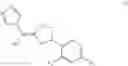
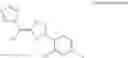
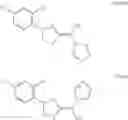
Note that the structures of the SE form and the Z form, which are stereoisomers of luliconazole, are shown below.
<Conditions of High-Performance Liquid Chromatography>
HPLC: LC-20AD, manufactured by Shimadzu Corporation
HPLC conditions: Column; CHIRALCEL OD-RH 4.6×150 mm,
-
- Column temperature; 35° C.,
- Mobile phase; a mixture of methanol/an aqueous solution of 1.8% potassium hexafluorophosphate (83:17, v/v),
- Flow rate; 0.56 mL/min.,
- Detection; 295 nm
| TABLE 1 |
| (% by mass) |
| Compo- | Compara- | Compara- | Compara- | Compara- | |
| sition | tive Ex- | tive Ex- | tive Ex- | tive Ex- | |
| Components | 1 | ample 1 | ample 2 | ample 3 | ample 4 |
| Luliconazole | 1 | 1 | 1 | 1 | 1 |
| Methyl ethyl | 99 | ||||
| ketone | |||||
| Propylene | 99 | ||||
| carbonate | |||||
| NMP | 99 | ||||
| Crotamiton | 99 | ||||
| DMSO | 99 | ||||
| Total | 100 | 100 | 100 | 100 | 100 |
| SE form (%) | 0.15 | 0.22 | 0.16 | 0.14 | 0.35 |
Reference Example 1
According to the following formulation, a pharmaceutical composition 1 of Reference Example, and Comparative Examples 1 to 4 were prepared in the same way as in Example 1. A storage test was performed at 60° C. for 1 month, and the amounts of the SE form were determined. The results reveal that benzyl alcohol has a similar ability for steric stabilization in storage at 60° C. for 1 month to that of propylene carbonate, NMP, or crotamiton.
| TABLE 2 |
| (% by mass) |
| Reference | Compara- | Compara- | Compara- | Compara- | |
| Compo- | tive Ex- | tive Ex- | tive Ex- | tive Ex- | |
| Components | sition 1 | ample 1 | ample 2 | ample 3 | ample 4 |
| Luliconazole | 1 | 1 | 1 | 1 | 1 |
| Benzyl | 99 | ||||
| alcohol | |||||
| Propylene | 99 | ||||
| carbonate | |||||
| NMP | 99 | ||||
| Crotamiton | 99 | ||||
| DMSO | 99 | ||||
| Total | 100 | 100 | 100 | 100 | 100 |
| SE form (%) | 1.0 | 1.11 | 0.24 | 0.11 | 4.33 |
Example 2
According to the following formulation, a pharmaceutical composition 2 of the present invention, and Comparative Example 5 were prepared in the same way as in Example 1. A storage test was performed at 60° C. for 1 month, and the amounts of the SE form were determined. The results reveal that methyl ethyl ketone, which is a ketone represented by the general formula (2), has a similar ability for steric stabilization in storage at 60° C. for 1 month to that of propylene carbonate, NMP, or crotamiton, even in the case of using ethanol as a dilution medium. In addition, in the case of using ethanol as a solvent, the steric stabilization effect was found to decrease compared with the case of using only methyl ethyl ketone as a solvent.
| TABLE 3 |
| (% by mass) |
| Comparative | |||
| Components | Composition 2 | Example 5 | |
| Luliconazole | 1 | 1 | |
| Methyl ethyl ketone | 5 | ||
| Propylene carbonate | |||
| Dehydrated ethanol | 94 | 99 | |
| Total | 100 | 100 | |
| SE form (%) | 14.8 | 41.7 | |
Examples 3 to 10
According to the following formulation described in Table 4, compositions 3 to 10 of the present invention were produced. Moreover, as Comparative Example 6, a compound was produced using diacetyl instead of the ketone represented by the general formula (2). Luliconazole and benzyl alcohol were mixed, and the ketone represented by the general formula (2) was added. The whole was heated to 90° C. to further dissolve the components, and the rest of the components were sequentially added, followed by stirring to solubilize the components. After the solubilization was confirmed, the solution was cooled by stirring, thereby obtaining a pharmaceutical composition. Moreover, the amounts of the SE form as well as the Z form were determined under the above-mentioned HPLC conditions. The results are shown in Table 4. The results reveal that the pharmaceutical compositions of the present invention each has ability to enable preparation of highly-concentrated preparations and to stabilize the steric structure and solubility of the compound represented by the general formula (1) and/or the salt thereof. Moreover, the data suggests that, in the case of addition of the ketone, a combination use with benzyl alcohol is preferred for both solubilization and steric stabilization. Such combination was found to provide an excellent effect of stabilizing the steric structure even in the case of using ethanol as a solvent. As the concentration of luliconazole becomes higher, the effect becomes more significant. Therefore, the concentration of luliconazole is preferably 4% by mass or more, or particularly preferably 5% by mass or more.
| TABLE 4 |
| (% by mass) |
| Comparative | |||||||||
| Comp. 3 | Comp. 4 | Comp. 5 | Comp. 6 | Comp. 7 | Comp. 8 | Comp. 9 | Comp. 10 | Example 6 | |
| Luliconazole | 8 | 10 | 12 | 8 | 10 | 12 | 10 | 15 | 10 |
| Methyl ethyl ketone | 10 | 10 | 10 | ||||||
| (2-butanone) | |||||||||
| Methyl isobutyl ketone | 10 | 10 | 10 | ||||||
| (4-methyl-2-pentanone) | |||||||||
| Benzophenone | 10 | 10 | |||||||
| Diacetyl | 10 | ||||||||
| Benzyl alcohol | 2 | 2 | 2 | 2 | 2 | 2 | 2 | 4 | 2 |
| Lactic acid | 6 | 6 | 8 | 6 | 6 | 8 | 6 | 8 | 6 |
| Propylene carbonate | 3 | 5 | 5 | 3 | 5 | 5 | 5 | 5 | 5 |
| Propylene glycol | 10 | 10 | 10 | 10 | 10 | 10 | 10 | 10 | 10 |
| Dehydrated ethanol | 61 | 57 | 53 | 61 | 57 | 53 | 57 | 43 | 57 |
| Total | 100 | 100 | 100 | 100 | 100 | 100 | 100 | 100 | 100 |
| Presence or absence of | |||||||||
| precipitation | |||||||||
| At production time | ∘ | ∘ | ∘ | ∘ | ∘ | ∘ | ∘ | ∘ | ∘ |
| At starting time | ∘ | ∘ | ∘ | ∘ | ∘ | x | ∘ | ∘ | ∘ |
| 5° C., 1 week | ∘ | ∘ | x | ∘ | ∘ | x | ∘ | ∘ | ∘ |
| 5° C., 1 month | ∘ | ∘ | x | ∘ | ∘ | x | ∘ | ∘ | ∘ |
| (60° C., 3 weeks) | ∘ | ∘ | ∘ | ∘ | ∘ | ∘ | ∘ | ∘ | ∘ |
| Stability | |||||||||
| At starting time | |||||||||
| Quantification (based on | 100 | 100 | 100 | 100 | 100 | 100 | 100 | 100 | 100 |
| the value at the starting | |||||||||
| time) (%) | |||||||||
| Purity SE form (%) | 0.23 | 0.23 | 0.23 | 0.24 | 0.23 | 0.24 | 0.22 | 0.23 | 0.24 |
| Z form (%) | 0.03 | 0.03 | 0.03 | 0.03 | 0.03 | 0.02 | 0.03 | 0.03 | 0.06 |
| Others (%) | 0.03 | 0.03 | 0.03 | 0 | 0.02 | 0.02 | 0 | 0 | 0 |
| 60° C., 3 week | |||||||||
| Quantification (based on | 100.3 | 100.7 | 100.4 | 101 | 100.2 | 107 | 99.5 | 99.8 | 81.1 |
| the value at the starting | |||||||||
| time) (%) | |||||||||
| Purity SE form (%) | 0.26 | 0.23 | 0.27 | 0.26 | 0.27 | 0.29 | 0.25 | 0.26 | 0.19 |
| Z form (%) | 0.08 | 0.08 | 0.09 | 0.07 | 0.08 | 0.09 | 0.08 | 0.1 | 0.12 |
| Others (%) | 0.11 | 0.16 | 0.2 | 0.12 | 0.16 | 0.2 | 0.2 | 0.31 | 0.48 |
| ∘: No precipitation | |||||||||
| x: Precipitation visible to the naked eye |
INDUSTRIAL APPLICABILITY
The present invention can be applied to pharmaceutical compositions.
Claims
1. A pharmaceutical composition comprising:
1) a compound represented by the following general formula (1) and/or a salt thereof; and
2) a ketone represented by the following general formula (2):
where R1 and R2 each independently represents a hydrogen atom or a halogen atom, and at least one of R1 and R2 represents a halogen atom; and
where R3 and R4 each independently represents an alkyl group or alkenyl group which may have an aromatic group, or an aromatic group, and a sum of a number of carbon atoms in R3 and R4 is 3 or more.
2. The pharmaceutical composition according to claim 1, wherein the compound represented by the general formula (1) is luliconazole, where R1═R2=a chlorine atom.
3. The pharmaceutical composition according to claim 1, wherein the ketone represented by the general formula (2) is methyl ethyl ketone, methyl isobutyl ketone, or benzophenone.
4. The pharmaceutical composition according to claim 1, further comprising a hydroxyalkylbenzene.
5. The pharmaceutical composition according to claim 4, wherein the hydroxyalkylbenzene is benzyl alcohol.
6. The pharmaceutical composition according to claim 1, further comprising an α-hydroxy acid and/or phosphoric acid.
7. A method for treating tinea unguium comprising treating an individual in need of treatment with the pharmaceutical composition of claim 1.
8. A method of producing a pharmaceutical composition comprising:
1) a compound represented by the following general formula (1) and/or a salt thereof;
2) a ketone represented by the following general formula (2); and
3) a hydroxyalkylbenzene,
the method comprising:
mixing, as a solubilizing agent, the hydroxyalkylbenzene with the compound represented by the general formula (1) and/or the salt thereof; and
mixing, as a dilution medium, the ketone represented by the general formula (2) with the resultant mixture:
where R1 and R2 each independently represents a hydrogen atom or a halogen atom, and at least one of R1 and R2 represents a halogen atom; and
where R3 and R4 each independently represents an alkyl group or alkenyl group which may have an aromatic group, or an aromatic group, and a sum of a number of carbon atoms in R3 and R4 is 3 or more.
9. The pharmaceutical composition according to claim 2, wherein the ketone represented by the general formula (2) is methyl ethyl ketone, methyl isobutyl ketone, or benzophenone.
10. The pharmaceutical composition according to claim 2, further comprising a hydroxyalkylbenzene.
11. The pharmaceutical composition according to claim 10, wherein the hydroxyalkylbenzene is benzyl alcohol.
12. The pharmaceutical composition according to claim 2, further comprising an α-hydroxy acid and/or phosphoric acid.
13. The pharmaceutical composition according to claim 3, further comprising a hydroxyalkylbenzene.
14. The pharmaceutical composition according to claim 13, wherein the hydroxyalkylbenzene is benzyl alcohol.
15. The pharmaceutical composition according to claim 3, further comprising an α-hydroxy acid and/or phosphoric acid.
16. The pharmaceutical composition according to claim 4, further comprising an α-hydroxy acid and/or phosphoric acid.
17. The pharmaceutical composition according to claim 5, further comprising an α-hydroxy acid and/or phosphoric acid.
18. The method according to claim 7, wherein the compound represented by the general formula (1) is luliconazole, where R1═R2=a chlorine atom.
19. The method according to claim 7, wherein the ketone represented by the general formula (2) is methyl ethyl ketone, methyl isobutyl ketone, or benzophenone.
20. The method according to claim 7, wherein the pharmaceutical composition further comprises a hydroxyalkylbenzene.
Images & Drawings included:



Sources:
- United States Patent and Trademark Office - verify current appl. status at the USPTO↗
Similar patent applications:
- » 20120014893
Antimycotic pharmaceutical composition - » 20120022120
Antimycotic pharmaceutical composition - » 20130011351
ANTIMYCOTIC PHARMACEUTICAL COMPOSITION - » 20130090365
Antimycotic pharmaceutical composition - » 20110202025
Antimycotic and prebiotic pharmaceutical composition and a method for treating candidal vaginitis
Recent applications in this class:
- » 20250268867 2025-08-28
OPHTHALMIC PHARMACEUTICAL COMPOSITIONS AND USES RELATING THERETO - » 20250195477 2025-06-19
DEUTERATED IDAZOXAN AND METHODS OF USE THEREOF - » 20250177355 2025-06-05
TREATMENT OF IDIOPATHIC PULMONARY FIBROSIS - » 20250170102 2025-05-29
PHARMACEUTICAL COMPOSITION FOR INHIBITING FIBROSIS IN ORGANS - » 20250127760 2025-04-24
COMPOSITION AND USE THEREOF IN PREPARATION OF MEDICAMENT FOR TREATING PRESBYOPIA - » 20250049761 2025-02-13
COMPOSITIONS AND METHODS FOR TREATING PRESBYOPIA, MILD HYPEROPIA, AND IRREGULAR ASTIGMATISM - » 20240423958 2024-12-26
C-7 FUNCTIONALIZED ARTEMISININ DERIVATIVES FOR THE TREATMENT OF MALARIA - » 20240382462 2024-11-21
PRESBYOPIA TREATMENTS - » 20240382461 2024-11-21
PHARMACEUTICAL COMPOSITION AND METHOD FOR PREVENTION AND TREATMENT OF HEARING LOSS - » 20240350458 2024-10-24
14-3-3 PROTEIN MODULATORS AS ANTITUMOR AGENTS
Recent applications for this Assignee:
- » 20170260199 2017-09-14
Oxazepine compound and agricultural/horticultural insecticide containing said compound as active ingredient, and method for using the same - » 20160136278 2016-05-19
External-use composition producing foamed state upon use - » 20150238606 2015-08-27
PHARMACEUTICAL COMPOSITION CONTAINING LULICONAZOLE - » 20150238606 2015-08-27
PHARMACEUTICAL COMPOSITION CONTAINING LULICONAZOLE - » 20140135221 2014-05-15
Desiccant and Defoliant Composition for Crops - » 20130090365 2013-04-11
Antimycotic pharmaceutical composition - » 20130090365 2013-04-11
Antimycotic pharmaceutical composition - » 20130011351 2013-01-10
ANTIMYCOTIC PHARMACEUTICAL COMPOSITION - » 20130011351 2013-01-10
ANTIMYCOTIC PHARMACEUTICAL COMPOSITION - » 20120329845 2012-12-27
Pharmaceutical composition