Winglet for a blade of a wind turbine
US20120230832A1
2012-09-13
13/406,834
2012-02-28
✅ Patent granted
US 8,459,947 B2
2013-06-11
-
-
Igor Kershteyn
2032-02-28
Abstract:
A winglet for a blade of a wind turbine is disclosed. The winglet contains a core with a predetermined water absorption-rate to reduce or even avoid the absorption of water in the core. This may be achieved via different variations on the core material and/or core cover material including composition, density and thickness.
Assignee:
- SIEMENS AKTIENGESELLSCHAFT 4,819 🇩🇪 Munchen, Germany
Applicant:
Interested in similar patents?
Get notified when new applications in this technology area are published.
Classification:
F01D5/14 IPC
Blades; Blade-carrying members ; Heating, heat-insulating, cooling or antivibration means on the blades or the members; Blades Form or construction
F03D1/065 » CPC main
Wind motors with rotation axis substantially parallel to the air flow entering the rotor ; Rotors characterised by their construction, i.e. structural design details
F03D80/30 » CPC further
Details, components or accessories not provided for in groups - Lightning protection
F05B2240/307 » CPC further
Components; Rotors; Characteristics of rotor blades, i.e. of any element transforming dynamic fluid energy to or from rotational energy and being attached to a rotor Blade tip, e.g. winglets
F05C2203/02 » CPC further
Non-metallic inorganic materials Glass
F05C2225/00 » CPC further
Synthetic polymers, e.g. plastics; Rubber
F05C2253/14 » CPC further
Other material characteristics; Treatment of material Foam
F05C2253/16 » CPC further
Other material characteristics; Treatment of material Fibres
Y02E10/72 » CPC further
Energy generation through renewable energy sources; Wind energy Wind turbines with rotation axis in wind direction
Y02E10/72 » CPC further
Energy generation through renewable energy sources; Wind energy Wind turbines with rotation axis in wind direction
Description
CROSS REFERENCE TO RELATED APPLICATIONS
This application claims priority of European Patent Office application No. 11157315.0 EP filed Mar. 8, 2011. All of the applications are incorporated by reference herein in their entirety.
FIELD OF INVENTION
The invention relates to a winglet for a blade of a wind turbine.
BACKGROUND OF INVENTION
Sometimes a blade of a wind turbine is equipped with a winglet to improve the aerodynamic characteristics of the blade.
The winglet may be connected to the blade asides the final site of the wind turbine to simplify the transportation of the blade.
It is also possible to retrofit an already mounted blade with a winglet if there is the need due to specific conditions at the wind turbine site.
The mounting of blades towards a hub of a wind turbine has to be done very carefully due to the weight and due to the dimensions of the blade. This work becomes more difficult if the blade shows an additional winglet on its end.
This kind of work is quite expensive as special designed vessels with huge cranes are needed. Additionally there is the need for calm weather conditions to mount the huge blade to the hub.
It is known that lightning preferably strikes the wind turbine blades. Even the winglet may be harmed by lightning strikes.
Lightning strikes are especially problematic if the winglet contains a water-absorbing-material. The lightning strike evaporates the absorbed water into steam in only a split-second. Thus the winglet seems to explode due to the evaporated water.
SUMMARY OF INVENTION
It is therefore the aim of the invention to provide an improved winglet for a wind turbine, which is more resistant to the effects of lightning strikes as described above.
This aim is reached by the features of the claims. Preferred configurations of the invention are object of the dependent claims.
According to the invention the winglet for a wind turbine blade contains a core with a very low water absorption-rate. Thus the core does not or does nearly not absorb water.
The winglet is preferably made of epoxy foam. This foam prevents that water is absorbed by the core of the winglet.
Preferably a so called “lightweight epoxy foam” is used. Preferably the well known “Sicomin Epoxy Foam PB 250” is used.
The PB 250 is a two part epoxy formulation which produce closed cell low density foams. The densities obtained are respectively about 250 kg / m3 (open mould expansion). A hardener might modify curing time and reachable thickness.
Preferably the exterior surface of the core is covered by glass fiber. The glass fiber covers the core like a skin.
Preferably the skin shows a thickness between 1 mm and 5 mm.
Due to the materials being used for the core and for its skin the winglet is quite strong in view to mechanical forces that are acting on the winglet and on the tip end of the blade.
The winglet-construction is capable to withstand forces acting on the tip-end-region of modern wind turbine blades.
Preferably the winglet is casted by help of the well known “Vacuum Assisted Resin Transfer Mould, VARTM”-process.
This process ensures that voids, cavities, air inclusions, gaps or other weaknesses are reduced, which might result in an amount of absorbed water in the winglet.
Preferably the winglet is connected with the blade by glue or by an adhesive, which is applied between the blade and the winglet. The glue or adhesive is applied in a way that no voids, cavities, air inclusions, gaps or other weaknesses remain within the zone of connection. Thus no water may gather in this zone.
Due to the chosen winglet-materials the damaging effects of evaporated water are avoided or even reduced when lightning strikes the winglet.
As described above the winglet is optimized in view to the absorbed water. The whole winglet is as dry as possible. Thus even the risk that the winglet is hit by lightning strikes is reduced.
The winglet is strong and extremely light weight, thus it is best suited to retrofit an existing blade.
Due to the light weight of the winglet it is even possible to cope with centrifugal forces, which are quite strong at the tip-end region of the blade.
BRIEF DESCRIPTION OF THE DRAWINGS
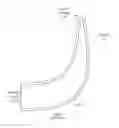
The invention is shown in more detail by help of the sole FIGURE which shows a preferred configuration in a cross sectional view and does not limit the scope of the invention
DETAILED DESCRIPTION OF INVENTION
Referring to the FIGURE, the winglet W shows a tip-end TEW and a root-end REW. The root-end REW is prepared to be connected with the tip-end of a blade (not shown here).
The core C of the winglet W shows a very low water absorption-rate, thus the absorption of water in the core is reduced as best as possible or is even avoided.
The core C is preferably made of a light weight epoxy foam as described above.
The core C is covered by a skin, which contains glass fibers S preferably.
Claims
1. A winglet for a blade of a wind turbine, comprising:
a core with a predetermined water absorption-rate to reduce or even avoid the absorption of water in the core,
wherein the core of the winglet is made of epoxy foam.
2. The winglet according to claim 2,
wherein the core of the winglet is made of a lightweight epoxy foam.
3. The winglet according to claim 3,
wherein the lightweight epoxy foam show a density of 250 kg/m3.
4. The winglet according to claim 1,
wherein the exterior surface of the core is covered by a sheet of glass fiber.
5. The winglet according to claim 5,
wherein the glass fiber covers the core like a skin with a thickness between 1 mm and 5 mm.
6. The winglet according to claim 1,
where the winglet is prepared for a connection with a blade of a wind turbine.
7. A winglet for a blade of a wind turbine, comprising:
a core with a predetermined water absorption-rate to reduce or even avoid the absorption of water in the core,
wherein the exterior surface of the core is covered by a sheet of glass fiber.
8. The winglet according to claim 7,
wherein the glass fiber covers the core like a skin with a thickness between 1 mm and 5 mm.
9. The winglet according to claim 7,
wherein the core of the winglet is made of epoxy foam.
10. The winglet according to claim 7,
wherein the core of the winglet is made of a lightweight epoxy foam.
11. The winglet according to claim 7,
wherein the lightweight epoxy foam show a density of 250 kg/m3.
12. The winglet according to claim 7,
where the winglet is prepared for a connection with a blade of a wind turbine. terial including composition, density and thickness.
Images & Drawings included:

Sources:
- United States Patent and Trademark Office - verify current appl. status at the USPTO↗
Similar patent applications:
- » 20110255974
CONFIGURABLE WINGLET FOR WIND TURBINE BLADES - » 20110142677
Winglet for wind turbine rotor blade - » 20160327020
Attachment method and system to install components, such as tip extensions and winglets, to a wind turbine blade - » 20160327019
Attachment method to install components, such as tip extensions and winglets, to a wind turbine blade, as well as the wind turbine blade and component - » 20120027595
PITCHABLE WINGLET FOR A WIND TURBINE ROTOR BLADE - » 20110142642
Wind turbine rotor blade with aerodynamic winglet - » 20120275925
Winglet for a wind turbine rotor blade - » 20130251535
Winglet for a wind turbine rotor blade - » 20160025066
Winglet for a wind turbine rotor blade - » 20090035134
VERTICAL AXIS WIND TURBINE WITH WINGLETTED CAM-TILTABLE BLADES
Recent applications in this class:
- » 20220025846 2022-01-27
Rotor blade for a wind power installation, and associated wind power installation - » 20190063400 2019-02-28
Methods and systems for disassembling a pitch bearing from a wind turbine hub - » 20170051718 2017-02-23
Wind turbine blade and an associated manufacturing method - » 20150064014 2015-03-05
Method for installing a shear web insert within a segmented rotor blade assembly - » 20150008678 2015-01-08
AIRBORNE WIND ENERGY CONVERSION SYSTEM WITH ENDLESS BELT AND RELATED SYSTEMS AND METHODS - » 20140377066 2014-12-25
Portable Self-Inflating Airborne Wind Turbine System - » 20140345789 2014-11-27
Direct mold for rotor blades for wind turbines - » 20140245580 2014-09-04
Method and device for mounting a rotor of a wind energy plant - » 20130323007 2013-12-05
Facilitated handling of wind turbine blades - » 20130219718 2013-08-29
BLADE INSERT FOR A WIND TURBINE ROTOR BLADE AND RELATED METHODS
Recent applications for this Assignee:
- » 20250291935 2025-09-18
Method, Apparatus and Device for Hardening Assets in OT System and Storage Medium and Computer Program Product - » 20250287560 2025-09-11
Parameterizing an Electronics Production Line - » 20250287419 2025-09-11
WLAN Communication Method, Access Point, Client, and Computing Device - » 20250284885 2025-09-11
Method and Apparatus for Adjusting Natural Language Sentence - » 20250283598 2025-09-11
Optimized Closed-Loop Control Of A Combustion Apparatus - » 20250279680 2025-09-04
Additively Manufactured Magnetic Lamination - » 20250272494 2025-08-28
Method and Apparatus for Generating Natural Language Sentence Describing Workflow - » 20250267066 2025-08-21
Network Configuration Method And Apparatus - » 20250266996 2025-08-21
Method, Device and System for Managing Carbon Data and Related Apparatus - » 20250265531 2025-08-21
Methods, Systems, Apparatus, Electronic Devices, And Storage Media For Evaluating Work Tasks