BALL COVER STRUCTURE OF BASEBALL OR SOFTBALL
US20120244971A1
2012-09-27
13/186,407
2011-07-19
Abstract:
In a structure of a ball cover of a baseball or softball, the ball cover is manufactured from PU material, and the ball cover is one unit from the ball core to the outside of the ball, and a raised sewn section is formed thereon, and the raised sewn section is situated along the mold line on the surface of the ball cover. The PU material is used to replace leather in the manufacture of the ball cover, thereby reducing material costs. Utilizing a mold to directly form the ball cover, and a mechanized production process effectively increases the production rate and reduces worker costs; moreover mechanized production ensures uniformity of the ball, thereby producing balls with precise standards of pressure resistance and bounce values and so on; a ball cover directly formed as one unit and with good overall surface qualities makes it hard for the ball core to be soaked and the sewn section to break, therefore it's extremely waterproof and the outside environment has little effect on the ball, moreover PU material overall displays better durability and resistance qualities than leather, thereby effectively increasing the lifespan of the ball.
Interested in similar patents?
Get notified when new applications in this technology area are published.
Classification:
A63B45/00 » CPC further
Apparatus or methods for manufacturing balls
A63B2037/125 » CPC further
Solid balls; Marbles Rigid hollow balls;; Special coverings, i.e. outer layer material stitchings
A63B2102/18 » CPC further
Application of clubs, bats, rackets or the like to the sporting activity ; particular sports involving the use of balls and clubs, bats, rackets, or the like Baseball, rounders or similar games
A63B2102/182 » CPC further
Application of clubs, bats, rackets or the like to the sporting activity ; particular sports involving the use of balls and clubs, bats, rackets, or the like; Baseball, rounders or similar games Softball
A63B37/12 » CPC main
Solid balls; Marbles Rigid hollow balls; Special coverings, i.e. outer layer material
Description
BACKGROUND OF THE INVENTION
1. Field of the Invention
The present invention relates to a structure of a baseball or softball, in particular, to the structure of a ball cover of a baseball or softball.
2. Description of Related Art
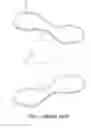
Baseballs and softballs are currently constructed mainly with a ball core wrapped in an outer leather cover. As shown in FIG. 1, the outer cover is made from two figure of 8 shaped pieces “A” which cover the ball core “B” and are sewn together to form the ball.
A raised sewn section is situated where the seams of the opposing ball covers join, fulfilling the required outward appearance of a baseball or softball, but this traditional construction of the ball cover has the following drawbacks:
- 1. The raised sewn section on the outside surface of the ball cover is hand-sewn, requiring skilled labor, and therefore workers possessing greater operational skills. This increases the labor time; and in the current economic climate where worker's costs continue to rise, this increased labor inevitably leads to a higher manufacturing cost of the product.
- 2. The thread on the raised sewn section easily breaks over time, resulting in a short lifespan of the product.
- 3. The source of the leather ball covers is limited, and leather prices are high. Additionally, leather has pores, and with the holes added for sewing this leads to poor waterproofing characteristics of the ball. When the ball is used in humid or rainy weather, moisture or water enters the ball at the seams and soaks the ball core, causing the ball to be heavier, leading to the ball core loosening and the ball changing shape, thereby affecting the characteristics of the ball. There is therefore no way to guarantee the original physical properties of the ball which greatly shortens the lifespan of the ball.
- 4. Leather is a natural material, and the overall uniformity of the surface is uneven, therefore requiring adjustments to the hardness of the ball core, so as to meet requirements for its use.
SUMMARY OF THE INVENTION
The goal of this utility model is to provide an easy processing method for the construction of a baseball and softball, a low production cost and production method that's easy to control, and an increased lifespan of the ball.
In order to achieve the above described goals, this invention solves the drawbacks by:
Providing a construction of a softball or baseball, having: a ball cover constructed from PU material, and formed as one unit from the core to the outside, the ball having a raised sewn section formed on the surface of the ball cover, and the joint lines of the molds for the ball cover situated where the raised sewn section is formed.
To achieve the above, a ball cover structure of the baseball or softball according this invention is made from two opposite and corresponding figure of 8 shaped mold pieces joining to form the cavity of the ball cover, and PU material is used to shape the cavity, thereby shaping the ball from the ball core to the outside, and a raised sewn section is formed along the mold lines of the two joined mold pieces. Constructing the ball in this way has the following advantages:
- 1. Material costs are low, because utilizing PU material to replace leather in the manufacture of the ball cover effectively reduces the material costs;
- 2. Manufacturing costs are low, because utilizing a mold to directly shape the ball cover as one unit, and with a mechanized production process, effectively increases the production rate and lowers the labor costs; additionally the mechanized production ensures uniformity, and produces balls with precise standards of pressure resistance, bounce values and so on;
- 3. Lengthened lifespan of the ball, by shaping the ball cover as one unit the outside integrity is good, and it's difficult for water to enter and the thread can't be broken, therefore the ball is extremely waterproof and the outside environment has little effect on the ball; moreover PU material overall is more durable and resistant thereby increasing the integrity of the ball, and effectively lengthening the lifespan of the ball.
The invention, as well as its many advantages, may be further understood by the following detailed description and drawings in which:
BRIEF DESCRIPTION OF THE DRAWINGS
FIG. 1 is an exploded perspective view of a prior art baseball and softball.
FIG. 2 is a schematic diagram showing a ball cover shaping mold of the present invention.
FIG. 3 is a schematic diagram showing the working ball cover shaping mold of the present invention.
FIG. 4 is a schematic diagram showing the outside appearance of the ball of the present invention.
FIG. 5 is a sectional diagram along line A-A of FIG. 4.
DETAILED DESCRIPTION OF THE INVENTION
As shown in FIG. 4 and FIG. 5, this invention discloses the construction of the ball cover of a baseball or softball, having the following key points: a ball cover 3 made from PU material to form the ball as one unit from the ball core 5 to the outside, at the same time forming the raised sewn section 4 on the surface of the ball cover 3, and the joint lines of the molds for the ball cover 3 situated where the raised sewn section 4 on the surface of the ball cover is formed.
As shown in FIG. 2 and FIG. 3, the outer cover of this invention is made from two soft figure of 8 shaped mold pieces 1 and 2 joining to form the mold cavity, the two mold pieces 1 and 2 corresponding to the two pieces which are sewn together on a traditional outer cover, and where the mold pieces 1 and 2 join are grooves 11 and 21 to directly form the raised sewn section on the surface of the outer cover. When removing the molds, the joint lines are situated along the raised sewn section 4 of the ball cover 3, thereby ensuring the integrity of the outside of the ball, and unnecessary to trim the ball to achieve the required outside appearance of the ball.
In summarizing the above, the ball cover construction of this invention directly utilizes PU material together with a mold to directly achieve the shape, thereby not only reducing the material costs, but also achieving a mechanized production process to simultaneously increase the production rate and reduce labor costs; in addition, the mechanized process ensures uniformity of the product, and the ability to produce balls with precise standards of pressure resistance, bounce standards, and so on; the ball cover 3 being shaped as one unit ensuring good outside integrity, and it's difficult for water to enter and the thread can't be broken, therefore the ball is extremely waterproof and the outside environment has little effect on the ball; moreover PU material overall is more durable and resistant than leather thereby increasing the integrity of the ball, and effectively lengthening the lifespan of the ball; the color of the PU material can also be changed which is an advantage over leather, therefore allowing for richly colored balls as required.
Many changes and modifications in the above described embodiment of the invention can, of course, be carried out without departing from the scope thereof. Accordingly, to promote the progress in science and the useful arts, the invention is disclosed and is intended to be limited only by the scope of the appended claims.
Claims
What is claimed is:1. A structure of a ball cover of a baseball or softball, characterized in that: the ball cover is manufactured from PU material, and the ball cover is one unit formed on a ball core, and a raised sewn section is directly formed on a surface of the ball cover, and the raised sewn section is situated along a mold line on the surface of the ball cover.
Images & Drawings included:



Sources:
- United States Patent and Trademark Office - verify current appl. status at the USPTO↗
Recent applications in this class:
- » 20240278084 2024-08-22
BASKETBALL - » 20240269521 2024-08-15
Leather covered game ball - » 20210283468 2021-09-16
Sports training ball having embossed design - » 20200086178 2020-03-19
SPORTS TRAINING BALL WITH ENHANCED GRIPPING SURFACE - » 20200070009 2020-03-05
SPORTS TRAINING BALL AND METHOD OF MANUFACTURING A SPORTS TRAINING BALL - » 20190351294 2019-11-21
HIGH VISIBILITY LACROSSE BALL - » 20190321691 2019-10-24
COMPOSITE BALL WITH HIGH WEAR RESISTANCE AND WATERPROOFNESS - » 20180333614 2018-11-22
Lamp globe with a tactile surface - » 20180333613 2018-11-22
YOUTH BASEBALL - » 20180200581 2018-07-19
Golf ball compositions