Fuel Cell Powered Jet Engine
US20120304645A1
2012-12-06
13/102,639
2011-05-31
Abstract:
This invention is the use of a fuel cell for powering all the components of a jet engine, but especially heating elements used to heat the air moving through the engine, rather than burning jet fuel.
Interested in similar patents?
Get notified when new applications in this technology area are published.
Classification:
F02K99/00 » CPC further
Subject matter not provided for in other groups of this subclass
H01M2250/20 » CPC further
Fuel cells for particular applications; Specific features of fuel cell system Fuel cells in motive systems, e.g. vehicle, ship, plane
H01M2250/405 » CPC further
Fuel cells for particular applications; Specific features of fuel cell system; Combination of fuel cells with other energy production systems Cogeneration of heat or hot water
Y02B90/10 » CPC further
Enabling technologies or technologies with a potential or indirect contribution to GHG emissions mitigation Applications of fuel cells in buildings
Y02B90/10 » CPC further
Enabling technologies or technologies with a potential or indirect contribution to GHG emissions mitigation Applications of fuel cells in buildings
Y02E60/50 » CPC further
Enabling technologies; Technologies with a potential or indirect contribution to GHG emissions mitigation; Hydrogen technology Fuel cells
Y02E60/50 » CPC further
Enabling technologies; Technologies with a potential or indirect contribution to GHG emissions mitigation; Hydrogen technology Fuel cells
Y02T90/40 » CPC further
Enabling technologies or technologies with a potential or indirect contribution to GHG emissions mitigation Application of hydrogen technology to transportation, e.g. using fuel cells
Y02T90/40 » CPC further
Enabling technologies or technologies with a potential or indirect contribution to GHG emissions mitigation Application of hydrogen technology to transportation, e.g. using fuel cells
F02C1/05 » CPC main
Gas-turbine plants characterised by the use of hot gases or unheated pressurised gases, as the working fluid the working fluid being heated indirectly characterised by the type or source of heat, e.g. using nuclear or solar energy
Description
CROSS-REFERENCE TO RELATED APPLICATIONS
Not Applicable
STATEMENT REGARDING FEDERALLY SPONSORED RESEARCH OR DEVELOPMENT
Not Applicable
REFERENCE TO SEQUENCE LISTING
Not Applicable
BACKGROUND OF THE INVENTION
The purpose of this invention is to reduce emissions of aircraft that rely on jet engines for propulsion. It will also increase the capability of any jet that uses it, as a fuel cell requires less fuel than a conventional jet engine uses. The invention was originally envisioned to be used for powering a spacecraft through the atmosphere prior to lighting a rocket engine to reach low-Earth orbit.
BRIEF SUMMARY OF THE INVENTION
A fuel cell has the capability to heat MoSi2 heating elements to a temperature necessary for a jet engine to be functional. For example, an 80 kW fuel cell (such as the ones being utilized in automobiles) would be able to provide the 25.6 kW of power necessary to heat a chamber one meter in diameter by half a meter long containing eight heating elements to approximately 1200-degrees Celsius, well above the typical jet engine exhaust temperature of 600-degrees Celsius. This would leave 54.4 kW of power available for powering the other components of the jet engine. One fuel cell for each jet engine would use less fuel (liquid hydrogen and potentially liquid oxygen) than a conventional jet engine burning JP-8 jet fuel. The only byproduct of the engine would be water.
BRIEF DESCRIPTION OF THE DRAWING
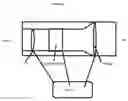
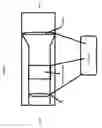
The attached drawing shows a side-view of the concept with the fuel cell attached to the heating elements and the turbine of the engine.
DETAILED DESCRIPTION OF THE INVENTION
The invention differs from a typical jet engine in that rather than a section where the air is heated by burning jet fuel, it is heated by ceramic (likely MoSi2) heating elements. As referenced in the brief summary, eight heating elements spaced evenly around a one meter diameter by one half meter chamber would heat the chamber to 1200-degrees Celsius. The fuel cell would be outside the engine and the liquid hydrogen (and potentially liquid oxygen) would be fed to the fuel cell from tanks either in the wings or elsewhere on the aircraft or spacecraft.
Claims
1. the use of a fuel cell and heating elements to provide the heat necessary for a jet engine to produce the thrust, AND
2. The use of a fuel cell to power the other components of the jet engine (turbine, etc.).
Images & Drawings included:
Sources:
- United States Patent and Trademark Office - verify current appl. status at the USPTO↗
Recent applications in this class:
- » 20240247610 2024-07-25
Organic rankine cycle (ORC) power generation system utilizing LNG cold energy and dual-fuel marine engine waste heat - » 20240183307 2024-06-06
Integrated system for converting nuclear energy into electrical, mechanical, and thermal energy - » 20240167416 2024-05-23
Reconfigurable hybrid solar gas turbine system operating in a semi-open cycle - » 20240068400 2024-02-29
Electrical power producing device - » 20230392545 2023-12-07
POWER CONVERSION SYSTEM INCLUDING ENGINE AND HEAT EXCHANGER - » 20230235697 2023-07-27
Integrated system for converting nuclear energy into electrical, mechanical, and thermal energy - » 20220307416 2022-09-29
VARIABLE PRESSURE TURBINE - » 20220042452 2022-02-10
HYBRID POWER GENERATION SYSTEMS AND METHODS - » 20220010726 2022-01-13
HIGH EFFICIENCY POWER GENERATION SYSTEM AND SYSTEM UPGRADES - » 20210363918 2021-11-25
Baler Boiler Apparatus and Method