Wardrobe box
US20130056529A1
2013-03-07
13/667,342
2012-11-02
✅ Patent granted
US 8,915,420 B2
2014-12-23
-
-
Robert J Hicks
Lawrence G. Fridman
2033-03-01
Abstract:
The wardrobe box comprises a lid (1), a bottom (2) and side walls (3), comprising also a door (4) at one of its side walls (3), and it is characterised in that said lid (1) comprises two hinged sectors (5, 6) engageable to each other.
Said sectors (5, 6) of the lid (1) comprise preferably complementary flaps (5a, 6a) engageable to each other, and said door (4) comprises a detachable closing element (7).
It permits to use no additional closing element, such as e.g. adhesive tape, to close the lid and to keep the door closed.
Inventors:
- Manuel Lopez Masague 6 🇪🇸 Arenys De Mar, Spain
- Embalajes Caspa, S.L. 1 🇺🇸 , United States
Assignee:
- EMBALAJES CAPSA, S.L. 9 🇪🇸 Canet De Mar, Spain
Applicant:
Interested in similar patents?
Get notified when new applications in this technology area are published.
Classification:
A47B61/06 » CPC further
Wardrobes Travelling or trunk wardrobes also made of cardboard or the like, e.g. provided with garment-holders, ironing board, washing outfit, for picnics
B65D5/6602 » CPC further
Rigid or semi-rigid containers of polygonal cross-section, e.g. boxes, cartons or trays, formed by folding or erecting one or more blanks made of paper; Details of containers or of foldable or erectable container blanks; Lids; Hinged lids formed by folding one or more extensions hinged to the upper edge of a tubular container body
B65D5/6605 » CPC further
Rigid or semi-rigid containers of polygonal cross-section, e.g. boxes, cartons or trays, formed by folding or erecting one or more blanks made of paper; Details of containers or of foldable or erectable container blanks; Lids; Hinged lids formed by folding one or more extensions hinged to the upper edge of a tubular container body the lid being formed by two mating halves joined to opposite edges of the container body
B65D5/08 IPC
Rigid or semi-rigid containers of polygonal cross-section, e.g. boxes, cartons or trays, formed by folding or erecting one or more blanks made of paper by folding or erecting a single blank to form a tubular body with or without subsequent folding operations, or the addition of separate elements, to close the ends of the body with end closures formed by inward-folding of portions of body, e.g. flaps, interconnected by, or incorporating, gusset folds
B65D85/185 » CPC main
Containers, packaging elements or packages, specially adapted for particular articles or materials for wearing apparel, headwear or footwear Containers for shipping garments on hangers
B65D2313/02 » CPC further
Connecting or fastening means of hook-and-loop type
B65D5/16 » CPC further
Rigid or semi-rigid containers of polygonal cross-section, e.g. boxes, cartons or trays, formed by folding or erecting one or more blanks made of paper by folding or erecting a single blank to form a tubular body with or without subsequent folding operations, or the addition of separate elements, to close the ends of the body the tubular body being formed with an aperture or removable portion arranged to allow removal or insertion of contents through one or more sides
B65D5/10 » CPC main
Rigid or semi-rigid containers of polygonal cross-section, e.g. boxes, cartons or trays, formed by folding or erecting one or more blanks made of paper by folding or erecting a single blank to form a tubular body with or without subsequent folding operations, or the addition of separate elements, to close the ends of the body with end closures formed by inward-folding of self-locking flaps hinged to tubular body
B65D85/18 IPC
Containers, packaging elements or packages, specially adapted for particular articles or materials for wearing apparel, headwear or footwear
Description
The present invention refers to a wardrobe box, specially designed to contain and transport clothes hung from hangers.
BACKGROUND OF THE INVENTION
The wardrobe boxes are used to contain and transport clothes hung from hungers. To this end, the wardrobe boxes comprise a transversal bar, from which the hangers hung. This transversal bar is usually engaged on the upper edge of the wardrobe box.
To place or remove the clothes, the wardrobe box comprises an upper lid. Usually, to transport the wardrobe box the upper lid must be closed by a closing element, e.g. adhesive tape.
To place and remove the clothes, the known wardrobe boxes comprise a door at one of its side walls.
Furthermore, to facilitate the transportation of the wardrobe box, it comprises handle-like holes in two opposed side walls of the wardrobe box.
The known wardrobe boxes have several drawbacks. Firstly, to close the door of the wardrobe box it is necessary to place the closing element on the lid, because if it is not closed, the lid can be opened. The placement of the closing element each time the lid is closed is uncomfortable, and when the closing element is removed the lid can be damaged, so that the wardrobe box cannot be used several times.
SUMMARY OF THE INVENTION
With the wardrobe box of the invention said drawbacks can be solved, presenting other advantages that will be described.
The wardrobe box of the present invention comprises a lid, a bottom and side walls, and it is characterised in that said lid comprises two hinged sectors engageable to each other.
Therefore, it is not necessary to use an additional closing element, such as e.g. adhesive tape, to close the lid and to keep the door closed, unlike the known wardrobe boxes. Furthermore, it permits to use less material than the conventional wardrobe boxes.
Advantageously, said sectors of the lid comprise complementary flaps engageable to each other.
Preferably, the door of the wardrobe box of the present invention comprises a detachable closure, that according to a preferred embodiment, is made from Velcro®, i.e. is formed by the bands engageable to each other, one provided with a plurality of hooks and the other one provided with a velvet material, one of the bands being placed on said door and the other one on the adjacent side wall against which the door closes.
With respect to the bottom of the wardrobe box of the present invention, it comprises formed flaps engageable to each other.
BRIEF DESCRIPTION OF THE DRAWINGS
For a better understanding of what has been described some drawings are attached in which, diagrammatically and only as a non-limitative example, a practical case of embodiment is shown.
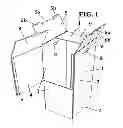
FIG. 1 is a perspective view of the wardrobe box of the present invention with its lid and its door opened;
FIG. 2 is a perspective view of the wardrobe box of the present invention closed; and
FIG. 3 is a perspective view of the wardrobe box of the present invention with its lid and its bottom opened.
DESCRIPTION OF A PREFERRED EMBODIMENT
As it can be seen in the figures, the wardrobe box of the present invention comprises a lid 1, a bottom 2 and four side walls 3, one of said side walls 3 being provided with a door 4.
The lid 1 comprises two hinged sectors 5, 6 engageable to each other by flaps 5a, 6a provided in said sectors.
These hinged sectors 5, 6 permit to close the lid 1 with no external closing element, such as e.g. adhesive tape.
The lid 1 can also comprise a pair of additional flaps 9 to reinforce it, that are folded below said hinged sectors 5, 6.
Furthermore, the lid 1 comprises adhesives 5b, 6b to keep said hinged sectors 5, 6 joined to each other. Preferably, said adhesives 5b, 6b are double-sided adhesives tapes.
When the lid 1 is closed, the door 4 is also closed, which means that the door 4 can be closed also with no external closing element.
The door 4 also comprises a detachable closing element 7, made up from two complementary bands of Velcro® or adhesive, one placed in the door 4 and the other one placed on the adjacent side wall 3.
This detachable Velcro® closing element or adhesive permits to open and close the door 4 any times not damaging the wardrobe box of the present invention.
Two opposed side walls 3 comprise holes 8 provided to house the ends of a transversal bar (not shown) to hang the hangers for cloths that will be placed inside the wardrobe box of the present invention.
This transversal bar is the same that is disclosed in the Spanish utility model U9500827, which is included here as reference, whose inventor is the same than the inventor of this application.
The use of this transversal bar permits to provide handles at their ends, and it permits at the same time to close completely the wardrobe box, preventing the entrance of dust.
The bottom 2 of the wardrobe box of the present invention is made up from flaps 2a engageable to each other, as it can be seen from FIG. 3.
Said bottom 2 also comprises adhesives 2b, 2c that join the flaps 2a to each other. Preferably, said adhesives 2b, 2c are double-sided tapes.
Even though reference is made to a specific embodiment of the invention, it is apparent for a person skilled in the art that the described wardrobe box is susceptible of numerous variations and modifications, and that all the details cited can be substituted by other technically equivalent ones, without departing from the scope of protection defined by the attached claims.
Claims
1. A wardrobe box comprising:
a lid, a bottom, and side walls, further comprising:
an opening defined between a first side wall and a second side wall, and
a door pivotally coupled to at least one of the first and second side walls, the door being configured to cover the opening,
wherein (i) the lid comprises a first hinged sector and a second hinged sector capable of engaging the first hinged sector, (ii) the first hinged sector is pivotally coupled to the first side wall and includes a first flap, and (iii) the second hinged sector is pivotally coupled to the second side wall and includes a second flap capable of engaging the first flap.
2. (canceled)
3. The wardrobe box according to claim 1, wherein the door comprises a detachable closing element.
4. The wardrobe box according to claim 3, wherein the detachable closing element of the door comprises a first band and a second band capable of engaging each other, wherein the first band contains a plurality of hooks and the second band contains a velvet material, wherein one of the bands is placed on the door and the other band is placed on the adjacent side wall against which the door is closed.
5. The wardrobe box according to claim 1, wherein the bottom comprises four flaps capable of engaging to each other.
6. The wardrobe box according to claim 1, wherein the first hinged sector and the second hinged sector are moveable between (i) a first position in which the first flap and the second flap are engaged such that the second flap is positioned over the first flap, and (ii) a second position in which the first flap and the second flap are spaced apart from each other.
7. The wardrobe box according to claim 1, wherein (i) the first hinged sector has a first pair of side flaps and the first flap is positioned between the first pair of side flaps, (ii) the second hinged sector has a second pair of side flaps and the second flap is positioned between the second pair of side flaps, and (iii) the first pair of side flaps is positioned over the second pair of side flaps when first flap engages the second flap.
Images & Drawings included:



Sources:
- United States Patent and Trademark Office - verify current appl. status at the USPTO↗
Similar patent applications:
- » 20100308067
WARDROBE BOX - » 20150183574
Wardrobe box - » 20160257483
Wardrobe box - » 20220194689
Wardrobe box assembly - » 20240109717
Wardrobe box and hanger support member therefor - » 20240116696
Method of assembling a wardrobe box assembly - » 20250197097
METHOD OF ASSEMBLING A WARDROBE BOX ASSEMBLY - » 20250276843
WARDROBE BOX AND HANGER SUPPORT MEMBER THEREFOR
Recent applications for this Assignee:
- » 20190177029 2019-06-13
Storage and shipping box - » 20160257483 2016-09-08
Wardrobe box - » 20150259091 2015-09-17
Storage and shipping box - » 20150191271 2015-07-09
Storage box - » 20140217158 2014-08-07
STORAGE BOX - » 20140197230 2014-07-17
Storage and shipping box - » 20110036904 2011-02-17
Storage box - » 20100308067 2010-12-09
WARDROBE BOX