Thuja plant named 'Concesarini'
US20130117897P1
2013-05-09
13/373,190
2011-11-08
Abstract:
A new Thurja occidentalis (i.e., American Arborvitae) plant is provided which originated as a whole plant mutation of the ‘Linesville’ variety (non-patented in the United States). Unlike the parental variety, the new plant displays a distinctive much lower growing dense globular rounded growth habit. Good winter hardiness is displayed and the plant resists sun and winter burning. The plant is well suited for providing attractive and uniform ornamentation close to ground level.
Assignee:
- CP DELAWARE INC. 106 🇺🇸 Wilmington, DE, United States
Interested in similar patents?
Get notified when new applications in this technology area are published.
Classification:
A01H7/00 IPC
Gymnosperms, e.g. conifers
Description
BOTANICAL/COMMERCIAL CLASSIFICATION
Thuja occidentalis/THUJA Plant
VARIETAL DENOMINATION
cv. Concesarini
SUMMARY OF THE INVENTION
Many varieties of Thuja occidentalis plants (i.e., American Arborvitae plants) are known in the horticultural industry. Among these is the ‘Linesville’ variety (non-patented in the United States) which is known to display a tight and compact growth habit with a dwarf mounded globe and soft sage-green juvenile foliage.
The new variety was discovered as a whole plant mutation of unknown causation among plants of the ‘Linesville’ variety growing at the nursery of the originator at Denton, Md., U.S.A. The new variety was observed to display a growth habit that was considerably lower than even its ‘Linesville’ parent. Had the new variety not been discovered and preserved it would have been lost to mankind.
It was found that the new Thuja plant of the present invention possesses the following combination of characteristics:
-
- (a) displays a much lower growing dense globular rounded growth habit than the ‘Linesville’ variety (non-patented in the United States),
- (b) displays good winter hardiness,
- (c) resists sun and winter burning, and
- (d) is well suited for growing as attractive uniform ornamentation close to ground level.
The new variety of the present invention can be readily distinguished from its ‘Linesville’ variety parent and all other Thuja varieties known to the discoverer in view of its distinctive extremely low growth habit.
The new variety is well suited for providing attractive uniform low-growing ornamentation in gardens and in the landscape over an extended period of time.
Asexual reproduction of the new variety at West Grove, Pa., U.S.A., beginning in 2006, by the use of semi-hardwood cuttings has demonstrated that the distinctive characteristics of the new variety of the present invention are reliably transmitted from one generation to another. Accordingly, the new variety reproduces in a true-to-type manner by such technique.
The new variety has been named ‘Concesarini’ and will be marketed under the PANCAKE trademark.
BRIEF DESCRIPTION OF THE PHOTOGRAPH
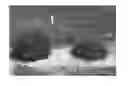
The accompanying photograph shows as true as it is reasonably possible to make the same in color illustrations of this character a typical specimen of the new variety of the present invention. Such plant of the present invention is shown at the right of the photograph. For comparative purposes, a plant of the ‘Lineville’ variety is shown at the left of the photograph. The depicted plants were approximately three years of age and were growing outdoors in the ground under full sun at West Grove, Pa., U.S.A. The significantly lower growth habit of the new variety is readily apparent.
DETAILED DESCRIPTION
The following description is based upon the observation of typical plants of the new variety at an age of approximately three years during the month of October while growing in containers in full sun at West Grove, Pa., U.S.A. The growing conditions approximated those employed for the commercial production of Thuja plants. The chart used in the identification of colors is the R.H.S. Colour Chart of The Royal Horticultural Society, London, England, 1995. Common color terms are to be accorded their customary dictionary significance.
- Plant:
-
- Height.—Approximately one foot for a three-year-old plant.
- Width.—Approximately 2½ feet for a three-year-old plant.
- Growth habit.—Extremely low growing, compact, dense, globular, rounded, perennial evergreen shrub.
- Growth rate.—Moderate.
- Propagation.—Is well asexually reproduced through the use of semi-hardwood cuttings.
- Roots.—Fibrous.
-
- Stems:
-
- Shape.—Generally oval.
- Diameter.—Commonly approximately 1 cm for main branches, and approximately 0.3 cm for lateral branches.
- Length.—Commonly approximately 3 cm for main branches, and approximately 17 cm for lateral branches.
- Texture.—Glabrous and knobby with scales.
- Color.—New growth in sprays commonly is Grey-Brown Group 199C with scales of near Greyed-Orange Group 167D, young branches commonly are Greyed-Orange Group 166B with scales of near Greyed-Orange Group 166A, and mature branches commonly are near Greyed-Orange Group 177A.
- Internode length.—Commonly approximately 3 cm on average at the base and approximately 2 cm on average approaching the tip.
-
- Branching:
-
- Arrangement.—Alternate, main stem arises from a base with numerous secondary branches.
- Frequency.—Commonly approximately 34 lateral branches on average per main stem.
- Aspect.—Main stems are substantially upright, lateral stems are held at an angle of approximately 45° from a main stem, and substantially flat sprays extend outwards.
-
- Foliage:
-
- Arrangement.—Numerous leaves on planar branchlets, closely alternate or opposite; and scale-like decussate.
- Form.—Simple, facial pair keeled, flat pair flattened and oblong.
- Leaf size.—Approximately 2 mm in length on average, and approximately 1 mm in width on average.
- Leaf quantity.—Commonly approximately 15 leaves per cm on lateral branchlets.
- Apex.—Apiculate.
- Base.—Cuneate.
- Venation.—Not apparent.
- Margin.—Entire.
- Texture.—On upper and lower surfaces glabrous, smooth, and glossy.
- Color.—New growth commonly is near Greyed-Green Group 191A on the upper and lower surfaces, and mature growth commonly is a blend of near Green Group 137A and near Green Group 141A on the upper and lower surfaces.
- Fragrance.—Somewhat acrid when crushed.
-
- Development:
-
- Resistance to disease.—No disease susceptibility has been encountered during observations to date.
- Resistance to pests.—No pest susceptibility has been encountered during observations to date.
- Weather tolerance.—Has been observed to be tolerant to drought, rain and wind, and temperatures ranging from 0° to 100° F.
- Cold hardiness.—U.S.D.A. Hardiness Zone Nos. 3 to 7.
-
The new ‘Concesarini’ variety has not been observed to date under all possible environmental conditions. Accordingly, it is possible that the phenotype may vary somewhat with variations in the environment, such as temperature, light intensity, day length, and other cultural conditions without variance of the genotype.
Claims
I claim:1. A new and distinct Thuja plant having the following combination of characteristics:
(a) displays a much lower growing dense globular rounded growth habit than the ‘Linesville’ variety (non-patented in the United States),
(b) displays good winter hardiness,
(c) resists sun and winter burning, and
(d) is well suited for growing as attractive uniform ornamentation close to ground level;
substantially as illustrated and described.
Images & Drawings included:

Sources:
- United States Patent and Trademark Office - verify current appl. status at the USPTO↗
Recent applications in this class:
- » 20240292771 2024-08-29
Campanula plant named 'Twilight' - » 20240251691 2024-07-25
HYDRANGEA PLANT NAMED 'HYLV17520' - » 20240251690 2024-07-25
Vaccinium Plant Named 'BWPBLUE02' - » 20240251689 2024-07-25
BLUEBERRY PLANT NAMED 'FC13-113' - » 20240251688 2024-07-25
BLUEBERRY PLANT NAMED 'FCM14-057' - » 20240237567 2024-07-11
PONGAMIA VARIETIES - » 20240224827 2024-07-04
PELARGONIUM PLANT NAMED 'PEQZ0103' - » 20240215470 2024-06-27
Agapanthus plant named 'Monsapho' - » 20240215469 2024-06-27
plant named ‘LOCORA3519’ - » 20240206359 2024-06-20
CORYLUS PLANT NAMED 'BWM01'
Recent applications for this Assignee:
- » 20170188496 2017-06-29
HYDRANGEA PLANT NAMED 'MCKAY' - » 20170188493 2017-06-29
Climbing Rose Plant Named 'RADPETALS' - » 20170181356 2017-06-22
Salvia plant named 'Novasalred' - » 20170181355 2017-06-22
Salvia plant named 'NOVASALFUC' - » 20170181354 2017-06-22
Salvia plant named 'Novasalpur' - » 20170181347 2017-06-22
Mahonia plant named 'sPg-15-1' - » 20170094848 2017-03-30
Grandiflora rose plant named 'Radnectar' - » 20170071084 2017-03-09
Shrub Rose Plant Named 'Meizorland' - » 20170034973 2017-02-02
FLORIBUNDA ROSE PLANT NAMED 'MEIDOSCOPE' - » 20170034972 2017-02-02
Floribunda rose plant named 'MEIRIANSOIS'