Softwood cutting board
US20130134644A1
2013-05-30
13/305,989
2011-11-29
✅ Patent granted
US 8,870,173 B2
2014-10-28
-
-
Lee D Wilson
2032-12-10
Abstract:
A cutting board which is used for the preparation of types of food and/or for the presentation and cutting of appetizer type foods such as cheese, fruit, etc. The cutting board is constructed simply of a relatively thick (1½″) piece of soft wood such as douglas fir and reinforced with wooden dowels perpendicular to the grain of the wood. Such unique construction maintains the flatness of the board allowing it to be maintenance free and washable in a normal dishwasher cycle without warping.
Applicant:
Interested in similar patents?
Get notified when new applications in this technology area are published.
Classification:
A47J47/005 » CPC further
Miscellaneous kitchen containers, stands, or the like ; Cutting-boards, e.g. for bread Cutting boards
A47J47/00 » CPC main
Miscellaneous kitchen containers, stands, or the like ; Cutting-boards, e.g. for bread
B23Q3/00 IPC
Devices holding, supporting, or positioning work or tools, of a kind normally removable from the machine
Description
BACKGROUND OF THE INVENTION
1—Field of Invention
The invention relates to a food cutting board. More particularly it relates to a cutting board that is constructed of wood and can be washed and sterilized in a normal dishwasher cycle without warping. Two prototype cutting boards were constructed in 1983, used daily and subjected to hundreds of dishwashing machine cycles. They remain flat and in use today.
2—Description of Related Arts
Cutting boards are necessarily widely used for food preparation. Existing cutting boards are constructed of hard woods such as maple and walnut (frequently of laminar construction) or of plastic materials. Wooden boards are preferred by many due to their appearance and surface texture as experienced with the knife as the food is cut. These boards must be oil treated and hand washed to maintain flatness. Plastic boards offer dimensional stability when subjected to a dishwasher cycle, however the appearance and feel of the material and cutting sensation is not the same as a wooden board. In addition, the smooth surface of the plastic promotes slippage of some foods on the board and slipping of the board on the counter surface.
SUMMARY OF INVENTION
The invention is the unique construction of a softwood cutting board that allows the board to be cleaned and sterilized in a dishwashing cycle on a daily basis without warping. Proven by extended time prototype usage.
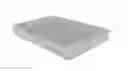
Attached drawing shows the board and illustrates its construction in an isometric view.
The cutting board is constructed of softwood, such as douglas fir with wooden dowels inserted at the centerline of the thickness (1½″ thick) extending partially though the width of the board. Although not shown in the conceptual drawing the edges of the board are rounded to approximately ¼″ radius. The board is to be constructed in multiple sizes to suit each purpose but to minimize weight and storage requirement space. Standard sizes 1½ inches thick include, but are not limited to:
-
- 7¼″ wide×10⅛″ long (mini)
- 9¼″ wide×13″ long (standard)
- 11¼″ wide×15⅞″ long (super size)
Claims
1- The primary object of the invention is to provide an aesthetically pleasing wooden board with a superior cutting surface that can be cleaned and sterilized in a normal dishwashing cycle without warping.
2- Another object is that due to the construction material, the board is relatively light weight as compared to hard wood boards or plastic boards of equivalent thickness.
3- Another object is that the soft wood surface resists slipping will not dull the knife to the extent that a hard wood or plastic surface does.
4- Another object is that the utilization of shorter dowels promotes the flatness of the board as opposed to solid wooden board or dowels continuous for the width of the board.
Images & Drawings included:

Sources:
- United States Patent and Trademark Office - verify current appl. status at the USPTO↗
Recent applications in this class:
- » 20240324825 2024-10-03
Customized identification of ingredients in a storage system - » 20190174965 2019-06-13
Friction Reducing Pad System - » 20190000278 2019-01-03
CADDY AND MEAT DONENESS MARKERS ASSEMBLY - » 20140124997 2014-05-08
FOOD WORK TABLE - » 20120067749 2012-03-22
Container - » 20060190104 2006-08-24
Methods and apparatus for mountable culinary recipe storage and display - » 14534888 2017-05-16
Food preparation system and associated methods - » 14054796 2015-11-24
Grease collector receptacle and cooking utensil for use therewith - » 13162057 2014-05-13
Food preparation cutting board and associated method