Compounds as ligands for transition metal complexes and materials made thereof, and use therefor
US20130158262A1
2013-06-20
13/704,596
2011-05-31
✅ Patent granted
US 8,937,175 B2
2015-01-20
WO; PCT/EP2011/058903; 20110531
WO; WO2011/157546; 20111222
Venkataraman Balasubramanian
Slater & Matsil, L.L.P.
2031-07-23
Abstract:
The invention relates to novel compounds as ligands for transition metal complexes and materials made thereof that can be used, for example, as emitters in organic light-emitting electrochemical cells (OLEECs). According to the invention, non-fluorinated electron-poor emitter materials are disclosed for the first time that can be used in organic light-emitting electrochemical cells.
Assignee:
- OSRAM GMBH 177 🇩🇪 Muenchen, Germany
- OSRAM GmbH 667 🇩🇪 Munich, Germany
Applicant:
Interested in similar patents?
Get notified when new applications in this technology area are published.
Classification:
C07F15/0033 » CPC main
Compounds containing elements of Groups 8, 9, 10 or 18 of the Periodic System compounds of the platinum group Iridium compounds
C07D253/10 » CPC further
Heterocyclic compounds containing six-membered rings having three nitrogen atoms as the only ring hetero atoms, not provided for by group condensed with carbocyclic rings or ring systems Condensed 1,2,4-triazines; Hydrogenated condensed 1,2,4-triazines
C07F15/00 IPC
Compounds containing elements of Groups 8, 9, 10 or 18 of the Periodic System
C07D253/08 » CPC further
Heterocyclic compounds containing six-membered rings having three nitrogen atoms as the only ring hetero atoms, not provided for by group condensed with carbocyclic rings or ring systems
H01L51/0085 » CPC further
Solid state devices using organic materials as the active part, or using a combination of organic materials with other materials as the active part; Processes or apparatus specially adapted for the manufacture or treatment of such devices, or of parts thereof; Selection of organic semiconducting materials, e.g. organic light sensitive or organic light emitting materials; Coordination compounds, e.g. porphyrin; Transition metal complexes, e.g. Ru(II)polypyridine complexes comprising Iridium
C09K2211/1059 » CPC further
Chemical nature of organic luminescent or tenebrescent compounds; Non-macromolecular compounds; Heterocyclic compounds characterised by ligands containing three nitrogen atoms as heteroatoms
C09K2211/185 » CPC further
Chemical nature of organic luminescent or tenebrescent compounds; Metal complexes of the platinum group, i.e. Os, Ir, Pt, Ru, Rh or Pd
C07D233/54 IPC
Heterocyclic compounds containing 1,3-diazole or hydrogenated 1,3-diazole rings, not condensed with other rings having two double bonds between ring members or between ring members and non-ring members
C07D401/04 » CPC further
Heterocyclic compounds containing two or more hetero rings, having nitrogen atoms as the only ring hetero atoms, at least one ring being a six-membered ring with only one nitrogen atom containing two hetero rings directly linked by a ring-member-to-ring-member bond
C07D403/04 » CPC further
Heterocyclic compounds containing two or more hetero rings, having nitrogen atoms as the only ring hetero atoms, not provided for by group containing two hetero rings directly linked by a ring-member-to-ring-member bond
C09K11/06 » CPC further
Luminescent, e.g. electroluminescent, chemiluminescent materials containing organic luminescent materials
H01L51/00 IPC
Solid state devices using organic materials as the active part, or using a combination of organic materials with other materials as the active part; Processes or apparatus specially adapted for the manufacture or treatment of such devices, or of parts thereof
H05B33/14 » CPC further
Electroluminescent light sources; Light sources with substantially two-dimensional radiating surfaces characterised by the chemical or physical composition or the arrangement of the electroluminescent material, or by the simultaneous addition of the electroluminescent material in or onto the light source
C09K2211/1044 » CPC further
Chemical nature of organic luminescent or tenebrescent compounds; Non-macromolecular compounds; Heterocyclic compounds characterised by ligands containing two nitrogen atoms as heteroatoms
Description
This patent application is a national phase filing under section 371 of PCT/EP2011/058903, filed May 31, 2011, which claims the priority of German patent application 10 2010 023 959.3, filed Jun. 16, 2010, each of which is incorporated herein by reference in its entirety.
TECHNICAL FIELD
The invention relates to novel compounds as ligands for transition metal complexes and to materials produced therefrom, which can be used, for example, as emitters in organic light-emitting electrochemical cells (OLEECs).
BACKGROUND
OLEECs have been developed in the last few years and have the potential to attain the performance of, and be producible even less expensively than, the organic electroluminescent diodes (OLEDs).
WO 2010/007107, DE 10 2009 031 683 and DE 10 2010 005 632 have already disclosed transition metal complexes as emitting materials for these components.
DETAILED DESCRIPTION OF ILLUSTRATIVE EMBODIMENTS
A particular problem is still that of stable OLEEC emitters which emit at short wavelengths, i.e., in the blue. Such blue OLEEC emitters have to date been obtained only on the basis of fluorinated ligands, the aromatic base structure of which is particularly electron-deficient as a result of the fluorine substitution. However, the stability of such materials in the component is only very low. The emission wavelength shifts to a longer-wave spectral region within a short time, which suggests exchange of the fluorine in the electrical field.
In contrast OLEEC emitters without fluorinated ligand systems are very long-lived, but do not emit in the blue.
In one aspect, the invention provides novel ligand systems which, without fluorination, lead to a similarly low electron density in the aromatic base structure and therefore lead to the same effect of a short-wave, blue luminescence.
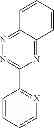
The invention provides the novel substance class of the electron-deficient heterocycles of the 3-arylbenzo-1,2,4-triazine series A
where X is —CH═ and —N═ and the ortho positions of the adjacent phenyl rings may be joined to one another by a chemical bond.
The invention also provides a novel class of cationic transition complexes with a ligand A, for example a combination of ligand A with 2-phenylimidazole ligand structures B or with itself,
where, in structure A, X is —CH═ and —N═ and, in the structure B, Ar is “phenyl” or “2,6-diisopropyl-1-phenyl,” the ortho positions of the adjacent phenyl rings may be joined to one another by a chemical bond, R1 and R2 may each independently be “H” or “phenyl” and together form a annulated benzene ring.
Finally, the invention provides for the use of a transition metal complex with a ligand A or for the use of a combination of a ligand A with a ligand B in an organic light-emitting electrochemical cell.
The following reaction scheme depicts a preferred preparation of the novel OLEEC emitters by the Nonoyama synthesis route.
1.) Reaction scheme for complex formation:
Access to cationic iridium complexes by the Nonoyama route has been known from the literature for a few years.
Unknown to date are all structures which can be formed by the incorporation of the A ligand.
These inventive structures C and D are blue-emitting materials which have to be provided with a suitable anion by salt exchange for use in an OLEEC device. Tetrafluoroborate, hexafluorophosphate and hexafluoroantimonate are particularly suitable anions Likewise suitable are anions of ionic liquids, the organo component of which corresponds to the anion.
For formation of the transition metal complex, for example, iridium is used, but it is also possible to use other transition metal atoms such as ruthenium, rhodium, palladium, rhenium, osmium, platinum, gold and the lanthanides as the central atom according to the invention.
The preparation of the ligand A is accomplished according to reaction scheme 2.
2-Nitrophenyl hydrazine is converted to an amidrazone by reaction with imido esters, and these are hydrogenated over a platinum catalyst and filtered off from the catalyst. The reduction product which has been freed of the solvent is stirred with silylated polyphosphoric acid.
2.) Reaction scheme for ligand system A
Working examples will now be described.
Preparation of N′-(2-nitrophenyl)picoline hydrazonamide 16 g (0.104 mol; 1 equivalent) of 2-nitrophenyl hydrazine and 15.55 g (0.104 mol; 1 equivalent) of picolinimidic acid ethyl ester are initially charged in 200 ml of THF. The mixture is then heated to 50° C. for six hours. On completion of reaction, a dark solid precipitates out. A check by thin-film chromatography (absorbent: silica gel 60; eluent: 4:1 toluene/ethyl acetate) shows virtually complete conversion. The solvent is removed on a rotary evaporator, and the remaining precipitate is recrystallized from a little ethanol. The solid is filtered off with suction and washed with a little cold ethanol. Yield: 24.2 g (90%); dark green, sparkling powder M=257.25 g/mol (C12H11N5O2) Melting point: 197° C. MS (ESI): m/z=258.3 ([M+H]+).
Preparation of N′-(2-nitrophenyl)benzohydrazonamide 10 g (0.065 mol; 1 equivalent) of 2-nitrophenyl hydrazine and 12.07 g (0.065 mol; 1 equivalent) of benzoimidic acid ethyl ester hydrochloride are initially charged in 200 ml of a mixture of anhydrous ethanol and THF in a ratio of 1:1 and 6.58 g (0.065 mol; 1 equivalent) of triethylamine are added. The mixture is boiled at reflux for two hours. After cooling the reaction mixture, a dark red solid precipitates out, which is filtered off with suction and washed with cold ethanol. The melting point is determined to be 180-182° C. Yield: 6.8 g (41%); dark red, amorphous powder M=256.26 g/mol (C13H12N402) MS (ESI): m/z=257.3 ([M+H]+).
Preparation of 3-(pyridin-2-yl)benzo[e][1,2,4]-triazine by reduction of N′-(2-nitrophenyl)picoline hydrazonamide by means of hydrogen over a platinum catalyst. The reduction of the amidrazone is conducted in a hydrogenation apparatus: 8 g (0.0311 mol) of N′-(2-nitrophenyl)picolinohydrazonamide are initially charged in 500 ml of ethanol in a 1000 ml Erlenmeyer flask. A catalytic amount of platinum(IV) oxide is added to this suspension. Once the Erlenmeyer flask has been installed into the hydrogenation apparatus, the required volume of hydrogen is introduced into the apparatus and the reduction of the amidrazone present is conducted with vigorous stirring. After the reduction has ended, the elemental platinum is filtered off and the filtrate is very substantially concentrated.
The oily mass formed is weighed, 60 ml of a solution of trimethylsilyl polyphosphate (preparation as described below) are added, and the mixture is boiled at reflux for one hour. The reaction mixture is then concentrated again as far as possible and a few milliliters of water are added. The pale yellow solid which then crystallizes out gradually is recrystallized from ethanol and then filtered off with suction; this leaves a white precipitate. Yield: 1.61 g (25%); white, fine pulverulent precipitate M=208.22 g/mol (C12H8N4) Melting point: 145° C. MS (EI): m/z=208 ([M]+).
Preparation of trimethylsilyl polyphosphate: In a flask with a reflux condenser and drying tube, 11.37 g (0.070 mol; 1 equivalent) of hexamethyldisiloxane and 10 g (0.070 mol; 1 equivalent) of phosphorus pentoxide, P205, are heated at reflux in 100 ml of 1,2-dichloroethane for about two hours, until all P2O5 has dissolved.
Preparation of a di-μ-chloro complex of B A 500 ml one-neck flask is initially charged under inert conditions with 0.69 g (2.3 mmol; 1 equivalent) of iridium(III) chloride hydrate, IrCl3*nH20, and 0.40 g (6.9 mmol; 3 equivalents) of sodium chloride, NaCl, in 20 ml of degassed water, and 1.76 g (4.6 mmol; 2 equivalents) of 1-(2,6-diisopropylphenyl)-2-phenyl-1H-imidazole which has been dissolved in a mixture of 12 ml of degassed water and 28 ml of 2-ethoxyethanol are added. The mixture is heated to about 50° C. and, after 3 hours, by TLC monitoring (absorbent: silica gel 60; eluent: 9:1 toluene/acetone), substantial conversion to the complex is observed. 200 ml of diethyl ether and 20 ml of methanol are added, and the yellow-green solid formed is filtered off with suction and washed with methanol. The compound can be obtained with a yield of 32% and decomposes above 310° C. Yield: 0.54 g (32%); pale yellow-green precipitate M=1669.02 g/mol (C84H92Cl2Ir2N8) Melting point: >310° C. (decomposition) MS (ESI): m/z =799.4 ([(M/2)-Cl]+).
Preparation of the iridium coordination compound from A (X=N) and B (di-μ-chloro complex 0.50 g (0.30 mmol; 1 equivalent) of B (di-μ-chloro complex) is initially charged in 30 ml of chloroform. 0.12 g (0.60 mmol; 2 equivalents) of 3-(pyridin-2-yl)benzo[e][1,2,4]triazine A (X=N) is added to the resulting suspension. The mixture is boiled at reflux for about 30 minutes. The precipitated pale yellow solid is filtered off with suction and washed with diethyl ether. The yield is 90%. The melting point is 194° C.; the material decomposes at the same time. Yield: 0.56 g (90%); yellow solid. M=787.29 g/mol (C35H25ClIrN7O) Emission maximum (PL): Xmax=484 nm (acetonitrile).
The present invention for the first time presents unfluorinated electron-deficient emitter materials which can be used in organic light-emitting electrochemical cells.
Claims
1-5. (canceled)
6. An electron-deficient heterocycle of the 3-arylbenzo-1,2,4-triazine series as ligand A
where X is —CH═ and N═ and the ortho positions of the adjacent phenyl rings may be joined to one another by a chemical bond.
7. A cationic transition complex comprising a central atom and two structures of a ligand A according to the heterocycle of claim 6.
8. A cationic transition complex comprising:
a central atom,
a ligand A according to the heterocycle of claim 6, and
a 2-phenylimidazole ligand structure B,
where, in structure A, X is —CH═ and —N═ and, in the structure B, Ar is “phenyl” or “2,6-diisopropyl-1-phenyl,” and
wherein the ortho positions (2,2′ positions) of the adjacent phenyl rings may be joined to one another by a chemical bond,
wherein R1 and R2 may each independently be “H” or “phenyl” and together form a annulated benzene ring, and
wherein the central atom comprises an atom selected from the group consisting of iridium, ruthenium, rhodium, palladium, rhenium, osmium, platinum, gold and the lanthanides.
9. A material for a light-emitting layer of an organic light-emitting electrochemical cell, comprising a transition metal complex with a ligand A according to claim 6.
10. A material for a light-emitting layer of an organic light-emitting electrochemical cell comprising a transition metal complex comprising a central atom and two structures of a ligand A according to claim 7.
11. A material for a light-emitting layer of an organic light-emitting electrochemical cell, comprising a transition metal complex with a ligand A in combination with a ligand B according to claim 8.
12. An organic light-emitting electrochemical cell comprising a transition metal complex with a ligand A according to claim 6.
13. An organic light-emitting electrochemical cell comprising a transition metal complex comprising a central atom and two structures of a ligand A according to claim 7.
14. An organic light-emitting electrochemical cell comprising a transition metal complex with a ligand A in combination with a ligand B according to claim 8.
15. A cationic transition complex according to claim 7, which comprising the following compound and derivatives thereof:
16. A cationic transition complex according to claim 7, which comprising the following compound and derivatives thereof:
17. A cationic transition complex according to claim 8, which comprising the following compound and derivatives thereof:
18. A cationic transition complex according to claim 8, which comprising the following compound and derivatives thereof:
19. A method of producing an electron-deficient heterocycle of the 3-arylbenzo-1,2,4-triazine series A according to claim 6, the method comprising:
reacting 2-Nitrophenyl hydrazine with the formula 1 and derivatives thereof
and an imido ester with the formula 2 and derivatives thereof
in order to form an amidrazone with the formula 3 and derivatives thereof
converting the amidrazone with the formula 3 and derivatives thereof into a compound with the formula 4 and derivatives thereof
and
reacting the compound with the formula 4 and derivatives thereof and silylated polyphosphoric acid and derivatives thereof or trimethylsilyl polyphosphate and derivatives thereof in order to form 3-arylbenzo-1,2,4-triazine series A.
Images & Drawings included:


Sources:
- United States Patent and Trademark Office - verify current appl. status at the USPTO↗
Recent applications in this class:
- » 20250289838 2025-09-18
ORGANIC ELECTROLUMINESCENT MATERIALS AND DEVICES - » 20250282805 2025-09-11
ORGANOMETALLIC COMPOUND, LIGHT-EMITTING DEVICE INCLUDING THE SAME, AND ELECTRONIC APPARATUS INCLUDING THE LIGHT-EMITTING DEVICE - » 20250270244 2025-08-28
ORGANOMETALLIC COMPLEX, LIGHT-EMITTING MATERIAL FOR TOP EMISSION, LIGHT-EMITTING DEVICE, LIGHT-EMITTING APPARATUS, ELECTRONIC DEVICE, AND LIGHTING DEVICE - » 20250270243 2025-08-28
ORGANIC ELECTROLUMINESCENT MATERIALS AND DEVICES - » 20250263429 2025-08-21
ORGANIC ELECTROLUMINESCENT MATERIALS AND DEVICES - » 20250257087 2025-08-14
ORGANIC ELECTROLUMINESCENT MATERIALS AND DEVICES - » 20250243229 2025-07-31
ORGANIC ELECTROLUMINESCENT MATERIALS AND DEVICES - » 20250223309 2025-07-10
ORGANIC ELECTROLUMINESCENT MATERIALS AND DEVICES - » 20250215034 2025-07-03
ORGANOMETALLIC COMPOUND, ORGANIC LIGHT-EMITTING DEVICE INCLUDING THE SAME, AND ELECTRONIC APPARATUS INCLUDING THE ORGANIC LIGHT-EMITTING DEVICE - » 20250215033 2025-07-03
ORGANIC ELECTROLUMINESCENT MATERIALS AND DEVICES
Recent applications for this Assignee:
- » 20240210009 2024-06-27
Optical element for a lamp and lamp having such an optical element - » 20240183504 2024-06-06
Lamp - » 20240151384 2024-05-09
Lamp - » 20240035633 2024-02-01
Lamp - » 20230417881 2023-12-28
Light Emitting Device - » 20230300959 2023-09-21
Electronic load to install in the power supply of a vehicle lamp - » 20230232514 2023-07-20
Regulating method for continuous and pulsed output variables and associated circuit arrangement - » 20230194064 2023-06-22
Reflector optics for a vehicle retrofit headlamp - » 20230114996 2023-04-13
Vehicle retrofit headlamp having reflector optic portions facing each other - » 20230104957 2023-04-06
Automotive solid-state retrofit headlamp