Pb(Hf,Ti)Obased high performance polycrystalline piezoelectric materials
US20130168596A1
2013-07-04
13/629,205
2012-09-27
✅ Patent granted
US 8,889,030 B2
2014-11-18
-
-
Carol M Koslow
Gifford, Krass, Sprinkle, Anderson & Citkowski, P.C.
2032-12-26
Abstract:
A ternary polycrystalline material based on lead hafnate (PbHfO3) and having improved dielectric, piezoelectric, and/or thermal stability properties. The Pb(Hf,Ti)O3 based material can exhibit enhanced electromechanical coupling factors when compared to PZT based ceramics and can be used as high performance actuators, piezoelectric sensors and/or ultrasonic transducers. The ternary polycrystalline material can have a perovskite crystal structure with an ABO3 formula and can be characterized by a substitution of heterovalent acceptor and donor ions at A or B (Zr/Hf) sites.
Inventors:
- Shujun Zhang 10 🇺🇸 State College, PA, United States
- Dawei Wang 1 🇺🇸 State College, PA, United States
- Mingfu Zhang 1 🇺🇸 State College, PA, United States
- Shiyi Guo 1 🇺🇸 State College, PA, United States
- Thomas R. Shrout 4 🇺🇸 Furnace, PA, United States
- The Pennsylvania State University 1 🇺🇸 University Park, PA, United States
Assignee:
- The Penn State Research Foundation 943 🇺🇸 University Park, PA, United States
- THE PENNSYLVANIA STATE UNIVERSITY 10 🇺🇸 University Park, PA, United States
Applicant:
Interested in similar patents?
Get notified when new applications in this technology area are published.
Classification:
C04B35/472 » CPC further
Shaped ceramic products characterised by their composition ; Ceramics compositions ; Processing powders of inorganic compounds preparatory to the manufacturing of ceramic products based on oxide ceramics based on titanium oxides or titanates based on titanates based on lead titanates
C04B35/62675 » CPC further
Shaped ceramic products characterised by their composition ; Ceramics compositions ; Processing powders of inorganic compounds preparatory to the manufacturing of ceramic products; Forming processes; Processing powders of inorganic compounds preparatory to the manufacturing of ceramic products; Preparing or treating the powders individually or as batches ; preparing or treating macroscopic reinforcing agents for ceramic products, e.g. fibres; mechanical aspects section; Treating the starting powders individually or as mixtures; Thermal treatment of powders or mixtures thereof other than sintering characterised by the treatment temperature
C04B35/62685 » CPC further
Shaped ceramic products characterised by their composition ; Ceramics compositions ; Processing powders of inorganic compounds preparatory to the manufacturing of ceramic products; Forming processes; Processing powders of inorganic compounds preparatory to the manufacturing of ceramic products; Preparing or treating the powders individually or as batches ; preparing or treating macroscopic reinforcing agents for ceramic products, e.g. fibres; mechanical aspects section; Treating the starting powders individually or as mixtures characterised by the order of addition of constituents or additives
C04B35/62695 » CPC further
Shaped ceramic products characterised by their composition ; Ceramics compositions ; Processing powders of inorganic compounds preparatory to the manufacturing of ceramic products; Forming processes; Processing powders of inorganic compounds preparatory to the manufacturing of ceramic products; Preparing or treating the powders individually or as batches ; preparing or treating macroscopic reinforcing agents for ceramic products, e.g. fibres; mechanical aspects section; Treating the starting powders individually or as mixtures Granulation or pelletising
H01L41/1875 » CPC further
Piezo-electric devices in general; Electrostrictive devices in general; Magnetostrictive devices in general; Processes or apparatus specially adapted for the manufacture or treatment thereof or of parts thereof; Details thereof; Selection of materials for piezo-electric or electrostrictive devices, e.g. bulk piezo-electric crystals; Ceramic compositions, i.e. synthetic inorganic polycrystalline compounds incl. epitaxial, quasi-crystalline materials Lead based oxides
H01L41/43 » CPC further
Piezo-electric devices in general; Electrostrictive devices in general; Magnetostrictive devices in general; Processes or apparatus specially adapted for the manufacture or treatment thereof or of parts thereof; Details thereof; Processes or apparatus specially adapted for the assembly, manufacture or treatment of piezo-electric or electrostrictive devices or of parts thereof; Forming piezo-electric or electrostrictive materials; Inorganic materials by sintering
C04B2235/3206 » CPC further
Aspects relating to ceramic starting mixtures or sintered ceramic products; Composition of constituents of the starting material or of secondary phases of the final product; Constituents and secondary phases not being of a fibrous nature; Metal oxides, mixed metal oxides, or oxide-forming salts thereof, e.g. carbonates, nitrates, (oxy)hydroxides, chlorides; Alkaline earth oxides or oxide forming salts thereof, e.g. beryllium oxide Magnesium oxides or oxide-forming salts thereof
C04B2235/3224 » CPC further
Aspects relating to ceramic starting mixtures or sintered ceramic products; Composition of constituents of the starting material or of secondary phases of the final product; Constituents and secondary phases not being of a fibrous nature; Metal oxides, mixed metal oxides, or oxide-forming salts thereof, e.g. carbonates, nitrates, (oxy)hydroxides, chlorides Rare earth oxide or oxide forming salts thereof, e.g. scandium oxide
C04B2235/3232 » CPC further
Aspects relating to ceramic starting mixtures or sintered ceramic products; Composition of constituents of the starting material or of secondary phases of the final product; Constituents and secondary phases not being of a fibrous nature; Metal oxides, mixed metal oxides, or oxide-forming salts thereof, e.g. carbonates, nitrates, (oxy)hydroxides, chlorides; Refractory metal oxides, their mixed metal oxides, or oxide-forming salts thereof Titanium oxides or titanates, e.g. rutile or anatase
C04B2235/3246 » CPC further
Aspects relating to ceramic starting mixtures or sintered ceramic products; Composition of constituents of the starting material or of secondary phases of the final product; Constituents and secondary phases not being of a fibrous nature; Metal oxides, mixed metal oxides, or oxide-forming salts thereof, e.g. carbonates, nitrates, (oxy)hydroxides, chlorides; Refractory metal oxides, their mixed metal oxides, or oxide-forming salts thereof; Zirconium oxides, zirconates, hafnium oxides, hafnates, or oxide-forming salts thereof Stabilised zirconias, e.g. YSZ or cerium stabilised zirconia
C04B2235/3251 » CPC further
Aspects relating to ceramic starting mixtures or sintered ceramic products; Composition of constituents of the starting material or of secondary phases of the final product; Constituents and secondary phases not being of a fibrous nature; Metal oxides, mixed metal oxides, or oxide-forming salts thereof, e.g. carbonates, nitrates, (oxy)hydroxides, chlorides; Refractory metal oxides, their mixed metal oxides, or oxide-forming salts thereof Niobium oxides, niobates, tantalum oxides, tantalates, or oxide-forming salts thereof
C04B2235/3279 » CPC further
Aspects relating to ceramic starting mixtures or sintered ceramic products; Composition of constituents of the starting material or of secondary phases of the final product; Constituents and secondary phases not being of a fibrous nature; Metal oxides, mixed metal oxides, or oxide-forming salts thereof, e.g. carbonates, nitrates, (oxy)hydroxides, chlorides; Iron group oxides, their mixed metal oxides, or oxide-forming salts thereof Nickel oxides, nickalates, or oxide-forming salts thereof
C04B2235/3284 » CPC further
Aspects relating to ceramic starting mixtures or sintered ceramic products; Composition of constituents of the starting material or of secondary phases of the final product; Constituents and secondary phases not being of a fibrous nature; Metal oxides, mixed metal oxides, or oxide-forming salts thereof, e.g. carbonates, nitrates, (oxy)hydroxides, chlorides Zinc oxides, zincates, cadmium oxides, cadmiates, mercury oxides, mercurates or oxide forming salts thereof
C04B2235/3286 » CPC further
Aspects relating to ceramic starting mixtures or sintered ceramic products; Composition of constituents of the starting material or of secondary phases of the final product; Constituents and secondary phases not being of a fibrous nature; Metal oxides, mixed metal oxides, or oxide-forming salts thereof, e.g. carbonates, nitrates, (oxy)hydroxides, chlorides Gallium oxides, gallates, indium oxides, indates, thallium oxides, thallates or oxide forming salts thereof, e.g. zinc gallate
C04B2235/442 » CPC further
Aspects relating to ceramic starting mixtures or sintered ceramic products; Composition of constituents of the starting material or of secondary phases of the final product; Constituents and secondary phases not being of a fibrous nature; Metal salt constituents or additives chosen for the nature of the anions, e.g. hydrides or acetylacetonate Carbonates
C04B35/49 » CPC main
Shaped ceramic products characterised by their composition ; Ceramics compositions ; Processing powders of inorganic compounds preparatory to the manufacturing of ceramic products based on oxide ceramics based on zirconium or hafnium oxides, zirconates, zircon or hafnates containing also titanium oxides or titanates
H01L41/187 IPC
Piezo-electric devices in general; Electrostrictive devices in general; Magnetostrictive devices in general; Processes or apparatus specially adapted for the manufacture or treatment thereof or of parts thereof; Details thereof; Selection of materials for piezo-electric or electrostrictive devices, e.g. bulk piezo-electric crystals Ceramic compositions, i.e. synthetic inorganic polycrystalline compounds incl. epitaxial, quasi-crystalline materials
Description
CROSS-REFERENCE TO RELATED APPLICATIONS
This application claims priority of U.S. Provisional Application 61/581,365, filed Dec. 29, 2011, the contents of which are incorporated herein by reference.
FIELD OF THE INVENTION
The present invention is related to a piezoelectric material, and in particular, a high performance polycrystalline piezoelectric material based on lead hafnate.
BACKGROUND OF THE INVENTION
For the past 60 years, perovskite Pb(ZrxTi1-x)O3 (PZT) piezoelectric ceramics have dominated the commercial market of piezoelectric sensors, actuators and medical ultrasonic transducers due to their high dielectric, piezoelectric and electromechanical coupling factor properties. In addition, the properties of PZT piezoelectric ceramics can be further modified with different additives and/or dopants. In particular, PZT piezoelectric ceramics with compositions in the vicinity of a morphotropic phase boundary (MPB) that separates a rhombohedral phase from a tetragonal ferroelectric phase can exhibit anomalously high dielectric and piezoelectric properties. The high properties are the result of enhanced polarizability from the coupling between two equivalent energy states, i.e. between a tetragonal phase and a rhombohedral phase, which allows optimum domain reorientation during poling.
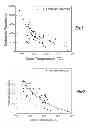
Numerous PZT formulations/compositions have been engineered for specific characteristics that enhance their use in many applications. For example, Tables I and II list the properties of commercially available soft PZT ceramics, and FIGS. 1 and 2 provide plots of dielectric permittivity and piezoelectric coefficient d33 versus Curie temperature (TC) for such materials. As shown by the data, polycrystalline materials with higher Curie temperatures generally possess lower dielectric and piezoelectric properties.
| TABLE I |
| Piezoelectric, dielectric and ferroelectric |
| properties of commercial PZT5A type ceramics. |
| Pr | |||||||
| d33 | kp | tanδ | TC | (μC/ | EC | ||
| PZT5H | (pC/N) | (%) | εr | (%) | (° C.) | cm2) | (kV/cm) |
| TRS200HD1 | 400 | 0.66 | 2000 | 1.8 | 340 | / | / |
| 3195STD2 | 350 | 0.63 | 1800 | 1.8 | 350 | 39 | 14.9 |
| 3295HD2 | 390 | 0.65 | 1900 | 1.8 | 350 | 39 | 12.0 |
| PIC2553 | 400 | 0.62 | 1750 | 2.0 | 350 | / | / |
| PIC1553 | 360 | 0.62 | 1450 | 2.0 | 345 | / | / |
| PKI5024 | 425 | 0.60 | 2000 | 1.5 | 350 | / | / |
| PZ235 | 328 | 0.52 | 1500 | 1.3 | 350 | / | / |
| PZ275 | 425 | 0.59 | 1800 | 1.7 | 350 | / | / |
| PZT5A16 | 410 | 0.62 | 1875 | 2.0 | 370 | / | / |
| PZT5A36 | 374 | 0.60 | 1700 | 2.0 | 365 | / | / |
| 1TRS Technologies; | |||||||
| 2CTS; | |||||||
| 3PIceramic; | |||||||
| 4Piezo-kinetics; | |||||||
| 5Ferroperm; | |||||||
| 6Morgan. |
| TABLE II |
| Piezoelectric, dielectric and ferroelectric |
| properties of commercial PZT5H type ceramics. |
| Pr | |||||||
| d33 | kp | tanδ | TC | (μC/ | EC | ||
| PZT5H | (pC/N) | (%) | εr | (%) | (° C.) | cm2) | (kV/cm) |
| TRS610HD1 | 690 | 0.70 | 3900 | 1.8 | 210 | / | / |
| CTS3203STD2 | 550 | 0.69 | 3250 | 2.0 | 235 | 37 | 10.6 |
| CTS3203HD2 | 650 | 0.70 | 3800 | 2.0 | 225 | 39 | 8.0 |
| PIC1513 | 500 | 0.62 | 2400 | 2.0 | 250 | / | / |
| PIC1533 | 600 | 0.62 | 4200 | 3.0 | 185 | / | / |
| PKI5324 | 490 | 0.63 | 2700 | 2.0 | 220 | / | / |
| PKI5524 | 600 | 0.67 | 3400 | 2.2 | 200 | / | / |
| PZ215 | 640 | 0.60 | 3980 | 1.6 | 218 | / | / |
| PZ295 | 570 | 0.64 | 2870 | 1.6 | 235 | / | / |
| PZT5H16 | 620 | 0.60 | 3400 | 1.8 | 200 | / | / |
| PZT5H26 | 590 | 0.65 | 3400 | 2.5 | 195 | / | / |
| 1TRS Technologies; | |||||||
| 2CTS; | |||||||
| 3PIceramic; | |||||||
| 4Piezo-kinetics; | |||||||
| 5Ferroperm; | |||||||
| 6Morgan. |
It is appreciated that innovations in electronic devices have been the driving force for new developments in piezoelectric ceramics. In fact, and in order to meet the newly developed electromechanical devices, materials with Curie temperatures equivalent to heretofore developed materials but with higher dielectric and piezoelectric properties, and/or materials with similar dielectric and piezoelectric properties but higher Curie temperatures, are desired.
In addition to the above, the electromechanical coupling factor—the square of which is closely related to output power density—is known to be an important material parameter in ultrasonic transducer applications and the dielectric variation for prior art PZT based materials is relatively broad and on the order of 2000-8000 ppm/° C. Therefore, a new polycrystalline piezoelectric material with increased electromechanical coupling factor and reduced dielectric variation would also be desirable.
SUMMARY OF THE INVENTION
Ternary polycrystalline materials based on lead hafnate (PbHfO3) and having improved dielectric, piezoelectric, and/or thermal stability properties are provided. In addition, the PbHfO3 based materials can exhibit enhanced electromechanical coupling factors when compared to PZT based ceramics. The inventive materials can be used as high performance actuators, piezoelectric sensors and/or ultrasonic transducers.
In particular, the ternary polycrystalline materials provide piezoelectric ceramic materials based on lead hafnium titanate, e.g. PbHfO3—PbTiO3 (PHT), that have a perovskite crystal structure with an ABO3 formula and are characterized by a substitution of heterovalent acceptor and donor ions at Zr/Hf sites. In addition, Pb(MI3+,MII5+)O3—PHT ternary systems are provided that have: (1) equivalent Curie temperatures as prior art PZT based ceramics but exhibit higher dielectric and piezoelectric properties when compared thereto; and/or (2) comparable dielectric and piezoelectric properties as prior art PZT based ceramics but exhibit higher Curie temperatures when compared thereto.
In some instances, the ternary polycrystalline materials have a formula of Pb1-xMx [(MI,MII)O3]1-y-zHfzTiyO3, where M is Ba2+, Ca2+, Sr2+, La3+ and the like; MI is Mg2+, Zn2+, Ni3+, Yb3+, Sc3+, In3+ and the like; MII is Nb5+, Ta5+, Sb5+ and the like; x is greater than or equal to 0.0 and less than 0.2; y is greater than 0.3 and less than 0.7; and z is greater than 0.3 and less than 0.7. In other instances, the ternary piezoelectric polycrystalline material has a formula of Pb1-xMx [(MI3+,MII5+)O3]1-y-zHfzTiyO3, where Hf 4+ or Ti4+ ions are at least partially replaced with donor dopants or acceptor dopants. The donor dopants can be Nb5+, Ta5+, W5+ and the like and the acceptor dopants can be Fe2+,3+, Co2+,3+, Mn2+,3+ and the like.
The inventive material can have a Curie temperature in the range of 180° C. to 280° C. and a piezoelectric coefficient d33 greater than 600 pC/N, a Curie temperature of greater than 300° C. and a piezoelectric coefficient d33 greater than 500 pC/N, a Curie temperature in the range of 260-300° C. and a piezoelectric coefficient d33 in the range of 450-680 pC/N, and/or a Curie temperature greater than 120° C. and a piezoelectric coefficient d33 greater than 800 pC/N. In addition, the material can have electromechanical coupling k33 greater than or equal to 78-80%.
BRIEF DESCRIPTION OF THE DRAWINGS
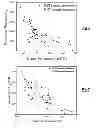
FIG. 1 is a graphical plot illustrating dielectric permittivity as a function of Curie temperature for PZT piezoelectric ceramics;
FIG. 2 is a graphical plot illustrating piezoelectric coefficient d33 as a function of Curie temperature for PZT piezoelectric ceramics;
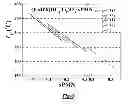
FIG. 3 is a graphical plot illustrating Curie temperature versus amount of PMN for pellets having a composition formula of (1-x)Pb(Hf1-yTiy)O3-xPMN with various levels of lead titanate (PT);
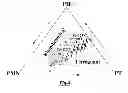
FIG. 4 is an isothermal map of Currie temperature (TC) for (1-x)Pb(Hf1-yTiy)O3-xPMN;
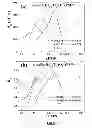
FIG. 5a is a graphical plot illustrating piezoelectric coefficient d33 as a function of PMN content;
FIG. 5b is a graphical plot illustrating planar electrochemical coupling kp as a function of PMN content;
FIG. 6 is a graphical plot with data from the inventive materials shown in Tables III-V superimposed on data shown in FIG. 1;
FIG. 7 is a graphical plot with data from the inventive materials shown in Tables III-V superimposed on data shown in FIG. 2; and
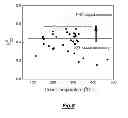
FIG. 8 is a graphical plot of electromechanical coupling factor squared (k332) as a function of Currie temperature for prior art PZT based ceramics and the inventive PHT based ceramics disclosed herein.
DETAILED DESCRIPTION OF THE INVENTION
Inventive lead hafnium titanate-lead magnesium niobate (PHT-PMN) ternary ceramics with compositions of (1-x)Pb(Hf1-yTiy)O3-xPb(Mg1/3Nb2/3)O3 ((1-x)Pb(Hf1-yTiy)O3-xPMN, x=0˜0.5, y=0.515˜0.7) are provided. For example and for illustrative purposes only, an example of how typical PHT-PMN ternary ceramics according to one or more embodiments of the present invention were produced and associated properties are described below.
The inventive materials were prepared using a two-step precursor method. Raw materials of MgCO3 (99.9%, Alfa Aesar, Ward Hill, Mass.), Nb2O5 (99.9%, Alfa Aesar), HfO2 (99.9%, Alfa Aesar) and TiO2 (99.9%, Ishihara, San Francisco, Calif.) were used to synthesize columbite precursors of MgNb2O6 and Hf0.45Ti0.55O2 at 1000° C. and 1200° C., respectively. Thereafter, Pb3O4 (99%, Alfa Aesar) and the MgNb2O6 and Hf0.45Ti0.55O2 percursor powders were batched stoichiometrically by wet-milling in alcohol for 24 hours (h). Dried mixed powders of the Pb3O4, MgNb2O6 and Hf0.45Ti0.55O2 were then calcined at 800° C. for 4 h to produce synthesized powders which were subsequently vibratory milled in alcohol for 12 h. The synthesized powders were then granulated and pressed into pellets having a 12 mm diameter, followed by a binder burnout at 550° C. and sintering in a sealed crucible at 1250° C. In order to minimize PbO evaporation during sintering, PbZrO3 was used as a lead (Pb) source in the sealed crucible.
Sintered pellets were tested for temperature dependence of dielectric permittivity with FIG. 3 illustrating Curie temperature (TC) versus amount of PMN for pellets having a composition formula of (1-x)Pb(Hf1-yTiy)O3-xPMN with various levels of lead titanate (PT). As shown in the figure, increasing the PMN content resulted in a monotonic TC decrease from 360-285° C., 340-270° C., 320-255° C., 328-243° C. and 234-186° C. for the different PT levels corresponding to y=0.515, 0.534, 0.555, 0.574 and 0.7, respectively. Furthermore, with increasing PMN content, the ternary solid solution exhibited more relaxor-like characteristics, showing broadened dielectric peaks and dispersive dielectric behavior with respect to frequency.
Based on the above results, an isothermal map of Currie temperature (TC) for (1-x)Pb(Hf1 -yTiy)O3-xPMN was developed and is shown in FIG. 4. It is appreciated that along the MPB line from the PH-PT side towards the PMN-PT side, TC gradually decreases from 325° C. to 200° C. It is appreciated that this decrease in TC could be due to an increase of PMN content in the sintered pellets that were tested.
The dielectric, piezoelectric and electromechanical properties of all studied (1-x)Pb(Hf1-yTiy)O3-xPMN compositions are summarized in Table III. In addition, the piezoelectric coefficient d33 and planar electromechanical coupling kp as a function of PMN are shown in FIGS. 5a and 5b, respectively. As shown in the figures, optimum piezoelectric and electromechanical properties where exhibited for specific compositions and it is appreciated that the optimum properties could be due to enhanced polarizability arising from coupling between tetragonal and rhombohedral phases. In addition, the optimum piezoelectric and electromechanical properties were achieved for the composition 0.8Pb(Hf0,445Ti0,555)O3-0.2Pb(Mg1/3Nb2/3)O3, with dielectric permittivity εr, piezoelectric coefficient d33, planar electromechanical coupling kp and TC being on the order of 2870, 680 pC/N, 70% and 276° C., respectively.
| TABLE III |
| Piezoelectric, dielectric and ferroelectric properties of (1 − |
| x)Pb(Hf1−yTiy)O3-xPMN ternary ceramics. |
| d33 | kp | tanδ | TC | Pr | EC | ||
| (1 − x)Pb(Hf1−yTiy)O3-xPMN | (pC/N) | (%) | εr | (%) | (° C.) | (μC/cm2) | (kV/cm) |
| y = 0.515 | x = 0 | 210 | 37 | 1220 | 1.1 | 360 | 13 | 13.2 |
| x = 0.05 | 280 | 41 | 1560 | 1.6 | 333 | 25 | 11.9 | |
| x = 0.1 | 430 | 62 | 1100 | 2.1 | 306 | 37 | 8.8 | |
| x = 0.15 | 330 | 58 | 870 | 2.4 | 285 | 39 | 8.3 | |
| y = 0.534 | x = 0.05 | 190 | 32 | 1350 | 1.4 | 340 | 18 | 14.4 |
| x = 0.1 | 450 | 58 | 2030 | 1.4 | 312 | 32 | 15 | |
| x = 0.15 | 600 | 69 | 2330 | 1.9 | 291 | 40 | 9.4 | |
| x = 0.2 | 320 | 59 | 960 | 2.2 | 271 | 36 | 8.1 | |
| y = 0.555 | x = 0.1 | 360 | 37 | 1300 | 1.4 | 321 | 23 | 17.3 |
| x = 0.15 | 430 | 57 | 2120 | 1.4 | 296 | 32 | 15.2 | |
| x = 0.18 | 580 | 65 | 2770 | 1.5 | 286 | 37 | 11.3 | |
| x = 0.19 | 640 | 68 | 2810 | 1.5 | 278 | 40 | 10.3 | |
| x = 0.2 | 680 | 70 | 2870 | 1.7 | 276 | 40 | 9.9 | |
| x = 0.21 | 590 | 69 | 2040 | 1.6 | 271 | 42 | 9.3 | |
| x = 0.22 | 490 | 68 | 1630 | 1.8 | 268 | 40 | 8.4 | |
| x = 0.25 | 340 | 60 | 1020 | 2.2 | 255 | 38 | 7.9 | |
| y = 0.574 | x = 0.1 | 160 | 32 | 1050 | 1.3 | 328 | 22 | 19.9 |
| x = 0.15 | 300 | 49 | 1550 | 1.2 | 304 | 31 | 19.4 | |
| x = 0.2 | 440 | 58 | 2360 | 1.4 | 283 | 34 | 13.3 | |
| x = 0.24 | 670 | 69 | 2960 | 1.4 | 263 | 41 | 9.5 | |
| x = 0.25 | 640 | 65 | 2470 | 1.6 | 262 | 38 | 9.3 | |
| x = 0.26 | 580 | 65 | 1900 | 1.6 | / | 41 | 8.6 | |
| x = 0.3 | 230 | 48 | 1120 | 2.2 | 243 | 28 | 7.1 | |
| y = 0.7 | x = 0.4 | 330 | 46 | 2360 | 0.8 | 234 | 26 | 10.7 |
| x = 0.45 | 390 | 54 | 2050 | 1.1 | 213 | 30 | 7.3 | |
| x = 0.47 | 540 | 66 | 2090 | 1.3 | 201 | 37 | 7 | |
| x = 0.5 | 400 | 60 | 1420 | 1.8 | 186 | 36 | 5.9 | |
The main properties of other systems, such as (1-x)Pb(Hf1-yTiy)O3-xPb(Ni1/3Nb2/3)O3 (PHT-PNN), (1-x)Pb(Hf1-yTiy)O3-xPb(Sc0.5Nb0.5)O3 (PHT-PSN) and (1-x)Pb(Hf1-yTiy)O3-xPb(Zn1/3Nb2/3)O3 (PHT-PZN), are given in Tables IV and V below, respectively.
| TABLE IV |
| Piezoelectric, dielectric and ferroelectric properties of (1 − |
| x)Pb(Hf1−yTiy)O3-xPNN ternary ceramics. |
| d33 | kp | loss | TC | Pr | Ec | ||
| Samples | (pC/N) | (%) | K | (%) | (° C.) | (μC/cm2) | (kV/cm) |
| y = 0.55 | x = | 5 | 160 | 35 | 1050 | 1.0 | 337 | 10 | 12 |
| 10 | 280 | 43 | 1400 | 1.2 | 310 | 16 | 12 | ||
| 15 | 340 | 49 | 1830 | 1.8 | 280 | 24 | 10.7 | ||
| 18 | 495 | 61 | 2140 | 1.7 | 260 | 29 | 8 | ||
| 19 | 470 | 61 | 1970 | 1.6 | 256 | 28 | 7.5 | ||
| 20 | 435 | 61 | 1870 | 1.8 | 250 | 31 | 7.5 | ||
| 22 | 380 | 60 | 1250 | 1.7 | 238 | 34 | 7.3 | ||
| 25 | 350 | 60 | 1180 | 1.8 | 222 | 36 | 7.2 | ||
| y = 0.57 | x = | 10 | 170 | 1030 | 1.1 | — | |||
| 15 | 250 | 39 | 1280 | 1.4 | 292 | 19 | 13.7 | ||
| 19 | 350 | 47 | 1950 | 1.5 | 266 | 21 | 10.2 | ||
| 20 | 360 | 49 | 2000 | 1.5 | 257 | 23 | 10.2 | ||
| 21 | 420 | 57 | 2100 | 1.55 | 252 | 27 | 9.8 | ||
| 22 | 480 | 57 | 2600 | 1.77 | 246 | 28 | 9 | ||
| 23 | 550 | 65 | 2650 | 1.8 | 240 | 32 | 8.8 | ||
| 25 | 595 | 66 | 2200 | 1.66 | 229 | 34 | 7.6 | ||
| 20 | 320 | 50 | 2000 | 1.2 | 260 | 24 | 11.5 | ||
| 22 | 410 | 54 | 2390 | 1.3 | 250 | 28 | 10.1 | ||
| 23 | 460 | 57 | 2600 | 1.38 | 244 | 29 | 9.8 | ||
| 24 | 530 | 61 | 2850 | 1.4 | 235 | 31 | 9.4 | ||
| 25 | 610 | 65 | 3000 | 1.5 | 234 | 33 | 8.6 | ||
| 26 | 650 | 68 | 2950 | 1.6 | 227 | 35 | 8.5 | ||
| 26.5 | 630 | 67 | 2430 | 1.5 | 225 | 35 | 8.4 | ||
| 27 | 660 | 68 | 2200 | 1.35 | 221 | 37 | 7.5 | ||
| 28 | 530 | 65 | 2270 | 1.5 | 215 | 36 | 7 | ||
| 30 | 460 | 64 | 2000 | 1.7 | 204 | 36 | 6.4 | ||
| y = 0.60 | x = | 25 | 570 | 63 | 3200 | 1.46 | 225 | 29 | 9.5 |
| 28 | 650 | 67 | 3450 | 1.5 | 220 | 31 | 9 | ||
| 29 | 700 | 69 | 3610 | 1.7 | 214 | 32 | 8.3 | ||
| 30 | 765 | 70 | 3800 | 2.0 | 210 | 32 | 7.4 | ||
| 30.5 | 795 | 71 | 3600 | 2.0 | 206 | 33 | 7.2 | ||
| 31 | 760 | 71 | 3250 | 2.0 | 203 | 34 | 7.2 | ||
| 31.5 | 730 | 71 | 2940 | 1.8 | — | 35 | 6.9 | ||
| 32 | 690 | 70 | 2880 | 1.75 | 199 | 34 | 6.6 | ||
| 33 | 640 | 68 | 2350 | 1.75 | 191 | 34 | 6.2 | ||
| y = 0.70 | x = | 30 | 300 | 47 | 1900 | 1.4 | 208 | 25 | 12.5 |
| 40 | 445 | 51 | 2700 | 1.3 | 184 | 26 | 9 | ||
| 42 | 540 | 55 | 3600 | 1.65 | 168 | 26 | 6 | ||
| 44 | 650 | 58 | 4500 | 1.85 | 155 | 26 | 6.7 | ||
| 45 | 725 | 60 | 4950 | 1.98 | 151 | 26 | 6.5 | ||
| 46 | 800 | 61 | 5500 | 1.8 | 145 | 27 | 5.6 | ||
| 47 | 865 | 63 | 5830 | 2.3 | 138 | 27 | 5.1 | ||
| 48 | 940 | 65 | 5240 | 2.4 | 120 | 27 | 3.8 | ||
| 49 | 970 | 65 | 6000 | 2.5 | — | 27 | 4.2 | ||
| 50 | 930 | 65 | 5930 | 2.38 | — | 27 | 4.3 | ||
| TABLE V |
| Piezoelectric, dielectric and ferroelectric properties |
| of (1 − x)Pb(Hf1−yTiy)O3-xPSN and |
| (1 − x)Pb(Hf1−yTiy)O3-xPZN ternary ceramics. |
| Pr | |||||||
| Materials | d33 | kp | loss | TC | (μC/ | Ec |
| y | x | (pC/N) | (%) | K | (%) | (° C.) | cm2) | (kV/cm) |
| (1 − x)Pb(Hf1−yTiy)O3-xPSN |
| 0.60 | 0.20 | 550 | 65 | 2420 | 1.5 | 325 | 38 | 10.6 |
| 0.575 | 0.175 | 600 | 71 | 2220 | 1.6 | 325 | 43 | 9.4 |
| 0.55 | 0.12 | 590 | 70 | 2250 | 1.6 | 334 | 43 | 9.5 |
| 0.55 | 0.125 | 560 | 67 | 1950 | 1.7 | 330 | 41 | 9.2 |
| (1 − x)Pb(Hf1−yTiy)O3-xPZN |
| 0.519 | 0.20 | 500 | 70 | 1650 | 2.0 | 292 | 42 | 9.1 |
| 0.525 | 0.20 | 530 | 69 | 2060 | 2.0 | 295 | 41 | 10.3 |
| 0.525 | 0.25 | 510 | 68 | 1900 | 2.0 | 280 | 41 | 9.9 |
| 0.539 | 0.225 | 570 | 68 | 2300 | 2.0 | 292 | 38 | 11.6 |
In order to provide a clearer view of the enhanced properties exhibited by the inventive materials, FIGS. 6 and 7 are plots of data from Tables III-V above compared to the data shown in FIGS. 1 and 2. The data from Tables III-V are labeled as PHT based ceramics, versus the data from FIGS. 1 and 2 which are labeled as PZT based ceramics. As shown in the figures, a comparable dielectric permittivity with significant higher d33 coefficient is exhibited by the inventive materials compared to heretofore polycrystalline piezoelectric materials. In addition, FIG. 8 provides a plot of the electromechanical coupling factor squared (k332) as a function of TC for prior art PZT based ceramics and the inventive PHT based ceramics. Again, a significant improvement in output power density is expected by the ternary PHT polycrystalline piezoelectric materials disclosed herein.
The invention is not restricted to the illustrative examples and embodiments described above. The examples are not intended as limitations on the scope of the invention. Methods, apparatus, compositions, and the like described herein are exemplary and not intended as limitations on the scope of the invention. Changes therein and others will occur to those skilled in the art and, as such, the specification and the appendices should be interpreted broadly.
Claims
We claim:1. A ternary piezoelectric polycrystalline material comprising:
a lead hafnium titanate containing ceramic having a formula of Pb1-xMx [(MI,MII)O3]1-y-zHfzTiyO3, where:
M is at least one of Ba2+, Ca2+, Sr2+and La3+;
MI is at least one of Mg2+, Zn2+, Ni3+, Yb3+, Sc3+,In3+, Fe3+ and Co3+, etc.;
MII is at least one of Nb5+, Sb5+ and Ta5+;
x is greater than or equal to 0.0 and less than 0.2;
y is greater than 0.2 and less than 0.8; and
z is greater than 0.2 and less than 0.8.
2. The composition of claim 1, wherein said lead hafnium titanate containing ceramic has a Curie temperature in the range of 180° C. to 280° C. and a piezoelectric coefficient d33 greater than 600 pC/N.
3. The composition of claim 1, wherein said lead hafnium titanate containing ceramic has a Curie temperature of greater than 300° C., a piezoelectric coefficient d33 greater than 500 pC/N and electromechanical coupling k33 greater than or equal to 78-80%.
4. The composition of claim 1, wherein said lead hafnium titanate containing ceramic has a Curie temperature in the range of 260-300° C. and a piezoelectric coefficient d33 in the range of 450-680 pC/N.
5. The composition of claim 1, wherein said lead hafnium titanate containing ceramic has a Curie temperature greater than 120° C. and a piezoelectric coefficient d33 greater than 800 pC/N.
6. A ternary piezoelectric polycrystalline material comprising
a lead hafnium titanate containing ceramic having a formula of Pb1-xMx [(MI3+,MII5+)O3]1-y-zHfzTiyO3, where:
Hf4+ or Ti4+ ions are at least partially replaced with donor dopants or acceptor dopants;
said donor dopants being at least one of Nb5+, Ta5+ and W5+; and
said acceptor dopants being at least one of Fe2+,3+, Co2+,3+, Mn2+,3+, Cu+,2+.
7. The composition of claim 6, wherein said lead hafnium titanate containing ceramic has a Curie temperature in the range of 180° C. to 280° C. and a piezoelectric coefficient d33 greater than 600 pC/N.
8. The composition of claim 6, wherein said lead hafnium titanate containing ceramic has a Curie temperature of greater than 300° C., a piezoelectric coefficient d33 greater than 500 pC/N and electromechanical coupling k33 greater than or equal to 78-80%.
9. The composition of claim 6, wherein said lead hafnium titanate containing ceramic has a Curie temperature in the range of 260-300° C. and a piezoelectric coefficient d33 in the range of 450-680 pC/N.
10. The composition of claim 6, wherein said lead hafnium titanate containing ceramic has a Curie temperature greater than 120° C. and a piezoelectric coefficient d33 greater than 800 pC/N.
11. A process for manufacturing a ternary polycrystalline piezoelectric ceramic comprising:
providing precursors of columbite and hafnium-titanium oxide;
providing a powder of Pb3O4;
mixing the precursors of columbite and hafnium-titanium oxide with the powders of Pb3O4;
calcining the mixture of columbite and hafnium-titanium oxide precursors and Pb3O4 powder to produce a synthesized powder; and
sintering the synthesized powder to produce a ternary polycrystalline piezoelectric ceramic having a formula of Pb1-x,Mx[MI,MII)O3]1-y-zHfzTiyO3, where:
M is at least one of Ba2+, Ca2+, Sr2+ and La3+;
MI is at least one of Mg2+, Zn2+, Ni3+, Yb3+, Sc3+,In3+, Fe3+ and Co3+, etc.;
MII is at least one of Nb5+, Sb5+ and Ta5+;
x is greater than or equal to 0.0 and less than 0.2;
y is greater than 0.2 and less than 0.8; and
z is greater than 0.2 and less than 0.8.
12. The process of claim 11, wherein the ternary polycrystalline piezoelectric ceramic has a Curie temperature in the range of 180° C. to 280° C. and a piezoelectric coefficient d33 greater than 600 pC/N.
13. The process of claim 11, wherein the ternary polycrystalline piezoelectric ceramic has a Curie temperature of greater than 300° C., a piezoelectric coefficient d33 greater than 500 pC/N and electromechanical coupling k33 greater than or equal to 78-80%.
14. The process of claim 11, wherein the ternary polycrystalline piezoelectric ceramic has a Curie temperature in the range of 260-300° C. and a piezoelectric coefficient d33 in the range of 450-680 pC/N.
15. The process of claim 11, wherein the ternary polycrystalline piezoelectric ceramic a Curie temperature greater than 120° C. and a piezoelectric coefficient d33 greater than 800 pC/N.
Images & Drawings included:
Sources:
- United States Patent and Trademark Office - verify current appl. status at the USPTO↗
Recent applications for this Assignee:
- » 20250281239 2025-09-11
SYSTEMS AND METHODS FOR PROVIDING AUTOMATED TRAINING FOR MANUALLY CONDUCTED PROCEDURES - » 20250205462 2025-06-26
SURGICAL METHOD, DEVICE, SYSTEM AND KIT FOR THE TREATMENT OF HYDROCEPHALUS - » 20250134347 2025-05-01
TWO-PHASE INSTRUMENT GUIDANCE FOR ACCURATE ENDOSCOPIC SURGICAL PROCEDURES - » 20250111207 2025-04-03
APPARATUS AND METHOD FOR IMPROVED INSPECTION AND/OR MAINTENANCE MANAGEMENT - » 20250108006 2025-04-03
BIOACTIVE GRANULAR HYDROGEL SCAFFOLDS AND USE THEREOF - » 20250017661 2025-01-16
Multi-destination procedure planning and guidance for endoscopic surgery - » 20240415841 2024-12-19
SMALL MOLECULE TRAIL GENE INDUCTION BY NORMAL AND TUMOR CELLS AS AN ANTICANCER THERAPY - » 20240398303 2024-12-05
SYSTEMS AND METHODS FOR AUTOMATED RECOGNITION OF BODILY EXPRESSION OF EMOTION - » 20240325488 2024-10-03
REGENERATING FUNCTIONAL NEURONS FOR TREATMENT OF HEMORRHAGIC STROKE - » 20240325014 2024-10-03
Free motion laparoscopic surgical system