COATED ARTICLE AND METHOD FOR MAKING SAME
US20130171446A1
2013-07-04
13/451,075
2012-04-19
Abstract:
A coated article is provided. The coated article comprises a transparent substrate, a base paint layer directly formed on a surface of the transparent substrate, an aluminum layer directly formed on the aluminum layer, and a top paint layer directly formed on the aluminum layer. The base paint layer is made of a paint containing color paste. The top paint layer is made of a transparent paint. A method for making the coated article is also described.
Assignee:
- FIH (HONG KONG) LIMITED 1,461 🇭🇰 Kowloon, Hong Kong
- SHENZHEN FUTAIHONG PRECISION INDUSTRY CO., LTD. 1,108 🇨🇳 ShenZhen City, China
Interested in similar patents?
Get notified when new applications in this technology area are published.
Classification:
B05D5/067 » CPC main
Processes for applying liquids or other fluent materials to surfaces to obtain special surface effects, finishes or structures to obtain multicolour or other optical effects Metallic effect
B05D7/57 » CPC further
Processes, other than flocking, specially adapted for applying liquids or other fluent materials to particular surfaces or for applying particular liquids or other fluent materials; Multilayers; Three layers or more the last layer being a clear coat
C09D133/08 » CPC further
Coating compositions based on homopolymers or copolymers of compounds having one or more unsaturated aliphatic radicals, each having only one carbon-to-carbon double bond, and at least one being terminated by only one carboxyl radical, or of salts, anhydrides, esters, amides, imides, or nitriles thereof; Coating compositions based on derivatives of such polymers; Homopolymers or copolymers of esters of esters containing only carbon, hydrogen and oxygen, the oxygen atom being present only as part of the carboxyl radical Homopolymers or copolymers of acrylic acid esters
C23C14/024 » CPC further
Coating by vacuum evaporation, by sputtering or by ion implantation of the coating forming material; Pretreatment of the material to be coated Deposition of sublayers, e.g. to promote adhesion of the coating
C23C14/18 » CPC further
Coating by vacuum evaporation, by sputtering or by ion implantation of the coating forming material characterised by the coating material; Metallic material, boron or silicon on other inorganic substrates
C23C14/20 » CPC further
Coating by vacuum evaporation, by sputtering or by ion implantation of the coating forming material characterised by the coating material; Metallic material, boron or silicon on organic substrates
C23C14/584 » CPC further
Coating by vacuum evaporation, by sputtering or by ion implantation of the coating forming material; After-treatment Non-reactive treatment
B05D1/62 » CPC further
Processes for applying liquids or other fluent materials Plasma-deposition of organic layers
B05D2350/65 » CPC further
Pretreatment of the substrate; Adding a layer before coating metal layer
Y10T428/265 » CPC further
Stock material or miscellaneous articles; Web or sheet containing structurally defined element or component, the element or component having a specified physical dimension; Coating layer not in excess of 5 mils thick or equivalent; Up to 3 mils 1 mil or less
Y10T428/31678 » CPC further
Stock material or miscellaneous articles; Composite [nonstructural laminate] Of metal
Y10T428/31699 » CPC further
Stock material or miscellaneous articles; Composite [nonstructural laminate]; Of metal; Next to addition polymer from unsaturated monomers Ester, halide or nitrile of addition polymer
B32B15/082 IPC
Layered products comprising a layer of metal comprising metal as the main or only constituent of a layer, next to another layer of a of synthetic resin comprising vinyl resins; comprising acrylic resins
B05D1/02 IPC
Processes for applying liquids or other fluent materials performed by spraying
B32B27/20 IPC
Layered products comprising synthetic resin characterised by the use of special additives using fillers, pigments, thixotroping agents
C23C16/06 IPC
Chemical coating by decomposition of gaseous compounds, without leaving reaction products of surface material in the coating, i.e. chemical vapour deposition [CVD] processes characterised by the deposition of metallic material
B82Y30/00 IPC
Nanotechnology for materials or surface science, e.g. nanocomposites
Description
BACKGROUND
1. Technical Field
The present disclosure relates to coated articles, particularly to a coated article having a good light-proof property and a method for making the coated article.
2. Description of Related Art
Non-conductive vacuum metallization (NCVM) is used for forming metallic coatings having metallic appearance that are non-conductive on electronic devices, such as communication devices. Transparent parts of electronic devices, such as keypads and light-guiding pillars, usually require portions to be light-transmitting while other portions to be coated with metallic coatings must be totally light-proof. However, simple NCVM is difficult to form metallic coatings which are totally light-proof and non-conductive.
Therefore, there is room for improvement within the art.
BRIEF DESCRIPTION OF THE FIGURE
Many aspects of the disclosure can be better understood with reference to the following figure. The components in the figure are not necessarily drawn to scale, the emphasis instead being placed upon clearly illustrating the principles of the disclosure.
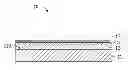
The FIGURE is a cross-sectional view of an exemplary embodiment of a coated article.
DETAILED DESCRIPTION
The FIGURE shows a portion of a coated article 10 according to an exemplary embodiment. The coated article 10 may be a keypad. The coated article 10 includes a transparent substrate 11, a base paint layer 13 directly formed on a surface 110 of the substrate 11, an aluminum layer 15 directly formed on the base paint layer 13, and a top paint layer 17 directly formed on the aluminum layer 15. As used in this disclosure, “directly” means a surface of one layer is in contact with a surface of the other layer.
The substrate 11 may be made of a transparent material, such as transparent plastic, transparent rubber, or transparent glass. In this exemplary embodiment, the substrate 11 is made of polycarbonate or polymethyl methacrylate.
The base paint layer 13 may be made of a paint mainly comprising acrylic resin. The paint for the base paint layer 13 further contains color paste. The color paste may be either white paste or black paste. In case of white paste, the white paste may have a weight percentage of about 35% to about 40% within the paint. The white paste mainly comprises titanium dioxide particles. In case of black paste, the black paste may have a weight percentage of about 2% to about 4% within the paint. The black paste mainly comprises carbon particles or ferric oxide particles. The color paste may effectively prevent light transmission. The base paint layer 13 may have a thickness of about 10 μm-about 20 μm. The base paint layer 13 may partially cover the surface 110 of the substrate 11.
The thickness of the aluminum layer 15 may be about 200 nm-about 500 nm. When the coated article 10 is used for a communication device (e.g., mobile phone), the aluminum layer 15 within the above thickness range is non-conductive, not interfering with the commutation signals of the communication device. The aluminum layer 15 may entirely cover the base paint coating 13.
The top paint layer 17 may entirely cover the aluminum layer 15. The top paint layer 17 may be made of a transparent paint mainly comprising acrylic resin. The thickness of the top paint layer 17 may be from about 10 μm to about 15 μm.
An exemplary method for making the coated article 10 may include the following steps:
The substrate 11 is provided.
The substrate 11 may be pretreated. The substrate 11 may be cleaned with a solution (e.g., alcohol or acetone) in an ultrasonic cleaner, to remove impurities such as grease or dirt from the substrate 11. Then, the substrate 11 is dried.
The base paint layer 13 is directly formed on a surface 110 of the substrate 11 by spraying a paint mainly comprising acrylic resin. The paint for the base paint layer 13 further contains color paste. The color paste may be either white paste or black paste. In case of white paste, the white paste may have a weight percentage of about 35% to about 40% within the paint for the base paint layer 13. The white paste mainly comprises titanium dioxide. In case of black paste, the black paste may have a weight percentage of about 2% to about 4% within the paint for the base paint layer 13. The black paste mainly comprises carbon or ferric oxide.
The aluminum layer 15 is directly formed on the base paint layer 13 by physical vapor deposition. In this exemplary embodiment, the aluminum layer 15 is formed by vacuum evaporating aluminum at a voltage of about 7 volts (V) to about 9 V and an electric current of about 4000 ampere (A) to about 5000 A. The vacuum evaporating may takes about 7 minutes.
The top paint layer 17 is directly formed on the aluminum layer 15 by spraying a transparent paint mainly comprising acrylic resin.
The light-proof property of the coated article 10 is tested. The test indicates that no light transmits through coated portions of the coated article 10 under the radiation of a LED lamp having a power of 1 W by visual observation. Thus, the coated portions of the coated article 10 have a good light-proof property.
It is believed that the exemplary embodiment and its advantages will be understood from the foregoing description, and it will be apparent that various changes may be made thereto without departing from the spirit and scope of the disclosure or sacrificing all of its advantages, the examples hereinbefore described merely being preferred or exemplary embodiment of the disclosure.
Claims
What is claimed is:1. A coated article, comprising:
a transparent substrate;
a base paint layer directly formed on a surface of the transparent substrate, the base paint layer made of a paint containing color paste;
an aluminum layer directly formed on the aluminum layer; and
a top paint layer directly formed on the aluminum layer, the top paint layer made of a transparent paint.
2. The coated article as claimed in claim 1, wherein the transparent substrate is made of a material selected from the group consisting of transparent plastic, transparent rubber, and transparent glass.
3. The coated article as claimed in claim 1, wherein the paint for the base paint layer mainly comprises acrylic resin.
4. The coated article as claimed in claim 1, wherein the color paste is white paste.
5. The coated article as claimed in claim 4, wherein the white paste has a weight percentage of about 35% to about 40% within the paint for the base paint layer.
6. The coated article as claimed in claim 4, wherein the white paste mainly comprises titanium dioxide particles.
7. The coated article as claimed in claim 1, wherein the color paste is black paste.
8. The coated article as claimed in claim 7, wherein the black paste has a weight percentage of about 2% to about 4% within the paint for the base paint layer.
9. The coated article as claimed in claim 7, wherein the black paste mainly comprises carbon particles.
10. The coated article as claimed in claim 7, wherein the black paste mainly comprises ferric oxide particles.
11. The coated article as claimed in claim 1, wherein the base paint layer has a thickness of about 10 μm-about 20 μm.
12. The coated article as claimed in claim 1, wherein the thickness of the aluminum layer is about 200 nm-about 500 nm.
13. The coated article as claimed in claim 1, wherein the transparent paint for the top paint layer mainly comprises acrylic resin.
14. A method for making a coated article, comprising:
providing a transparent substrate;
forming a base paint layer directly on the substrate spraying a paint containing color paste;
forming an aluminum layer directly on the base paint layer by physical vapor deposition; and
forming a top paint layer directly on the aluminum layer by spraying a transparent paint.
15. The method as claimed in claim 14, wherein the paint for the base paint layer mainly comprises acrylic resin.
16. The method as claimed in claim 14, wherein the color paste is white paste having a weight percentage of about 35% to about 40% within the paint for the base paint layer.
17. The method as claimed in claim 16, wherein the white paste mainly comprises titanium dioxide particles.
18. The method as claimed in claim 14, wherein the color paste is black paste having a weight percentage of about 2% to about 4% within the paint for the base paint layer.
19. The method as claimed in claim 18, wherein the black paste mainly comprises carbon particles or ferric oxide particles.
20. The method as claimed in claim 14, wherein the thickness of the aluminum layer is about 200 nm-about 500 nm.
Images & Drawings included:
Sources:
- United States Patent and Trademark Office - verify current appl. status at the USPTO↗
Similar patent applications:
- » 20240384130
COATED ARTICLES, METHODS OF MAKING COATED ARTICLES, AND METHODS OF MAKING COMPOSITIONS - » 20100068404
Draw-off coating apparatus for making coating articles, and/or methods of making coated articles using the same - » 20160096970
COATING COMPOSITION, A METHOD OF MAKING A COATING COMPOSITION, A COATED ARTICLE, AND A METHOD OF MAKING A COATED ARTICLE - » 20130224469
COATED ARTICLE AND METHOD FOR MAKING THE COATED ARTICLE - » 20220016747
Coated abrasive articles and methods of making coated abrasive articles - » 20050129863
Protective layers for sputter coated article and method for making sputter coated articles - » 20230001544
COATED ABRASIVE ARTICLES AND METHODS OF MAKING COATED ABRASIVE ARTICLES - » 20110135897
Coated Article and Method for Making a Coated Article - » 20200362179
Ionic liquid-based coating and method of making articles coated with the same - » 20140364544
COATED ELASTOMERIC ARTICLE AND METHOD FOR MAKING A COATED ELASTOMERIC ARTICLE
Recent applications in this class:
- » 20230321688 2023-10-12
METHOD OF PRODUCING MAGNESIUM-CONTAINING COMPONENTS HAVING VISUAL METALLIC SURFACES - » 20210078039 2021-03-18
Method for coating the visible surfaces of motor vehicle wheel rims - » 20200306794 2020-10-01
Multilayer coating film forming method - » 20200230646 2020-07-23
Process for the preparation of metallic nano-particle layers and their use for decorative or security elements - » 20190329291 2019-10-31
Aqueous coating composition and method for forming metallic coating film using same - » 20180185877 2018-07-05
Method for producing coated article - » 20170120292 2017-05-04
Finishing method for a metal surface - » 20140220232 2014-08-07
EQUIPMENT FOR DECORATING A SECTION - » 20130153407 2013-06-20
METHOD OF PREPARING SANDWICH COMPOSITE COATING ON ENGINEERING PLASTIC SURFACE - » 20130052419 2013-02-28
HEAT-MANAGEMENT STRUCTURES WITH IMAGES
Recent applications for this Assignee:
- » 20220140846 2022-05-05
Antenna structure and wireless communication device using same - » 20220094077 2022-03-24
Antenna structure and wireless communication device using same - » 20220059931 2022-02-24
Antenna structure and wireless communication device - » 20220021116 2022-01-20
Single antenna structure capable of operating in multiple band widths - » 20220010948 2022-01-13
Anti-loosing structure and backlight module - » 20200170133 2020-05-28
Housing, electronic device, and method for manufacturing same - » 20200122194 2020-04-23
Frame and surface treatment method for the frame - » 20200060034 2020-02-20
Housing, method for manufacturing the same, and electronic device having the same - » 20200016805 2020-01-16
Housing, electronic device, and method for manufacturing the same - » 20190368052 2019-12-05
COMPOSITE AND METHOD FOR MAKING SAME