Reinforced textile support with cellulosic fiber multi-filaments, particularly for bituminous membranes
US20130177754A1
2013-07-11
13/823,780
2011-11-10
✅ Patent granted
US 9,309,611 B2
2016-04-12
WO; PCT/EP2011/069859; 20111110
WO; WO2012/065903; 20120524
Aaron Austin | Jasper Saberi
Wenderoth, Lind & Ponack, L.L.P.
2032-01-20
Abstract:
A reinforced textile support, particularly for bituminous membranes, made of at least one layer of polyester non woven web and continuous high modulus reinforcement yarns longitudinally set with respect to said layer. The reinforcement yarns consist of cellulosic fibre multi-filaments of the Lyocell type. The assembly is bound by mechanical needling or water entangling, stabilised by means of thermal treatment at a temperature of 200-250° C. and consolidated by means of a chemical binder.
Assignee:
- POLITEX S.A.S. DI FREUDENBERG POLITEX S.R.L. 3 🇮🇹 Milan, Italy
Applicant:
Interested in similar patents?
Get notified when new applications in this technology area are published.
Classification:
D04H1/488 » CPC further
Non-woven fabrics formed wholly or mainly of staple fibres or like relatively short fibres from fleeces or layers composed of fibres without existing or potential cohesive properties the fleeces or layers being consolidated by mechanical means, e.g. by rolling by needling or like operations to cause entanglement of fibres in combination with at least one other method of consolidation in combination with bonding agents
D04H1/49 » CPC further
Non-woven fabrics formed wholly or mainly of staple fibres or like relatively short fibres from fleeces or layers composed of fibres without existing or potential cohesive properties the fleeces or layers being consolidated by mechanical means, e.g. by rolling by needling or like operations to cause entanglement of fibres in combination with at least one other method of consolidation entanglement by fluid jet in combination with another consolidation means
D04H1/74 » CPC main
Non-woven fabrics formed wholly or mainly of staple fibres or like relatively short fibres characterised by the method of forming fleeces or layers, e.g. reorientation of fibres the fibres being orientated, e.g. in parallel (anisotropic fleeces)
B32B2260/023 » CPC further
Layered product comprising an impregnated, embedded, or bonded layer wherein the layer comprises an impregnation, embedding, or binder material; Composition of the impregnated, bonded or embedded layer; Fibrous or filamentary layer Two or more layers
B32B5/06 » CPC further
Layered products characterised by the non- homogeneity or physical structure, i.e. comprising a fibrous, filamentary, particulate or foam layer; Layered products characterised by having a layer differing constitutionally or physically in different parts characterised by structural features of a layer characterised by a fibrous layer to another layer, e.g. of fibres, of paper
E04D1/20 » CPC further
Roof covering by making use of tiles, slates, shingles, or other small roofing elements; Roofing elements shaped as plain tiles or shingles, i.e. with flat outer surface of plastics; of fibrous materials of asphalt;
B32B2250/03 » CPC further
Layers arrangement 3 layers
D06N5/00 IPC
Roofing materials comprising a fibrous web coated with bitumen or another polymer, e.g. pitch
B32B5/022 » CPC further
Layered products characterised by the non- homogeneity or physical structure, i.e. comprising a fibrous, filamentary, particulate or foam layer; Layered products characterised by having a layer differing constitutionally or physically in different parts characterised by structural features of a layer Non-woven fabric
B32B5/28 » CPC further
Layered products characterised by the non- homogeneity or physical structure, i.e. comprising a fibrous, filamentary, particulate or foam layer; Layered products characterised by having a layer differing constitutionally or physically in different parts characterised by the presence of two or more layers which are next to each other and are fibrous, filamentary, formed of particles or foamed one layer being a fibrous or filamentary layer impregnated with or embedded in a plastic substance
D04H1/4258 » CPC further
Non-woven fabrics formed wholly or mainly of staple fibres or like relatively short fibres from fleeces or layers composed of fibres without existing or potential cohesive properties characterised by the use of certain kinds of fibres insofar as this use has no preponderant influence on the consolidation of the fleece; Cellulose series Regenerated cellulose series
D04H1/435 » CPC further
Non-woven fabrics formed wholly or mainly of staple fibres or like relatively short fibres from fleeces or layers composed of fibres without existing or potential cohesive properties characterised by the use of certain kinds of fibres insofar as this use has no preponderant influence on the consolidation of the fleece; Condensation or reaction polymers Polyesters
D04H3/04 » CPC further
Non-woven fabrics formed wholly or mainly of yarns or like filamentary material of substantial length characterised by the method of forming fleeces or layers, e.g. reorientation of yarns or filaments in rectilinear paths, e.g. crossing at right angles
D04H5/02 » CPC further
Non woven fabrics formed of mixtures of relatively short fibres and yarns or like filamentary material of substantial length strengthened or consolidated by mechanical methods, e.g. needling
D04H13/00 IPC
Other non-woven fabrics
D04H13/002 » CPC further
Other non-woven fabrics; Making non-woven fabrics from staple fibres, filaments or yarns, bonded to at least one web-like material, e.g. woven, knitted non-woven fabric, paper, leather, during consolidation characterised by the disposition or nature of their elements
B32B5/26 » CPC further
Layered products characterised by the non- homogeneity or physical structure, i.e. comprising a fibrous, filamentary, particulate or foam layer; Layered products characterised by having a layer differing constitutionally or physically in different parts characterised by the presence of two or more layers which are next to each other and are fibrous, filamentary, formed of particles or foamed one layer being a fibrous or filamentary layer another layer also being fibrous or filamentary
D04H13/005 » CPC further
Other non-woven fabrics; Making non-woven fabrics from staple fibres, filaments or yarns, bonded to at least one web-like material, e.g. woven, knitted non-woven fabric, paper, leather, during consolidation strengthened or consolidated by mechanical methods by needling
D04H13/006 » CPC further
Other non-woven fabrics; Making non-woven fabrics from staple fibres, filaments or yarns, bonded to at least one web-like material, e.g. woven, knitted non-woven fabric, paper, leather, during consolidation strengthened or consolidated by the use of bonding agents in solid or liquid form
D06N5/003 » CPC further
Roofing materials comprising a fibrous web coated with bitumen or another polymer, e.g. pitch coated with bitumen
B32B2250/20 » CPC further
Layers arrangement All layers being fibrous or filamentary
B32B2250/40 » CPC further
Layers arrangement Symmetrical or sandwich layers, e.g. ABA, ABCBA, ABCCBA
B32B2260/046 » CPC further
Layered product comprising an impregnated, embedded, or bonded layer wherein the layer comprises an impregnation, embedding, or binder material; Impregnation, embedding, or binder material Synthetic resin
B32B2262/0284 » CPC further
Composition or structural features of fibres which form a fibrous or filamentary layer or are present as additives; Synthetic macromolecular fibres; Polyester fibres Polyethylene terephthalate [PET] or polybutylene terephthalate [PBT]
B32B2262/04 » CPC further
Composition or structural features of fibres which form a fibrous or filamentary layer or are present as additives Cellulosic plastic fibres, e.g. rayon
B32B2274/00 » CPC further
Thermoplastic elastomer material
B32B2305/08 » CPC further
Condition, form or state of the layers or laminate Reinforcements
B32B2305/20 » CPC further
Condition, form or state of the layers or laminate; Fibres of continuous length in the form of a non-woven mat
B32B2307/734 » CPC further
Properties of the layers or laminate; Other properties; Dimensional properties Dimensional stability
B32B2419/06 » CPC further
Buildings or parts thereof Roofs, roof membranes
E04D5/02 » CPC further
Roof covering by making use of flexible material, e.g. supplied in roll form of materials impregnated with sealing substances, e.g. roofing felt
E04D5/10 » CPC further
Roof covering by making use of flexible material, e.g. supplied in roll form by making use of compounded or laminated materials, e.g. metal foils or plastic films coated with bitumen
B32B5/02 » CPC further
Layered products characterised by the non- homogeneity or physical structure, i.e. comprising a fibrous, filamentary, particulate or foam layer; Layered products characterised by having a layer differing constitutionally or physically in different parts characterised by structural features of a layer
Y10T442/646 » CPC further
Fabric [woven, knitted, or nonwoven textile or cloth, etc.]; Nonwoven fabric [i.e., nonwoven strand or fiber material]; Including parallel strand or fiber material within the nonwoven fabric Parallel strand or fiber material is naturally occurring [e.g., cotton, wool, etc.]
Description
The present invention relates to a textile support suitable for waterproofing bituminous membranes.
The supports for bituminous membranes used for waterproofing roofs must satisfy many technical requirements.
Firstly, the supports must have mechanical properties suitable to support the stresses to which they are subjected during the impregnation with bitumen and during the subsequent installation of the finished membranes on the roofs.
Furthermore, the supports must have excellent dimensional stability to mechanical and thermal stress, especially during the bitumen saturation process and during the lifecycle of the membranes on the roof, when the supports are subjected to a critical temperature range.
In this regard, it is known the technique of coupling one or more synthetic fiber textile substrates with continuous high modulus yarns, e.g. made of glass or other mineral materials, either natural or synthetic, set in the longitudinal sense (U.S. Pat. No. 5,118,550; U.S. Pat. No. 4,539,254; U.S. Pat. No. 6,131,351; EP 0806509).
The textile substrates and the reinforcement yarns are joined by means of mechanical needling or water entangling and consolidated using a chemical binder.
In other configurations, on the contrary, consolidation occurs thermally by melting a low-melting component added to the substrate in the form of fibers or filaments (U.S. Pat. No. 4,504,539).
The known techniques allow to obtain supports with good stiffness and dimensionality stability, to either avoid or reduce shrinkage during the production process or during the lifecycle of the membranes.
In particular, glass reinforcement yarns are widely used for its performance, related to its high elastic modulus, and for its low cost. However, the use of glass reinforcement yarns has many drawbacks.
Glass is fragile and the yarns are subject to break both during coupling and mostly during the needling process.
The fracture, and thus the lack of even only one reinforcement yarn, causes important faults in the finished product (bituminous membrane), if the missing reinforcement yarn is not detected and the faulty support is used. Indeed, the polyester substrate portion between the two yarns adjacent to the missing one (double clear distance between two subsequent yarns) is weakened and consequently subjected to structural failure during the bitumen impregnation process (such as thinning, formation of folds etc.).
If the fracture of a reinforcement yarn is detected, considerable amounts of supports of lower quality are produced with severe economic damage, because of high production speed of the supports and response time of the restoring procedures.
As a result of the low elasticity of the glass, which has an elongation at break of about 2.5-3.5%, the reinforcement yarns do not increase the mechanical properties of the support in the longitudinal sense.
Artificial fibers derived from cellulose, such as viscose, cellulose acetate or other modified cellulosic fibers, are not currently used for the reinforcement yarns of textile supports for bituminous membranes.
From U.S. 200401265677 and U.S. Pat. No. 6,983,779 it is known the use of a multi-filament fiber named “Lyocell” which is used as reinforcement for tires subjected to thermal stress in the range from 60 to 80° C., for which the mechanical properties of the cellulosic fibers in relation to humidity absorption are of particular interest. However, the use of cellulosic fibers for products subjected to much higher thermal stress, such as that deriving from the immersion of reinforced textile supports in hot bitumen (180-200° C.) for the production of bituminous membranes for roofing, are not known.
According to the state of the art, the purpose of the present invention is to make a reinforced textile support for bituminous membranes, which can overcome the drawbacks described above connected to the use of glass yarns.
According with the present invention, this purpose is reached with a textile support composed of at least one layer of non woven web of synthetic fibers, and continuous high modulus reinforcement yarns, longitudinally set with respect to said layer, that are made of filaments of cellulosic fibers.
Each layer of non woven web is made of continuous polyester filaments (spun bond) or staple fibers made of the same material, with a linear density between 0.5 and 6 dtex, rather between 2.5 and 5 dtex.
The reinforcement yarns of cellulosic fibers, preferably constituted by multi-filaments of the Lyocell type described in U.S. 20040126577 and U.S. Pat. No. 6,983,779, are laid on a non woven web layer or sandwiched between two layers.
These yarns have a Young modulus higher than 5 GPa, preferably higher than 20 GPa.
The assembly, made up of layers of non woven web and reinforcement yarns, is bound by means of mechanical needling, with needling density between 20 and 150 stitches/cm2, or water entangling and then stabilized with a thermal treatment at the temperature of 200-250° C., rather between 220 and 240 ° C., by calendaring or in hot air oven (air-through) and finally consolidated using a chemical binder, in particular with acrylic, styrol-butadiene, vinyl resins etc., possibly mixed with resins derived from vegetable starches or cellulose, in a content comprised between 10 and 30% by weight.
The support thus obtained has many advantages.
Mainly, the support is free from possible fractures of the reinforcement yarns, and thus from consequents failures.
During the mechanical consolidation process, it is also possible to use needles with very high fiber carrying efficiency and/or to increase the needling density within wide limits, obtaining supports with better mechanical properties, without weakening due to the break of the reinforcement yarns.
The yarns described in the present invention have significantly lower density than the glass (1.5 g/cm3 vs. 2.6 g/cm3), allowing to obtain less added weight, with the same length and unitary titer; because the reinforcement yarns are purchased by weight, the lower density translates into lower costs.
Thanks to the higher tenacity compared to glass, the Lyocell yarns may be formed with a considerably lower number of twists per linear meter. This translates into an increase of the contact surface between yarn and non woven web, due to the fact that the single filaments can split during the matrix-reinforcement coupling.
Consequently, the greater contact surface deriving from the lower density and lower number of twists lead to the increase of adhesion of reinforcement yarns to the matrix, thus obtaining a better efficiency with respect to glass. The greater adhesion allows better performance in terms of mechanical and thermal strength (the filaments of cellulosic fibers are not thermoplastic) and of dimensional stability.
Furthermore, the polymeric nature of Lyocell yarns and the presence of functional groups (—OH) facilitates the formation of stable chemical bonds with some families of resins widely used in the chemical consolidation process. In the case of glass reinforcement yarns, such objective is reached with costly additives (silanes), added in the sizing formulation applied during the formation of the filaments.
The result obtained, according with the advantages described above, is a considerable increase of dimensional stability, thanks to the increase of the modulus at 180° C. to values of 1000-1600 daN by linear meter, compared to 80-100 daN obtained with fiber reinforcements disclosed in U.S. Pat. No. 5,118,550.
EXAMPLE 1
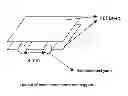
A support for bituminous membrane was produced with two layers of PET staple fiber non woven web of linear density equal to 4 dtex joined with two yarns of Lyocell 1650, 180 tex titer, supplied by Hyosung, set in between and longitudinally at a reciprocal distance of 8 mm, as shown in FIG. 1.
The support was needled using Grotz Becker needles 15×18×38×3 CB with 11 mm penetration and needling density of 110 cm/m2, impregnated with a styrol-butadiene resin and cured in an oven at 220° C.
The total weight of the support is 157 g/m2 and the resin content is equal to 17.5% of the finished product.
The support was analyzed according to standard ISO 9073, to determine its mechanical properties at room temperature. Furthermore, 50×180 mm size specimens were taken for carrying out tensile tests in hot chamber at 180° C.
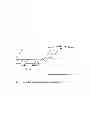
The results of tensile tests at room temperature are shown in FIG. 2 and in Tab. 1: the curves, obtained as an average of 5 specimens, show the comparison with similar support reinforced with Vetrotex 68 tex glass yarns.
| TAB. 1 |
| Results of tensile tests at room temperature of the specimens in FIG. 2 |
| Glass | Lyocell | |
| Grammage [g/m2] | 145 | 157 |
| Yarn tensile strength [N/50 mm] | 338 | 477 |
| Yarn elongation at break [%] | 3.4% | 3.6% |
| Load @ strain = 2% [N/50 mm] | 226 | 334 |
| Tenacity at yarn break [N/50 mm/g*m2] | 0.234 | 0.305 |
| Composite Young modulus [MPa] | 148 | 288 |
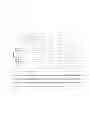
FIG. 3 and Tab. 2 show the results of tensile tests at 180° C.: the curves, again obtained as an average of the 5 specimens, show the difference with similar support reinforced with Vetrotex 68 tex glass yarns.
| TAB. 2 |
| Results of tensile tests at 180° C. of the specimens in FIG. 3. |
| Glass | Lyocell | ||
| Grammage [g/m2] | 141 | 157 | |
| Yarn tensile strength [N/50 mm] | 74 | 177 | |
| Yarn elongation at break [%] | 2.21% | 2.55% | |
| Tenacity at yarn break | 0.05 | 0.11 | |
| [N/50 mm/g*m2] | |||
| Young modulus [MPa] | 49 | 104 | |
| Strain @ Load = 50 N | 1.38% | 0.68% | |
| Strain @ Load = 80 N | — | 0.95% | |
| Strain @ Load = 100 N | — | 1.15% | |
EXAMPLE 2
Continuous filaments of PET were produced with linear density 3.3 dtex, arranged to form two random webs of width 3.5 m, inserting Lyocell 1100 yarns, 120 tex titer, supplied by Hyosung, longitudinally set at a reciprocal distance of 8 mm (FIG. 1).
The support was needled using Grotz Becker needles 15×18×38×3 CB with 13 mm penetration and needling density of 91 cm/m2, impregnated with a styrol-butadiene resin and cured in an oven at 200° C.
The total weight of the support is 204 g/m2 and the resin content is equal to 23% of the finished product.
The support was analyzed according to standard ISO 9073, to determine mechanical properties at room temperature. Furthermore, 50×180 mm size specimens were taken for carrying out tensile tests in hot chamber at 180° C.
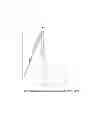
The results of tensile tests at room temperature are shown in FIG. 4 and in Tab. 3: the curves, obtained as an average of 5 specimens, show the comparison with similar support reinforced with Vetrotex 68 tex glass yarns.
| TAB. 3 |
| Results of tensile tests at room temperature |
| of the specimens in FIG. 4. |
| Glass | Lyocell | ||
| Grammage [g/m2] | 197 | 204 | |
| Yarn tensile strength [N/50 mm] | 576 | 688 | |
| Yarn elongation at break [%] | 3.9% | 5.8% | |
| Composite tensile strength [N/50 mm] | 526 | 525 | |
| Composite elongation at break [%] | 24.8% | 18.8% | |
| Load @ strain = 2% [N/50 mm] | 409 | 431 | |
| Tenacity at yarn break | 0.294 | 0.338 | |
| [N/50 mm/g*m2] | |||
| Composite Young modulus [MPa] | 337 | 464 | |
FIG. 5 and Tab. 4 show the results of tensile tests at 180° C.: the curve is again obtained as an average of the 5 specimens and compared with similar support reinforced with Vetrotex 68 tex glass yarns.
| TAB. 4 |
| Results of tensile tests at 180° C. of the specimens in FIG. 5. |
| Glass | Lyocell | ||
| Grammage [g/m2] | 201 | 196 | |
| Yarn tensile strength [N/50 mm] | 93 | 180 | |
| Yarn elongation at break [%] | 2.30% | 3.20% | |
| Tenacity at yarn break | 0.05 | 0.09 | |
| [N/50 mm/g*m] | |||
| Young modulus [MPa] | 81 | 105 | |
| Strain @ Load = 50 N | 1.18% | 0.65% | |
| Strain @ Load = 80 N | 1.81% | 1.08% | |
| Strain @ Load = 100 N | — | 1.35% | |
Mechanical Properties of the Reinforcement Yarns
The Lyocell reinforcement yarns, supplied by Hyosung, were analyzed and compared with the Vetrotex glass yarn (68 tex) making different tensile tests on dynamometer MTS Qtest/5, provided with terminals and specific clamping system for yarn testing.
The properties of the different types of reinforcement yarns are summarized in the following table 5:
| TAB. 5 |
| Properties of reinforcement yarns analyzed with tensile tests. |
| Glass | Lyocell 1100 | Lyocell 1650 | |
| Titer [tex] | 68 | 120 | 180 |
| Diameter [mm] | 0.182 | 0.322 | 0.394 |
| Density [g/cm3] | 2.6 | 1.5 | 1.5 |
| Supplier | VSG | Hyosung | Hyosung |
These tests were carried out at room temperature at a speed of 200 mm/min using 10 specimens for each type of yarn. The load-strain curve was re-processed with Testworks 4 software (MTS). The tensile test graphs are shown in FIG. 6a-b, FIG. 7a-b and FIG. 8a-b.
Tests are carried out to yarn breaking point, which coincides with the maximum of the load-strain curve. The average values calculated for the three samples are:
| TAB. 6 |
| The tensile test results on the yarn of the specimens FIG. 6a-b, |
| FIG. 7a-b and FIG. 8a-b. |
| Glass | Lyocell 1100 | Lyocell 1650 | |
| Tensile strength [N] | 35 | 53 | 79 |
| Elongation at break [%] | 2.8% | 6.4% | 6.3% |
| Tenacity at break [cN/tex] | 51.2 | 43.7 | 43.1 |
| Specific tenacity at break | 19.7 | 29.1 | 28.7 |
| [cN/tex/g · cm3] | |||
| Load @ strain = 1% [N] | 13 | 17 | 27 |
| Tenacity @ Stain = 1% [cN/tex] | 19.1 | 13.9 | 14.7 |
| Specific tenacity @ strain = 1% | 7.3 | 9.3 | 9.8 |
| [cN/tex/g · cm3] | |||
| Young modulus [GPa] * | 54 | 25 | 25 |
| * The Young modulus was calculated in the 0.5-1% strain range. |
It is shown that although the modulus and tenacity of the Lyocell yarn are lower than those of glass, the performance of this yarn is better thanks to the lower density of cellulose.
Claims
1. Reinforced textile support, particularly for bituminous membranes, comprising at least one layer of non woven web of synthetic fibers, and continuous high modulus reinforcement yarns longitudinally set in respect of said layer, the reinforcement yarns having a Young modulus equal to or higher than 5 Gpa, preferably equal to or higher than 20 Gpa, characterized in that said reinforcement yarns consist of filaments of cellulosic nature.
2. Textile support according to claim 1, characterized in that every layer of non woven web consists of continuous spun bonded polyester filaments.
3. Textile support according to claim 1, characterized in that every layer of non woven web consists of polyester staple fibers.
4. Textile support according to claim 2, characterized in that said synthetic fibers have a linear density between 0,5 and 6 dtex, preferably between 2.5 and 5 dtex.
5. Textile support according to claim 1, characterized in that it has a basis weight comprised between 20 and 500 g/m2.
6. Textile support according to claim 1, characterized in that said reinforcement yarns consist of Lyocell type cellulosic fiber multi-filaments.
7. Textile support according to claim 1, characterized in that the reinforcement yarns have a linear density comprised between 30 and 200 tex.
8. Textile support according to claim 1, characterized in that the reinforcement yarns are set at a spacing comprised between 2 and 30 mm, preferably between 6 and 12 mm.
9. (canceled)
10. Process for manufacturing a textile support according to claim 1, characterized in that the assembly which consists of the layer or layers of non woven web and of the reinforcement yarns is consolidated by means of mechanical needling and/or water entangling, stabilized by means of thermal treatment at the temperature of 200-250° C. and consolidated by means of a chemical binder.
11. Process for manufacturing a textile support according to claim 1, characterized in that the assembly which consists of the layer or layers of non woven web and the reinforcement yarns is consolidated by thermal means.
12. Process according to claim 10, characterized in that the value of the needling density is comprised between 20 and 150 stitches/cm2.
13. Process according to claim 10, characterized in that said chemical binder is applied by saturation.
14. Process according to claim 10, characterized in that the binder consists of synthetic resins and starch/cellulose based resins.
15. Process according to claim 14, characterized in that the content of resins is comprised between 10 and 25% in weight.
16. Textile support according to claim 3, characterized in that said synthetic fibers have a linear density between 0.5 and 6 dtex, preferably between 2.5 and 5 dtex.
17. Textile support according to claim 6, characterized in that the reinforcement yarns have a linear density comprised between 30 and 200 tex.
18. Textile support according to claim 6, characterized in that the reinforcement yarns are set at a spacing comprised between 2 and 30 mm, preferably between 6 and 12 mm.
19. Textile support according to claim 7, characterized in that the reinforcement yarns are set at a spacing comprised between 2 and 30 mm, preferably between 6 and 12 mm.
20. Textile support according to claim 17, characterized in that the reinforcement yarns are set at a spacing comprised between 2 and 30 mm, preferably between 6 and 12 mm.
Images & Drawings included:




Sources:
- United States Patent and Trademark Office - verify current appl. status at the USPTO↗
Recent applications in this class:
- » 20250179703 2025-06-05
Nonwoven Material with Three-Dimensional Active Wicking and Evaporation - » 20240301601 2024-09-12
NON-WOVEN MICRO-TRELLIS FABRICS AND COMPOSITE OR HYBRID-COMPOSITE MATERIALS REINFORCED THEREWITH - » 20240263372 2024-08-08
CARBON FIBER NONWOVEN FABRIC SHEET, METHOD FOR PRODUCING SAME AND CARBON FIBER REINFORCED RESIN MOLDED BODY USING SAME - » 20240191409 2024-06-13
RECYCLABLE LINER, PANEL, OR COMPONENT - » 20230050800 2023-02-16
HIGH-STRENGTH PROTECTIVE CLOTH WITH MOISTURE PERMEABILITY AND MANUFACTURING METHOD THEREOF - » 20220162787 2022-05-26
METHOD FOR NONWOVEN TEXTILES WITH VARIABLE ZONAL PROPERTIES - » 20220162786 2022-05-26
Nonwovens having aligned segmented fibers - » 20220042224 2022-02-10
Fabrication of nanofibers as dry adhesives and applications of the same - » 20210388549 2021-12-16
FIBER STRUCTURE - » 20210285138 2021-09-16
FIBER MESH SHEET, METHOD FOR MANUFACTURING FIBER MESH SHEET, AND CELL CULTURE CHIP FORMED OF FIBER MESH SHEET
Recent applications for this Assignee:
- » 20220316212 2022-10-06
Flame-resistant composite substrates for bituminous membranes - » 20160122923 2016-05-05
Substrate for a support for bituminous membrane and method for the preparation thereof