Method for manufacturing a connection between two ceramic parts, especially parts of a pressure sensor, and a ceramic product, especially a ceramic pressure sensor
US20130213138A1
2013-08-22
13/881,533
2011-10-28
✅ Patent granted
US 9,136,662 B2
2015-09-15
WO; PCT/EP2011/068943; 20111028
WO; WO2012/055989; 20120503
Lisa Caputo | Jonathan Dunlap
Bacon & Thomas, PLLC
2032-05-26
Abstract:
A method for manufacturing a connection between two ceramic parts comprises: providing a first ceramic part and a second ceramic part; providing an active hard solder, or active braze, on at least one surface section of at least one of the ceramic parts; and heating the active hard solder, or active braze, in a vacuum soldering, brazing process. The entire active hard solder, or active braze, for connecting the first and second ceramic parts is provided in such a manner that at least one surface section of at least one of the ceramic parts, preferably both ceramic parts, is coated by means of gas phase deposition of the alloy of the active hard solder, or active braze.
Inventors:
- Andreas Rossberg 40 🇩🇪 Bad Sackingen, Germany
- Michael Philipps 14 🇩🇪 Lorrach, Germany
- Frank Hegner 14 🇩🇪 Lorrach, Germany
- Ulfert Drewes 23 🇩🇪 Mullheim, Germany
- Jorg Muller 1 🇩🇪 Buccholz, Germany
- Marco Doms 1 🇩🇪 Oppenheim, Germany
Assignee:
- Endress + Hauser 1 🇩🇪 Maulbug, Germany
- Endress Hauser GmbH Co. KG 380 🇩🇪 Maulburg, Germany
Applicant:
Interested in similar patents?
Get notified when new applications in this technology area are published.
Classification:
H01R43/0235 » CPC main
Apparatus or processes specially adapted for manufacturing, assembling, maintaining, or repairing of line connectors or current collectors or for joining electric conductors for soldered or welded connections for applying solder
B23K1/0008 » CPC further
Soldering, e.g. brazing, or unsoldering specially adapted for particular articles or work
B23K1/008 » CPC further
Soldering, e.g. brazing, or unsoldering Soldering within a furnace
B23K1/19 » CPC further
Soldering, e.g. brazing, or unsoldering taking account of the properties of the materials to be soldered
B23K35/0222 » CPC further
Rods, electrodes, materials, or media, for use in soldering, welding, or cutting characterised by mechanical features, e.g. shape for use in soldering, brazing
B23K35/32 » CPC further
Rods, electrodes, materials, or media, for use in soldering, welding, or cutting characterised by the composition or nature of the material; Selection of soldering or welding materials proper with the principal constituent melting at more than 1550 degrees C
C04B37/006 » CPC further
Joining burned ceramic articles with other burned ceramic articles or other articles by heating by means of an interlayer consisting of a combination of materials selected from glass, or ceramic material with metals, metal oxides or metal salts consisting of metals or metal salts
G01L7/00 » CPC further
Measuring the steady or quasi-steady pressure of a fluid or a fluent solid material by mechanical or fluid pressure-sensitive elements
G01L7/00 » CPC further
Measuring fluid pressure
C04B2235/6581 » CPC further
Aspects relating to ceramic starting mixtures or sintered ceramic products; Aspects relating to heat treatments of ceramic bodies such as green ceramics or pre-sintered ceramics, e.g. burning, sintering or melting processes; Atmosphere during thermal treatment Total pressure below 1 atmosphere, e.g. vacuum
C04B2235/72 » CPC further
Aspects relating to ceramic starting mixtures or sintered ceramic products; Aspects relating to sintered or melt-casted ceramic products Products characterised by the absence or the low content of specific components, e.g. alkali metal free alumina ceramics
C04B2237/122 » CPC further
Aspects relating to ceramic laminates or to joining of ceramic articles with other articles by heating; Aspects relating to interlayers, e.g. used to join ceramic articles with other articles by heating; Metallic interlayers based on refractory metals
C04B2237/127 » CPC further
Aspects relating to ceramic laminates or to joining of ceramic articles with other articles by heating; Aspects relating to interlayers, e.g. used to join ceramic articles with other articles by heating; Metallic interlayers wherein the active component for bonding is not the largest fraction of the interlayer The active component for bonding being a refractory metal
C04B2237/128 » CPC further
Aspects relating to ceramic laminates or to joining of ceramic articles with other articles by heating; Aspects relating to interlayers, e.g. used to join ceramic articles with other articles by heating; Metallic interlayers wherein the active component for bonding is not the largest fraction of the interlayer The active component for bonding being silicon
C04B2237/343 » CPC further
Aspects relating to ceramic laminates or to joining of ceramic articles with other articles by heating; Composition of layers of ceramic laminates or of ceramic or metallic articles to be joined by heating, e.g. Si substrates; Ceramic; Oxidic Alumina or aluminates
C04B2237/592 » CPC further
Aspects relating to ceramic laminates or to joining of ceramic articles with other articles by heating; Processing aspects relating to ceramic laminates or to the joining of ceramic articles with other articles by heating; Aspects relating to the structure of the interlayer whereby the interlayer is not continuous, e.g. not the whole surface of the smallest substrate is covered by the interlayer
C04B2237/60 » CPC further
Aspects relating to ceramic laminates or to joining of ceramic articles with other articles by heating; Processing aspects relating to ceramic laminates or to the joining of ceramic articles with other articles by heating Forming at the joining interface or in the joining layer specific reaction phases or zones, e.g. diffusion of reactive species from the interlayer to the substrate or from a substrate to the joining interface, carbide forming at the joining interface
C04B2237/708 » CPC further
Aspects relating to ceramic laminates or to joining of ceramic articles with other articles by heating; Processing aspects relating to ceramic laminates or to the joining of ceramic articles with other articles by heating; Forming laminates or joined articles comprising layers of a specific, unusual thickness of one or more of the interlayers
C04B37/00 IPC
Joining burned ceramic articles with other burned ceramic articles or other articles by heating
G01L7/08 IPC
Measuring the steady or quasi-steady pressure of a fluid or a fluent solid material by mechanical or fluid pressure-sensitive elements in the form of elastically-deformable gauges of the flexible-diaphragm type
B23K1/00 IPC
Soldering, e.g. brazing, or unsoldering
B23K1/00 IPC
Soldering, e.g. brazing, or unsoldering
H01R43/02 IPC
Apparatus or processes specially adapted for manufacturing, assembling, maintaining, or repairing of line connectors or current collectors or for joining electric conductors for soldered or welded connections
B23K35/02 IPC
Rods, electrodes, materials, or media, for use in soldering, welding, or cutting characterised by mechanical features, e.g. shape
Description
The present invention relates to a method for manufacturing a connection between two ceramic parts, especially parts of a pressure sensor, and to a ceramic product, especially a ceramic pressure sensor.
Ceramic pressure sensors comprise a platform and a measuring membrane, wherein the measuring membrane is joined with the platform by means of an active hard solder, or active braze. A suitable active hard solder, or active braze, for joining ceramic parts of corundum is, for example, a Zr—Ni—Ti alloy, since such alloys have coefficients of thermal expansion compatible with corundum.
European Patent EP 0 490 807 B1 discloses such an active hard solder, or active braze. Patent EP 0 558 874 B1 discloses a method for manufacturing rings of such an active hard solder, or braze. Rings of active hard solder, or active braze, for connecting measuring membrane and platform are placed as space holders between the two parts, and melted in a high vacuum, soldering process, whereby a pressure tight and high strength annular connection arises between the two ceramic parts. An alternative for applying the solder in the form of prefabricated rings is to provide the active hard solder, or active braze, in a screen printing process. A screen printable paste of the active hard solder, or active braze, and a method for its manufacture is disclosed in Offenlegungsschrift EP 0 988 919 A1.
The rings can, however, only be manufactured with reproducible quality with a minimum thickness of, for instance, 30 μm and also the screen printable paste includes granulations, which lead to joints with a minimum thickness of, for instance, 30 μm between the ceramic parts.
The desire for miniaturization of pressure sensors means indirectly a need for a thinner joint. For example, in the case of a ceramic pressure sensor with a capacitive transducer, miniaturization leads to a reduction of the electrode areas of the capacitive transducer, which then must be compensated by a lessening of the distance.
It is, therefore, an object of the present invention to provide a method, which overcomes the disadvantages of the state of the art.
The object is achieved according to the invention by the method as defined in claim 1 and the ceramic pressure sensor as defined in claim 15.
The method of the invention for manufacturing a connection between two surfaces or surface sections of two ceramic parts comprises steps as follows: providing a first ceramic part and a second ceramic part; providing an active hard solder, or active braze, on at least one surface section of at least one of the ceramic parts; and heating the active hard solder, or active braze, in a soldering, brazing process, wherein according to the invention the entire active hard solder, or active braze, for connecting the first and second ceramic parts is provided in such a manner that at least one surface section of at least one of the ceramic parts, preferably both ceramic parts, is coated by means of a gas phase deposition of the alloy of the active hard solder, or active braze, and/or its components.
According to a currently preferred further development of the invention, the gas phase deposition comprises a sputtering process, in order to transfer the components of the active hard solder, or active braze, into the gas phase.
Furthermore, instead of sputtering, according to the invention, a thermal evaporating of the active braze material can occur. In this case, it is advantageous to provide the components of the alloy from different sources, for example, crucibles, wherein the evaporation rates for maintaining a desired composition of the alloy are controlled, for example, via the temperatures of the sources.
In a further development of the invention, the active hard solder, or active braze, comprises a plurality of components, wherein, in the sputter process, a sputter target, or cathode, is used, which preferably contains all components of the active hard solder, or active braze.
The active hard solder, or active braze, according to a further development of the invention, comprises a desired composition, in which components Ki of the active hard solder, or active braze, are present in a weight percent ci, and in the case of which the difference between the coefficient of thermal expansion of the active hard solder, or active braze, and the coefficient of thermal expansion of the material the ceramic parts, especially in the case of given strength of the joint, has a minimum, wherein the sputter target contains the components of the active hard solder, or active braze, in proportions ci, target, which have relative deviations di of the individual components from the desired composition, ci, desired, as follows:
di:=|(ci, target−ci, desired)/ci, desired|
wherein di<4%, preferably no more than 2% and especially preferably no more than 1%.
In a further development of the invention, the at least one surface section of the at least one ceramic part is coated by means of gas phase deposition, first of all, only with one active component of the active hard solder, or active braze. In such case, the one active component is, on the one hand, applied, in a thickness, which amounts, for example, to no more than 5%, preferably no more than 2% and especially preferably no more than 1% of the total thickness of the active hard solder, or active braze, between the first and second ceramic parts. On the other hand, the one active component is applied in a thickness, which amounts, for example, to not less than 0.1%, preferably not less than 0.2% of the total thickness of the active hard solder, or active braze, between the first and second ceramic parts.
In an embodiment of the invention, the coating with the one active component has, on the one hand, a thickness of, for example, not less than 10 nm, especially not less than 40 nm, and preferably not less than 80 nm, wherein, on the other hand, the coating with the one active component has a thickness of, for example, no more than 400 nm, especially no more than 300 nm, and preferably no more than 200 nm.
In a further development of the invention, the one active component for gas phase deposition is brought into the gas phase by means of a sputtering process, wherein in the sputter process a sputter target is used, which contains only the one active component.
In a further development of the invention, the active hard solder, or active braze, comprises a Zr—Ni—Ti alloy, wherein the at least one active component comprises especially titanium or zirconium.
The components of the active hard solder, or active braze, can, according to a further development of the invention, for example, have a desired composition as follows: 55<cZr<65.5, 20.5<cNi<27.5 and 14<cTi<17.5, especially 61<cZr<63.5, 21.5<cNi<24 and 14.5<cTi<15.5.
In a further development of the invention, the first ceramic part and the second ceramic part are pressure-tightly connected along an annular joint, which surrounds a hollow space between the first ceramic part and the second ceramic part, wherein the active hard solder, or active braze, is deposited on at least one annular surface section of a ceramic part, wherein a region surrounded by the annular surface section is masked during the deposition of the active hard solder, or active braze.
In a further development of the invention, the soldering process is a vacuum soldering, brazing process or a soldering, brazing process under protective gas.
The ceramic product of the invention, which is especially obtainable according to the method of the invention, comprises a first ceramic part and a second ceramic part, wherein the first and second ceramic parts are joined by means of a joint, which comprises an active hard solder, or active braze, wherein the active hard solder, or active braze, in the joint has a thickness of no more than 20 μm, especially no more than 17 μm, preferably no more than 14 μm and especially preferably no more than 12 μm.
In a further development of the invention, the ceramic parts comprise corundum, wherein the active hard solder, or active braze, comprises a Zr—Ni—Ti alloy.
In a further development of the invention, the ceramic product is a pressure sensor, wherein the first ceramic part comprises a platform of the pressure sensor, wherein the second ceramic part comprises the measuring membrane of the pressure sensor, and wherein the measuring membrane is connected pressure-tightly with the platform along an annular joint, which comprises the active hard solder, or active braze.
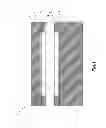
The invention will now be explained based on the example of an embodiment illustrated in the drawing, the sole FIGURE of which shows as follows:
FIG. 1 components a ceramic pressure sensor, which are joined by means of the method of the invention.
The components of a ceramic pressure sensor 1 illustrated in FIG. 1 comprise a circular disk shaped measuring membrane 2 and a circular disk shaped platform 3, both of corundum. Especially, the measuring membrane can be highly pure corundum with a purity of more than 99.98%. The measuring membrane 1 and the platform 2 have, depending on embodiment, for example, a diameter of, for instance, 15 to 25 mm. The diameter is, however, not a variable essential to the invention and can be selected, for example, according to metrological requirements or other boundary conditions. Measuring membrane 1 and platform 2 are to be connected pressure-tightly by means of a Zr—Ni—Ti-active hard solder, or active braze, in a high vacuum soldering process.
For this, the end faces of the measuring membrane 1 and platform 2 to be joined are, first of all, in each case, masked, except for an annular edge region, in order then to prepare, by means of gas phase deposition, the active hard solder, or active braze, for the joint in the annular edge region.
In order to facilitate reaction with the respective ceramic substrates, instead of direct deposition of the alloy with a desired composition, first of all, exclusively an active component can be deposited. This can be, for example, a titanium layer in a thickness of, for example, in each case, for instance, 100 nm. The coatings 4, 5 can be prepared, for example, in a sputtering process with a pure Ti target.
Then, in each case, on the annular regions of the measuring membrane and platform precoated with the active component, a part of the active hard solder, or active braze, required for the thickness of the joint can be deposited. The division can be, for example, half and half, according to which in the case of a desired thickness of the joint of, for example, for instance, 10 μm, in each case, an annular layer 6, 7 with a thickness of, for instance, 5 μm can be deposited in the desired composition on the measuring membrane and on the platform. For this, a target is applied, which contains the alloy of the active hard solder, or active braze, in the desired composition. The target can be produced, for example, using powder metallurgical methods.
In order to achieve efficient deposition rate with sufficiently good control of the rate, preferably a sputtering facility with a high power magnetron is applied. In this way, deposition rates can be controlled between, for example, about 0.2 nm/s to about 2 nm/s. For depositing the 5 μm, in the case of a deposition rate of 2 mm/s, then 2500 s, or about 42 minutes, are required.
After complete deposition of the active hard solder, or active braze, the joint is formed by placing the measuring membrane 2 and the platform 3 with the active hard solder rings on top of one another and vacuum soldering, brazing, at about 900° C., in order to connect the two part pressure-tightly with one another.
Preferably, before deposition of the active hard solder, or active braze, electrodes (not shown) are prepared for a capacitive transducer of the pressure sensor. This can likewise occur by means of gas phase deposition in a sputter process. Suitable as electrode material is, for example, Ta, which is deposited in a thickness of, for example, 0.1 to 0.2 μm. A preferred electrode arrangement can enable, for example, the forming of a differential capacitor, for which, on the end of the platform in the region surrounded by the annular joint, a central, circular disk shaped measuring electrode is deposited, along with an annular reference electrode surrounding the measuring electrode and having equal capacitance.
The measuring electrode, the reference electrode and the joint are preferably electrically isolated from one another in the finished pressure sensor.
Prepared on the membrane is preferably a full surface, counter electrode, which, in the finished sensor, is preferably in galvanic contact with the joint.
Claims
1-15. (canceled)
16. A method for manufacturing a connection between two ceramic parts, comprising the steps of:
providing a first ceramic part and a second ceramic part;
providing an active hard solder, or active braze, on at least one surface section of at least one of the ceramic parts; and
heating the active hard solder, or active braze, in a soldering, brazing process, wherein:
the entire active hard solder, or active braze, for connecting the first and second ceramic parts is provided in such a manner that at least one surface section of at least one of the ceramic parts, preferably both ceramic parts, is coated by means of gas phase deposition of the alloy of the active hard solder, or active braze, and/or its components.
17. The method as claimed in claim 16, wherein:
the gas phase deposition comprises a sputtering process or thermal evaporating, in order to transfer the components of the active hard solder, or active braze, into the gas phase.
18. The method as claimed in claim 17, wherein:
the active hard solder, or active braze, has a plurality of components; and
in the sputter process, a sputter target is used, which contains the components of the active hard solder, or active braze.
19. The method as claimed in claim 18, wherein:
the active hard solder, or active braze, has a desired composition, in which components Ki of the active hard solder, or active braze, are present in a weight percent ci, and in the case of which the difference between the coefficient of thermal expansion of the active hard solder, or active braze, and the coefficient of thermal expansion of the material of the ceramic parts, especially in the case of given strength the joint, has a minimum; and
the sputter target contains the components of the active hard solder, or active braze, in proportions ci, target, which have relative deviations di of the individual components from the desired composition ci, desired, as follows:
di:=|(ci, target−ci, desired)/ci, desired|
wherein di<4%, preferably no more than 2% and especially preferably no more than 1%.
20. The method as claimed in claim 16, wherein:
the at least one surface section of the at least one ceramic part is coated by means of gas phase deposition, first of all, only with at least one active component of the active hard solder, or active braze.
21. Method as claimed in claim 20, wherein:
the coating with the at least one active component has a thickness of not less than 10 nm, especially not less than 40 nm, and preferably not less than 80 nm.
22. The method as claimed in claim 20, wherein:
the coating with the at least one active component has a thickness of no more than 400 nm, especially no more than 300 nm, and preferably no more than 200 nm.
23. The method as claimed in claim 20, wherein:
the at least one active component for gas phase deposition is brought into the gas phase by means of a sputter process; and
in the sputter process a sputter target is used, which contains only the at least one active component.
24. The method as claimed in claim 16, wherein:
the soldering, brazing process is a vacuum soldering, brazing process or a soldering, brazing process under protective gas.
25. The method as claimed in claim 16, wherein:
the active hard solder, or active braze, comprises a Zr—Ni—Ti alloy, and wherein the at least one active component comprises Ti or Zr.
26. The method as claimed in claim 19, wherein:
the concentrations of the components of the active hard solder, or active braze, in the desired composition are as follows: 55<cZr<65.5, 20.5<cNi<27.5 and 14<cTi<17.5, especially 61<cZr<63.5, 21.5<cNi<24 and 14.5<cTi<15.5.
27. The method as claimed in claim 16, wherein:
the first ceramic part and the second ceramic part are pressure-tightly connected along an annular joint, which surrounds a hollow space between the first ceramic part and the second ceramic part;
the active hard solder, or active braze, is deposited on at least one annular surface section of a ceramic part; and
a region surrounded by the annular surface section is masked during deposition of the active hard solder, or active braze.
28. A ceramic product, which is especially obtainable according to a method which comprises the steps of: providing a first ceramic part and a second ceramic part; providing an active hard solder, or active braze, on at least one surface section of at least one of the ceramic parts; and heating the active hard solder, or active braze, in a soldering, brazing process, wherein: the entire active hard solder, or active braze, for connecting the first and second ceramic parts is provided in such a manner that at least one surface section of at least one of the ceramic parts, preferably both ceramic parts, is coated by means of gas phase deposition of the alloy of the active hard solder, or active braze, and/or its components, wherein the ceramic product, comprises:
a first ceramic part; and
a second ceramic part, said first and said second ceramic parts are joined by means of a joint, which comprises an active hard solder, or active braze, wherein:
said active hard solder, or active braze, in said joint has a thickness of no more than 20 μm, especially no more than 17 μm, preferably no more than 14 μm and especially preferably no more than 12 μm.
29. The ceramic product as claimed in claim 28, wherein:
the ceramic parts comprise corundum; and
said active hard solder, or active braze, comprises a Zr—Ni—Ti alloy.
30. The ceramic product as claimed in claim 13, wherein:
the product is a pressure sensor;
said first ceramic part comprises a platform of the pressure sensor, said second ceramic part comprises said measuring membrane of the pressure sensor; and
said measuring membrane is connected pressure-tightly with the platform along an annular joint, which comprises the active hard solder, or active braze.
Images & Drawings included:

Sources:
- United States Patent and Trademark Office - verify current appl. status at the USPTO↗
Recent applications in this class:
- » 20240364065 2024-10-31
TECHNIQUES FOR SOLDERING ON A SUBSTRATE WITH A BELOW SOLDERING TEMPERATURE MELTING POINT - » 20220368095 2022-11-17
Preformed solder-in-pin system - » 20210320468 2021-10-14
Preformed solder-in-pin system - » 20210273393 2021-09-02
Preformed solder-in-pin system - » 20210126416 2021-04-29
Preformed solder-in-pin system - » 20200287341 2020-09-10
Preformed solder-in-pin system - » 20200280156 2020-09-03
Method for the integrally bonded joining of an electric cable to an electrical contact part and electric cable arrangement - » 20200161820 2020-05-21
JOINT OF COPPER TERMINAL AND ALUMINIUM CONDUCTOR AND PLASMA WELDING METHOD THEREFOR - » 20190165534 2019-05-30
MICRO-COAXIAL WIRE BONDING - » 20180048105 2018-02-15
Device for Soldering Wires to an LED Lighting Strip
Recent applications for this Assignee:
- » 20170328750 2017-11-16
Flow-rate measurement assembly according to the differential-pressure measurement principle - » 20170241954 2017-08-24
Vibronic sensor - » 20170167936 2017-06-15
Differential pressure sensor - » 20170134185 2017-05-11
PoE-system for use in automation technology - » 20170038270 2017-02-09
Pressure sensor having a ceramic platform - » 20160370241 2016-12-22
Ceramic pressure measuring cell and method for its manufacture - » 20160320498 2016-11-03
Radiometric measuring device for carrying out measurements in explosion-prone areas - » 20160313200 2016-10-27
Relative pressure sensor - » 20160305836 2016-10-20
Multilevel pressure sensor - » 20160294183 2016-10-06
Input circuit for providing a supply voltage