Coaxial progressive cavity pump
US20130224053A1
2013-08-29
13/596,657
2012-08-28
Abstract:
This invention relates a progressive cavity pump with a central feed-through for supplying steam, gas or liquids to the supply side of the pump. For the oil industry this invention enables single well stimulation. Steam can be supplied from the surface to the production zone or below through the central feed-through, heating or pressurizing oil and the surrounding formation, and facilitating production. In heavy oil fields solvents can be pumped down as well. Oil can be pumped up by the progressive cavity pump through the annulus of the connecting coaxial pipe.
Interested in similar patents?
Get notified when new applications in this technology area are published.
Classification:
F04C2/1071 » CPC main
Rotary-piston machines or pumps of intermeshing-engagement type, i.e. with engagement of co-operating members similar to that of toothed gearing of internal-axis type with the outer member having more teeth or tooth-equivalents, e.g. rollers, than the inner member with helical teeth the inner and outer member having a different number of threads and one of the two being made of elastic materials, e.g. Moineau type
F04C2/107 IPC
Rotary-piston machines or pumps of intermeshing-engagement type, i.e. with engagement of co-operating members similar to that of toothed gearing of internal-axis type with the outer member having more teeth or tooth-equivalents, e.g. rollers, than the inner member with helical teeth
Description
TECHNOLOGY
The invention is to be applied as pump, with an internal channel through the rotor of the pump, for supplying heating or pressure by steam to the supply side of the pump.
1. Objects of the Invention
Old, almost depleted, oil wells can be revived if steam is injected. Previously at least one additional steam injection well would be necessary. With this solution single wells can be continuously stimulated by steam injection through, and below, the pump, to heat the formation and to heat the produced oil, thus keeping the viscosity low and the oil flowing more freely. With the same reasoning, the pump can be applied for tarsand and other heavy oil wells.
2. Background of the Invention
The US alone has over 500,000 oil wells, with an average production in 2010 of only 10 barrels/day. About 300,000 wells are marginal wells with an average of about only 2 bbl/day production. Still just the marginal fields together produce about 700 million bbl/year, about half the imports from Saudi-Arabia. Doubling the marginal field production would be helping energy independence, as well as an economic stimulus.
A non-Moineau progressive cavity pump is known from my patent NL 2004120 (20, Jul. 2011). This pump can be used with all metal parts, at much higher rpm's, and with much better balancing, thus much less vibrations. The pump is based as on a central oval rotor, and sections of housing with 2 rockers, helically spiraling around this rotor, thus creating 8 progressing cavities.
A feature not obvious from above patent is the lack of need for an universal joint or gear, as needed with Moineau pumps. And as such it is not obvious a simple opening inside the rotor can act as feed-through for steam, gas or liquid. Thus steam can be pumped below the pump, heating the formation, letting oil flow more freely, and keeping oil flowing more freely up the well. For this the pump has to be connected to a coaxial pipe, with the inner pipe transporting hot steam or solvent through the rotor, and the annulus transporting pumped oil.
BRIEF DESCRIPTION OF THE DRAWINGS
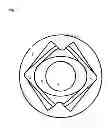
FIG. 1 front view of hollow elliptical rotor and two straight-edged rockers
FIG. 2 exploded view with most of the housing sections removed
DESCRIPTION OF THE DRAWINGS
FIG. 1 shows a cross-section of a machine comprising in essence of one rotor (3), two rockers (2) and a housing (1), creating inside the housing eighth separate variable volumes. The hollow rotor (3) has a cavity (4) which allows transport through the rotor, for example for injecting hot steam from the surface below the pump.
FIG. 2 shows an exploded view with all but 5 housing sections removed. It shows how the rockers are wrapped around the rotor.
Claims
1. A progressive cavity pump consisting of in essence one axially uniform rotor of oval shape and sets of two rockers with straight-edged shape and housing, with an isolated cavity through the rotor connecting both sides of the pump, to be used for supplying gas or liquid to the supply side of the pump.
2. A progressive cavity pump consisting of in essence one axially uniform rotor of oval shape and two rockers with straight-edged shape and one housing, with an isolated cavity through the rotor connecting both sides of the pump, to be used for supplying gas or liquid to the supply side of the pump.
3. A progressive cavity pump of claim 1 or 2, where the shape of the rotor changes in axial direction to allow for compression or decompression.
Images & Drawings included:


Sources:
- United States Patent and Trademark Office - verify current appl. status at the USPTO↗
Recent applications in this class:
- » 20240026880 2024-01-25
Mud motor rotor with core and shell - » 20200256334 2020-08-13
Dismounting device for progressive cavity pumps - » 20180003174 2018-01-04
Method to improve downhole motor durability - » 20160186748 2016-06-30
Flow restrictor for a mud motor - » 20160186747 2016-06-30
Method and apparatus to manufacture a progressive cavity motor or pump - » 20130048384 2013-02-28
Apparatus and method for controlling or limiting rotor orbit in moving cavity motors and pumps - » 20120237380 2012-09-20
Downhole backspin retarder for progressive cavity pump - » 20120134861 2012-05-31
Downhole motor or pump components, method of fabrication the same, and downhole motors incorporating the same - » 20120102738 2012-05-03
Method of Making Progressing Cavity Pumping Systems - » 20110305589 2011-12-15
Helical gear pump