Method for Mosquito Control
US20130259846A1
2013-10-03
13/636,889
2012-03-30
Abstract:
A formulation and method for insect control is provided in the form of insecticide carrying insects which can be introduced in a population to thereby control the insect population. The formulation may include artificially generated adult insect carriers of a larvicide in which the larvicide has minimal impact on the adult insect and which larvicide affects juvenile survival or interferes with metamorphosis of juvenile insects to adulthood. The insects may be either male or female and may include mosquitoes.
Interested in similar patents?
Get notified when new applications in this technology area are published.
Classification:
A01N63/00 » CPC main
Biocides, pest repellants or attractants, or plant growth regulators containing microorganisms, viruses, microbial fungi, animals or substances produced by, or obtained from, microorganisms, viruses, microbial fungi or animals, e.g. enzymes or fermentates
A01N43/40 » CPC further
Biocides, pest repellants or attractants, or plant growth regulators containing heterocyclic compounds having rings with one nitrogen atom as the only ring hetero atom six-membered rings
Description
CROSS REFERENCE TO RELATED APPLICATIONS
This application claims the benefit of U.S. Provisional Application No. 61/477,781, filed Apr. 21, 2011, herein incorporated by reference.
FIELD OF THE INVENTION
The present invention relates to a method and a formulation for mosquito control and, in particular, a method and a formulation for mosquito control which includes, but is not limited to, using mosquitoes or other insects for delivering agents, e.g., insecticides such as a larvicide, to an insect population to thereby control the insect population.
BACKGROUND OF THE INVENTION
Malaria, dengue and dengue haemorrhagic fever, West Nile Virus (WNV) and other encephalites, human African trypanosomiasis (HAT), human filariasis, dog heartworm and other pathogens important to animals are on the increase. These diseases are transmitted via insects and, in particular, mosquitoes. Methods for controlling mosquito populations include the use of pesticides and vector control methods.
Existing insecticidal control methods rely upon field technicians, who fail to find and treat many breeding sites, which can be numerous, cryptic and inaccessible. Additional methods consist of area-wide treatment via airplane or wind-assisted dispersal from truck-mounted foggers. Unfortunately, the latter fail to treat many breeding sites and are complicated by variable environmental conditions. Barrera et al., “Population Dynamics of Aedes aegypti and Dengue as Influenced by Weather and Human Behavior in San Juan, Puerto Rico,” PLoS Neglected Tropical Diseases, 5:e1378, 2011, describing the effects of various breeding sites on disease.
Surveys of natural and artificial water containers demonstrate mosquitoes and other arthropods to be highly efficient in finding, inhabiting and laying eggs in variously sized, cryptic water pools, including tree holes and gutters high above ground level.
One prior formulation or method for treating mosquito populations includes the use of dissemination stations which are deployed in a target environment. The dissemination stations may be laced with a pesticide, including, but not limited to, a juvenile hormone analog. The dissemination station may include a box or other structure which attracts female mosquitoes. The mosquitoes enter the dissemination station, become exposed to the pesticide or hormone, and carry that hormone back to affect other mosquitoes by mating. An example of this mosquito control is described in the article by Devine et al., entitled “Using adult mosquitoes to transfer insecticides to Aedes aegypti larval habitats,” PNAS, vol. 106, no. 28, Jul. 14, 2009.
In tests of another dissemination station, researchers showed that males in the wild that acquire the pesticide from a station can transfer the pesticide to females during copulation. The females receiving pesticide particles via venereal transfer were then shown to cause a significant inhibition of emergence in larval bioassays. This was reported in the article by Gaugler et al, entitled “An autodissemination station for the transfer of an insect growth regulator to mosquito oviposition sites,” Med. Vet. Entomol. 2011.
In view of continuing mosquito problems, as noted, additional tools are required to control mosquitoes that are important as nuisance pests and disease vectors.
SUMMARY OF THE INVENTION
The present invention is directed to a novel, self-delivering, insecticidal formulations and delivery techniques. The formulations, in one form, are larvicide treated insects, such as male mosquitoes. The insecticidal formulations can control medically important mosquitoes. These medically important mosquitoes include mosquitoes having an economic or medical importance to animal or human health. Medically important mosquitoes include those listed in the Appendix to this disclosure.
One aspect of the present formulations and delivery techniques relates to a new larvicide treatment for males, as a formulation which can be used to control a mosquito population. The formulation can be generated by exposing adult insects, such as mosquitoes and, in particular, male mosquitoes, to a pesticide, such as a juvenile hormone which affects juvenile survival or interferes with metamorphosis of juvenile mosquitoes and has relatively little impact on adult mosquitoes. Advantageously, the adult insects are exposed to the pesticide in a controlled, factory environment. The factory-reared or captured from the wild adult insects which have been exposed to the pesticide are referred to as direct treated individuals (DTI). The DTI are then released into an environment in which one wishes to control the mosquito population. The DTI control a mosquito population by interacting with untreated individuals (e.g., mating), such that the pesticide, e.g., a larvicide, is communicated to other individuals (known as Indirectly Treated Individuals; (ITI)).
In specific further embodiments, the control method uses compounds that affect immature/juvenile stages (eggs, larvae, pupae) more than adults. A list of larvicidal compounds is maintained at the IR-4 Public Health Pesticides Database. Examples of compounds include (1) insect growth regulators such as juvenile hormone mimics or analogs, including methoprene, pyriproxyfen (PPF), and (2) Microbial larvicides, such as Bacillus thuringiensis and Bacillus sphaericus, herein incorporated by reference. Exemplary compounds are provided in Tables 1-3, below, in the Detailed Description section.
The present invention, in one form thereof, relates to a method for insect control. The method includes introducing insects which carry one or more insecticides comprising at least one larvicide, to an insect population, to thereby control the insect population. In one specific embodiment, the insects are adult males and the method further includes exposing the adult male insects to a pesticide which affects juvenile survival or interferes with metamorphosis of juvenile insects to adulthood, and which pesticide has little impact on adult insects.
In one further, specific embodiment, the insect population is a mosquito population. Further, the juvenile active insecticide (i.e. larvicide) may be within a chemical class (Table 1) or biological class (Table 2). Examples within the chemical class include insect growth regulators, such as juvenile hormone analogs or compounds which mimic juvenile hormones. For example, the larvicide may be pyriproxyfen or methoprene. Examples within the biological class include viruses, bacteria, protozoa, fungi and crustacean organisms or toxic compounds that they produce.
The present invention, in another form thereof, relates to a formulation for insect control which comprises an artificially generated adult insect carrier of a larvicide. The larvicide has minimal impact on the adult insect and the larvicide interferes with metamorphosis of juvenile insects to adulthood. In one specific formulation, the adult insect is a male mosquito and in an alternative form, the larvicide is pyriproxyfen, methoprene and microbial larvicides, including, but not limited to, Bacillus thuringiensis and Bacillus sphaericus.
BRIEF DESCRIPTION OF THE DRAWING
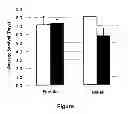
The sole FIGURE is a graph showing survival of treated (black) and untreated (white) adults, with bars showing standard deviation, in accordance with the present invention.
DETAILED DESCRIPTION
The present invention is directed to a method and a formulation for mosquito control. The formulation, in one advantageous form, is larvicide treated males. The treated males are generated from medically important adult male mosquitoes obtained via factory-rearing or captured from the wild. As a demonstration of the chemical class of juvenile active insecticides (Table 1), the adult male mosquitoes are exposed to a larvicide, such as pyriproxyfen (PPF), advantageously in a controlled laboratory or factory environment. PPF is a juvenile hormone mimic which interferes with metamorphosis of juvenile mosquitoes and has relatively little impact on adult mosquitoes. Thus, PPF is commonly used as a mosquito larvicide, but is not used as an adulticide.
The treated males are subsequently referred to as the Direct Treated Individuals (DTI), and this is the insecticidal formulation. The DTI are released into areas with indigenous conspecifics. Male mosquitoes do not blood feed or transmit disease. Accordingly, male mosquitoes provide unique advantages in the present control method as couriers of the larvicide. The DTI interact with untreated individuals (e.g., mating), such that PPF is communicated to the other individuals to produce Indirectly Treated Individuals (ITI). The PPF is delivered by both the DTI and ITI in the wild/in the environment, into the breeding areas, where the PPF accumulates to lethal doses and acts as a larvicide. It is noted that the PPF would impact additional mosquito species that share the same breeding site, providing control of additional mosquito species.
In an alternative control method, female mosquitoes can be used as the DTI. However, female mosquitoes blood feed and can vector disease. The use of female mosquitoes are applicable when the females are incapacitated prior to deployment in the environment and the females have limited procreation ability, bite and vector diseases.
In a further alternative method, other larvicidal active ingredients can be used which include, but are not limited to, compounds that affect juvenile survival or affect immature/juvenile stages of development (eggs, larvae, pupae) more than adults. A list of larvicidal compounds is maintained at the IR-4 Public Health Pesticides Database. Examples of compounds include (1) insect growth regulators such as juvenile hormone mimics or analogs, including methoprene, pyriproxyfen (PPF), and (2) Microbial larvicides, such as Bacillus thuringiensis and Bacillus sphaericus. Tables 1-3 provide abridged, exemplary lists of suitable compounds.
| TABLE 1 |
| Juvenile Active Insecticide - Chemical* |
| Azadirachtin | |
| Diflubenzuron | |
| Methoprene | |
| Neem Oil (Azadirachta indica) | |
| Novaluron | |
| Pyriproxyfen | |
| S-Methoprene | |
| S-Hydropene | |
| Temephos | |
| *A list of Public Health Pesticides is maintained at the IR-4 Public Health Pesticides Database |
| TABLE 2 |
| Juvenile Active Insecticide - Biological* |
| Ascogregarine spp. | |
| Bacillus sphaericus | |
| Bacillus thuringiensis israelensis | |
| Baculoviruses | |
| Copepoda spp. | |
| Densovirinae spp. | |
| Lagenidium giganteum | |
| Microsporida spp. | |
| Spinosad | |
| Spinosyn | |
| *A list of Public Health Pesticides is maintained at the IR-4 Public Health Pesticides Database |
| TABLE 3 |
| Public Health Pesticides from the IR-4 Database* |
| (−)-cis-Permethrin | Cyfluthrin | Oil of Basil, African Blue |
| (Ocimum kilimandscharicum × | ||
| basilicum) | ||
| (−)-trans-Permethrin | Cyhalothrin | Oil of Basil, Dwarf Bush |
| (Ocimum basilicum var. | ||
| minimum) | ||
| (+)-cis-Permethrin | Cyhalothrin, epimer R157836 | Oil of Basil, Greek Bush |
| (Ocimum minimum) | ||
| Cyhalothrin, Total | Oil of Basil, Greek Column | |
| (±)-cis,trans-Deltamethrin | (Cyhalothrin-L + R157836 | (Ocimum × citriodorum |
| epimer) | ‘Lesbos’) | |
| (1R)-Alpha-Pinene | Cypermethrin | Oil of Basil, Lemon (Ocimum |
| americanum) | ||
| (1R)-Permethrin | Cyphenothrin | Oil of Basil, Sweet (Ocimum |
| basilicum) | ||
| (1R)-Resmethrin | DDD, o,p | Oil of Basil, Thai Lemon |
| (Ocimum × citriodorum) | ||
| (1R,cis) Phenothrin | DDD, other related | Oil of Bay Laurel (Laurus |
| nobilis) | ||
| (1R,trans) Phenothrin | DDD, p,p′ | Oil of Cajeput (Melaleuca |
| leucadendra) | ||
| (1S)-Alpha-Pinene | DDE | Oil of Cassumunar Ginger |
| (Zingiber montanum) | ||
| (1S)-Permethrin | DDE, o,p | Oil of Fishpoison (Tephrosia |
| purpurea) | ||
| (E)-Beta-Caryophyllene | DDT | Oil of Ginger (Zingiber |
| officinale) | ||
| 1,1-dichloro-2,2-bis-(4-ethyl- | DDT, o,p′ | Oil of Gurjun Balsam |
| phenyl) ethane | (Dipterocarpus turbinatus | |
| balsam) | ||
| 1,8-Cineole | DDT, p,p′ | Oil of Lemon Eucalyptus |
| (Corymbia citriodora) | ||
| 1H-Pyrazole-3-carboxamide, | DDVP | Oil of Lemon Mint (Monarda |
| 5-amino-1-[2,6-dichloro-4- | citriodora) | |
| (trifluoromethyl)phenyl]-4- | ||
| [(trifluoromethyl)sulfinyl] | ||
| 1-Naphthol | DDVP, other related | Oil of Melaleuca (Melaleuca |
| spp.) | ||
| 1-Octen-3-ol | DEET | Oil of Myrcia (Myrcia spp.) |
| 2-(2-(p-(diisobutyl) phenoxy) | Deltamethrin | Oil of Nutmeg (Myristica |
| ethoxy) ethyl dimethyl | fragrans) | |
| ammonium chloride | ||
| 2-butyl-2-ethyl-1,3- | Deltamethrin (includes | Oil of Palmarosa |
| propanediol | parent Tralomethrin) | (Cymbopogon martinii) |
| Deltamethrin (isomer | ||
| 2-Hydroxyethyl Octyl Sulfide | unspecified) | Orange Oil (Citrus sinensis) |
| 2-Isopropyl-4-methyl-6- | Deltamethrin, other related | Oregano Oil (Origanum |
| hydroxypyrimidine | vulgare) | |
| 2-Pyrroline-3-carbonitrile, 2- | Desmethyl Malathion | Ortho-Phenylphenol |
| (p-chlorophenyl)-5-hydroxy- | ||
| 4-oxo-5- | ||
| 3,7-dimethyl-6-octen-1-ol | Desulfinyl Fipronil | Ortho-Phenylphenol, Sodium |
| acetate | Salt | |
| 3,7-dimethyl-6-octen-1-ol | Desulfinylfipronil Amide | Oviposition Attractant A |
| acetate | ||
| 3-Phenoxybenzoic Acid | Diatomaceous Earth | Oviposition Attractant B |
| 4-Fluoro-3-phenoxybenzoic | Diatomaceous Earth, other | Oviposition Attractant C |
| acid | related | |
| Absinth Wormwood | Diazinon | Oviposition Attractant D |
| (Artemisia absinthium) | ||
| Absinthin | Diazoxon | Oxymatrine |
| Acepromazine | Dibutyl Phthalate | Paracress Oil (Spilanthes |
| acmella) | ||
| Acetaminophen | Didecyl Dimethyl Ammonium | P-Cymene |
| Chloride | ||
| Acetamiprid | Dieldrin | Penfluron |
| Acetic Acid | Diethyl Phosphate | Pennyroyal Oil (American |
| False Pennyroyal, Hedeoma | ||
| pulegioides) | ||
| AI3-35765 | Diethylthio Phosphate | Peppermint (Mentha × |
| piperita) | ||
| AI3-37220 | Diflubenzuron | Peppermint Oil (Mentha × |
| piperita) | ||
| Alkyl Dimethyl Benzyl | Dihydro Abietyl Alcohol | Permethrin |
| Ammonium Chloride | ||
| (60% C14, 25% C12, 15% C16) | ||
| Alkyl Dimethyl Benzyl | Dihydro-5-heptyl-2(3H)- | Permethrin, other related |
| Ammonium Chloride | furanone | |
| (60% C14, 30% C16, 5% C12, | ||
| 5% C18) | ||
| Alkyl Dimethylethyl Benzyl | Dihydro-5-pentyl-2(3H)- | Phenothrin |
| Ammonium Chloride | furanone | |
| (50% C12, 30% C14, 17% C16, | ||
| 3% C18) | ||
| Alkyl Dimethylethyl Benzyl | Dimethyl Phosphate | Phenothrin, other related |
| Ammonium Chloride | ||
| (68% C12, 32% C14) | ||
| Allethrin | Dimethyldithio Phosphate | Picaridin |
| Allethrin II | Dimethylthio Phosphate | Pine Oil (Pinus pinea = Stone |
| Pine) | ||
| Allethrins | Dinotefuran | Pine Oil (Pinus spp.) |
| Allicin | Dipropyl Isocinchomeronate | Pine Oil (Pinus sylvestris = |
| (2, 5 isomer) | Scots Pine) | |
| Dipropyl Isocinchomeronate | ||
| Allyl Caproate | (3, 5 isomer) | Pine Tar Oil (Pinus spp.) |
| Allyl Isothiocyanate | Dipropylene Glycol | Pinene |
| Alpha-Cypermethrin | d-Limonene | Piperine |
| Alpha-lonone | d-Phenothrin | Piperonyl Butoxide |
| Alpha-Pinene | Dried Blood | Piperonyl Butoxide, |
| technical, other related | ||
| Alpha-Terpinene | d-trans-Beta-Cypermethrin | Pirimiphos-Methyl |
| Aluminum Phosphide | Esfenvalerate | PMD (p-Menthane-3,8-diol) |
| Amitraz | Ester Gum | Potassium Laurate |
| Potassium Salts of Fatty | ||
| Ammonium Bicarbonate | Estragole | Acids |
| Ammonium Fluosilicate | Etofenprox | Potassium Sorbate |
| Anabasine | Eucalyptus Oil (Eucalyptus | Prallethrin |
| spp.) | ||
| Anabsinthine | Eugenol | Propoxur |
| Andiroba Oil (Carapa | Eugenyl Acetate | Propoxur Phenol |
| guianensis) | ||
| Andiroba Oil (Carapa | Extract of Piper spp. | Propoxur, other related |
| procera) | ||
| Andiroba, African (Carapa | Extracts of Common Juniper | Putrescent Whole Egg Solids |
| procera) | (Juniperus communis) | |
| Andiroba, American (Carapa | Fenchyl Acetate | Pyrethrin I |
| guianensis) | ||
| Anethole | Fenitrothion | Pyrethrin II |
| Anise (Pimpinella anisum) | Fennel (Foeniculum vulgaris) | Pyrethrins |
| Aniseed Oil (Pimpinella | Fennel Oil (Foeniculum | Pyrethrins and Pyrethroids, |
| anisum) | vulgaris) | manufg. Residues |
| Atrazine | Fenoxycarb | Pyrethrins, other related |
| Avermectin | Fenthion | Pyrethrum |
| Azadirachtin | Fenthion Oxon | Pyrethrum Marc |
| Pyrethrum Powder other | ||
| Azadirachtin A | Fenthion Sulfone | than Pyrethrins |
| Bacillus sphaericus | Fenthion Sulfoxide | Pyriproxyfen |
| Pyrrole-2-carboxylic acid, 3- | ||
| Bacillus sphaericus, serotype | Ferula hermonis | bromo-5-(p-chlorophenyl)-4- |
| H-5A5B, strain 2362 | cyano- | |
| Pyrrole-2-carboxylic acid, 5- | ||
| Bacillus thuringiensis | Ferula hermonis Oil | (p-chlorophenyl)-4-cyano- |
| israelensis | (metabolite of AC 303268) | |
| Bacillus thuringiensis | Finger Root Oil | |
| israelensis, serotype H-14 | (Boesenbergia pandurata) | Quassia |
| Bacillus thuringiensis | Fipronil | Quassin |
| israelensis, strain AM 65-52 | ||
| Bacillus thuringiensis | Fipronil Sulfone | R-(−)-1-Octen-3-ol |
| israelensis, strain BK, solids, | ||
| spores, and insecticidal | ||
| toxins, ATCC number 35646 | ||
| Bacillus thuringiensis | Fipronil Sulfoxide | Red Cedar Chips (Juniperus |
| israelensis, strain BMP 144 | virginiana) | |
| Bacillus thuringiensis | Fragrance Orange 418228 | Resmethrin |
| israelensis, strain EG2215 | ||
| Bacillus thuringiensis | Gamma-Cyhalothrin | Resmethrin, other related |
| israelensis, strain IPS-78 | ||
| Bacillus thuringiensis | Garlic (Allium sativum) | Rhodojaponin-III |
| israelensis, strain SA3A | ||
| Balsam Fir Oil (Abies | Garlic Chives Oil (Allium | Rose Oil (Rosa spp.) |
| balsamea) | tuberosum) | |
| Basil, Holy (Ocimum | Garlic Oil (Allium sativum) | Rosemary (Rosmarinus |
| tenuiflorum) | officinalis) | |
| Bendiocarb | Geraniol | Rosemary Oil (Rosmarinus |
| officinalis) | ||
| Benzyl Benzoate | Geranium Oil (Pelargonium | Rosmanol |
| graveolens) | ||
| Bergamot Oil (Citrus | Glyphosate, Isopropylamine | Rosmaridiphenol |
| aurantium bergamia) | Salt | |
| Beta-Alanine | Hexaflumuron | Rosmarinic Acid |
| Beta-Caryophyllene | Hydroprene | Rotenone |
| Beta-Cyfluthrin | Hydroxyethyl Octyl Sulfide, | R-Pyriproxyfen |
| other related | ||
| Beta-Cypermethrin | Imidacloprid | R-Tetramethrin |
| Beta-Cypermethrin ([(1R)- | Imidacloprid Guanidine | Rue Oil (Ruta chalepensis) |
| 1a(S*),3a] isomer) | ||
| Beta-Cypermethrin ([(1R)- | ||
| 1a(S*),3b] isomer) | Imidacloprid Olefin | Ryania |
| Beta-Cypermethrin ([(1S)- | Imidacloprid Olefinic- | Ryanodine |
| 1a((R*),3a] isomer) | Guanidine | |
| Beta-Cypermethrin ([(1S)- | Imidacloprid Urea | S-(+)-1-Octen-3-ol |
| 1a(R*),3b] isomer) | ||
| Beta-Myrcene | Imiprothrin | Sabinene |
| Beta-Pinene | Indian Privet Tree Oil (Vitex | Sabinene |
| negundo) | ||
| Betulinic Acid | Ionone | Sage Oil (Salvia officinalis) |
| IR3535 (Ethyl | Sassafras Oil (Sassafras | |
| Bifenthrin | Butylacetylaminopropionate) | albidum) |
| Billy-Goat Weed Oil | Isomalathion | Schoenocaubn officinale |
| (Ageratum conyzoides) | ||
| Bioallethrin = d-trans- | ||
| Allethrin | Isopropyl Alcohol | S-Citronellol |
| Biopermethrin | Japanese Mint Oil (Mentha | Sesame (Sesamum indicum) |
| arvensis) | ||
| Bioresmethrin | Jasmolin I | Sesame Oil (Sesamum |
| indicum) | ||
| Bitter Orange Oil (Citrus | Jasmolin II | Sesamin |
| aurantium) | ||
| Blend of Oils: of Lemongrass, | Kerosene | Sesamolin |
| of Citronella, of Orange, of | ||
| Bergamot; Geraniol, lonone | ||
| Alpha, Methyl Salicylate and | ||
| Allylisothioc | ||
| Boric Acid | L-(+)-Lactic acid | S-Hydroprene |
| Borneol | Lactic Acid | Silica Gel |
| Bornyl Acetate | Lagenidium giganteum | Silver Sagebrush (Artemisia |
| cana) | ||
| Bromine | Lagenidium giganteum | Silver Sagebrush Oil |
| (California strain) | (Artemisia cana) | |
| Butane | Lambda-Cyhalothrin | S-Methoprene |
| Butoxy Poly Propylene Glycol | Lambda-Cyhalothrin R ester | Sodium Chloride |
| Caffeic Acid | Lambda-Cyhalothrin S ester | Sodium Lauryl Sulfate |
| Solvent Naphtha | ||
| Camphene | Lambda-Cyhalothrin total | (Petroleum), Light Aromatic |
| Camphor | Lauryl Sulfate | Soybean Oil (Glycine max) |
| Camphor Octanane | Lavender Oil (Lavendula | Spinosad |
| angustifolia) | ||
| Canada Balsam | Leaves of Eucalyptus | Spinosyn A |
| (Eucalyptus spp.) | ||
| Carbaryl | Leech Lime Oil (Citrus | Spinosyn D |
| hystrix) | ||
| Carbon Dioxide | Lemon Oil (Citrus limon) | Spinosyn Factor A |
| Metabolite | ||
| Carnosic Acid | Licareol | Spinosyn Factor D |
| Metabolite | ||
| Carvacrol | Limonene | S-Pyriproxyfen |
| Caryophyllene | Linalool | Succinic Acid |
| Cassumunar Ginger Oil | Linalyl Acetate | Sulfoxide |
| (Zingiber montanum) | ||
| Castor Oil (Ricinus | Linseed Oil (Linum | Sulfoxide, other related |
| communis) | usitatissimum) | |
| Catnip Oil (Nepeta cataria) | Lonchocarpus utilis (Cubé) | Sulfur |
| Catnip Oil, Refined (Nepeta | Lupinine | Sulfuryl Fluoride |
| cataria) | ||
| Cedarwood Oil (Callitropsis | Magnesium Phosphide | Sweet Gale Oil (Myrica gale) |
| nootkatensis = Nootka | ||
| Cypress, Alaska Yellow | ||
| Cedarwood) | ||
| Cedarwood Oil (Cedrus | Malabar (Cinnamomum | Tangerine Oil (Citrus |
| deodara = Deodar Cedar) | tamala) | reticulata) |
| Cedarwood Oil (Cedrus spp. = | Malabar Oil (Cinnamomum | Tansy Oil (Tanacetum |
| True Cedars) | tamala) | vulgare) |
| Cedarwood Oil (Cupressus | Malaoxon | Tar Oils, from Distillation of |
| funebris = Chinese Weeping | Wood Tar | |
| Cypress) | ||
| Cedarwood Oil (Cupressus | Malathion | Tarragon Oil (Artemisia |
| spp. = Cypress) | dracunculus) | |
| Cedarwood Oil (Juniper and | Malathion Dicarboxylic Acid | Tarwood Oil (Laxostylis alata) |
| Cypress) | ||
| Cedarwood Oil (Juniperus | Malic Acid | tau-Fluvalinate |
| ashei = Ashe's Juniper, Texan | ||
| Cedarwood) | ||
| Cedarwood Oil (Juniperus | Marigold Oil (Tagetes | Teflubenzuron |
| macropoda = Pencil Cedar) | minuta) | |
| Cedarwood Oil (Juniperus spp.) | Matrine | Temephos |
| Cedarwood Oil (Juniperus | Menthone | Temephos Sulfoxide |
| virginiana = Eastern | ||
| Redcedar, Southern | ||
| Redcedar) | ||
| Cedarwood Oil (Oil of | Metaflumizone | Terpinene |
| Juniper Tar = Juniperus spp.) | ||
| Cedarwood Oil (Thuja | Metarhizium anisopliae | Terpineol |
| occidentalis = Eastern | Strain F52 Spores | |
| Arborvitae) | ||
| Cedarwood Oil (Thuja spp. = | Methoprene | Tetrachlorvinphos, Z-isomer |
| Arborvitae) | ||
| Cedarwood Oil (unspecified) | Methoprene Acid | Tetramethrin |
| Cedrene | Methyl Anabasine | Tetramethrin, other related |
| Cedrol | Methyl Bromide | Theta-Cypermethrin |
| Chevron 100 Neutral Oil | Methyl Cinnamate | Thiamethoxam |
| Chlordane | Methyl cis-3-(2 2- | Thujone |
| dichlorovinyl)-2 2- | ||
| dimethylcyclopropane-1- | ||
| carboxylate | ||
| Chlorfenapyr | Methyl Eugenol | Thyme (Thymus vulgaris) |
| Chloropicrin | Methyl Nonyl Ketone | Thyme Oil (Thymus vulgaris) |
| Chlorpyrifos | Methyl Salicylate | Thymol |
| Cinerin I | Methyl trans-3-(2 2- | Timur Oil (Zanthoxylum |
| dichlorovinyl)-2 2- | alatum) | |
| dimethylcyclopropane-1- | ||
| carboxylate | ||
| Cinerin II | Metofluthrin | Tralomethrin |
| Cinerins | MGK 264 (N-octyl | trans-3-(2,2-Dichlorovinyl)- |
| Bicycloheptene | 2,2-dimethylcyclopropane | |
| Dicarboximide) | carboxylic acid | |
| Cinnamon (Cinnamomum zeylanicum) | Mineral Oil | Trans-Alpha-lonone |
| Cinnamon Oil (Cinnamomum zeylanicum) | Mineral Oil, Petroleum | Transfluthrin |
| Distillates, Solvent Refined | ||
| Light | ||
| cis-3-(2,2-Dichlorovinyl)-2,2- | Mixture of Citronella Oil, | trans-Ocimene |
| dimethylcyclopropane | Citrus Oil, Eucalyptus Oil, | |
| carboxylic acid | Pine Oil | |
| cis-Deltamethrin | MMF (Poly (oxy-1,2- | Transpermethrin |
| ethanediyl), alpha- | ||
| isooctadecyl-omega- | ||
| hydroxy) | ||
| Cismethrin | Mosquito Egg Pheromone | trans-Resmethrin |
| cis-Permethrin | Mugwort (Artemisia vulgaris) | Trichlorfon |
| Citral | Mugwort Oil (Artemisia | Triethylene Glycol |
| vulgaris) | ||
| Citric Acid | Mustard Oil (Brassica spp.) | Triflumuron |
| Citronella (Cymbopogon winterianus) | Myrcene | Trifluralin |
| Citronella Oil (Cymbopogon winterianus) | Naled | Turmeric Oil (Curcuma |
| aromatica) | ||
| Citronellal | Neem Oil (Azadirachta | Uniconizole-P |
| indica) | ||
| Citronellol | Nepeta cataria (Catnip) | Ursolic Acid |
| Citrus Oil (Citrus spp.) | Nepetalactone | Veratridine |
| Clove (Syzygium aromaticum) | Nicotine | Verbena Oil (Verbena spp.) |
| Clove Oil (Syzygium aromaticum) | Nonanoic Acid | Verbenone |
| CME 13406 | Nornicotine | Violet Oil (Viola odorata) |
| Coriander Oil (Coriandrum sativum) | Novaluron | White Pepper (Piper nigrum) |
| Coriandrol | Ocimene | Wintergreen Oil (Gaultheria |
| spp.) | ||
| Coriandrum sativum | Ocimum × citriodorum (Thai | Wood Creosote |
| (Coriander) | Lemon Basil) | |
| Corn Gluten Meal | Ocimum × citriodorum | Wood Tar |
| ‘Lesbos’ (Greek Column | ||
| Basil) | ||
| Corn Oil (Zea mays ssp. | Ocimum americanum | Wormwood Oil (Artemisia |
| Mays) | (Lemon Basil) | absinthium) |
| Corymbia citriodora (Lemon | Ocimum basilicum (Sweet | Ylang-ylang Oil (Canagium |
| Eucalyptus) | Basil) | odoratum) |
| Cottonseed Oil (Gossypium spp.) | Ocimum basilicum var. | |
| minimum (Dwarf Bush Basil) | Zeta-Cypermethrin | |
| Coumaphos | Ocimum kilimandscharicum × | Zinc Metal Strips |
| basilicum (African Blue | ||
| Basil) | ||
| Cryolite | Ocimum minimum (Greek | |
| Bush Basil) | ||
| Cube Extracts (Lonchocarpus utilis) | Oil of Balsam Peru | |
| (Myroxylon pereirae) | ||
| *A list of Public Health Pesticides is maintained at the IR-4 Public Health Pesticides Database; Version from March 2012 |
In yet another alternative method, the aforementioned methods can be applied to additional susceptible arthropods, including economically and medically important pests (including animal and human health), where one life stage and/or sex does not cause direct damage.
In other alternative delivery techniques, the present method can be applied using non-targeted, beneficial or non-pest arthropods that utilize the same breeding site as the targeted arthropod. For example, the DTI could be PPF-treated arthropods that come in contact with the targeted insect's breeding sites. As an example, Oytiscidae adults (Predaceous Diving Beetles) could be reared or field collected and treated with PPF to become the DTI. Additional candidate insects that could serve as the DTI include, but are not limited to: Diptera (e.g., Tipulidae, Chironomidae, Psychodidae, Ceratapogonidae, Cecidomyiidae, Syrphidae, Sciaridae, Stratiomyiidae, Phoridae), Coleoptera (e.g., Staphylinidae, Scirtidae, Nitidulidae, Oytiscidae, Noteridae) and Hemiptera (e.g., Pleidae, Belostomatidae, Corixidae, Notonectidae, Nepidae).
An additional benefit of the latter strategy (i.e. non-Culicid DTI) is that the DTI may be easier to rear, larger size (allowing increased levels of PPF), be less affected by the PPF, or have an increased probability of direct contact with the breeding site of the targeted arthropod (i.e. not necessarily rely on transfer of the PPF via mating, improved location of breeding sites).
It is noted that the species of DTI would vary based upon the specific application, habitat and location. For example, the regulatory issues may be simplified if the species used for DTI were indigenous. However, it is noted that there are numerous examples of exotic arthropods being imported for biological control. Furthermore, different DTI species may be more/less appropriate for urban, suburban and rural environments.
Referring to the following examples for exemplary purposes only, but not to limit the scope of the invention in any way, Aedes albopictus were used in experiments from a colony established in 2008 from Lexington, Ky. Callosobrochus maculatus were purchased from Carolina Biological Supply Company (Burlington, N.C.) and maintained on mung beans (Vigna radiata). Rearing and experiments were performed in ambient conditions (˜25° C.; 80% humidity). Larvae were reared in pans with ˜500 ml water and crushed cat food (Science Diet; Hill's Pet Nutrition, Inc.). Adults were provided with raisins as a sugar source. For line maintenance, females were blood fed by the author.
Sumilarv 0.5 G was generously provided by Sumitomo Chemical (London, UK). Liquid PPF was purchased from Pest Control Outlet (New Port Richey, Fla.). Bacillus thuringiensis subspecies israelensis technical powder was purchased from HydroToYou (Bell, Calif.). For application, Sumilarv granules were crushed into a fine powder and applied using a bellows-type dusting apparatus (J.T. Eaton Insecticidal Duster #530; Do-ityourself Pest Control, Suwanee, Ga.). Liquid PPF was applied using a standard squirt bottle (WalMart, Lexington, Ky.). Treated adults were held in individualized bags with a raisin as a sucrose source until used in larval bioassays. Larval bioassays were performed in 3 oz. Dixie Cups (Georgia-Pacific, Atlanta, Ga.) containing ten L3 larvae, 20 ml water and crushed cat food.
Adult treatment does not affect survival. Male and female Ae. albopictus treated with pulverized Sumilarv showed good survival in laboratory assays, which is indistinguishable from that of untreated control individuals. In an initial assay, 100% survival was observed for adults in both the Sumilarv treated (n=8 replications) and untreated control groups (n=2 replications) during a two-day observation period. In a second comparison, adults were monitored for eight days. Similar to the initial experiment, no difference was observed between the treated and control groups. Specifically, a similar average longevity was observed comparing the Sumilarv treated (6.3±2.0 days; n=4) and undusted control (7.3 days; n=1) groups. In a third experiment, treated and untreated adults were separated by sex and monitored for eight days. Similar to prior experiments, survival was not observed to differ between the treated and untreated groups (FIGURE).
In a separate experiment, the survival of beetles (Callosobrochus maculatus) dusted with Sumilarv were compared to an undusted control group. In both the treatment and control groups, 100% survival was observed during the four day experiment.
To assess the larvicidal properties of treated adults, Sumilarv dusted adults and undusted control adults were placed individually into bioassay cups with larvae. No adults eclosed from the five assay cups receiving a treated adult; in contrast, high levels of adult eclosion was observed from all four control assay cups that received an untreated adult. Chi square analysis shows the adult eclosion resulting in assays receiving a treated adult to be significantly reduced compared to that in the control group (X2 (1, N=9)=12.37, p<0.0004). The bioassay experiment was repeated in a subsequent, larger experiment, yielding similar results; adult eclosion in the treated group was significantly reduced compared to the control group (X2 (1, N=24)=13.67, p<0.0002).
A similar bioassay was used to assess the larvicidal properties of treated beetles. Similar to the prior results, adult eclosion from assays in the treated beetle group was significantly reduced compared to the control group (X2 (1, N=14)=13.38, p<0.0003).
To examine an additional formulation of PPF, an identical bioassay was performed, but a liquid PPF solution was applied to mosquito adults, instead of Sumilarv dust. Similar to the prior results, adult eclosion in the treated group was significantly reduced compared to the control group (X2 (1, N=14)=16.75, p<0.0001).
To examine an example of the biological class of juvenile active insecticides (Table 2) and different active ingredients, an identical bioassay was performed, but a powder formulation of Bacillus thuringiensis subspecies israelensis technical powder was applied to mosquito adults, using the same method as the Sumilarv dust. Similar to the prior results, no difference was observed between the longevity of treated versus untreated adults (X2 (1, N=15)=3.2308, p>0.09). Upon exposing larvae to treat adults, eclosion was significantly reduced compared to the control group (X2 (1, N=28)=15.328, p<0.0001).
The results demonstrate that C. maculatus and A. albopictus adults do not experience reduced survival resulting from direct treatment with the insecticides. Specifically, the survival of treated mosquitoes and beetles did not differ significantly from that of the untreated conspecifics. The results are consistent with the traits required for the proposed application of treated adults as a self-delivering larvicide. Treated adults must survive, disperse and find breeding sites under field conditions. The results of the feasibility assays reported here provide evidence of an advantageous method of mosquito or other arthropod control.
Bioassays characterizing the larvicidal properties of treated adults show significant lethality resulting from the presence of treated mosquitoes and beetles. Similar results were observed for multiple formulations (i.e. dust and liquid) and multiple active ingredients. Furthermore, representative examples from each of the chemical and biological classes (Tables 1 and 2) of juvenile active insecticides have been demonstrated. This is also consistent with those traits required for the proposed application of treated arthropods as a self-delivering insecticide. Specifically, treated arthropods that reach mosquito breeding sites can be expected to impact immature mosquitoes that are present at the site.
It will now be clear that the present invention is directed to a novel formulation and method for treating insect populations, including, but not limited to, mosquito populations. Unlike prior control methods that disseminate a pesticide using dissemination stations, followed by an insect in the wild entering the dissemination station to become treated with the pesticide, the present formulation and method starts with generating insect carriers in an artificial controlled environment or setting. The insect carriers can either be factory-reared or adults captured from the wild. Subsequently, the carriers are released into an environment as the control agent or formulation. Thus, the carriers, i.e. the insects with the pesticide, are the formulation for insect control, whereas, in prior methods and formulations, the formulation is a treated dissemination station, not a treated insect.
One of ordinary skill in the art will recognize that the present treatment, which targets insect larvae, offers advantages over prior art techniques of insect control which target adult insects. The present method is a trans-generation insect control technique which targets the next generation of insects, whereas prior techniques target the present generation, i.e. adult insects. For example, García-Munguía et al., “Transmission of Beauveria bassiana from male to female Aedes aegypti mosquitoes,” Parasites & Vectors, 4:24, 2011 is a paper published on Feb. 26, 2011 describing mosquito control of adults and, thus, the paper describes the killing of the present generation of insects. The García-Munguía paper describes using fungus-treated males to deliver insecticidal fungus to adult females. The fungus shortens the female lifespan and reduces fecundity of adult females. This type of approach (using insects to deliver an adulticide) is not particularly novel, and has been used in several important insect species, including examples described in Baverstock et al., “Entomopathogenic fungi and insect behaviour: from unsuspecting hosts to targeted vectors,” Biocontrol, 55:89-102, 2009.
As described above, the present technique uniquely uses factory-treatment of adult insects with a larvicide in which the larvicide is chemical or biological in nature. No prior technique includes the manufacturing of larvicidal-treated insects for trans-generational delivery. Further, unlike prior techniques that treat adults with fungi that kills adults, the present technique merely treats adult males with larvicidal compounds which do not kill the adult males; rather, the treatment delivers the larvicidal compounds in a trans-generational delivery to kill the next generation, i.e. larvae.
Advantages which follow from the present technique include using the adults treated with the larvicide to communicate the larvicide to other adults through the lifespan of the initially treated adult insect. As a result, there is an exponential effect of the present technique which delivers a larvicide using treated adults to transfer the treatment to other adults, rather than prior techniques which kill the adult insect.
Further, the present technique delivers the larvicide by the treated adults into breeding sites where the larvicide can affect and kill thousands of developing, immature mosquitoes. This technique is unlike prior techniques which merely target the adults and, thus, only kill the directly affected adults and not thousands of developing, immature mosquitoes, i.e. a next generation of insects.
In addition, the present technique allows for the treatment of insect breeding sites, including cryptic, i.e. previously unknown, breeding sites which prior insect control techniques do not treat.
Further, the present technique allows one to affect insect populations of the species of a treated insect, as well as other species which share a common breeding site. Since the present technique uses adult insects to deliver a larvicide to a breeding site, the present technique allows for the transmission of a larvicide to breeding sites which may be common among more than one insect species. As a result, the present technique can target the species of the treated insect, as well as insects which share a common breeding site.
In addition, in contrast to adulticide methods, the present larvicide technique allows a pesticide to persist in a breeding site after the treated insect has departed or died.
One additional advantage of the present method is that the agents being disseminated are the insects themselves, as carriers of the insecticide which will directly affect an insect population. Prior formulation and methods require indirect dissemination, in which insects of a population in the wild must first find a dissemination station, acquire an appropriate dose of the insecticide, and then return to the population with the larvicide of a dissemination station in order to have an affect on the insect population.
It will now be clear to one of ordinary skill in the art that the present formulation of pesticide carrier insects and the present method for controlling insect populations based on the present experiments. For example, if the insects have a larval stage, adult insects can be used as carriers of larvicides which have minimal affect on the adult insect, but are lethal to the larvae, thereby controlling the insect population.
While the invention has been described in connection with numerous embodiments, it is to be understood that the specific mechanisms and techniques which have been described are merely illustrative of the principles of the invention, numerous modifications may be made to the methods and apparatus described without departing from the spirit and scope of the invention.
Claims
What is claimed is:1. A method for insect control, comprising:
introducing insects which carry one or more insecticides comprising at least a larvicide, to an insect population, to thereby control the insect population.
2. The method of claim 1, wherein the insects are adult insects, and the method further comprises exposing the adult insects to a pesticide which affects juvenile survival or interferes with metamorphosis of juvenile insects to adulthood, and which pesticide has little impact on adult insects.
3. The method of claim 2, wherein the adult insects are male insects.
4. The method of claim 1, wherein the insect population is a mosquito population.
5. The method of claim 2, wherein the insect population is a mosquito population.
6. The method of claim 3, wherein the insect population is a mosquito population.
7. The method of claim 6, wherein the adult male insects are mosquitoes.
8. The method of claim 2, wherein the pesticide is a chemical agent.
9. The method of claim 8, wherein the chemical agent is selected from the group consisting of Azadirachtin, Diflubenzuron, Methoprene, Neem Oil (Azadirachta indica), Novaluron, Pyriproxyfen, S-Methoprene, S-Hydropene and Temephos.
10. The method of claim 2, wherein the pesticide is a biological agent.
11. The method of claim 10, wherein the biological agent is selected from the group consisting of Ascogregarine spp., Bacillus sphaericus, Bacillus thuringiensis israelensis, Baculoviruses, Copepoda spp., Densovirinae spp., Lagenidium giganteum, Microsporida spp., Spinosad and Spinosyn.
12. The method of claim 1, wherein the larvicide is a juvenile hormone analog or a compound which mimics a juvenile hormone.
13. The method of claim 12, wherein the larvicide is pyriproxyfen.
14. The method of claim 2, wherein exposing the adult insects to a pesticide comprises exposing the adult males to the pesticide in a controlled environment to produce directly treated individuals and the introducing insects comprises introducing the directly treated individuals into the insect population.
15. The method of claim 14, further comprising allowing the direct treated individuals to interact with untreated individuals of the insect population, to which the directly treated individual insects have been introduced, to thereby produce indirectly treated individuals.
16. The method of claim 15, wherein both the directly treated individuals and the indirectly treated individuals control the insect population by delivering the pesticide to the insect population.
17. The method of claim 1, wherein the insects carrying the pesticide are female.
18. A formulation for insect control, said formulation comprising:
an artificially generated adult insect carrier of a larvicide, wherein said larvicide has minimal impact on the adult insect and which larvicide affects juvenile survival or interferes with metamorphosis of juvenile insects to adulthood.
19. The formulation of claim 18, wherein the adult insect is a male mosquito.
20. The formulation of claim 18, wherein the adult insect is a female mosquito.
21. The formulation of claim 18, wherein the larvicide is a chemical agent.
22. The formulation of claim 21, wherein the chemical agent is selected from the group consisting of Azadirachtin, Diflubenzuron, Methoprene, Neem Oil (Azadirachta indica), Novaluron, Pyriproxyfen, S-Methoprene, S-Hydropene and Temephos.
23. The formulation of claim 18, wherein the larvicide is a biological agent.
24. The formulation of claim 23, wherein the biological agent is selected from the group consisting of Ascogregarine spp., Bacillus sphaericus, Bacillus thuringiensis israelensis, Baculoviruses, Copepoda spp., Densovirinae spp., Lagenidium giganteum, Microsporida spp., Spinosad and Spinosyn.
Images & Drawings included:
Sources:
- United States Patent and Trademark Office - verify current appl. status at the USPTO↗
Similar patent applications:
- » 20070014824
Mosquito control method - » 20170071186
MOSQUITO CONTROL AEROSOL AND MOSQUITO CONTROL METHOD - » 20080153777
Mosquito control method - » 20210051937
MOSQUITO CONTROL AEROSOL AND MOSQUITO CONTROL METHOD - » 20230225311
Method for mosquito control - » 20100229458
Apparatus and method of mosquito control - » 20050081428
Method for controlling mosquito reproduction - » 20230123440
MOSQUITO VECTOR CONTROL COMPOSITIONS, METHODS AND PRODUCTS UTILIZING SAME - » 20160270387
Method for laser mosquito control - » 20190082687
Mosquito vector control compositions, methods and products utilizing same
Recent applications in this class:
- » 20240225009 2024-07-11
METHOD FOR IMPROVING THE RAINFASTNESS OF BENEFICIAL MICROORGANISMS - » 20240057609 2024-02-22
Biological Control Method For Ciliate Disease - » 20230354818 2023-11-09
MICROALGAE-BASED COMPOSITIONS FOR BENEFITING PLANTS AND METHODS OF APPLICATION - » 20230077291 2023-03-09
FCC1256 compositions and methods of controlling plant pathogens - » 20220322678 2022-10-13
Chlorella-based composition, and methods of its preparation and application to plants - » 20220159965 2022-05-26
Compositions comprising recombinant cells and a fungicide - » 20220151240 2022-05-19
Compositions comprising recombinant cells and an insecticide - » 20210337805 2021-11-04
Microalgae-based compositions for benefiting plants and methods of application - » 20210186026 2021-06-24
compositions and plants, plant parts and seeds coated therewith - » 20210145006 2021-05-20
Altering microbial populations and modifying microbiota