Plum tree named 'LRP40/205'
US20130318662P1
2013-11-28
13/506,923
2012-05-24
Abstract:
A new and distinct plum variety is described. The variety results from selection among a population of seedlings derived from collecting seed from open pollinated fruit. Seedlings generated from the open pollination were planted out at Lawn Road, Havelock North, Hawke's Bay, New Zealand. In 2003, ‘LRP40/205’ was identified as having potential as a new variety and was propagated for further trials. ‘LRP40/205’ was selected for its desirable tree and fruit characteristics, and timing of the harvest.
Assignee:
- The New Zealand Institute for Plant and Food Research Limited 49 🇳🇿 Auckland, New Zealand
Interested in similar patents?
Get notified when new applications in this technology area are published.
Classification:
A01H5/00 IPC
Products
A01H5/00 IPC
Angiosperms, i.e. flowering plants, characterised by their plant parts; Angiosperms characterised otherwise than by their botanic taxonomy
Description
GENUS AND SPECIES OF PLANT CLAIMED
Prunus salicina
VARIETY DENOMINATION
‘LRP40/205’
BACKGROUND TO THE INVENTION
Seedlings obtained from collecting seed from open pollinated fruit were planted out at Lawn Road Research Orchard, Havelock North, Hawke's Bay, New Zealand in 2000. In March 2003, ‘LRP40/205’ was identified as having potential as a new variety. Later in March 2003, ‘LRP40/205’ was first asexually propagated by budding onto ‘Golden Queen’ (not patented) peach seedling rootstock. ‘Golden Queen’ seedlings are a standard plum rootstock in New Zealand. The trees were planted out in Hawke's Bay during the southern hemisphere winter of 2004. The resulting plants propagated true to type, demonstrating that the characteristics of the new variety are stable and transmitted without change through succeeding generations.
SUMMARY OF THE INVENTION
Under the New Zealand growing conditions ‘LRP40/205’ is distinguished from varieties of common knowledge such as ‘Royal Star’ (U.S. Plant Pat. No. 7,192), ‘Omega’ (not patented) and its sibling ‘LRP40A’ by the following characteristics:
The fruit of ‘LRP40/205’ typically ripens approximately three weeks earlier than that of ‘Royal Star’. The skin colour of ‘Royal Star’ fruit is darker with a solid overcolour whereas the fruit of ‘LRP40/205’ has a red mottled skin colour.
The fruit of ‘Omega’ has similar mottled skin colour but is ovate in shape while the fruit of ‘LRP40/205’ is cordate. ‘Omega’ matures one week earlier than ‘LRP40/205’.
The fruit of ‘LRP40A’ are smaller, oblate in shape and slightly asymmetric with mahogany skin colour whereas the fruit of ‘LRP40/205’ are larger, cordate in shape and moderately asymmetric with mottled skin colour and ripen significantly earlier in the season.
BRIEF DESCRIPTION OF FIGURES
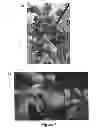
The accompanying photographs show typical specimens of the foliage, flowers and fruit of the new variety as depicted in colours as nearly true as is reasonably possible to make the same in a colour illustration of this character.
FIG. 1: fruit of ‘LRP40/205’ in the field (A and B).
FIG. 2: fruit of ‘LRP40/205’ (A) whole and (B) whole and transverse section.
FIG. 3: ‘LRP40/205’ (A) flowers at full bloom, (B) fully expanded leaves upper side, and (C) fully expanded leaves lower side.
DETAILED DESCRIPTION OF THE VARIETY
The following is a brief description of the new variety with colour terminology in accordance with The Royal Society Colour Charts (R.H.S.C.C.) 2001 edition. The specimens described were grown in Hawke's Bay, New Zealand. The observations were made in the 2010-2012 seasons on mature trees which ranged in age between two and seven years old. Trees were grown under standard orchard practices.
- Tree: considered to be a medium-large sized tree, ‘LRP40/205’ is medium vigour, and has a spreading habit. ‘LRP40/205’ scions are compatible with ‘Golden Queen’ peach seedlings which are the standard plum rootstock in New Zealand. Tree health is considered to be good under Hawke's Bay conditions in New Zealand with average yields of 50 kg per tree (mature tree of 4 years) which is considered to be excellent under New Zealand conditions and with a similar precocity to commercially grown varieties in the area.
- Leaves: the leaves examined were fully expanded and harvested from physiologically mature trees. The overall shape of the leaves was oblanceolate with a cuspidate tip, an acuminate base and serrulate margins. Leaves are clustered on spurs and singular on young branches. The colour of the upper side of the leaf was near green 137A and moderately glossy, while the lower side was near green 138B-C. The reticulate venation was coloured near yellow-green 145C extending to near green 145B on the underside at the end of the petiole. Some leaves had slight anthocyanin colouration of near red-purple 63B through the mid rib, extending down to near greyed-purple 184A on the upper and underside of the petiole, confined to the very end on the upperside. The average length of the blade was approximately 109.7 mm with an average width of approximately 38.6 mm.
- Petiole: the average petiole length of fully expanded leaves was 15.7 mm with an average width of 1.8 mm. The colour is described above.
- Flowers: observations were made at full bloom which occurred mid to late September in Hawke's Bay, New Zealand. Flowers had a subtle fragrance. Flowers were clustered predominantly in groups of two.
- Corolla: five petals per flower with an average length of 8.5 mm and an average width of 7.0 mm. Petals are predominantly free with some touching or slightly overlapping. The petals were near white N155A-B in colour. The petal shape was observed to be broadly obovate with slightly undulate margins.
- Stamens: an average of 30 per flower. Filaments were an average length of 9.83 mm and translucent white in colour. The dorsifixed anthers were near yellow-orange 14A in colour.
- Carpel: pistil length was on average 5.2 mm in length.
- Pedicel: average length was 7.5 mm and width 0.8 mm. Coloured near yellow-green 145C.
- Calyx: five sepals per flower, average length 3.7 mm and width 2.9 with an obtuse apex and smooth margin. Coloured near yellow-green 145B.
- Fruit: harvested late February in Hawke's Bay, New Zealand depending on the season. Fruit are borne on both spurs and long shoots.
- Size: fruit at horticultural maturity were on average 161.5 g. Average height was 59.2 mm, and width (ventral) 68.9 mm.
- Shape: fruit were moderately asymmetric, cordate in shape, with a medium-deep suture, a depressed base and rounded-slightly pointed apex.
- Skin: fruit surface is smooth with a weak to medium bloom. Background colour was near orange-red N34A
- Over colour: covers 50-75% of the fruit surface in a mottled pattern with a colour near greyed purple 184B-C with bloom, and near greyed purple 183B without bloom. Lenticels were coloured near yellow-orange 20B.
- Flesh: Colour is near greyed purple 185A in darkest areas and near red 83A in lightest. The stone cavity is near greyed purple 187A. Flesh texture is firm.
- Peduncle: Coloured near greyed orange 164A and 165B.
- Flavour: Average brix was measured to be 13.8. Fruit are sweet with some skin bitterness at harvest, usually mellowing during storage.
- Use: fresh eating.
- Keeping quality: The variety stores for up to 5 weeks at 0 C.
Claims
1. We claim a new and distinct plum plant substantially as illustrated and described.
Images & Drawings included:



Sources:
- United States Patent and Trademark Office - verify current appl. status at the USPTO↗
Recent applications in this class:
- » 20240292771 2024-08-29
Campanula plant named 'Twilight' - » 20240251691 2024-07-25
HYDRANGEA PLANT NAMED 'HYLV17520' - » 20240251690 2024-07-25
Vaccinium Plant Named 'BWPBLUE02' - » 20240251689 2024-07-25
BLUEBERRY PLANT NAMED 'FC13-113' - » 20240251688 2024-07-25
BLUEBERRY PLANT NAMED 'FCM14-057' - » 20240237567 2024-07-11
PONGAMIA VARIETIES - » 20240224827 2024-07-04
PELARGONIUM PLANT NAMED 'PEQZ0103' - » 20240215470 2024-06-27
Agapanthus plant named 'Monsapho' - » 20240215469 2024-06-27
plant named ‘LOCORA3519’ - » 20240206359 2024-06-20
CORYLUS PLANT NAMED 'BWM01'
Recent applications for this Assignee:
- » 20250154519 2025-05-15
REGULATION OF GENE EXPRESSION - » 20240373770 2024-11-07
Apple Tree Named 'HOT125A1' - » 20240373769 2024-11-07
APPLE TREE NAMED 'HOT141A1' - » 20240373768 2024-11-07
APPLE TREE NAMED 'HOT81A1' - » 20240093272 2024-03-21
CAS12 DETECTION METHODS AND COMPOSITIONS - » 20240000716 2024-01-04
Oral dosage forms comprising a hops extract - » 20230243724 2023-08-03
Method for assessing dry matter in horticultural products - » 20230189676 2023-06-15
Apple tree named 'SF118' - » 20230114811 2023-04-13
GLYCOSYLTRANSFERASES, POLYNUCLEOTIDES ENCODING THESE AND METHODS OF USE - » 20220183199 2022-06-09
Apple tree named ‘SF1’