Unique shapes for designing composite images
US20140110900A1
2014-04-24
14/058,283
2013-10-20
Abstract:
This invention consists of a set of six unique shapes that can be freely arranged on a two-dimensional surface to create a composite image.
Interested in similar patents?
Get notified when new applications in this technology area are published.
Classification:
A63F3/00694 » CPC main
Board games; Raffle games Magnetic board games
A63F3/00 IPC
Board games; Raffle games
Description
CROSS REFERENCE TO RELATED APPLICATIONS
This is a continuation of the U.S. provisional application No. 61/716,565
BACKGROUND OF THE INVENTION
1. Field of the Invention
This invention relates to a design game consisting of uniquely defined shapes that are used to create composite images.
2. Description of Prior Art
Prior design-forming games consist of geometrically identifiable elements which are arranged in a progressive way to form an abstract image or fixed in preselected locations to form a mosaic art. For example U.S. Pat. No. 4,651,993 consists of modules in the shape of a square progressing from the smallest of the series to the largest of the series according to a definite geometric formula. Another example is U.S. Pat. No. 4,993,984 which consists of a mosaic art kit made of equilateral triangles that are fixed on a board in preselected location.
Neither games provide the freedom of selectively placing the design forming elements at the discretion of the user on a two-dimensional surface to create artistic designs and stimulate the visual thinking without any restriction.
SUMMARY OF THE INVENTION
This invention consists of a set of unique shapes as depicted in the drawings. The plurality of the said shapes can be freely arranged on a two-dimensional surface to create a composite image.
BRIEF DESCRIPTION OF THE SEVERAL VIEWS OF THE DRAWING (IF ANY)
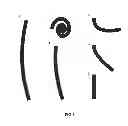
FIG. 1: Front view of the unique shapes
FIG. 2: Back view of the unique shapes
FIG. 3: A plan view illustrating one exemplary arrangement of the unique shapes
DETAILED DESCRIPTION OF THE INVENTION
As shown in FIG. 1 and FIG. 2, the invention consists of six unique shapes: a spiral 2, a straight bar 6, and four distinct curves 1, 3, 4 and 5. In its tangible form, the six shapes are made of dual sided soft magnet die-cuts and sized proportionately to one another. The plurality of the unique shapes can be selectively placed at the discretion of the user and adhered to a magnet receptive board or any other magnet receptive surface to form a composite image. The FIG. 3 illustrates exemplary arrangement of a plurality of the unique shapes to form composite images.
Images & Drawings included:



Sources:
- United States Patent and Trademark Office - verify current appl. status at the USPTO↗
Recent applications in this class:
- » 20250083030 2025-03-13
SMART CHESS-LIKE GAME PIECE POSITIONING AND RECOGNITION SYSTEM - » 20240335734 2024-10-10
BOARD GAME COMPRISING INCREASING AND MANIPULATING MAGNETIC FORCES WITH MAGNETIC PLAYING PIECES - » 20230293972 2023-09-21
Board game with levitating magnetic game pieces in a race - » 20210001208 2021-01-07
Method of playing sudoku using a magnetic sudoku board with color-coded magnets to provide visual assistance - » 20160346671 2016-12-01
Method and system for magnetic field based information transfer - » 20160287980 2016-10-06
MAGNETIC GAME DEVICE - » 20150196837 2015-07-16
Magnetic Board Game - » 20130175757 2013-07-11
GEOGRAPHY PUZZLE AND GAME PLATFORM - » 20130106055 2013-05-02
MAGNETIC PIECE FOR PLAY BOARD AND MAGNETIC PLAY BOARD - » 20090243214 2009-10-01
Therapy games