Method for burning pelletized good
US20140112848A1
2014-04-24
14/124,512
2012-05-09
✅ Patent granted
US 9,266,774 B2
2016-02-23
WO; PCT/EP2012/058549; 20120509
WO; WO2013/007413; 20130117
Gregory A Wilson
Renner Kenner Greive Bobak Taylor & Weber
2032-05-09
Abstract:
According to the invention, the method for burning fragmented material is carried out in at least one shaft which comprises a preheating zone, a combustion zone and a cooling zone, coal having a swelling index>1 being supplied via combustion lances, and the temperature of the coal in the combustion lances being maintained below a temperature value at which melting phases of the coal used are formed.
Inventors:
- Hannes Piringer 3 🇨🇭 Beinwill am See, Switzerland
- Patrick Bucher 2 🇨🇭 Dottikon, Switzerland
Assignee:
- MAERZ OFENBAU AG 11 🇨🇭 Zurich, Switzerland
- Maerz-Ofenbau AG 3 🇨🇭 , Switzerland
Applicant:
Interested in similar patents?
Get notified when new applications in this technology area are published.
Classification:
F27B1/02 » CPC further
Shaft or like vertical or substantially vertical furnaces with two or more shafts or chambers, e.g. multi-storey
C04B35/62675 » CPC further
Shaped ceramic products characterised by their composition ; Ceramics compositions ; Processing powders of inorganic compounds preparatory to the manufacturing of ceramic products; Forming processes; Processing powders of inorganic compounds preparatory to the manufacturing of ceramic products; Preparing or treating the powders individually or as batches ; preparing or treating macroscopic reinforcing agents for ceramic products, e.g. fibres; mechanical aspects section; Treating the starting powders individually or as mixtures; Thermal treatment of powders or mixtures thereof other than sintering characterised by the treatment temperature
C04B2235/3208 » CPC further
Aspects relating to ceramic starting mixtures or sintered ceramic products; Composition of constituents of the starting material or of secondary phases of the final product; Constituents and secondary phases not being of a fibrous nature; Metal oxides, mixed metal oxides, or oxide-forming salts thereof, e.g. carbonates, nitrates, (oxy)hydroxides, chlorides; Alkaline earth oxides or oxide forming salts thereof, e.g. beryllium oxide Calcium oxide or oxide-forming salts thereof, e.g. lime
C04B35/626 IPC
Shaped ceramic products characterised by their composition ; Ceramics compositions ; Processing powders of inorganic compounds preparatory to the manufacturing of ceramic products; Forming processes; Processing powders of inorganic compounds preparatory to the manufacturing of ceramic products Preparing or treating the powders individually or as batches ; preparing or treating macroscopic reinforcing agents for ceramic products, e.g. fibres; mechanical aspects section
F27B1/10 » CPC further
Shaft or like vertical or substantially vertical furnaces Details, accessories, or equipment peculiar to furnaces of these types
C04B2235/442 » CPC further
Aspects relating to ceramic starting mixtures or sintered ceramic products; Composition of constituents of the starting material or of secondary phases of the final product; Constituents and secondary phases not being of a fibrous nature; Metal salt constituents or additives chosen for the nature of the anions, e.g. hydrides or acetylacetonate Carbonates
F23G7/00 IPC
Incinerators or other apparatus for consuming industrial waste, e.g. chemicals
C04B2/12 » CPC main
Lime, magnesia or dolomite; Preheating, burning calcining or cooling in shaft or vertical furnaces
C04B2/02 » CPC further
Lime, magnesia or dolomite Lime
Description
The invention relates to a method for burning fragmented material, in particular limestone, dolomite stone, magnesite brick or other carbonate stones, in at least one shaft which comprises a preheating zone, a combustion zone and a cooling zone, coal being supplied via combustion lances.
The fuel costs in limestone burning are considerable and may amount to more than 50% of the production costs. Since coal is in most cases the most cost-effective energy carrier, most lime kilns are nowadays fired with coal. However, coal may be very different in terms of its properties. A high content of ash and sulphur is thus disadvantageous since the unhydrated lime is contaminated in an undesirable manner.
A particular feature of coal is its swelling index. From numerous practical tests, it is known that coal with a swelling index of more than 1.0 could previously not be used in lime kilns, in particular in co-current/counter-current regenerative lime kilns, since serious operational problems, such as, for example, clogging of the combustion lances, occurred. Owing to the limited usability of such coal in co-current/counter-current regenerative lime shaft kilns, either a rotary tubular kiln was previously used or petrol coke or liquid or gaseous fuels had to be used instead. However, rotary tubular kilns have the considerable disadvantage that they use from 50-100% more fuel than co-current/counter-current regenerative lime kilns and consequently considerably more CO2 is thereby discharged into the atmosphere. The use of petrol coke is also disadvantageous since its sulphur content can be up to 10 times higher than that of coal, whereby other limitations are produced. Furthermore, liquid and gaseous fuels may not be available under some circumstances or may be significantly more expensive than coal.
DE 32 27 395 C2 discloses a method for producing briquettes for the fixed bed of a gasification reactor or shaft kiln, from 30 to 85% of non-caking raw coal and from 15 to 70% of the caking raw coal being mixed and subsequently formed into briquettes, the caking coal having a swelling index of ≧5.
An object of the invention is to provide a method for burning fragmented material by means of which the fuel costs can be reduced.
According to the invention, the method for burning fragmented material is carried out in at least one shaft which comprises a preheating zone, a combustion zone and a cooling zone, coal having a swelling index >1, in particular also >2, being supplied via combustion lances and the temperature of the coal in the combustion lances being maintained below a temperature value at which melting phases of the coal used are formed.
In this application, the swelling index is understood in accordance with the standard ASTM D720-91.
The coal is conventionally blown into the kiln in the form of coal dust pneumatically by means of combustion lances. The combustion lances are located in the preheating zone or the combustion zone of the shaft and are surrounded by fragmented material, in particular limestone. In this instance, the temperature of the fragmented material at the upper end of the preheating zone is approximately 100° C. whilst, at the lower end, it is approximately 50° C. below the calcination temperature which is typical for the material to be calcined and which, for limestone, is typically approximately from 750° C. to 800° C. Through the walls of the combustion lances, the heat of the fragmented material is transmitted from the outer side to the inner side, whereby the supplied coal is heated before it leaves the combustion lances and is automatically ignited outside them.
In the tests forming the basis of the invention, it has been found that coal having a swelling index >1 forms from a specific temperature melting phases which accumulate on the inner walls of the combustion lances and clog them after a short period of time. These deposits within the combustion lances can further ignite during the regenerative phase of a kiln shaft and thereby very quickly destroy the combustion lances. It has been found that precisely the volatile components of the coal having a swelling index >1 very quickly lead to occurrences of caking when a specific temperature is exceeded. During this phenomenon, there is first formed a melt phase which swells owing to the gas emission of the volatile components and quickly clogs the combustion lances. It has been found that the volatile components of the coal are discharged slowly in the range from 200 to 300° C. and are discharged rapidly from 450° C. However, depending on the type of coal, these values can vary significantly.
In the tests forming the basis of the invention using different coals, it has been found that the phase conversions in most cases begin only from 150° C. Swelling experiments in laboratory kilns have further shown that the swelling of the coal can begin at different temperatures, depending on the coal type. Typically, this temperature is approximately 250° C. However, if the temperature of the coal in the combustion lances is kept below the temperature value at which melt phases of the coal used are formed, coal having a swelling index >1 can be readily used. In particular in North America there is a significant occurrence of cost-effective coal which has an increased swelling index >1. With the method described above, this cost-effective coal can now be used in a lime shaft kiln, whereby the fuel costs can be reduced considerably with respect to the coal previously used.
The dependent claims relate to other embodiments of the invention.
The combustion lances are preferably arranged in the preheating zone or the combustion zone of the shaft and are in operational contact with the fragmented material located there in order to heat the coal. In this instance, the temperature of the coal in the combustion lances is advantageously kept below 250° C., preferably below 200° C. and in a most preferable manner below 150° C.
In order to comply with these temperature values, one or more of the measures set out below can be taken:
- the combustion lances are provided with an insulation in order to thereby significantly reduce the heat flow from the outer side to the inner side through the wall of the combustion lances, whereby the coal is accordingly heated less. This measure has the advantage that the thermal efficiency level of the lime kiln is not impaired;
- the combustion lances are cooled, the cooling being able to be carried out, for example, by means of a gas or a liquid.
The combustion lances could, for example, be provided with a casing, which is cooled by means of water, thermal oil or air. This method also has only an insignificant influence on the thermal efficiency level of the lime kiln;
- the coal is cooled before being supplied to the combustion lances or the coal is supplied with a transport gas via the combustion lances, the temperature of the coal being adjusted by means of the quantity and/or temperature of the transport gas. Owing to these measures, the coal is heated to a correspondingly lower temperature within the combustion lances. However, the increase of the transport air quantity can be used only in a very limited manner since the thermal efficiency level of a co-current/counter-current regenerative lime kiln becomes correspondingly worse as the quantity of air increases and, furthermore, the exhaust gas temperature of the kiln rises accordingly;
- non-combustible components, in particular CaO or CaCO3-containing components, are introduced together with the coal into the combustion lances in order to adjust the temperature of the coal. To this end, it would be possible to add, for example, the dust from kiln exhaust gas filters, in order to increase the mass flow. Such a filter dust does not constitute a foreign material, with the result that it also does not lead to contamination of the product;
- a fluid, in particular water, is introduced via the combustion lances. Owing to the evaporation of the water, the temperature increase of the coal can be limited accordingly;
- shorter combustion lances are used or a radial arrangement is provided. Owing to these measures, smaller surfaces of the combustion lances are produced, whereby the coal is accordingly heated to a lesser degree;
- provision is made for simultaneous firing of coal and gas. In this instance, the coal and gas are supplied at the same time via the combustion lances. The smaller the thermal power of the gas were, the higher is the mass flow thereof which would cool the coal.
Other embodiments of the invention are described in greater detail below with reference to a specific embodiment.
In the drawings:
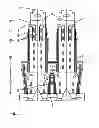
FIG. 1 is a cross-section of a co-current/counter-current regenerative lime kiln,
FIG. 2 is an enlarged detailed illustration in the region of the combustion lances, and
FIG. 3 is a graph which shows the path of the temperature along the kiln axis.
FIGS. 1 and 2 illustrate a co-current/counter-current regenerative lime kiln which has two shafts 1, 2 each having a preheating zone V, a combustion zone B and a cooling zone K and an overflow channel 3 which connects the two shafts. Both shafts are operated alternately in a manner known per se as a combustion shaft and an exhaust gas shaft, combustion air 4 being supplied to the combustion shaft in co-current with fragmented material 5 and coal 6 to be burnt. The fragmented material in this instance is limestone. The hot exhaust gases 7 which are produced in this instance are directed together with the heated cooling air 8 which is supplied from below via the overflow channel 3 into the exhaust gas shaft, where the exhaust gases are directed upwards in counter-current to the limestone and preheat the limestone. After a predetermined period of time, for example, of 15 minutes, the function of the two shafts is transposed, that is to say, the combustion shaft becomes the exhaust gas shaft and vice versa. This method allows very efficient burning of the limestone in co-current with the combustion gases and a regenerative preheating of the limestone in counter-current to the hot exhaust gases.
The coal 6, which has a swelling index >1, in particular also >2, is supplied via combustion lances 9.
The combustion lances 9 are, in the embodiment illustrated, arranged in the region of the preheating zone V substantially in the direction of the longitudinal shaft axis la and are surrounded by the limestone. The fuel is supplied in the form of coal powder using a transport gas via the combustion lances and is heated owing to the heat which is transmitted inwards from the limestone via the wall of the combustion lances so that the coal 6 is automatically ignited after being discharged from the combustion lance 9 with the combustion air 4 which is introduced into the shaft from the top. In order to now prevent the occurrences of blockage feared with the use of coal having a swelling index >1 in the combustion lances 9, appropriate measures must be taken so that the coal in the combustion lances is kept below a temperature value at which melting phases of the coal used form. Depending on the coal used, this temperature value is, for example, 250° C. By means of adaptation to a temperature value of 200° C. or even 150° C., the occurrences of caking with all previously known types of coal can be prevented.
A particularly advantageous measure for reducing the heating of the coal in the combustion lances 9 involves the use of an insulation 10 of the combustion lance. Alternatively or in addition, it is also possible to use one or more of the other measures already mentioned above.
The graph according to FIG. 3 illustrates the path of the temperature of the supplied coal 6, the combustion air 4 and the fragmented material (limestone) 5 along the kiln axis 1a. The region of the preheating zone from the surface of the limestone to be burnt as far as the lower end of the combustion lances 9 is illustrated in this instance.
In this embodiment, the temperature of the coal reaches approximately 200° C. at the outlet of the combustion lances 9. The limestone and the combustion air 4 are heated in this region to approximately 700° C.
Claims
1. Method for burning fragmented material in at least one shaft which comprises a preheating zone, a combustion zone and a cooling zone, coal being supplied via combustion lances,
characterised in that coal having a swelling index greater than 1 is supplied and the temperature of the coal in the combustion lances is maintained below a temperature value at which melting phases of the coal used are formed.
2. Method according to claim 1, characterised in that the combustion lances are arranged in the preheating zone or the combustion zone of the shaft and are in operational contact with the fragmented material located there in order to heat the coal in the combustion lances.
3. Method according to claim 1, characterised in that the temperature of the coal in the combustion lances is kept below 250° C., preferably below 200° C. and in a most preferable manner below 150° C.
4. Method according to claim 1, characterised in that the combustion lances are provided with an insulation.
5. Method according to claim 1, characterised in that the combustion lances are cooled.
6. Method according to claim 1, characterised in that the coal is cooled before being supplied to the combustion lances.
7. Method according to claim 1, characterised in that the coal is supplied with a transport gas via the combustion lances and the temperature of the coal is adjusted by means of the quantity and/or temperature of the transport gas.
8. Method according to claim 1, characterised in that non-combustible components, in particular CaO or CaCO3-containing components, are introduced into the combustion lances in order to adjust the temperature of the coal.
9. Method according to claim 1, characterised in that a fluid, in particular water, is introduced into the combustion lances in order to adjust the temperature of the coal.
10. Method according to claim 1, characterised in that the combustion of the fragmented material is carried out in a co-current/counter-current regenerative lime kiln, which has at least two shafts each having a preheating zone, a combustion zone and a cooling zone and an overflow channel which connects the two shafts, the two shafts being operated alternately as a combustion shaft and an exhaust gas shaft.
Images & Drawings included:


Sources:
- United States Patent and Trademark Office - verify current appl. status at the USPTO↗
Recent applications in this class:
- » 20250162935 2025-05-22
METHOD OF CALCINING MINERAL ROCK IN A REGENERATIVE PARALLEL-FLOW VERTICAL SHAFT FURNACE, AND FURNACE USED - » 20250162934 2025-05-22
METHOD OF CALCINING MINERAL ROCK IN A REGENERATIVE PARALLEL-FLOW VERTICAL SHAFT FURNACE, AND FURNACE USED - » 20240254043 2024-08-01
DECARBONATION PROCESS OF CARBONATED MATERIALS IN A MULTI-SHAFT VERTICAL KILN - » 20240239706 2024-07-18
DECARBONATION PROCESS OF CARBONATED MATERIALS IN A MULTI-SHAFT VERTICAL KILN - » 20240228373 2024-07-11
DECARBONATION PROCESS OF CARBONATED MATERIALS IN A MULTI-SHAFT VERTICAL KILN - » 20240217873 2024-07-04
METHOD AND INSTALLATION FOR PRODUCING LIME OR DOLIME - » 20240101476 2024-03-28
Apparatus and process for production of burnt lime or dolomite - » 20240067563 2024-02-29
APPARATUS AND PROCESS FOR PRODUCTION OF BURNT LIME OR DOLOMITE - » 20240018037 2024-01-18
PROCESS FOR DECARBONATING CARBONATED MATERIALS AND DEVICE THEREFOR - » 20230278919 2023-09-07
CALCINER USING RECIRCULATED GASES
Recent applications for this Assignee:
- » 20240361074 2024-10-31
PARALLEL-FLOW REGENERATIVE SHAFT KILN AND METHOD FOR BURNING CARBONATE ROCK - » 20230257302 2023-08-17
PARALLEL-FLOW REGENERATIVE SHAFT KILN AND METHOD FOR CALCINING CARBONATE ROCK - » 20230106711 2023-04-06
METHOD FOR BURNING CARBON-CONTAINING MATERIAL IN A PFR SHAFT FURNACE - » 20220170698 2022-06-02
Method and shaft furnace for burning carbon-containing material in a shaft furnace - » 20190345037 2019-11-14
Furnace and method for operating a furnace - » 20190077705 2019-03-14
System having a furnace and method for operating such a system - » 20160176760 2016-06-23
Parallel-flow regenerative lime kilns and processes for burning and cooling carbonate rock in same - » 20150353421 2015-12-10
Method for burning lump material - » 20120244484 2012-09-27
Parallel flow regenerative lime kiln and method for the operation thereof - » 20080118880 2008-05-22
Process and apparatus for calcining solids or sludges