Reinforced structural element made of plastic, in particular in the vehicle interior design field
US20140178652A1
2014-06-26
14/111,734
2012-03-12
✅ Patent granted
US 9,849,636 B2
2017-12-26
WO; PCT/EP2012/001096; 20120312
WO; WO2012/139689; 20121018
Maria Veronica Ewald | Travis Figg
Foley & Lardner LLP
2035-01-05
Abstract:
A vehicle structural clement made of plastic has at least one carbon filler reinforced region and at least one fiberglass reinforced region. In a method for producing the vehicle structural element, a pre-heated carbon fiber reinforced region and a pre-heated fiberglass reinforced region are placed in a press and shaped.
Inventors:
- Hans-Georg Werner 11 🇩🇪 Langenfeld, Germany
- Bernd Gross 19 🇩🇪 Langenfeld, Germany
- Sreenivas Paruchuri 2 🇬🇧 Eastbourne, United Kingdom
- Sreenivas Paruchuri 1 🇩🇪 Eastbourne, Germany
Assignee:
- Johnson Controls GmbH 190 🇩🇪 Burscheid, Germany
Applicant:
Interested in similar patents?
Get notified when new applications in this technology area are published.
Classification:
B60N2/68 IPC
Seats specially adapted for vehicles; Arrangement or mounting of seats in vehicles Seat frames
B29D99/001 » CPC further
Subject matter not provided for in other groups of this subclass Producing wall or panel-like structures, e.g. for hulls, fuselages, or buildings
B60N2/686 » CPC main
Seats specially adapted for vehicles; Arrangement or mounting of seats in vehicles; Seat frames Panel like structures
B29C70/42 » CPC main
Shaping composites, i.e. plastics material comprising reinforcements, fillers or preformed parts, e.g. inserts comprising reinforcements only, e.g. self-reinforcing plastics; Shaping operations therefor; Shaping or impregnating by compression not applied for producing articles of definite length, i.e. discrete articles
B29D99/00 IPC
Subject matter not provided for in other groups of this subclass
B60N2/70 IPC
Seats specially adapted for vehicles; Arrangement or mounting of seats in vehicles Upholstery springs ; Upholstery
B29L2031/30 » CPC further
Other particular articles Vehicles, e.g. ships or aircraft, or body parts thereof
Y10T428/2481 » CPC further
Stock material or miscellaneous articles; Structurally defined web or sheet [e.g., overall dimension, etc.]; Discontinuous or differential coating, impregnation or bond [e.g., artwork, printing, retouched photograph, etc.] including layer of mechanically interengaged strands, strand-portions or strand-like strips
Y10T428/24752 » CPC further
Stock material or miscellaneous articles; Structurally defined web or sheet [e.g., overall dimension, etc.] Laterally noncoextensive components
Y10T428/24802 » CPC further
Stock material or miscellaneous articles; Structurally defined web or sheet [e.g., overall dimension, etc.] Discontinuous or differential coating, impregnation or bond [e.g., artwork, printing, retouched photograph, etc.]
Y10T428/24818 » CPC further
Stock material or miscellaneous articles; Structurally defined web or sheet [e.g., overall dimension, etc.]; Discontinuous or differential coating, impregnation or bond [e.g., artwork, printing, retouched photograph, etc.] including layer of mechanically interengaged strands, strand-portions or strand-like strips Knitted, with particular or differential bond sites or intersections
B32B3/00 IPC
Layered products comprising a layer with external or internal discontinuities or unevennesses, or a layer of non-planar form ; Layered products having particular features of form
B29C70/46 » CPC further
Shaping composites, i.e. plastics material comprising reinforcements, fillers or preformed parts, e.g. inserts comprising reinforcements only, e.g. self-reinforcing plastics; Shaping operations therefor; Shaping or impregnating by compression not applied for producing articles of definite length, i.e. discrete articles using matched moulds, e.g. for deforming sheet moulding compounds [SMC] or prepregs
B60N2/7011 » CPC further
Seats specially adapted for vehicles; Arrangement or mounting of seats in vehicles; Upholstery springs ; Upholstery of substantially two-dimensional shape, e.g. hammock-like, plastic shells, fabrics
Description
The present invention relates to a vehicle structural element made of plastic. The present invention further relates to a method for producing a vehicle structural element made of plastic.
In vehicle construction, there are continuous efforts to reduce the weight of the vehicles. In this respect, metal structural parts in particular are to be replaced by fiber-reinforced vehicle structural elements made of plastic. Methods for producing fiber-reinforced vehicle structural elements made of plastic or plastic structural elements of this type are known, for example, from DE 195 48 854 C2, EP 0 782 909 B1 and also EP 0 782 909 B1. The fiber-reinforced vehicle structural elements made of plastic which are described therein are, however, relatively expensive to produce.
It was therefore an object of the present invention to provide a fiber-reinforced vehicle structural element made of plastic which can replace a metallic structural element and which is easy and inexpensive to produce.
The object is achieved by a vehicle structural element made of plastic having at least one carbon-fiber-reinforced region and at least one glass-fiber-reinforced region.
The present invention relates to a reinforced vehicle structural element made of plastic. This is in particular a vehicle structural element made of plastic which is provided in the vehicle interior design field. The vehicle structural element is preferably a component which replaces a component that has been produced to date from metal. A vehicle structural element within the context of the invention is any component which has not only a decorative function but also a bearing function in the vehicle. By way of example, the vehicle structural element which is reinforced according to the invention and is made of plastic is a structural component of the backrest or of the seat part of a front and/or back seat and/or a structural component of the dashboard and/or a structural component of the vehicle door and/or a structural component of the vehicle door panel and/or a crossmember and/or a vehicle body part. In particular, the vehicle structural element made of plastic according to the invention is part of the frame of a vehicle seat. Furthermore, the reinforced vehicle structural element made of plastic can be a seat substructure. However, any other structural element of a vehicle can also be provided as the vehicle structural element according to the invention.
According to the invention, the vehicle structural element made of plastic is reinforced, it having at least one region which is reinforced with carbon fibers and at least one region which is reinforced with glass fibers. The carbon fibers and the glass fibers can have any desired length or any desired thickness. The carbon fibers and the glass fibers can be directed or undirected. The carbon fibers and/or the glass fibers can be present as a woven fabric, mat, laid screen, knitted or crocheted fabric and/or a combination of these structures. This semifinished product is preferably shaped into a three-dimensional structure (3D structure), for example by thermal deformation. It is preferable that the carbon-fiber-reinforced region is arranged in a region of the vehicle structural element which is subjected to higher mechanical loading than the region of the vehicle structural element made of plastic in which the glass fibers are arranged. The carbon-fiber-reinforced region and the glass-fiber-reinforced region preferably butt directly against one another or are even provided in an at least partially overlapping manner. It is preferable that merely the regions subjected to high loading are reinforced with carbon fibers. The entire remaining region of the vehicle structural element made of plastic according to the invention is preferably reinforced with glass fibers, so that the vehicle structural element made of plastic is preferably provided with complete reinforcement.
However, it is also possible to provide segments of the vehicle structural element which are reinforced with glass fibers and reinforced with carbon fibers.
The materials are placed in the corresponding structural element to meet the requirements, taking into consideration the desired strength. This segmentation makes it possible to considerably reduce the component weight without having to accept losses in terms of mechanical stability. Furthermore, the division into different regions makes it possible to provide a component which is optimized in terms of cost and is considerably less expensive than a component produced, for example, completely from carbon-fiber-reinforced plastic.
The vehicle structural element made of plastic according to the invention preferably has a three-dimensional structure. It is furthermore preferable that the vehicle structural element made of plastic has a profile and/or a concavity or a convexity, in particular in order to further increase the stability thereof. In the vehicle structural element made of plastic according to the invention, provision can be made of a means, for example a recess, for fastening a component to the vehicle structural element.
The vehicle structural element made of plastic according to the invention can be produced, for example, by what is known as the D-L-F-T (direct long reinforced thermoplastic) pressing method. In this method, a preferably heated specific volume of various components is placed into a mold, for example by a robot. In this respect, the desired reinforcement in the respective region is taken into consideration. Then, the mass is changed into the desired shape, for example using a press. Polypropylene (PP) or PP copolymer is suitable in particular as the plastic which is reinforced by the carbon fibers and/or the glass fibers.
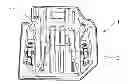
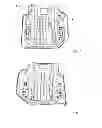
Hereinbelow, the invention will be explained with reference to FIGS. 1 and 2. These explanations do not have a limiting effect on the general concept of the invention. The explanations apply equally to all subjects of the present invention.
FIG. 1 shows the front side of a vehicle structural element made of plastic according to the invention,
FIG. 2 shows the rear side of a vehicle structural element made of plastic according to the invention.
FIG. 1 shows the front side of a vehicle structural element made of plastic, here a seat cushion shell, which is reinforced according to the invention. The seat cushion on which the occupant sits is arranged on said front side of the shell. The seat shell is a vehicle structural element made of plastic which is reinforced according to the invention and has two regions 2, 3 each reinforced with a different material. The region 2 is a region which is reinforced with carbon fibers, whereas the region 3 is reinforced with glass fibers. The region 2, here the thigh rest of the seat cushion shell, has to be reinforced to a particular extent, because this is where increased loads occur, for example in the event of an accident, and this region has to have a particularly rigid configuration in order, for example, to prevent “submarining”.
FIG. 2 shows the rear side of the structural element shown in FIG. 1. The two differently reinforced regions 2, 3 can again be seen, and therefore reference can be made to the statements relating to FIG. 1.
LIST OF REFERENCE SIGNS
- 1 Vehicle structural element made of plastic
- 2 Carbon-fiber-reinforced region
- 3 Glass-fiber-reinforced region
Claims
1. A vehicle structural element made of plastic, comprising:
at least one carbon-fiber-reinforced region; and
at least one glass-fiber-reinforced region.
2. The vehicle structural element as claimed in claim 1, wherein the carbon fibers of the carbon-fiber-reinforced region and the glass fibers of the glass-fiber-reinforced region are directed or undirected, wherein the carbon-fiber-reinforced and the glass-fiber-reinforced regions are preferably provided at least in part as semifinished products which are shaped in particular into a three-dimensional shape.
3. The vehicle structural element as claimed in claim 1, wherein the carbon fibers and/or the glass fibers are present as woven fabrics, mats, laid screens, knitted or crocheted fabrics and/or a combination of these structures.
4. The vehicle structural element as claimed in claim 1, wherein the carbon-fiber-reinforced region is arranged in a region of the vehicle structural element which is subjected to higher mechanical loading than the region of the vehicle structural element which is reinforced with glass fibers.
5. The vehicle structural element as claimed in claim 1, wherein the carbon-fiber-reinforced region and the glass-fiber-reinforced region are provided edge to edge and/or in an overlapping manner.
6. The vehicle structural element as claimed in claim 1, wherein the vehicle structural element is reinforced with glass fillers and/or carbon fibers on the whole.
7. The vehicle structural element as claimed in claim 1, wherein the vehicle structural element is the frame or the backrest or of the seat part of a vehicle seat.
8. The vehicle structural element as claimed in claim 1, wherein the vehicle structural element is the structure of the backrest or the cushion shell of the seat part.
9. The vehicle structural element as claimed in claim 8, wherein the seat part is reinforced in the region of the thigh rest.
10. A method for producing a vehicle structural clement made of plastic, comprising:
placing in a press and shaping a pre-heated carbon-fiber-reinforced region and a pre-heated glass-fiber-reinforced region; and
then removing the finished vehicle structural element from the press.
Images & Drawings included:
Sources:
- United States Patent and Trademark Office - verify current appl. status at the USPTO↗
Recent applications in this class:
- » 20250256630 2025-08-14
SENSOR DISPOSITION STRUCTURE IN SEAT - » 20250256629 2025-08-14
SEAT CUSHION - » 20240278699 2024-08-22
HYBRID SEAT STRUCTURE AND VEHICLE COMPRISING THE SAME - » 20240262271 2024-08-08
BACK SURFACE MEMBER FOR SEAT PAD AND METHOD FOR MANUFACTURING THE SAME - » 20240181946 2024-06-06
SENSOR DISPOSITION STRUCTURE IN SEAT - » 20240042909 2024-02-08
Method and apparatus for forming a seat component - » 20230398915 2023-12-14
SKELETAL STRUCTURE - » 20230398914 2023-12-14
SEAT FRAME - » 20230311731 2023-10-05
ENGINEERED BUS FOAM SOLUTION FOR SCHOOL BUS SEAT - » 20230264616 2023-08-24
Vehicle seat
Recent applications for this Assignee:
- » 20180154800 2018-06-07
Vehicle seat having an adjusting device - » 20170028887 2017-02-02
Method for producing an element having a cover, and such an element - » 20160318428 2016-11-03
Foam part, in particular for a vehicle seat, and vehicle seat - » 20160311008 2016-10-27
Method for connecting a first component to a second component by plastic deformation - » 20160311007 2016-10-27
Method for connecting a first component to a second component - » 20160297330 2016-10-13
Vehicle seat with a recliner - » 20160243966 2016-08-25
Vehicle seat, in particular motor vehicle seat - » 20160236591 2016-08-18
METHOD FOR PRESETTING A VEHICLE SEAT - » 20160229318 2016-08-11
Locking unit for a vehicle seat, and vehicle seat - » 20160221474 2016-08-04
Method for adjusting a vehicle seat and system for adjusting a vehicle seat