Process for the preparation of beta-santalol
US20140187811A1
2014-07-03
14/125,876
2012-06-28
✅ Patent granted
US 9,156,770 B2
2015-10-13
WO; PCT/EP2012/062615; 20120628
WO; WO2013/001027; 20130103
Karl J Puttlitz
Winston & Strawn LLP
2032-09-20
Abstract:
The present invention concerns a process for the preparation of a compound of formula (I) in the form of any one of its stereoisomers or mixtures thereof, wherein R represents a C2-C10 group of formula CORa wherein Ra is an alkyl or alkenyl group optionally comprising one or two ether functional groups or is a phenyl or benzyl group optionally substituted by one to three alkyl, alkoxyl, carboxyl, acyl, amino or nitro groups or halogen atoms.
Assignee:
- FIRMENICH SA 202 🇨🇭 Geneva 8, Switzerland
- FIRMENICH SA 303 🇨🇭 Geneva, Switzerland
Applicant:
Interested in similar patents?
Get notified when new applications in this technology area are published.
Classification:
C07C67/293 » CPC main
Preparation of carboxylic acid esters by modifying the hydroxylic moiety of the ester, such modification not being an introduction of an ester group by isomerisation; by change of size of the carbon skeleton
C07C47/21 » CPC further
Compounds having —CHO groups; Unsaturated compounds having —CHO groups bound to acyclic carbon atoms with only carbon-to-carbon double bonds as unsaturation
C07C29/1285 » CPC further
Preparation of compounds having hydroxy or O-metal groups bound to a carbon atom not belonging to a six-membered aromatic ring by alcoholysis of esters of organic acids
C07C67/297 » CPC further
Preparation of carboxylic acid esters by modifying the hydroxylic moiety of the ester, such modification not being an introduction of an ester group by splitting-off hydrogen or functional groups; by hydrogenolysis of functional groups
C07C67/00 » CPC further
Preparation of carboxylic acid esters
C07C67/283 » CPC further
Preparation of carboxylic acid esters by modifying the hydroxylic moiety of the ester, such modification not being an introduction of an ester group by hydrogenation of unsaturated carbon-to-carbon bonds
C07C69/16 » CPC further
Esters of carboxylic acids; Esters of carbonic or haloformic acids; Esters of acyclic saturated monocarboxylic acids having the carboxyl group bound to an acyclic carbon atom or to hydrogen; Acetic acid esters of dihydroxylic compounds
C07C69/28 » CPC further
Esters of carboxylic acids; Esters of carbonic or haloformic acids; Esters of acyclic saturated monocarboxylic acids having the carboxyl group bound to an acyclic carbon atom or to hydrogen having three or more carbon atoms in the acid moiety esterified with dihydroxylic compounds
C07C69/63 » CPC further
Esters of carboxylic acids; Esters of carbonic or haloformic acids; Halogen-containing esters of saturated acids
C07C29/128 IPC
Preparation of compounds having hydroxy or O-metal groups bound to a carbon atom not belonging to a six-membered aromatic ring by alcoholysis
C07C69/145 » CPC further
Esters of carboxylic acids; Esters of carbonic or haloformic acids; Esters of acyclic saturated monocarboxylic acids having the carboxyl group bound to an acyclic carbon atom or to hydrogen; Acetic acid esters of monohydroxylic compounds of unsaturated alcohols
C07C69/602 » CPC further
Esters of carboxylic acids; Esters of carbonic or haloformic acids; Esters of acyclic unsaturated carboxylic acids having the esterified carboxyl group bound to an acyclic carbon atom Dicarboxylic acid esters having at least two carbon-to-carbon double bonds
Description
TECHNICAL FIELD
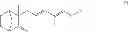
The present invention relates to the field of organic synthesis and more specifically it concerns a process for the preparation of a compound of formula
wherein R is as defined below, and said compound is in the form of any one of its to stereoisomers or mixtures thereof. The invention also concerns the use of compound (I) for the synthesis of β-santalol or of derivatives thereof.
PRIOR ART
The compounds of formula (I) are useful starting materials for the preparation of β-santalol ((Z)-2-methyl-5-((1SR,2RS,4RS)-2-methyl-3-methylenebicyclo[2.2.1]heptan-2-yl)pent-2-en-1-ol, i.e. the exo isomer), and derivatives thereof, in a very short, effective and industrially feasible manner.
The β-santalol, and derivatives thereof, are well known and highly valued perfuming ingredients, some of which have particular relevance. Synthetic β-santalol is not commercially available at this time and it is only available from natural sources (Sandalwood sp. essential oils). β-santalol is present in East Indian Sandalwood Oil (Santalum album) at a typical level of 20-25% and is generally accepted as the principal odour vector for the fine creamy sandalwood character of the essential oil. The West Australian Sandalwood Oil (Santalum spicatum.) typically contains much less β-santalol, in the range of 3-8% of the essential oil, and as a result is a less appreciated oil.
The export of East Indian sandalwood and the distillation of the essential oil is under strict government control since Santalum album has been classified by the Convention on International Trade in Endangered Species of Wild Fauna and Flora and International Union for Conservation of Nature Red list as vunerable and at risk of extinction.
Therefore, there is an urgent need for alternative syntheses to produce β-santalol and its dervivatives.
To the best of our knowledge, all known syntheses are lengthy or require expensive starting materials and/or reagents or even steps which are too expensive for an industrial process or generate unacceptable quantities of waste (e.g. see Brunke et al., in Rivista Italiana EPPOS, 1997, 49). In particular one may cite the following references, which are representative of the best examples of processes for the preparation of β-santalol:
-
- EP 10213: however said process, besides the fact that it is very long, requires many chlorinated intermediates (not optimal for a use in perfumery) and provides a very low overall yield for the preparation of an enal which still require several step to be converted into the desired product;
- A. Krotz et al, in Tet. Asymm., 1990, 1, 537: a relatively short synthesis, however it requires expensive reducing reagents that are difficult to manipulate on large scale, expensive chiral auxiliaries and two Wittig reactions, and then subsequent transformation of a ketone into the exo-methylene group:
- U.S. Pat. No. 3,662,008 and U.S. Pat. No. 3,679,756 (P&G) also describe the synthesis of β-santalol in low overall yield. This route is also dependent on a Wittig reaction to install the Z double bond and expensive reducing agents;
- WO2009/141781: reports a synthesis of some derivatives of formula (I), used as intermediates in the preparation of santalol; however said synthesis is long and still passes through the same key enal intermediate as described in EP 10213;
- C. Fehr et al. in Angew. Chem., Int. Ed, 2009, 48, 7221: describes a synthesis of β-santalol via Cu catalyzed rearrangement on an propargyl alcohol derivative which is not of easy preparation;
- EP 2119714: describes a synthesis implying a Scriabine reaction on a rich aromatic ring, but nothing about the use of such reaction on an alkene or in the preparation of β-santalol;
- H. Mayr et al in Chem. Ber., 1986, 119, 929: describes a 1,4 electrophillic addition to a cyclic alkene but does not mention or suggest the preparation of β-santalol.
The aim of the present invention is to provide a more industrial and efficient process for the preparation of β-santalol, and derivatives thereof. Indeed, the present invention shortens the overall process of preparation of the targeted compounds by allowing the three-step preparation of santalol from santene by creating a suitably functionalised side-chain moiety (with the correct configuration) together with the concomitant formation of the methylene function (without the mandatory need of a Wittig olefination or similar transformations) using a novel reaction without literature precedent.
It is well known in the literature that despite the epi-β-santalol being present in the natural East Indian sandalwood oil, it contributes little to the overall odour impact of the oil. Thus, a selective synthesis of (Z)-β-santalol containing a minimum of epi-β-santalol, and a minimum of the (E)-β-santalol thus highly desirable.
DESCRIPTION OF THE INVENTION
A first object of the present invention is a process for the preparation of a compound of formula
in the form of any one of its stereoisomers or mixtures thereof, wherein R represents a C2-C10 group of formula CORa wherein Ra is an alkyl or alkenyl group optionally comprising one or two ether functional groups or is a phenyl or benzyl group optionally substituted by one to three alkyl, alkoxyl, carboxyl, acyl, amino or nitro groups or halogen atoms.
As will be shown further below, said compounds (I) are direct precursors of β-santalol (in particular (Z)-2-methyl-5-((1S,2R,4R)-2-methyl-3-methylene-bicyclo[2.2.1]heptan-2-yl)pent-2-en-1-ol).
A particular aspect of the first object of the present invention is a process for the preparation of a compound of formula
-
- in the form of any one of its stereoisomers or mixtures thereof, and wherein R represents a C2-C10 group of formula CORa wherein Ra is an alkyl or alkenyl group optionally comprising one or two ether functional groups or is a phenyl or benzyl group optionally substituted by one to three alkyl, alkoxyl, carboxyl, acyl, amino or nitro groups or halogen atoms;
by reacting together a compound of formula
- in the form of any one of its stereoisomers or mixtures thereof, and wherein R represents a C2-C10 group of formula CORa wherein Ra is an alkyl or alkenyl group optionally comprising one or two ether functional groups or is a phenyl or benzyl group optionally substituted by one to three alkyl, alkoxyl, carboxyl, acyl, amino or nitro groups or halogen atoms;
-
- in the form of any one of its stereoisomers or mixtures thereof, and wherein R1 represents a hydrogen atom or a Si(R2)3 or B(OR2′)2 group, R2 representing a C1-4 alkyl or alkoxyl group and R2′ representing, taken separately, a C1-4 alkyl group or a or a phenyl group optionally substituted by one to three C1-3 alkyl or alkoxy groups, or said R2′, taken together, representing a C2-6 alkanediyl group or a diphenyl or dinaphthyl group optionally substituted by one to three C1-3 alkyl or alkoxy groups;
with a compound of formula
- in the form of any one of its stereoisomers or mixtures thereof, and wherein R1 represents a hydrogen atom or a Si(R2)3 or B(OR2′)2 group, R2 representing a C1-4 alkyl or alkoxyl group and R2′ representing, taken separately, a C1-4 alkyl group or a or a phenyl group optionally substituted by one to three C1-3 alkyl or alkoxy groups, or said R2′, taken together, representing a C2-6 alkanediyl group or a diphenyl or dinaphthyl group optionally substituted by one to three C1-3 alkyl or alkoxy groups;
-
- in the form of any one of its stereoisomers or mixtures thereof, and wherein R has the meaning defined in formula (I) and L represents a halogen atom or an OR group;
in the presence of
- in the form of any one of its stereoisomers or mixtures thereof, and wherein R has the meaning defined in formula (I) and L represents a halogen atom or an OR group;
- 1) at least one acid selected amongst
I. a Lewis acid selected from the group consisting of:
-
- i) a metal salt of a an element of the group 2, 3, 4, 13 or of a 3d element or of tin;
- ii) an alkyl aluminium chloride of formula Al(R4)aCl3-a, a representing 1 or 2 and R4 representing C1-10 alkyl or alkoxide group; and
- iii) a boron derivative of formula BZ3, wherein Z represents a fluoride or a phenyl group optionally substituted, and any one of its adduct with a C2-C10 ether or a C1-C8 carboxylic acid;
and/or
II. a protic acid having a pka comprised between 2.5 and −20; and
- 2) optionally an additive selected amongst the group consisting of alkaline-earth hydroxide or oxide and of the compounds of formula RbCOCl, ClSi(Rb)3, RbCOORc or (RbCOO)2Rd, Rb representing a C1-12 alkyl group or a phenyl group optionally substituted by one or two C1-4 alkyl or alkoxyl group, and Re representing a alkaline metal cation or a RbCO acyl group, and Rd representing a alkaline-earth metal cation.
As well understood by a person skilled in the art, by “pKa” it is understood the dissociation constant for acids which is measured at standard conditions. Said constant can be retrieved in chemical Handbooks such as “Handbook of Chemistry and Physics”, 87th edition, 2006-2007, page 15-13 to 15-23, ISBN 978-0-8493-0487-3, or such as March's “Advanced Organic Chemistry” 5th edition, ISBN 0-471-58589-0, or any other similar reference.
The invention's process is, to the best of our knowledge, the first example of a Scriabine type reaction reported in the literature using an alkene instead of an aromatic compound. It is also, to the best of our knowledge, the first example of a Scriabine type reaction reported in the literature and using a diene compound of the type of formula (III).
The compound of formula (II) can be obtained according to Chem. Ber., 1955, 88, 407 (for santene, i.e. R1 is a hydrogen atom).
The corresponding silyl (R1═Si(R2)3) or boryl (R1═B(OR2′)2) compounds can be obtained by either 1,4 hydrosilylation, (see J. Organometallic Chem., 1977, 132, 133, J. Am. Chem. Soc., 2010, 132, 13214) or 1,4 hydroboration (see J. Am. Chem. Soc., 2009, 131, 12915, or J. Am. Chem. Soc., 2010, 132, 2534.) of the corresponding santadiene (see Chem. Ber., 1955, 88, 407). Alternatively these same products can be obtained via mono functionalisation of santene via deprotonation with Lochmann-Schlosser base as described in Chem. Ber., 1994, 127, 1401 and Chem. Ber., 1994, 127, 2135 using the appropriate reagent.
According to any embodiment of the invention, and independently of the specific aspects, said R1 group represent a hydrogen atom.
Alternatively said R1 group represents a Si(R2)3, R2 representing a C1-4 alkyl or alkoxyl group, or a B(OR2′)2 group, R2′ representing, taken separately, a C1-4 alkyl group or a or a phenyl group optionally substituted by one to three C1-3 alkyl or alkoxy groups, or said R2′, taken together, representing a C2-6 alkanediyl group or a diphenyl or dinaphthyl group optionally substituted by one to three C1-3 alkyl or alkoxy groups.
According to any embodiment of the invention, said compound (II) is triethyl (((1SR,4RS)-3-methylbicyclo[2.2.1]hept-2-en-2-yl)methyl)silane, 2,3-dimethylbicyclo[2.2.1]hept-2-ene (santene) or 4,4,5,5-tetramethyl-2-(((1SR,4RS)-3-methylbicyclo[2.2.1]hept-2-en-2-yl)methyl)-1,3,2-dioxaborolane. In particular, said compound (II) is 2,3-dimethylbicyclo[2.2.1]hept-2-ene (santene).
The compounds of formula (III), to the best of our knowledge are novel compounds. Therefore, a second object of the invention are the novel and useful compounds of formula (III)
in the form of any one of its stereoisomers or mixtures thereof, and wherein R has the meaning defined in formula (I) and L represents a halogen atom or an OR group. In particular one may cite the ones wherein R is C2-6 acyl group and L is an OR group or Cl. In particular one may cite the (E)-2-methylpenta-2,4-diene-1,1-diyl dicarboxylate, wherein by carboxylate it is meant a C1-7, preferably a C2-6, acyl group as defined above.
According to any embodiment of the invention, and independently of the specific aspects, said R group represents a C2-C10 group of formula CORa wherein Ra is an alkyl or alkenyl group optionally comprising one or two ether functional groups or represents a phenyl or benzyl group optionally substituted by one or two C1-2 alkyl, alkoxyl, carboxyl, acyl, amino or nitro groups or halogen atoms.
According to any embodiment of the invention, and independently of the specific aspects, said R group represents an acyl group of formula CORa wherein, and Ra is
-
- a phenyl or benzyl group optionally substituted by one or two C1-2 alkyl, alkoxyl, carboxyl, acyl, amino or by one or two nitro groups; or
- a linear or branched or cyclic C1-C9 alkyl or alkenyl group.
In particular said R group is a C2-C7 acyl group.
Specific examples of said R are, AcO, EtCO, iPrCO, secBuCO, tBuCH2CO, tBuCO or PhCH2CO.
According to any embodiment of the invention, and independently of the specific aspects, said L group represent a Cl atom or represents a OR group as defined above.
The process for the preparation of a compound (I), according to the invention, requires an acid, which is used as catalyst for the Scriabine type reaction.
The invention's process can be carried out in the presence of a Lewis acid of various natures, inter alia a particular metal salt. According to any embodiment of the invention, and independently of the specific aspects, said metal salt is advantageously selected amongst the compounds formula
(Mn+)(X−)n-m(Y−)m
wherein m is an integer from 0 to (n−1), and
n is 2 and M is Zn, Cu or an alkaline earth metal;
n is 3 and M is a lanthanide, Sc, Fe, Al; or
n is 4 and M is Sn, Ti or Zr;
each X− represents Cl−, Br−, I−, a non-coordinating monoanion, R3SO3− wherein R3 represents a chlorine or fluorine atom, or a C1-3 hydrocarbon or perfluoro hydrocarbon, or a phenyl optionally substituted by one or two C1-4 alkyl groups;
each Y− represents a C1-6 carboxylate or 1,3-diketonate when n is 2 or 3, or a C1-6 alkoxylate when n is 3 or 4.
By the expression “weakly-coordinating monoanion” it is meant the usual meaning in the art, i.e. an monoanion which is weakly-coordinated or very weakly coordinated to the metal center. Typically such weakly-coordinating monoanion are the anions of acids FIX having a pKa below 1. Non limiting examples of such non-coordinating monoanions are ClO4—, BF4—, PF6−, SbCl6−, AsCl6−, SbF6−, AsF6− or BR4—, wherein R is a phenyl group optionally substituted by one to five groups such as halide atoms or methyl or CF3 groups, and in particular are PF6− or BF4−.
According to any embodiment of the invention, and independently of the specific aspects, said Lewis acid is selected amongst the compounds formula
(Mn+)(X−)n-m(Y−)m
wherein m is an integer from 0 to (n−1), and
n is 2 and M is Zn or Mg, Cu;
n is 3 and M is Fe, Ce, Al; or
n is 4 and M is Sn;
each X− represents Cl−, Br−, I−, PF6−, BF4−, R3SO3− wherein R3 represents a C1-3 hydrocarbon or perfluoro hydrocarbon or a phenyl optionally substituted by one or two C1-4 alkyl groups;
each Y− represents a C1-6 carboxylate or 1,3-diketonate when n is 2 or 3, or a C1-6 alkoxylate when n is 3 or 4.
According to any embodiment of the invention, said X− represents Cl−, Br−, I−, CF3SO3− or BF4− or PF6−.
According to any embodiment of the invention, when X− represents an halide, in particular Cl− or I−, then Mn+ is M4+, Fe3+ or Zn2+; alternatively when X− represents a non-coordinating monoanion or R3SO3−, in particular CF3SO− (OTf−), then Mn+ is M3+ or M2+.
It is understood by a person skilled in the art that the nature of X may depend on the redox potential of the anions X (in particular when said anion X is an halogen) and the redox potential of the metal cation.
According to any embodiment of the invention, said Y− represents a C1-6 carboxylate when n is 2 or 3, or a C1-3 alkoxylate when n is 3 or 4.
According to any embodiment of the invention, and independently of the specific aspects, said metal salt is selected amongst a salt of formula
-
- (Zn2+)(X−)2-m(Y−)m, wherein m, X− and Y− have the meaning indicated above, in particular m is 0;
- (M3+)(X−)3-m(Y−)m, wherein m, X− and Y− have the meaning indicated above and M is Al or Fe, in particular m is 0 or 1;
- (Sn4+)(Cl−)4-m(R5O−)m wherein m has the meaning indicated above, R5 representing C1-3 alkyl group, in particular m is 0 or 1.
According to any embodiment of the invention, said metal salt is a salt of formula:
-
- (Zn2+)(X−)2-m(Y−)m, wherein m, X− and Y− have the meaning indicated above;
- (M3+)(X−)3, wherein m, X−− has the meaning indicated above and M is Al or Fe;
- (Sn4+)(Cl−)4.
According to any embodiment of the invention, and independently of the specific aspects, said metal salt is one wherein n is 2 or 3.
The metal salt can be added to the reaction medium as a preformed salt or generated in situ, for example as described in the Examples e.g. by the reaction of a carboxylate salt (for example Zn(AcO)2) with ClSi(Rb)3 or RbCOCl.
Said Lewis acid may be also an alkyl aluminium chloride. According to any embodiment of the invention, and independently of the specific aspects, said alkyl aluminium chloride is of formula Al(R4)aCl3-a, a representing 1 or 2 and R4 representing C1-4 alkyl or alkoxide group. According to any embodiment of the invention, and independently of the specific aspects, said alkyl aluminium chloride is selected amongst the compounds of formula Al(R4)aCl3-a, a representing 1 or 2 and R4 representing a C1-3 alkyl group. According to any embodiment of the invention, said alkyl aluminium chloride is a compound wherein a represents 1 and R4 represents a C1-3 alkyl group, such as EtAlCl2 or Me2AlCl.
Said Lewis acid may be also a boron derivative of formula BZ3. According to any embodiment of the invention, and independently of the specific aspects, said boron derivative is of formula BZ3, wherein Z represents a fluoride or a phenyl group optionally substituted, and any one of its adduct with a C2-C8 ether or a C1-C6 carboxylic acid. According to any embodiment of the invention, and independently of the specific aspects, said boron derivative is BF3, and any one of its adduct with a C4-C6 ether or a C1-C3 carboxylic acid, such as BF3.(EtOEt)1-2 or BF3.(AcOH)1-2.
According to any embodiment of the invention, said Lewis acid is selected amongst Me2AlCl, BF3.(HOOCMe)1-2, (Zn2+)(X−)2, X− being as defined above and in particular Br−, I− or Cl−, FeCl3, SnCl4, Al(OTf)3.
The invention's process can be carried out in the presence of a protic acid of various natures. According to any embodiment of the invention, said protic acid is anhydrous, e.g the amount of water present in the acid is below 3% w/w.
According to any embodiment of the invention, said protic acid is selected amongst the C0-12 sulphonic acids and the anhydrous mineral acids having a pka comprised between 2.5 and −20.
According to any embodiment of the invention, said protic acid is selected amongst the mineral acids such as phosphomolybdinic acid, phosphoric or sulfuric acids and/or amongst the C0-12 sulphonic acids such as FSO3H, ClSO3H, MeSO3H, CF3SO3H, PhSO3H wherein Ph is a phenyl group optionally substituted by one or two NO2, NH2, C1-3 alkyl, C1-3 acyl C1-3 C1-3 carboxylic, C1-3 alkoxyl and/or C1-3 amino groups.
According to any embodiment of the invention, the acid used in the process is a Lewis acid.
Optionally, to said process of the invention, it can be also added, an additive. Said additive accelerate the reaction and/or provide better yield of the desired product.
According to any one of the above embodiments of the invention, said additive is amongst the group consisting of the compounds of formula RbCOCl, ClSiRb3, RbCOORc or (RbCOO)2Rd, Rb representing a C1-8, or even C1-4, alkyl group or a phenyl group optionally substituted by one or two C1-4 alkyl or alkoxyl group, and Rc representing a Li, Na, or K cation or a RbCO acyl group, and Rd representing a Mg or Ca cation.
According to any one of the above embodiments of the invention, said additive, as non limiting example, can be ClSiMe3, MeCOCl, AcOK or AcOAc.
In particular, when the Lewis acid is a metal salt as above defined then it is most advantageous to use an additive of the silyl or acyl chloride type. Similarly, when the Lewis acid is of the alkyl aluminium chloride type or a boron derivative as above described then it is most advantageous to use an additive of the alkali carboxylate or of the carboxylic anhydride type.
It goes without saying, as a person skilled in the art knows, that the addition of said additive, can be done in one-pot (e.g. together with the catalyst or subsequently to the catalyst, in the same reaction medium) or in a kind of a two pot process (e.g. treating compounds (II) and (III) together with the catalyst and after a purification of the product this obtained performing a treatment of said compound with the additive in a different reaction medium).
This second option (two-pot treatment) is particularly interesting in the case the Lewis acid is an alkyl aluminium chloride, since surprisingly we found that, in addition to the desired compound (I), an important product of the treatment with the Lewis acid can be a compound of formula
-
- in the form of any one of its stereoisomers or mixture thereof, and wherein R is as defined above;
to and that said compound (I″) can be converted into the desired product (I), by adding an additive such as an alkali or alkaline-earth carboxylate or a carboxylic anhydride, preferably an alkali carboxylate as defined for the additive. Said compound (I″) is novel, and therefore as intermediate of compound (I) is also another aspect of the present invention.
- in the form of any one of its stereoisomers or mixture thereof, and wherein R is as defined above;
The acid can be added to the reaction medium in a large range of concentrations. As non-limiting examples, one can cite concentrations ranging from about 0.01 to 0.30 molar equivalents, relative to the molar amount of the starting compound (III), preferably comprised between about 0.001 and 0.15 molar equivalents. As non-limiting examples, and more specifically for the protic acid, boron derivative or the metal salt, as described above, one can cite concentrations ranging from about 0.005 to 0.20 molar equivalents, relative to the molar amount of the starting compound (III), preferably comprised between about 0.007 and 0.15 molar equivalents. As non-limiting examples, and more specifically for alkyl aluminium chloride, as described above, one can cite concentrations ranging from about 0.5 to 2.00 molar equivalents, relative to the molar amount of the starting compound (III), preferably comprised between about 0.7 and 1.3 molar equivalents.
It goes without saying that the optimum concentration of the acid will depend on the nature of the latter and on the desired reaction time, as well as the presence of an additive or not.
The additive can be added to the reaction medium in a large range of concentrations. As non-limiting examples, one can cite additive concentrations ranging from 10 to 250%, relative to the weight of the acid, in particular of the Lewis acid. Preferably, the additive concentration will be comprised between 10 and 120%, relative to the weight of the acid, in particular of the Lewis acid.
The process for the preparation of a compound (I), according to the invention, can be carried out under a number of various reaction conditions, provided that they are compatible with the reagents and the reactivity of the salt and additive. A person skilled in the art is able to select the most appropriate ones in view of its own needs. According to any embodiment of the invention, and independently of the specific aspects, one may cite as non limiting examples the following conditions, independent from each other or associated in any combination:
-
- a reaction temperature comprised between −78° C. and 150° C., preferably between 0° C. and 60° C.; of course a person skilled in the art is also able to select the preferred temperature as a function of the melting and boiling point of the starting and final products and/or an eventual solvent;
- the transformation of (II) into (I), in any of its embodiments, can be carried out in absence or in the presence of solvent; non-limiting examples of such a solvent are C2-10 saturated esters, C1-6 saturated chlorinated solvents, C6-9 saturated or aromatic hydrocarbon (the latter are surprising since we observed no competition in the Scriabine type reaction with the starting compound (II)) and mixtures thereof. More preferably, the solvent is 1,2-dichloroethane, dichloromethane, chlorobenzene, dichlorobenzenes, toluene or xylene.
According to any embodiment of the invention, and independently of the specific aspects, the compounds (I), (I″), or (II) can be in the form of any one of its stereoisomers or mixture thereof. For the sake of clarity by the term stereoisomer it is intended any diastereomer, enantiomer, racemate or carbon-carbon double bond isomer of configuration E or Z.
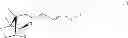
According to a particular embodiment of the invention, compound (I) is in the form of a mixture of stereoisomers comprising more than 50% (w/w) of the (1SR,2RS,4RS) stereoisomer, i.e. a compound having the relative exo configuration (the bridging carbon atom and the enol chain being in a relative cis configuration) as shown in formula (I-A)
wherein R has the meaning indicated above in formula (I), and the bold and hatched lines indicate a relative configuration.
According to a particular embodiment of the invention, compound (I) is in the form of a mixture of stereoisomers comprising more than 50% (w/w) of the (1S,2R,4R) stereoisomer, i.e. a compound having the absolute configuration as shown in formula (I-B)
wherein R has the meaning indicated above in formula (I), and the bold and hatched lines indicate a absolute configuration.
It is understood that, in any of the above or below embodiments, the starting material to prepare (e.g. (II) and (I″)) or the product obtained from (e.g. see below (IV) and β-santalol) said compound (I) may have, and preferably do have, the same stereo configuration. By way of examples one may cite the following reaction scheme:
the stereo configuration being relative or absolute. So the present invention allows a three step process for β-santalol from e.g. santene.
A further object of the present invention is a process for the preparation of β-santalol, or its derivatives such as β-santalal, β-santalyl benzoate, β-santalyl butyrate, β-santalyl iso-butyrate, β-santalyl propionate, comprising a step as defined above. It is understood that a person skilled in the art know how to perform said process using compound (I) obtained according to the invention's process.
The transformation of compound (I) into β-santalol can be performed in many different ways, which are well known by a person skilled in the art. Practical examples to are provided in Examples herein below.
However, as non-limiting example, one of the most direct manners to transform the compound (I) into β-santalol comprises the following reactions:
a) reducing the dienol derivative (I) into a compound (IV)
-
- in the form of any one of its stereoisomers or mixture thereof, and wherein R has the same meaning as in formula (I);
b) converting said compound (IV) into the β-santalol.
- in the form of any one of its stereoisomers or mixture thereof, and wherein R has the same meaning as in formula (I);
Steps a) and b) can be performed according to standard methods well known by a person skilled in the art.
For instance, one may cite the following method for each step:
step a): according to Shibasaki et al., in J. Org. Chem., 1988, 53, 1227 (where is reported the [1,4] hydrogenation of a dienol acetate derivative) or according to WO 08/120,175 or WO 09/141,781; and
step b): see WO 09/141,781.
An example of such procedure is provided in the Examples herein below.
EXAMPLES
The invention, in all its embodiments, will now be described in further detail by way of the following examples, wherein the abbreviations have the usual meaning in the art, the temperatures are indicated in degrees centigrade (° C.); the NMR spectral data were recorded in CDCl3 with a 400 MHz or 125 MHz machine for 1H or 13C respectively, the chemical shifts 8 are indicated in ppm with respect to TMS as standard, the coupling constants J are expressed in Hz.
Santene: 2,3-dimethylbicyclo[2.2.1]hept-2-ene (II, R═H) was prepared according to Chem. Ber., 1955, 88, 407. 2-methyl pentadienal could be prepared according to J. Chem. Soc. Perkin Trans. 1, 1986, 1203 or Synth. Commun., 1985, 15, 371 or according to the procedure described below.
Example 1
Preparation of Compounds of Formula (III)
Preparation of (E)-ethyl 2-methylpenta-2,4-dienoate
Sodium ethoxide solution (21% in ethanol, 33.3 ml, cat.) was added to a solution of ethyl 2-methylpenta-3,4-dienoate (Bedoukian, 125.0 g, 890 mmol) in anhydrous ethanol (350 ml) and stirred at ambient temperature for 12 hours. The solution was concentrated in vacuo and the residue partitioned between ether and saturated NH4Cl solution. The aqueous phase was re-extracted twice with ether, then the combined organic phase washed with NH4Cl and then brine, dried over Na2SO4, filtered and the solvents removed in vacuo to yield the crude ester, 125.8 g as an orange oil which was used directly in the next step without further purification.
13C NMR: 168.4 (C), 138.2 (CH), 132.3 (CH), 128.2 (C), 124.0 (CH2), 60.6 (CH2), 14.3 (CH3), 12.7 (CH3)
Preparation of (E)-2-methylpenta-2,4-dien-1-ol
LiAlH4 (14.8 g, 389 mmol) was suspended in anhydrous ether (500 ml) and a solution of the ester (50.0 g, 357 mmol) in anhydrous ether (250 ml) was added slowly dropwise at such a rate as to maintain a gentle reflux. Following the addition the suspension was stirred at ambient temperature for a further 30 minutes then cooled to 0° C. in an ice bath. Distilled water (15 ml) was added extremely cautiously dropwise followed by 15% NaOH solution (15 ml) extremely cautiously followed by distilled water (45 ml). The white suspension was vigorously stirred at ambient temperature for 30 minutes then Na2SO4 was added and the suspension stirred for a further 30 minutes then filtered, the precipitate washed well with ether. The solvents were removed in vacuo to yield the crude alcohol, which was further purified by bulb to bulb distillation (0.09 mbar at 145° C.) to give the pure alcohol, 32.0 g.
13C NMR: 137.8 (C), 132.6 (CH), 125.4 (CH), 117.0 (CH2), 68.2 (CH2), 14.1 (CH3)
Preparation of (E)-2-methylpenta-2,4-dienal
Manganese dioxide (45 g, 523 mmol) was added in one portion to a vigorously stirred solution of the alcohol (10.0 g, 102 mmol) in CH2Cl2 (200 ml) at ambient temperature. After 30 minutes a further portion of manganese dioxide (45 g, 523 mmol) was added in one portion followed by a further portion of 15 g. The suspension was stirred for a further 30 minutes at ambient temperature then filtered through a 6 cm plug of celite. The solid was washed with CH2Cl2. The combined washings were dried over Na2SO4 then filtered and used directly in the next step. A small portion was evaporated to dryness in vacuo (300 mbar) to yield the aldehyde.
13C NMR: (CD2Cl2) 195.2 (CH), 148.6 (CH), 138.4 (C), 132.0 (CH), 126.3 (CH2), 9.6 (CH3)
General Procedure for the Preparation of the (E)-2-methylpenta-2,4-diene-1,1-diyl-diesters
The anhydride (0.306 mol) was added to a stirred solution of the freshly prepared 2-methylpentadienal (9.8 g, 0.102 mol) in CH2Cl2 (100 ml) and the solution cooled to 0° C. FeCl3 anhydrous, (2% w/w, 0.15 g) was added in one portion. The solution was stirred at 0° C. for 5 hours then poured into a mixture of ether and saturated NaHCO3 and stirred overnight at ambient temperature. Re-extracted twice with ether, then washed combined organic phase with saturated NaHCO3 (2×), saturated NH4Cl, brine, then dried over Na2SO4, filtered and the solvents removed in vacuo to yield the crude diesters. Further purification by bulb to bulb distillation gave the pure diesters.
1. Preparation of (E)-2-methylpenta-2,4-diene-1,1-diyl diacetate
Bulb to bulb distillation at 0.6 mbar at 100° C. gave the desired diacetate, 6.5 g, 32%.
13C NMR: 168.6 (C), 131.5 (CH), 130.9 (C), 130.7 (CH), 120.7 (CH2), 92.4 (CH), 20.8 (CH3), 11.3 (CH3)
2. Preparation of (E)-2-methylpenta-2,4-diene-1,1-diyl propionate
Bulb to bulb distillation at 0.1 mbar at 120° C. gave the desired dipropionate, 1.8 g, 16%.
13C NMR: 172.2 (C), 131.5 (CH), 131.1 (C), 130.5 (CH), 120.5 (CH2), 92.3 (CH), 27.4 (CH2), 11.3 (CH3), 8.8 (CH3)
3. Preparation of (E)-2-methylpenta-2,4-diene-1,1-diyl bis(2-methylpropanoate)
Bulb to bulb distillation at 0.1 mbar at 125° C. gave the desired diisobutyrate, 6.1 g, 48%.
13C NMR: 174.7 (C), 131.6 (CH), 131.2 (C), 130.3 (CH), 120.4 (CH2), 92.1 (CH), 34.0 (CH), 18.7, 18.6 (CH3), 11.3 (CH3)
Example 2
Preparation of (1E,3E)-2-methyl-5-((1SR,2RS,4RS)-2-methyl-3-methylenebicyclo[2.2.1]heptan-2-yl)penta-1,3-dien-1-yl acetate
Use of ZnBr2
ZnBr2 (155 mg, 0.7 mmol) was added to stirred dienyl diacetate (2.5 g, 12.5 mmol) at ambient temperature. The suspension was stirred for 15 minutess at ambient temperature then a solution of santene (1.23 g, 10 mmol) in CH2Cl2 (3 ml) was added slowly dropwise. The brown suspension was stirred at ambient temperature for a further 3 hours then diluted with ethyl acetate, and NaHCO3, re extracted with ethyl acetate, washed combined organic phase with NaHCO3, dried over MgSO4, filtered and the solvent removed in vacuo to yield the crude dienyl acetate, 3.11 g as a yellow oil.
Further purification by bulb to bulb distillation 0.12 mbar at 150-165° C., gave the desired dienyl acetate, 2.08 g. (12:1, exo:endo, yield=80%)
13C NMR: 167.9 (C), 165.4 (C), 134.4 (CH), 130.7 (CH), 126.8 (CH), 120.7 (C), 100.0 (CH2), 46.9 (CH), 45.3 (C), 45.0 (CH), 44.5 (CH2), 37.0 (CH2), 29.7 (CH2), 23.7 (CH2), 23.0 (CH3), 20.8 (CH3), 10.4 (CH3)
Use of ZnCl2
ZnCl2 (20 mg, 5 mol %) was added to the dienyl diacetate (402 mg, 2 mmol) in CH2Cl2 (2 ml) and stirred for 5 minutes at ambient temperature and then santene (240 mg, 2 mmol) was added dropwise. The mixture was stirred at ambient temperature for a further 3 hours. Diluted with ethyl acetate then added NaHCO3 stirred overnight at ambient temperature. Re-extracted with ethyl acetate, washed combined organic phase with NaHCO3, filtered and the solvents removed in vacuo to yield the crude dienyl acetate, 0.48 g. Further purification by bulb to bulb at 1 mbar 165° C. gave the dienyl acetate, 0.27 g, yield=50%. (20:1, exo:endo). Spectroscopically identical to that prepared above.
Use of ZnI2 and In Situ Generation of the Compound (III)
to ZnI2 (0.1 mmol, 3 mol %, 0.033 g) was added to a solution of dienal (0.35 g, 3.5 mmol) and santene (0.52 g, 4 mmol) in CH2Cl2 (3 ml) at ambient temperature. Acetic anhydride (0.5 g, 5 mmol) was added slowly dropwise over 10 minutes. Added ZnCl2 (0.025 g, 1 mol %) and the solution stirred at ambient temperature for 48 hours. Then diluted with ethyl acetate then NaHCO3, re-extracted with ethyl acetate, washed combined organic phase with NaHCO3, dried over MgSO4, filtered and the solvents removed in vacuo to yield the crude dienyl acetate, 1.0 g as a dark yellow oil.
Further purification bulb to bulb distillation 0.45 mbar at 175° C. gave the dienyl acetate, 0.46 g, yield=48% (30:1, exo:endo). Spectroscopically identical to that prepared previously.
Use of Al(OTf)3
Al(OTf)3 (1.7 mol %, 1.7 mmol, 811 mg) was added to toluene (25 mL) followed by santene (12.2 g, 100 mmol) at ambient temperature. Then a solution of the diene diacetate (21.8 g, 110 mmol) in toluene (25 mL) was added slowly dropwise over 45 minutes. After a further 30 minutes at ambient temperature diluted with ethyl acetate and NaHCO3 solution (gas evolution), rextracted the aqueous phase with EtOAc, washed combined organic phase with NaHCO3 then water, dried over MgSO4, filtered and the solvents removed in vacuo to yield the crude dienyl acetate, Further purification by bulb to bulb distillation 195° C. at 8.0×10⁻² mbar gave the dienyl acetate as a pale yellow oil, 17.8 g 68% exo:endo >50:1. Spectroscopically identical to that prepared previously.
Example 3
Preparation of (1E,3E)-2-methyl-5-((1SR,2RS,4RS)-2-methyl-3-methylenebicyclo[2.2.1]heptan-2-yl)penta-1,3-dien-1-yl acetate
General Procedure Lewis Acid:
The lewis acid (5-10 mol %) was added to a stirred mixture of santene (122 mg, 1 mmol) and the dienyl diacetate (180 mg, 1.1 mmol) in dichloromethane (1 ml) cooled to 0° C. After 30 minutes at 0° C. the solution was allowed to warm to ambient temperature and stirred for a further 2-4 hours at ambient temperature. Conversion analyzed by GC.
| TABLE 1 |
| Reaction catalysed by various Lewis acids |
| % | ||||
| % | % | GC2) | ||
| Lewis acid | GC1) | GC1) | Compound | Ratio |
| (10 mol % if not specified) | exo | endo | (I″) | exo:endo |
| 0.9 eq EtAlCl2 | 47 | 4 | 14 | 92:8 |
| 0.9 eq Et2AlCl | 39 | 2 | 24 | 95:5 |
| 0.9 eq MeAlCl2 | 38 | 3 | 5.5 | 93:7 |
| 0.9 eq Me2AlCl | 53 | 3 | 12 | 95:5 |
| BF3•Et2O | 68 | 9 | 88:12 | |
| BF3•HOAc | 74 | 10 | 88:12 | |
| Zn(OTs)2 + 2 eq. TMS-Cl | 42 | 4 | 31 | 90:10 |
| Zn(acac)2 + 2 eq. AcCl | 13 | 6 | 31 | 68:32 |
| Zn(acac)2 + 2 eq. TMS-Cl | 56 | 11 | 12 | 84:16 |
| Zn(TFA)2 + 2 eq. AcCl | 13 | 5 | 41 | 72.28 |
| Zn(TFA)2 + 2 eq. TMS-Cl | 59 | 10 | 13 | 85:15 |
| Zn(oxalate) + 2 eq. AcCl | 11 | 4 | 49 | 76:24 |
| Zn(oxalate) + 2 eq. TMS-Cl | 18 | 2 | 45 | 89:11 |
| Zn(3,5-ditertBu salicylate)2 + | 12 | 2 | 64 | 86:14 |
| 2 eq. AcCl | ||||
| Zn(3,5-ditertBu salicylate)2 + | 53 | 8 | 21 | 87:13 |
| 2 eq. TMS-Cl | ||||
| FeCl3 | 77 | 2 | 97:3 | |
| Al(BF4)3* | 40 | 13 | 75/25 | |
| Al(OTf)3 | 72 | 1 | 98.5:1.5 | |
| Al(OPri)3 + 2 eq. AcCl | 11 | 1 | 92:8 | |
| Ce(OTf)3* | 53 | 1 | 98:2 | |
| Sc(OTf)3* | 22 | 10 | 75:25 | |
| La(OTf)3* | 26 | 0.8 | 98:2 | |
| PrOZrCl3 | 18 | 0.4 | 98:2 | |
| SnCl4 | 71 | 2 | 97:3 | |
| Cu(OTf)2 | 30 | 15 | 77:33 | |
| Mg(OTf)2 | 58 | 3 | 94:6 | |
| Cu(BF4)2* | 57 | 8 | 88:12 | |
| Zn(BF4)2 | 54 | 10 | 5:1 | |
| *= 5 mol %; acac = acetylacetonate; TFA = trifluoroacetic acid; OTs = paratoluenesulfonate; OTf = trifluoromethylsulfonate | ||||
| 1)= yield observed by GC of the mentioned isomer of compound (I) | ||||
| 2)= yield observed by GC of the mentioned compound |
General Procedure Protic Acid:
Santene (61 mg, 0.5 mmol) and the dienyl diacetate (91 mg, 0.5 mmol) were dissolved in CH2Cl2 (1 ml) at ambient temperature. The acid catalyst was then added and the mixture to stirred for the specified time at ambient temperature. The conversions are given by GC FID (%). (Based on comparison with an authentic sample.)
| TABLE 2 |
| Reaction catalysed by various protic acids |
| Amount | Ratio | |||
| Protic acid | acid* | Time | Product** | Exo:endo |
| Phospomolybdic acid | 10 mol % | 15 | mins | 63% | 50:1 |
| 2,4 dinotrobenzene | 5 mol % | 15 | mins | 62% | 25:1< |
| sulfonic acid | |||||
| H2SO4 (98%) | 10 mol % | 5 | mins | 49% | 50:1< |
| H3PO4 + acetic | 10 mol % | 30 | mins | 43% | 20:1 |
| anhydride (0.5 eq) | |||||
| TriFluoroAcetic acid | 20 mol % | 12 | hrs | 20% | 25:1 |
| Amberlyst 15 | 10% w/w | 12 | hrs | 31% | 15:1 |
| Filtrol G13 | 10% w/w | 2 | hrs | 33% | 10:1 |
| p-TolueneSulphonic | 10 mol % | 1 | hr | 50% | 20:1< |
| acid | |||||
| HBF4•(Et2O)2 | 5 mol % | 5 | mins | 83% | 7:1 |
| Mins: minutes, hrs = hours | |||||
| *relative to the stating santene; | |||||
| **desired product |
Example 4
Preparation of (1E,3E)-2-methyl-5-((1SR,2RS,4RS)-2-methyl-3-methylenebicyclo[2.2.1]heptan-2-yl)penta-1,3-dien-1-yl carboxylate
General Procedure:
Al(OTf)3 (0.024 g, 1 mol %) was added in one portion to a stirred mixture of the santene (0.61 g, 5 mmol) and the 2-methylpenta-2,4-diene-1,1-diyl ester (5 mmol) at ambient temperature. After a further 60 minutes poured into saturated sodium bicarbonate and ether. Re extracted with ether, washed combined organic phase with ammonium chloride then brine, dried over sodium sulfate, filtered and the solvents removed in vacuo to yield the crude dienyl ester. Further purification by bulb to bulb distillation gave the pure dienyl ester as a mixture of exo and endo isomers.
1. (1E,3E)-2-methyl-5-((1SR,2RS,4RS)-2-methyl-3-methylenebicyclo[2.2.1]heptan-2-yl)penta-1,3-dien-1-yl propionate
5 mmol scale, bulb to bulb distillation 175° C. at 0.6 mbar gave the dienyl propionate, 0.99 g, yield=72%. (Exo:endo=50/1)
13C NMR: 171.3 (C), 165.5 (C), 134.4 (CH), 130.7 (CH), 126.8 (CH), 120.6 (C), 100.0 (CH2), 46.9 (CH), 45.3 (C), 45.0 (CH), 44.5 (CH2), 37.0 (CH2), 29.7 (CH2), 23.7 (CH2), 27.5 (CH3), 23.0 (CH3), 10.4 (CH3), 9.0 (CH3)
2. (1E,3E)-2-methyl-5-((1SR,2RS,4RS)-2-methyl-3-methylenebicyclo[2.2.1]heptan-2-yl)penta-1,3-dien-1-yl isobutyrate
5 mmol scale, bulb to bulb distillation 175° C. at 0.6 mbar gave the dienyl isobutyrate, 1.0 g, yield=70%. (Exo:endo=50/1)
13C NMR: 173.9 (C), 165.4 (C), 134.5 (CH), 130.7 (CH), 126.8 (CH), 120.7 (C), 100.0 (CH2), 46.9 (CH), 45.3 (C), 45.0 (CH), 44.5 (CH2), 37.0 (CH2), 29.7 (CH2), 23.7 (CH2), 34.0 (CH), 18.8, 18.3 (CH3), 23.0 (CH3), 10.4 (CH3)
Example 5
Preparation of (1E,3E)-2-methyl-5-((1SR,2RS,4RS)-2-methyl-3-methylenebicyclo[2.2.1]heptan-2-yl)penta-1,3-dien-1-yl carboxylate
Preparation of the Silyl Derivative of Formula (II)
Ethyldimethyl(((1SR,4RS)-3-methylbicyclo[2.2.1]hept-2-en-2-yl)methyl)silane
Triethyl aluminium (1.0 M in hexanes, 4.2 mL, 4.2 mmol) was added slowly dropwise to a suspension of Ni(acac)2 (dried in vacuo 120° C. 3 hrs, 107 mg, 0.4 mmol, 5 mol %), santadiene (1.0 g, 8.3 mmol) in freshly degassed toluene (85 mL) cooled to 0° C. After 15 minutes, dimethyl ethyl silane (1.1 mL, 8.3 mmol) was added slowly dropwise and the solution was then allowed to slowly warm to ambient temperature and stirred for a further 2 hours. The reaction mixture was poured into saturated ammonium chloride solution and extracted with ether, then the combined organic phase was washed with brine and dried over Na2SO4, then filtered and the solvents removed in vacuo to yield the crude allyl silane 0.9 g, which was further purified by bulb to bulb distillation 30° C. at 0.08 mbar and gave the desired ally silane 0.65 g, 37%.
13C NMR: 137.4 (C), 132.4 (C), 47.8 (CH), 47.3 (CH), 46.3 (CH2), 26.2, 26.0 (CH2), 15.2 (CH2), 12.0 ((CH3), 7.4 (CH3), 7.3 (CH2), −3.4 (CH3) ppm.
Triethyl(((1SR,4RS)-3-methylbicyclo[2.2.1]hept-2-en-2-yl)methyl)silane
A solution of the diene (2.64 g, 22 mmol) in toluene (25 mL) containing Ni(acac)2 (predried in vacuo 0.08 mbar at 120° C. for 7 hrs, 252 mg, 1 mmol) was cooled to 1° C. in an ice bath. Et3Al (1.0 M in hexanes, 5.0 mL, 5 mmol) was added slowly dropwise. This solution was stirred at 0° C. for a further 15 minutes then Et3SiH (2.4 g, 24 mmol) was added slowly dropwise and then the solution was stirred at ambient temperature for 2 hours. Added saturated NaHCO3, and extracted the aqueous phase with ethyl acetate, washed the combined organic phase with NH4Cl, brine, dried over MgSO4, filtered and the solvents removed in vacuo. Further purification by bulb to bulb distillation 120-130° C. at 0.05 mbar gave desired allyl silane, 1.5 g (63%).
13C NMR: 137.5, 132.4 (C), 47.9, 47.5 (CH), 46.3 26.4, 26.2 (CH2), 12.2 (CH3), 11.7 (CH2), 7.5 (CH3) 3.9 (CH2) ppm.
Dimethoxy(methyl)(((1SR,4RS)-3-methylbicyclo[2.2.1]hept-2-en-2-yl)methyl)silane
Triethyl aluminium (1.0 M in hexanes, 2.5 mL, 2.5 mmol) was added slowly dropwise to a suspension of Ni(acac)2 (dried in vacuo 120° C. 3 hrs, 130 mg, 0.4 mmol, 5 mol %), santadiene (1.2 g, 10 mmol) in freshly degassed toluene (80 mL) cooled to 0° C. After 15 minutes, dimethoxy methyl silane (1.2 mL, 10 mmol) was added slowly dropwise and the solution was then allowed to slowly warm to ambient temperature and stirred for a further 2 hours. The reaction mixture was poured into saturated ammonium chloride solution and extracted with ether, then the combined organic phase was washed with brine and dried over Na2SO4, then filtered and the solvents removed in vacuo to yield the crude allyl silane 1.5 g, which was further purified by bulb to bulb distillation 75° C. at 0.08 mbar and gave the desired ally silane 1.2 g, 53%.
13C NMR: 134.7 (C), 134.3 (C), 50.3, 50.2 (CH3), 47.6 (CH), 47.4 (CH), 46.6 (CH2), 26.0, 25.9 (CH2), 13.5 (CH2), 12.0 (CH3), −5.5 (CH3) ppm.
Coupling:
Using a Lewis Acid:
ZnBr2 (30 mg, 0.14 mmol) was added to a solution of the allyl silane (300 mg, 1.4 mmol), the diacetate (300 mg, 1.4 mmol) in toluene (8 mL) at ambient temperature. After 12 hours at ambient temperature GC analysis indicated 40% of the desired product plus 9% epi (endo).
Using a Protic Acid:
2,4 dinitrobenzene sulfonic acid (25 mg, 5 mol %) was added in one portion to a mixture of the dimethylethyl silyl alkene (300 mg, 1.3 mmol) and the dienyl diacetate (250 mg, 1.3 mmol) in CH2Cl2 (8 mL) at ambient temperature. After 15 minutes at ambient temperature GC analysis showed 63% of the desired product had formed.
Using a Lewis Acid:
ZnBr2 (30 mg, 0.14 mmol 10 mol %) was added to a solution of the allyl silane (300 mg, 1.3 mmol), the diacetate (300 mg, 1.4 mmol) in CH2Cl2 (3 mL) at ambient temperature. After 30 minutes at ambient temperature GC analysis indicated 85% of the desired product.
Using a Protic Acid:
2,4 dinitrobenzene sulfonic acid (40 mg, 10 mol %) was added in one portion to a mixture of the dimethoxymethyl silyl alkene (300 mg, 1.3 mmol) and the dienyl diacetate (250 mg, 1.3 mmol) in CH2Cl2 (3 mL) at ambient temperature. After 15 minutes at ambient temperature GC analysis showed 45% of the desired product had formed.
Using a Lewis Acid:
ZnBr2 (2.5 mol %, 7 mg) was added in one portion to a mixture of the triethylsilyl alkene (300 mg, 1.3 mmol) and the dienyl diacetate (250 mg, 1.3 mmol) in CH2Cl2 (3 mL) and the mixture stirred at ambient temperature then analysed by GC. 33% of the allyl silane remained and the desired product had already formed (23%).
Using a Protic Acid:
2,4 dinitrobenzene sulfonic acid (4 mg, 1 mol %) was added in one portion to a mixture of the triethyl silyl alkene (300 mg, 1.3 mmol) and the dienyl diacetate (250 mg, 1.3 mmol) in CH2Cl2 (3 mL) at ambient temperature. After 6 hours at ambient temperature GC analysis showed 2% of the desired product had formed.
Preparation of the Boron Derivative of Formula (II)
4,4,5,5-tetramethyl-2-(0SR,4RS)-3-methylbicyclo[2.2.1]hept-2-en-2-yl)methyl)-1,3,2-dioxoborolane
Ni(COD)2 (114 mg, 5 mol %), tricyclohexylphosphine (233 mg, 10 mol %) were weighed into a Schlenk flask in a glovebox, then dissolved in freshly degassed toluene (85 mL) at ambient temperature. Santadiene (freshly distilled, 1.0 g, 8.3 mmol) was added followed by pinacol borane solution (8.3 mL, 8.3 mmol, 1.0 M in THF) dropwise. The solution was stirred for 3 hours at ambient temperature then poured into saturated NaHCO3 solution and extracted with ether. The organic phase was to washed with water and then brine, dried over Na2SO4, filtered and the solvents removed in vacuo to yield the crude bononate, 1.5 g. Further purification by bulb to bulb distillation, 100° C. at 0.1 mbar gave gave the desired allyl boronate, 620 mg, 31%.
13C NMR: 135.6, 134.9 (C), 83.0 (C), 47.5, 47.4 (CH), 46.6 (CH2), 26.2, 25.8 (CH2), 24.9, 24.8, 24.75 (CH3), 11.9 (CH3)
Coupling:
ZnBr2 (10 mol %, 0.05 mmol, 11 mg) was added in one portion to a stirred solution of the boronate (250 mg, 1 mmol) and the dienyl diacetate (200 mg, 1 mmol) in CH2Cl2 (3 mL) at ambient temperature. The suspension was stirred at ambient temperature for 6 hrs. GC analysis showed 24% boronate remained and 50% of the desired product formed.
Example 6
Preparation of (1E,3E)-2-methyl-5-((1SR,2RS,4RS)-2-methyl-3-methylenebicyclo[2.2.1]heptan-2-yl)penta-1,3-dien-1-yl acetate via compound of formula (I″)
(1E,3E)-5-((1SR,2SR,4SR,7RS)-2-chloro-1,7-dimethylbicyclo[2.2.1]hetan-7-yl)-2-methylpenta-1,3-dien-1-yl acetate (I″)
Diethyl aluminium chloride (1.0 M in hexanes, 7.2 ml, 7.2 mmol) was added dropwise over 15 minutes to a stirred solution of Santene (978 mg, 8 mmol) and the dienyl diacetate (1982 mg, 10 mmol) in CH2Cl2 (8 ml) cooled to 0° C. Stirred at 0° C. for further 90 minutes then poured into ice and saturated NaHCO3, re extracted with ether, washed combined organic phase with NaHCO3, dried over Na2SO4, filtered and the solvents removed in vacuo to yield the crude dienyl acetate, 1.7 g as a yellow oil.
Further purification by bulb to bulb distillation 0.12 mbar at 180° C., gave the desired to dienyl acetate, 0.82 g. Identical to that prepared above. The residue contained the desired chloro dienyl acetate, 0.15 g, (yield=6%).
13C NMR: 167.9 (C), 134.2 (CH), 130.1 (CH), 127.2 (CH), 120.7 (C), 68.2 (CH), 50.8 (C), 50.6 (C), 43.3 (CH), 42.1 (CH2), 36.7 (CH2), 36.4 (CH2), 26.8 (CH2), 20.8 (CH3), 16.9 (CH3), 13.5 (CH3), 10.4 (CH3)
(1E,3E)-2-methyl-5-((1SR,2RS,4RS)-2-methyl-3-methylenebicyclo[2.2.1]heptan-2-yl)penta-1,3-dien-1-yl acetate
Treatment of the chloro dienyl acetate obtained above (150 mg) and potassium acetate (250 mg) at 150° C. gave the desired dienyl acetate spectroscopically identical to that prepared previously (yield=quantitative).
Example 7
Preparation of β-Santalol
(Z)-2-methyl-5-((1SR,2RS,4RS)-2-methyl-3-methylenebicyclo[2.2.1]heptan-2-yl) pent-2-en-1-yl isobutyrate (compound of formula (IV))
The freshly distilled dienyl isobutyrate (1.0 g, 3.5 mmol) and maleic acid (25 mg, 2.2 mol %) were placed in a s/s autoclave and the catalyst RuCp*COD.BF4, (30 mg, 2 mol %) was then added. Acetone (2 ml, degassed with ultrasound and argon bubbling, stored under argon) was added last and the mixture sealed, evacuated then purged with hydrogen 5 times. The suspension was stirred under an atmosphere of hydrogen 5 bars at 60° C. for 12 hours. Then filtered through a plug of silica (5 cm) with ethyl acetate as eluent then the solvents removed in vacuo to yield the crude product. Further purification by column chromatography cartridge (80 g) with 1:99 ethyl acetate:cyclohexane as eluent gave the pure isobutyrate, 0.9 g which was further purified by bulb to bulb distillation 175° C. at 0.6 mbar to give the pure desired product, 0.71 g, yield=72% as a mixture of exo:endo, 50:1, (Z:E selectivity >98:2).
13C NMR: 177.2 (C), 166.2 (C), 131.1 (CH), 129.7 (C), 99.7 (CH2), 63.0 (CH2), 46.8 (CH); 44.8 (C), 44.6 (CH), 41.2 (CH2), 37.1 (CH2), 34.1 (CH), 29.7 (CH2), 23.7 (CH2), 23.4 (CH2), 22.6 (CH3), 21.4 (CH3), 19.0 (CH3)
(Z)-2-methyl-5-((1SR,2RS,4RS)-2-methyl-3-methylenebicyclo[2.2.1]heptan-2-yl)pent-2-en-1-ol (β-Santalol)
The allylic acetate (1.25 g, 4.5 mmol) was dissolved in methanol (15 ml) and sodium methoxide (23% solution in methanol, 100 μl) was added and the solution was stirred for 1 hour. The majority of the methanol was removed in vacuo then the residue was partioned between cyclohexane and water. Re-extracted with cyclohexane and then the combined organic phases washed with water, then NaHCO3, dried over K2CO3 and MgSO4, then filtered. The solvents were removed in vacuo to yield the crude β-santalol, 1.1 g. Further purification by bulb to bulb distillation 170° C. at 0.1 mbar gave a mixture of β-santalol and epi-β-santalol 96:4 (exo:endo), 0.9 g, yield=90% (Z:E selectivity >99:1).
13C NMR: 166.2 (C), 133.9 (C), 129.0 (CH), 99.7 (CH2), 61.6 (CH2), 46.8 (CH), 44.7 (C), 44.6 (CH), 41.5 (CH2), 37.1 (CH2), 29.7 (CH2), 23.7 (CH2), 23.2 (CH2), 22.6 (CH3), 21.3 (CH3)
Claims
1. A process for the preparation of a compound of formula
in the form of any one of its stereoisomers or mixtures thereof, and wherein R represents a C2-C10 group of formula CORa wherein Ra is an alkyl or alkenyl group optionally comprising one or two ether functional groups or is a phenyl or benzyl group optionally substituted by one to three alkyl, alkoxyl, carboxyl, acyl, amino or nitro groups or halogen atoms;
by reacting together a compound of formula
in the form of any one of its stereoisomers or mixtures thereof, and wherein R1 represents a hydrogen atom or a Si(R2)3 or B(OR2′)2 group, R2 representing a C1-4 alkyl or alkoxyl group and R2′ representing, taken separately, a C1-4 alkyl group or a or a phenyl group optionally substituted by one to three C1-3 alkyl or alkoxy groups, or said R2′, taken together, representing a C2-6 alkanediyl group or a diphenyl or dinaphthyl group optionally substituted by one to three C1-3 alkyl or alkoxy groups;
with a compound of formula
in the form of any one of its stereoisomers or mixtures thereof, and wherein R has the meaning defined in formula (I) and L represents a halogen atom or an OR group;
in the presence of:
1) at least one acid selected amongst
I. a Lewis acid selected from the group consisting of:
i) a metal salt of a an element of the group 2, 3, 4, 13 or of a 3d element or of tin;
ii) an alkyl aluminium chloride of formula Al(R4)aCl3-a, representing 1 or 2 and R4 representing C1-10 alkyl or alkoxide group; and
iii) a boron derivative of formula BZ3, wherein Z represents a fluoride or a phenyl group optionally substituted, and any one of its adduct with a C2-C10 ether or a C1-C8 carboxylic acid;
and/or
II. a protic acid having a pka comprised between 2.5 and −20; and
2) optionally an additive selected amongst the group consisting of alkaline-earth hydroxide or oxide and of the compounds of formula RbCOCl, ClSi(Rb)3, RbCOORc or (RbCOO)2Rd, Rb representing a C1-12 alkyl group or a phenyl group optionally substituted by one or two C1-4 alkyl or alkoxyl group, and Rc representing a alkaline metal cation or a RbCO acyl group, and Rd representing a alkaline-earth metal cation.
2. A process according to claim 1, wherein R1 is a hydrogen atom.
3. A process according to claim 1, wherein R is a C2-7 acyl group.
4. A process according to claim 1, wherein the metal salt is selected amongst a salt of formula
(Mn+)(X)n-m(Y−)m
wherein m is an integer from 0 to (n−1), and
n is 2 and M is Zn, Cu or an alkaline earth metal;
n is 3 and M is a lanthanide, Sc, Fe, Al; or
n is 4 and M is Sn, Ti or Zr;
each X− represents Cl−, Br−, I−, a non-coordinating monoanion, R3SO3− wherein R3 represents a chlorine or fluorine atom, or a C1-3 hydrocarbon or perfluoro hydrocarbon, or a phenyl optionally substituted by one or two C1-4 alkyl groups;
each Y− represents a C1-6 carboxylate or 1,3-diketonate when n is 2 or 3, or a C1-6 alkoxylate when n is 3 or 4.
5. A process according to claim 1, wherein the metal salt is selected amongst a salt of formula
(Zn2+)(X−)2-m(Y−)m, wherein m, X− and Y− have the meaning indicated in claim 6;
(M3+)(X−)3-m(Y−)m, wherein m, X− and Y− have the meaning indicated in claim 6 and M is Al or Fe;
(Sn4+)(Cl−)4-m(R5O−)m wherein m has the meaning indicated in claim 6, R5 representing C1-3 alkyl group.
6. A process according to claim 1, wherein X− represents Cl−, Br−, I−, CF3SO3− or BF4−.
7. A process according to claim 1, wherein Y− represents a C1-6 carboxylate when n is 2 or 3, or a C1-3 alkoxylate when n is 3 or 4.
8. A process according to claim 1, wherein said alkyl aluminium chloride is selected amongst the compounds of formula Al(R4)aCl3-a, a representing 1 or 2 and R4 representing a C1-3 alkyl group.
9. A process according to claim 1, wherein said boron derivative is BF3, and any one of its adduct with a C4-C6 ether or a C1-C3 carboxylic acid.
10. A process according to claim 1, wherein said protic acid is C0-12 sulphonic acid or an anhydrous mineral acid.
11. A process according to claim 1, wherein said acid is a Lewis acid.
12. A process according to claim 1, wherein said additives are ClSiMe3, MeCOCl, AcOK or AcOAc.
13. A compound of formula
in the form of any one of its stereoisomers or mixtures thereof, and wherein
R represents a C2-C10 group of formula CORa wherein Ra is an alkyl or alkenyl group optionally comprising one or two ether functional groups or is a phenyl or benzyl group optionally substituted by one to three alkyl, alkoxyl, carboxyl, acyl, amino or nitro groups or halogen atoms; and
L represents a halogen atom or an OR group.
14. A compound according to claim 13, wherein L represents an OR group.
15. A compound of formula
in the form of any one of its stereoisomers or mixture thereof, and wherein R has the same meaning defined in claim 1.
Images & Drawings included:




Sources:
- United States Patent and Trademark Office - verify current appl. status at the USPTO↗
Similar patent applications:
- » 20110118497
Process for the preparation of beta-santalol and derivatives thereof - » 20140213818
Process for the preparation of beta-santalol - » 20150368179
Process for the preparation of beta-santalol
Recent applications in this class:
- » 20250136539 2025-05-01
ESTERS OF 5-METHYLHEX-2-ENOL AND THEIR USE AS AROMA CHEMICALS - » 20230159429 2023-05-25
Vitamin K2 synthesis - » 20220315519 2022-10-06
ISOMERIZATION OF POLYUNSATURATED NON-AROMATIC COMPOUNDS - » 20220267247 2022-08-25
Process for the synthesis of non-racemic cyclohexenes - » 20220169590 2022-06-02
Intermediates for the vitamin A synthesis - » 20200283368 2020-09-10
NEW INTERMEDIATES FOR THE VITAMIN A SYNTHESIS - » 20180319733 2018-11-08
System and methods for making bioproducts - » 20180022683 2018-01-25
Method for preparing substituted alkyl cycloalkanones - » 20170137365 2017-05-18
Production of fatty olefin derivatives via olefin metathesis - » 20160159727 2016-06-09
Use of immobilized molybdenum- and tungsten-containing catalysts in olefin cross metathesis
Recent applications for this Assignee:
- » 20230310288 2023-10-05
ANTIMICROBIAL COMPOSITION - » 20210395786 2021-12-23
Sesquiterpene synthases for production of drimenol and mixtures thereof - » 20210315790 2021-10-14
Antiperspirant or deodorant composition - » 20210315790 2021-10-14
Antiperspirant or deodorant composition - » 20210230089 2021-07-29
Cyclopropyl ring opening by alpha alkylation of an aldehyde with a polycyclic olefin - » 20210147328 2021-05-20
Alpha alkylation of aldehyde with a polycyclic olefin - » 20210145719 2021-05-20
Rinse-off conditioner compositions comprising microcapsules - » 20210108153 2021-04-15
Vetiver odorant - » 20210106178 2021-04-15
Modular food dispensing device - » 20210015722 2021-01-21
PROCESS FOR THE PREPARATION OF MICROCAPSULES