Method and apparatus for producing a fiber-reinforced plastics casting
US20140306372A1
2014-10-16
14/248,508
2014-04-09
✅ Patent granted
US 9,469,052 B2
2016-10-18
-
-
Matthew Daniels
Lerner, David, Littenberg, Krumholz & Mentlik, LLP
2034-12-13
Abstract:
An apparatus and method for producing a fiber-reinforced plastics casting (FRP), includes a moulding box filled with free flowing moulding material, in what a prototype of casting or a textile preform is inserted, forming a mould cavity for infiltration the inserted preform of textile with synthetic resin material in order to form a fiber-reinforced plastics casting (FRP).
Inventors:
- Alexander Gillessen 11 🇩🇪 Stade, Germany
- Johannes Born 3 🇩🇪 Bremen, Germany
- Sascha Backhaus 5 🇩🇪 Hamburg, Germany
- Joachim Piepenbrock 10 🇩🇪 Buxtehude, Germany
Assignee:
- AIRBUS OPERATIONS GMBH 2,524 🇩🇪 Hamburg, Germany
- Airbus Operations GmbH 447 🇩🇪 , Germany
Applicant:
Interested in similar patents?
Get notified when new applications in this technology area are published.
Classification:
B29C33/38 » CPC main
Moulds or cores; Details thereof or accessories therefor characterised by the material or the manufacturing process
B29C70/542 » CPC further
Shaping composites, i.e. plastics material comprising reinforcements, fillers or preformed parts, e.g. inserts comprising reinforcements only, e.g. self-reinforcing plastics; Shaping operations therefor; Component parts, details or accessories; Auxiliary operations, e.g. feeding or storage of prepregs or SMC after impregnation or during ageing Placing or positioning the reinforcement in a covering or packaging element before or during moulding, e.g. drawing in a sleeve
B29C33/3807 » CPC further
Moulds or cores; Details thereof or accessories therefor characterised by the material or the manufacturing process Resin-bonded materials, e.g. inorganic particles
B29C70/54 IPC
Shaping composites, i.e. plastics material comprising reinforcements, fillers or preformed parts, e.g. inserts comprising reinforcements only, e.g. self-reinforcing plastics; Shaping operations therefor Component parts, details or accessories; Auxiliary operations, e.g. feeding or storage of prepregs or SMC after impregnation or during ageing
B29C70/36 » CPC further
Shaping composites, i.e. plastics material comprising reinforcements, fillers or preformed parts, e.g. inserts comprising reinforcements only, e.g. self-reinforcing plastics; Shaping operations therefor; Shaping by lay-up, i.e. applying fibres, tape or broadsheet on a mould, former or core; Shaping by spray-up, i.e. spraying of fibres on a mould, former or core and impregnating by casting, e.g. vacuum casting
Description
FIELD OF THE INVENTION
The invention relates to a method for producing a fiber-reinforced plastics casting. The invention further relates to an apparatus for producing such a fiber-reinforced plastics casting by means of a mould.
The invention concerns to the technical field of highly industrialized manufacturing of fiber-reinforced plastics casting (FRP), preferably used to manufacture aircraft parts with high geometrical variance. It also offers the possibility to make FRP production feasible for high automation and high series production in any FRP application field.
BACKGROUND OF THE INVENTION
For producing fiber-reinforced plastics casting usually solid, massive and non-flexible moulds are used. The moulds mostly consist of metal material.
The WO 2009-124724 A1 discloses a method for production of a fiber-reinforced plastics part from rovings by means of a mould. Said method comprises the following steps:
(a) rovings formed from dry fibers are applied to a mould surface by stretching the rovings,
(b) resin material is applied to the stretched rovings;
(c) the arrangement of fiber strands and resin material is consolidated by applying temperature and pressure such that a preform for the part to be produced is formed,
(d) the preform is detached from the deflection devices and is removed from the mould,
(e) once the preform has been detached from the deflection device, an injection process is carried out in order to form the fiber-reinforced plastics casting.
Due to the many production steps and the special rovings techniques this technical solution is limited to special formed castings.
The US 2003/0168775 A1 discloses another solution in which a fiber textile semi-finished material (preform) is fed directly and reformed onto a carrier and reforming tool, where it is fixed with a resin material as a binder. A carrier has a counter matching the negative or positive shape of the final required geometry of the preform that is to be fabricated. The reformed semi-finished article fixed with the binder is removed from the carrier to provide the preform. Several preforms of different cross-sectional shapes are jointed together, compacted to form a dense component having nearly the required finished contour, impregnated with a matrix system including a curable adhesive synthetic resin and then cured under an elevated temperature and/or pressure.
The result is a finished fiber-reinforced plastics casting such as an aircraft window frame or the like. This method is carried out on an apparatus including the rotating carrier and reforming tool which may have a cylindrical and/or manual surface to receiving and reforming the material. However, the apparatus for producing the fiber-reinforced plastics casting causes a high effort.
BRIEF SUMMARY OF THE INVENTION
An aspect of the present invention provides a method and apparatus for producing a fiber-reinforced plastics casting with high geometric variance and complex shapes with a low technical effort.
The invention encompasses the technical teaching according to which the manufacturing process of a fiber-reinforced plastics casting comprises the following steps:
-
- filling and pressing a free flowing fine-grained moulding material for casting into an open moulding box;
- inserting a prototype of casting in the precompressed moulding material in order to form a mould cavity;
- removing of the prototype of casting from the mould cavity and inserting a textile preform in the mould cavity;
- infiltrating the textile preform with synthetic resin material in order to form a fiber-reinforced plastics casting (FRP);
- demoulding the plastics casting after curing of the resin material.
According to another feature of the invention more moulding material will be filled in the moulding box after the textile preform is inserted into the mould cavity in order to cover the moulding cavity. Thus, the FRP is completely surrounded from moulding material in order to avoid additional re-working effort.
Preferably, an infiltration conduit of a resin infiltrated device will be connected to the mould cavity after inserting the textile preform in the mould cavity for infiltrating the textile preform with a synthetic resin material in order to facilitate the infiltrating process.
The invention also encompasses the technical teaching according to which the following alternative manufacturing steps are carried out using the same moulding principle:
-
- filling a free flowing coarse-grained moulding material for casting into an open moulding box;
- inserting a textile preform in the moulding material in order to form a moulding cavity;
- infiltrating the moulding material with high viscosity synthetic resin material in order to form a durable mould and curing the resin material;
- infiltrating the textile preform with low viscosity synthetic resin material in order to form a fiber-reinforced plastics casting (FRP);
- demoulding the cured moulding material after curing of the low viscosity resin material in order to separate the plastics casting.
Each pellet has defined a release property so that it can be released from the mould polymer after the process is finished. The pellet size is defined such as it can form the outer contour of the manufactured part properly.
Preferably, after inserting the textile preform in the moulding material an infiltration conduit of a high viscosity resin infiltrator device will be connected for infiltrating the moulding material with high viscosity synthetic resin material. For infiltrating the textile preform with low viscosity synthetic resin material another infiltration conduit of a low viscosity resin infiltrator device will be connected to the mould cavity after curing the resin material of the moulding material.
Preferably, the prototype of casting for forming the moulding cavity consists of a plastics material manufactured by a rapid prototyping process. Alternatively, it is possible to use a simple stamp or the like in order to form the moulding cavity into the pre-compressed moulding material.
In view of the two alternative methods as described above the general idea of the disclosure is to manufacture the mould for infiltration a pre-produced preform with synthetic resin material in-process in analogy to the classical metal dead moulded casting process. A basis for the mould is a free flowing moulding material of fine grained particles, especially sand, which can be used for the first method as described above. For the second method the free flowing moulding material preferably consists of coarse-grained elements, such as pellets. The pellets material has release properties. The mould for the second method as described above is created by infiltrating the pellets with a specific high viscosity resin material in order to prevent a flow of the said resin material into the area of the textile preform. This can be reached in that the moulding material comprises a higher flow resistance than the flow resistance of the textile preform inserted in the mould cavity.
The first method describes a two-step-process. The second method describes a kind of twin-filtration-process. For the said twin-filtration-process two different synthetic resin materials are necessary having a low and a high viscosity respectively.
The handling-stiffly textile preform preferably consists of glass or carbon fiber material. It is possible to use short, long or endless fibers for the textile preform. Preferably, the carbon fiber preform is embedded in a cover foil. The cover foil is made of thermoplastic material, thus it is mouldable. The foil could be deep drawn over a rapid prototype or a master and it could have dimensionally influencing properties. The foil can also have multiple functions integrated for the proposed process, e.g. release properties, integrated coating and integrated surface master. Also resin gatings can be integrated in the foil.
The moulding box is preferably covered by a lid in form of a plaid or a plastics folio in order to allow an infiltration process under pressure.
An automated process could be implemented by arranging a continuous process with automated sand/pellet filling infiltration, sand/pellet recycling and moulding box refeeding.
BRIEF DESCRIPTION OF THE DRAWINGS
Further features that improve the invention are stated in the dependent claims or are shown in more detail below together with the description of both preferred similar methods for producing a FRP with reference to the figures. The following are shown:
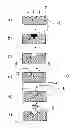
FIG. 1 a sequence of schematic manufacturing steps corresponding to the first method, and
FIG. 2 a sequence of schematic manufacturing steps corresponding to the second method.
DETAILED DESCRIPTION
According to FIG. 1 an open moulding box 1 will be filled with a free flowing fine-graded moulding material in form of a mould sand (step a). After filling the moulding box 1 and pressing it a prototype 3 of casting will be inserted in the pre-compressed moulding material 2 in order to form a corresponding moulding cavity 4 (step b). After the prototype of casting 3 is removed from the mould cavity 4 (step c) a textile preform 5 is covered by a foil (11) made of thermoplastic material and inserted in the mould cavity 4 (step d). Next, the textile preform 5 will be infiltrated with synthetic resin material 6 which flows via an infiltration conduit 7 of a resin infiltrator device into the mould cavity 4 for infiltration the inserted textile preform 5 (step e). After curing of the resin material 6 the fiber re-enforced plastics casting 9 can be demould from the mould cavity 4 (step f).
According to the twin-jection-process as shown in FIG. 2 at first a free flowing coarse-grained moulding material 2′ in form of pellets is filled into the open moulding box 1 (step a′). In order to form a moulding cavity 4 a textile preform 5 is directly inserted into the moulding material 2′ (step b′). After inserting the textile preform 5 in the moulding material 2′ an infiltration conduit 7′ of a high viscosity resin infiltrator device 8′ will be connected to the moulding material 2′ in order to infiltrate the moulding material 2′ with high viscosity synthetic resin material which is provided with a viscosity that is such high that the synthetic resin material 8′ cannot infiltrate the textile preform 5 (step c′). During the infiltration process the moulding box 1 is covered by a lid 10 in form of a plaid.
After curing the high viscosity synthetic resin material 6′ together with the enclosed moulding material 2′ an infiltration conduit 7″ of a low viscosity resin infiltrator device 8″ will be connected to the mould cavity 4 for infiltrating the textile preform 5 with low viscosity synthetic resin material 6″ (step d′).
After curing of the low viscosity resin material 6″ the FRP will be demould from the mould cavity 4 by removing the cured moulding material 2′ from the plastics casting 9.
In addition, let it be noted that “encompass” does not preclude any other elements or steps, and “an” or “a” do not rule out a plurality. Let it further be noted that the features or steps described with reference to one of the above exemplary embodiments can also be used in combination with other features or steps of other exemplary embodiments described above. References in the claims are not to be construed as a limitation.
REFERENCE SIGNS
- 1 moulding box
- 2 moulding material
- 3 prototype of casting
- 4 mould cavity
- 5 textile preform
- 6 synthetic resin material
- 7 infiltration conduit
- 8 resin infiltrator device
- 9 plastics casting
- 10 lid
- 11 cover foil
Claims
1. A method for producing a fiber-reinforced plastics casting, comprising:
filling and pressing a free flowing fine-grained moulding material for casting into an open moulding box;
inserting a prototype of casting in the precompressed moulding material to form a mould cavity;
removing of the prototype of casting from the mould cavity and inserting a textile preform in the mould cavity;
infiltrating the textile preform with synthetic resin material to form a fiber-reinforced plastics casting (FRP); and
demoulding the plastics casting after curing of the resin material.
2. The method according to claim 1, wherein after the textile preform is inserted into the mould cavity, the method further comprises filling the moulding box with more moulding material to completely cover the moulding cavity.
3. The method according to claim 1, wherein after inserting a textile preform in the mould cavity, the method further comprises connecting an infiltration conduit of a resin infiltrator device to the mould cavity for infiltrating the textile preform with synthetic resin material.
4. A method for producing a fiber-reinforced plastics casting, comprising:
filling a free flowing coarse-grained moulding material for casting into an open moulding box;
inserting a textile preform in the moulding material to form a moulding cavity;
infiltrating the moulding material with high viscosity synthetic resin material to form a durable mould and curing the resin material;
infiltrating the textile preform with low viscosity synthetic resin material to form a fiber-reinforced plastics casting (FRP);
demoulding the cured moulding material after curing of the low viscosity resin material to separate the plastics casting.
5. The method according to claim 4, wherein after inserting a textile preform in the moulding material, the method further comprises connecting an infiltration conduit of a high viscosity resin infiltrator device for infiltrating the moulding material with high viscosity synthetic resin material.
6. The method according to claim 4, wherein after curing the resin material enclosing the moulding material, the method further comprises connecting an infiltration conduit of a low viscosity resin infiltrator device to the mould cavity for infiltrating the textile preform with low viscosity synthetic resin material.
7. The method according to claim 4, wherein the prototype of casting consists of a plastics material manufactured by a rapid prototyping process.
8. An apparatus for producing a fiber-reinforced plastics casting (FRP), the apparatus comprising:
a moulding box filled with free flowing moulding material, a prototype of casting or a textile preform configured to be inserted in the moulding box filled with a free flowing moulding material, for forming a mould cavity for infiltration of the inserted textile preform; and
synthetic resin material for forming a fiber-reinforced plastics casting (FRP).
9. The apparatus according to claim 8, wherein the textile preform is embedded in a cover foil made of thermoplastic material.
10. The apparatus according to claim 8, wherein the free flowing moulding material comprises fine-grained sand or coarse-grained pellets.
11. The apparatus according to claim 8, wherein the molding box is covered by a lid in form of a plate or a plastics folio.
12. The apparatus according to claim 8, wherein the textile preform comprises glass or carbon fibre material.
Images & Drawings included:

Sources:
- United States Patent and Trademark Office - verify current appl. status at the USPTO↗
Recent applications in this class:
- » 20250205936 2025-06-26
VARIABLE STIFFNESS TOOL - » 20200223104 2020-07-16
Composite material molding jig and composite material, molding method - » 20200139589 2020-05-07
Mould for the Spatial Shaping of Plastic Parts made of HDPE or PA or Similar Plastics, in particular HDPE or PA Tubes - » 20200039116 2020-02-06
Method of manufacturing molded article - » 20200009763 2020-01-09
Thermal extrusion method to fabricate large-dimension superhydrophobic cylinder pillar arrays with droplet pancake bouncing phenomenon - » 20190210254 2019-07-11
METHOD FOR MANUFACTURING PLASTIC AND RUBBER TOYS - » 20180326624 2018-11-15
Method for producing mold - » 20170232643 2017-08-17
Enhanced systems that facilitate vacuum bag curing of composite parts - » 20170197336 2017-07-13
Resin molding mold - » 20170095946 2017-04-06
METHOD OF MANUFACTURING MOLD AND METHOD OF MANUFACTURING PATTERN SHEET
Recent applications for this Assignee:
- » 20250269975 2025-08-28
FUSELAGE FOR AN AIRCRAFT OR SPACECRAFT, AND AIRCRAFT OR SPACECRAFT - » 20250256829 2025-08-14
AIRCRAFT STRUCTURE PART AND METHOD FOR PROVIDING AN AIRCRAFT STRUCTURE PART - » 20250201879 2025-06-19
Soft-Start Strategy Of A Fuel Cell - » 20250198329 2025-06-19
ENGINE PROTECTION COVER DEVICE FOR AIRTIGHT SEALING AN ENGINE OF AN AIRCRAFT OR SPACECRAFT - » 20250173475 2025-05-29
SIMULATION METHOD, ASSEMBLY METHOD, ASSEMBLY PROGRAM, COMPUTER-READABLE DATA CARRIER, COMPUTING DEVICE AND ASSEMBLY ARRANGEMENT FOR ASSEMBLING AN APPARATUS - » 20250136267 2025-05-01
HATCH LOCKING DEVICE, AIRCRAFT OR SPACECRAFT HATCH AND AIRCRAFT OR SPACECRAFT - » 20250136265 2025-05-01
AIRCRAFT CARGO DOOR ACTUATION SYSTEM - » 20250136264 2025-05-01
AIRCRAFT CARGO DOOR ACTUATION SYSTEM - » 20250128817 2025-04-24
METHOD AND SYSTEM FOR OPERATING A PUMP AND VALVE IN A WATER SUPPLY SYSTEM OF AN AIRCRAFT - » 20250108908 2025-04-03
AIRCRAFT TANK DEVICE FOR INCREASING A FLIGHT RANGE AND A WING AREA OF AN AIRCRAFT AS WELL AS AIRCRAFT