GOLF PUTTING METHOD
US20140329621A1
2014-11-06
13/886,274
2013-05-03
Abstract:
Golf putting method for striking a golf ball with a putter toward a hole, comprising the steps of taking a golf putter club comprising a shaft and a head extending itself at a lower end of the shaft, said head having a face to strike the ball; grasping the shaft, with or without interposition of a grip, at a distance from the head with at least the hand of the arm on the side of the hole, or leading hand; and positioning the leading hand on the shaft or the grip so that at least part of the shaft or the grip extends in the region between the thumb and the index of the leading hand and at least the palm side face of the proximal phalange of the auricular or little finger is not in contact with the shaft or the grip.
Interested in similar patents?
Get notified when new applications in this technology area are published.
Description
BACKGROUND OF THE INVENTION
The present invention relates to a process for holding a golf club, in particular a putter, to hit a golf ball, in particular to putt, to make it roll towards the hole, hopefully in the hole, on the surface of a green.
Green surfaces have become extremely fast and putting is now the most important part of the game of golf and probably the most difficult to master.
Many techniques have been developed by professional golfers to simplify the movement of putting so as to obtain the best possible results. Many methods for holding the putter have in particular been developed.
Consequently, in addition to the usual grip consisting in holding the putter the same way the other clubs are being held (in particular the Vardon grip, the baseball grip or the interlocking grip), some have thought to place the index finger of the hand of the leading arm (the left arm for the right handed players, i.e. the arm that is on the side of the hole relative to the ball when the player addresses the ball) aligned with the shaft of the club substantially parallel to the thumb of the leading hand. Some have also thought of inverting the positions of the hands on the club, placing the leading hand below the trailing hand.
A more recent method comprises the fact of holding the club normally with the leading hand but to place the trailing hand in contact with the club only at the level of the interspace thumb forefinger (or index), the same way one holds a pen to write. Furthermore, long or belly putters have also been developed, which are held by the leading hand at the very top of the grip, with the first closed against the grip, the palm and the four fingers grasping the top of the club and by anchoring the butt or top of the club in contact with the chin, the sternum or the nombril to create a fixed or substantially fixed anchoring point or pivot point in relation to which the player will be able to swing his putter in the manner of a pendulum.
This long putter method is very efficient to the point that the Regulating Bodies of the game of golf are considering to forbid its use, not by forbidding the use of long putters but by forbidding the fact of anchoring the club. This method allows to move the putter with very little energy, insuring a very stable movement of the club, resulting in a high ability to repeat the same movement with high reproducibility and giving to the ball an excellent roll.
BRIEF SUMMARY OF THE INVENTION
The present invention aims to provide a method for holding a putter, whatever its size (long or normal), which permits on average to hole more putts and to consequently decrease the putting average on a given round, over the year, or along, full career, and this in particular without having to anchor the putter.
the golf putting method of the present invention is as defined in the claims.
Preferably, the end of the shaft or the grip opposite the head and the leading hand stay away from the body, and in particular are not in contact with a part of the body such as the chin, the nombril, the plexus or same.
Preferably, the internal faces, or palm side faces, of the phalanges of the ring finger are not in contact with the shaft.
Preferably, the internal faces, or palm side faces, of the phalanges of the middle finger are not in contact with the shaft.
In particular, in a preferred embodiment, the forefinger is in contact with the front side of the shaft or the grip, i.e. on the side of the head.
Preferably, either the club is not in contact with the palm of the leading hand, or it is in very little contact with the palm, only the base of the index, i.e. the part of the palm in the vicinity of the proximal phalange of the forefinger and having a surface substantially equal to the surface of the proximal phalange of the forefinger is in contact with the shaft or the grip.
Preferably, the shaft comprises a grip and the contact between the leading hand and the shaft is made with the interposition of a grip.
Indeed in the present invention, the shaft may or may not have a grip. In any case, the grip is part of the shaft and when in the present invention it is recited that the hand grasps the shaft, this can be either that it grasps the shaft directly or that it grasps the grip which is part of the shaft.
Preferably, the proximal phalanges of the little finger, the ring finger and the middle finger extend toward the floor.
In a preferred embodiment, the index is placed so that it points at least in part toward the putting surface (green).
In a favorable embodiment, the index is placed in contact with the thumb to clasp the shaft or the grip between them.
In an improvement, the shaft or grip passes between the index and the middle finger.
In another embodiment, the shaft or grip passes between the middle finger and the ring finger or between the ring finger and the little finger.
Preferably, the fingers points towards the green, notably with the face of the back of the hand substantially parallel with the direction of play, i.e. parallely to the line ball to hole.
BRIEF DESCRIPTION OF THE VIEWS OF THE DRAWINGS
We now describe, only for illustrative purpose, preferred embodiments of the invention, in reference to the drawings in which:
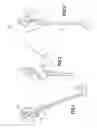
FIG. 1 is a rear view (in the line of play) of a putter, of a ball and of the left hand (the leading hand) of a right handed player holding the putter along a first embodiment of the present invention;
FIG. 2 is a view from above of the leading hand and of the club of the FIG. 1 of a player holding the putter along another embodiment of the present invention;
FIG. 3 is a front view of the ball, putter and player of FIG. 2.
DETAILED DESCRIPTION OF THE INVENTION
In FIG. 3, a putter comprises a head having a face to strike the golf ball to have it roll toward the hole and a shaft 1. The shaft 1 comprises at the end thereof opposite the head a grip 2 to help holding the club. This is very well known in the field. Grips are in general made of a flexible or elastomeric material to add feel and touch.
The ways the putter is being held represented in the figures are those for a player who wants to strike the ball towards its left. The left hand or leading hand is on top of the right hand or trailing end. However, without departing from the scope of the present invention, one could place the leading hand below the trailing hand.
The right hand is represented in FIG. 3 as holding the club in the usual way, the grip being in contact with the internal faces (palm side faces)of the fingers. However, any other technique for holding the putter with the right hand could be used without departing of the scope of the present invention.
In the left hand or leading hand, i.e. the hand on the side of the player facing the hole, the putter is held, at the level of the grip 2, in a manner which can be described in general terms as being the “Chinese” grip for ping pong rackets.
The leading side of the shaft is the side facing the hole. The trailing side is the side on the opposite side of the leading side relative to the shaft. The front side is the side of the shaft in which the head extends. The rear side is the side opposite the front side relative to the shaft.
The putter is substantially shifted toward the trailing side relative to the palm of the left hand, which as a result is no more in contact with the grip 2, or at least is very little in contact with the grip 2. Preferably less than 10% of the surface of the palm of the left hand is in contact with the grip. In particular, it is not in contact except for a small surface below the forefinger, small surface which is of the same dimension than the internal face of the proximal phalange of the forefinger.
Part of the grip 2 extends itself between the index and the thumb, both the thumb and the index clasping together the grip between them. Part of the thumb extends on the rear side of the grip, whereas part of the forefinger extends on the front side of the grip.
Part of the grip extends between the forefinger and the middle finger. The forefinger and/or the middle finger can point towards the bottom (i.e. toward the head) or else be retracted toward the top (i.e. toward the head of the player).
The internal faces 10, 11, 12 (i.e. the palm side face) of the distal phalanges respectively of the middle finger, ring finger and little finger are not in contact with the grip or with the shaft.
The internal faces (i.e. the palm side face) of the intermediate phalanges respectively of the middle finger, ring finger and little finger are not in contact with the grip or with the shaft.
The internal faces (i.e. the palm side face) of the proximal phalanges 13, 14, 15 respectively of the little finger, ring finger and middle finger are not in contact with the grip or with the shaft.
In FIGS. 2 and 3, only the base of the index, i.e. the part of the palm in the immediate vicinity of the proximal phalange of the index is in contact with the club. The contact surface is not bigger than the internal surface of the internal surface of the proximal phalange of the index.
In FIG. 1, the palm is not in contact with the grip. Except for this slight difference, all the features of the two embodiments of FIG. 1 and of FIGS. 2 and 3 are the same.
In particular, the grip is in contact with the lateral face 16 of the leading hand, i.e. the face between the palm and the back of the hand, in the region between the thumb and the forefinger.
When the face is placed behind the ball (the ball is addressed to be played) the player, in both method of FIG. 1 or FIGS. 2 and 3, sees the knuckle 17 of the forefinger. He also sees the knuckle 18 of the middle finger. In some embodiment, as represented in FIG. 3, he also sees the knuckle 19 of the ring finger and, in some other embodiment, also the knuckle 20 of the little finger.
Said in another way, in some embodiment, the back of the hand is turned towards the head of the player or upwards at least in part. In one embodiment it is turned totally toward the head of the player. In other embodiment, in particular in FIG. 1, it is partially turned upwards (towards the head of the player) and partially horizontally (toward the hole). In another embodiment, it can be turned totally towards the hole. In any case, it is never turned towards the ball or downwards.
In the present invention, the knuckle is defined for a given finger as being the articulated joint between the given finger and the rest of the hand on the back side of the hand.
Claims
1. Golf putting method for striking a golf ball with a putter toward a hole, comprising the steps of:
taking a golf putter club comprising a shaft and a head extending itself at a lower end of the shaft, said head having a face to strike the bail,
grasping the shaft, with or without interposition of a grip, at a distance from the head with at least the hand of the arm on the side of the hole, or leading hand, and
positioning the leading hand on the shaft or the grip so that at least part of the shaft or the grip extends in the region between the thumb and the index of the leading hand;
wherein at least the palm side face of the proximal phalange of the auricular or little finger of the leading hand is not in contact with the shaft or the grip; and
wherein when the face of the head of the putter is placed behind the ball (the ball is addressed to be played), the player sees at least the knuckle of the forefinger.
2. Method as defined in claim 1, wherein the player sees the knuckle of the middle finger.
3. Method as defined in claim 1, wherein the player sees all the knuckles.
4. Method as defined in claim 1, wherein the end of the shaft opposite the head and the leading hand stay away form the body of the player.
5. Golf putting method as defined in claim 1, wherein at least the palm side face of the proximal phalange of the auricular or little finger of the leading hand is not in contact with the shaft or the grip.
6. Method as defined in claim 1, wherein the internal faces of the proximal, intermediate and distal phalanges of the ring finger are not in contact with the shaft or grip.
7. Method as defined in claim 1, wherein the internal faces of the proximal, intermediate and distal phalanges of the middle finger are not in contact with the shaft or grip.
8. Method as defined in claim 1, wherein the index is in contact with the front side of the shaft or grip.
9. Method as defined in claim 1, wherein the proximal phalanges of the little finger, ring finger and middle finger point towards the putting surface.
10. Method of claim 1, wherein at least part of the index points towards the putting surface.
11. Method as defined in claim 1, wherein the index is positioned in contact with the thumb so as to clasp the grip or shaft in the region between the thumb and the index.
12. Method as defined in claim 1, wherein the shaft or grip extends itself between the index and the middle finger.
13. Method as defined in claim 1, wherein the shaft or drip extends itself between the middle finger ad the ring finger.
14. Method for striking a golf ball with a putter toward a hole, comprising the steps of:
taking a golf putter club comprising a shaft and a head extending itself at a lower end of the shaft, said head having a face to strike the ball,
grasping the shaft, with or without interposition of a at a distance from the head with at least the hand of the arm on the side of the hole, or leading hand,
positioning the leading hand on the shaft or the grip so that at least part of the shaft or the grip extends in the region between the thumb and the index of the leading hand;
wherein at least the palm side face of the proximal phalange of the auricular or little finger of the leading hand is not in contact with the shaft or the grip; and
the back of the leading hand faces horizontally toward the hole, upwards or a combination of both orientations.
15. Method as defined in claim 11, wherein the internal faces of the proximal, intermediate and distal phalanges of the ring finger are not in contact with the shaft or grip.
16. Method as defined in claim 1, wherein neither the butt of the shaft nor the leading hand are in contact with the main body of the player.
17. Method as defined in claim 11, wherein neither the butt of the shaft nor the leading hand are in contact with the main body of the player.
18. Method as defined in claim 11, wherein the index is in contact with the front side of the shaft or grip.
19. Method as defined in claim 11, wherein the proximal phalanges of the little finger, ring finger and middle finger point towards the putting surface.
20. Method as defined in claim 11, wherein the index is positioned in contact with the thumb so as to clasp the grip or shaft in the region between the thumb and the index.
Images & Drawings included:

Sources:
- United States Patent and Trademark Office - verify current appl. status at the USPTO↗
Similar patent applications:
- » 20100120548
Golf putter and grid for training a golf putting method - » 20110269561
Golf putter and grid for training a golf putting method - » 20250090931
GOLF PUTTING DEVICES, SYSTEMS, METHODS AND MEDIA - » 20080132348
Golf putting practice device, method for practicing putting using same, and method for advertising using same - » 20220134207
System and method for a golf putting training aid apparatus - » 20220409977
GOLF PUTTING APPARATUS AND METHOD OF USING THE SAME - » 20090280919
GOLF PUTTING PRACTICE DEVICE, METHOD FOR PRACTICING PUTTING USING SAME, AND METHOD FOR ADVERTISING USING SAME - » 20050070370
Golf putting aid and method of using - » 20150314186
Golf Putting Aid and Method - » 20070078019
Apparatus and method for practicing golf ball putting
Recent applications in this class:
- » 20250161764 2025-05-22
Golf Putter - » 20250121260 2025-04-17
ADJUSTABLE LENGTH PUTTER - » 20250121259 2025-04-17
ADJUSTABLE LENGTH PUTTER - » 20250108269 2025-04-03
GOLF PUTTER - » 20250099819 2025-03-27
GOLF PUTTER - » 20250032863 2025-01-30
Golf Club With Off-Axis Grip - » 20250018253 2025-01-16
PUTTER - » 20250018252 2025-01-16
Putter - » 20240123294 2024-04-18
PUTTER, PUTTING STROKE-SELECTION SYSTEM, AND METHOD - » 20240082650 2024-03-14
PUTTER ASSEMBLY HAVING AN IMAGE SENSOR AND DISPLAY ASSOCIATED THEREWITH