Olefin metathesis catalysts and related methods
US20150065723A1
2015-03-05
14/479,917
2014-09-08
✅ Patent granted
US 9,242,240 B2
2016-01-26
-
-
Porfirio Nazario Gonzalez
Choate, Hall & Stewart, LLP | Brenda Herschbach Jarrell | Xiaodong Li
2034-09-08
Abstract:
The present invention provides methods for the synthesis of catalysts and precursors thereof. Methods of the invention may comprise combining a catalyst precursor and at least one ligand to generate a catalytically active species, often under mild conditions and in high yields. In some cases, a wide variety of catalysts may be synthesized from a single catalyst precursor. Methods of the invention may also include the preparation of catalysts which, under reaction conditions known in the art, may have been difficult or impossible to prepare and/or isolate due to, for example, steric crowding at the metal center. The present invention also provides catalyst compositions, and precursors thereof, which may be useful in various chemical reactions including olefin metathesis. In some cases, methods of the invention may reduce the number of synthetic and purification steps required to produce catalysts and/or other reaction products, as well as reducing time, cost, and waste production.
Inventors:
- Richard R. Schrock 19 🇺🇸 Winchester, MA, United States
- Adam S. Hock 8 🇺🇸 Chicago, IL, United States
Assignee:
- MASSACHUSETTS INSTITUTE OF TECHNOLOGY 7,186 🇺🇸 Cambridge, MA, United States
Applicant:
Interested in similar patents?
Get notified when new applications in this technology area are published.
Classification:
B01J31/2295 » CPC main
Catalysts comprising hydrides, coordination complexes or organic compounds containing coordination complexes; Organic complexes; Unsaturated compounds used as ligands Cyclic compounds, e.g. cyclopentadienyls
B01J31/2291 » CPC further
Catalysts comprising hydrides, coordination complexes or organic compounds containing coordination complexes; Organic complexes; Unsaturated compounds used as ligands Olefins
B01J2231/543 » CPC further
Catalytic reactions performed with catalysts classified in; Redistribution or isomerisation reactions of C-C, C=C or C-C triple bonds; Metathesis reactions, e.g. olefin metathesis alkene metathesis
B01J2531/64 » CPC further
Additional information regarding catalytic systems classified in; Complexes comprising metals of Group VI (VIA or VIB) as the central metal Molybdenum
C07C2531/22 » CPC further
Catalysts comprising hydrides, coordination complexes or organic compounds containing coordination complexes Organic complexes
B01J31/22 IPC
Catalysts comprising hydrides, coordination complexes or organic compounds containing coordination complexes Organic complexes
C07C6/04 » CPC further
Preparation of hydrocarbons from hydrocarbons containing a different number of carbon atoms by redistribution reactions; Metathesis reactions at an unsaturated carbon-to-carbon bond at a carbon-to-carbon double bond
B01J31/12 IPC
Catalysts comprising hydrides, coordination complexes or organic compounds containing organic compounds or metal hydrides containing organo-metallic compounds or metal hydrides
B01J31/122 » CPC further
Catalysts comprising hydrides, coordination complexes or organic compounds containing organic compounds or metal hydrides containing organo-metallic compounds or metal hydrides Metal aryl or alkyl compounds
B01J31/181 » CPC further
Catalysts comprising hydrides, coordination complexes or organic compounds containing coordination complexes containing nitrogen, phosphorus, arsenic or antimony as complexing atoms, e.g. in pyridine ligands, or in resonance therewith, e.g. in isocyanide ligands C=N-R or as complexed central atoms the ligands containing nitrogen Cyclic ligands, including e.g. non-condensed polycyclic ligands, comprising at least one complexing nitrogen atom as ring member, e.g. pyridine
B01J31/1805 » CPC further
Catalysts comprising hydrides, coordination complexes or organic compounds containing coordination complexes containing nitrogen, phosphorus, arsenic or antimony as complexing atoms, e.g. in pyridine ligands, or in resonance therewith, e.g. in isocyanide ligands C=N-R or as complexed central atoms the ligands containing nitrogen
B01J31/2265 » CPC further
Catalysts comprising hydrides, coordination complexes or organic compounds containing coordination complexes; Organic complexes Carbenes or carbynes, i.e.(image)
B01J2231/482 » CPC further
Catalytic reactions performed with catalysts classified in; Substitution reactions at carbon centres, e.g. C-C or C-X, i.e. carbon-hetero atom, cross-coupling, C-H activation or ring-opening reactions; Ring-opening reactions asymmetric reactions, e.g. kinetic resolution of racemates
B01J2231/54 » CPC further
Catalytic reactions performed with catalysts classified in; Redistribution or isomerisation reactions of C-C, C=C or C-C triple bonds Metathesis reactions, e.g. olefin metathesis
B01J2531/66 » CPC further
Additional information regarding catalytic systems classified in; Complexes comprising metals of Group VI (VIA or VIB) as the central metal Tungsten
C07C6/00 IPC
Preparation of hydrocarbons from hydrocarbons containing a different number of carbon atoms by redistribution reactions
B01J31/18 IPC
Catalysts comprising hydrides, coordination complexes or organic compounds containing coordination complexes containing nitrogen, phosphorus, arsenic or antimony as complexing atoms, e.g. in pyridine ligands, or in resonance therewith, e.g. in isocyanide ligands C=N-R or as complexed central atoms
Description
FIELD OF THE INVENTION
The present invention generally relates to compositions useful as organometallic catalysts, and related methods.
BACKGROUND OF THE INVENTION
Transition metal-catalyzed reactions which form carbon-carbon bonds have become an important tool in synthetic organic chemistry. One example is transition metal-catalyzed olefin metathesis, which has been shown to be useful in the synthesis of high molecular weight polymers, pharmaceuticals, and other materials. Olefin metathesis may be defined conceptually as a mutual exchange of alkylidene units between two olefins involving both the formation and cleavage of carbon-carbon double bonds, i.e., via [2+2] cycloadditions between an M=C center and a carbon-carbon double bond. Metal alkylidene complexes including ruthenium and molybdenum alkylidene complexes have been shown to perform olefin metathesis in the presence of a variety of functional groups. However, in many cases, multi-step syntheses are required to generate the catalyst compositions.
In some applications, variation of the substituents and/or ligands of the catalyst may greatly affect the performance of the catalyst. For example, in asymmetric olefin metathesis, the stereoselectivity of a catalyst may be largely affected by the steric size and/or electronic properties of, for example, ligands bound to the metal center of the catalyst. Thus, the availability of a wide variety of catalysts, each having different combinations of ligands and/or substitutents, may be advantageous in optimizing catalysts and/or reactions conditions for a particular chemical reaction. However, using methods currently known in the art, the synthesis and isolation of many different catalyst compositions may be impractical. In some cases, the substitution or replacement of ligands bound to an organometallic catalyst may occur slowly and/or incompletely, or not all. In other cases, the synthesis of organometallic catalysts may occur with poor yield due to the occurrence of side reactions. For example, the syntheses of metal alkylidene complexes for olefin metathesis may often result in low yields due to competitive side reactions including deprotonation of the alkylidene.
Accordingly, improved methods are needed.
SUMMARY OF THE INVENTION
The present invention relates to compositions of matter comprising compounds having the structure,
wherein M is Mo or W; R1 is alkyl, heteroalkyl, aryl, or heteroaryl, optionally substituted; R2 and R3 can be the same or different and are hydrogen, alkyl, heteroalkyl, aryl, or heteroaryl, optionally substituted; R4 and R5 can be the same or different and are heteroalkyl or heteroaryl, optionally substituted, or R4 and R5 are joined together to form a bidentate ligand with respect to M, optionally substituted; and wherein R4 and R5 each comprise at least one nitrogen atom.
The present invention also provides methods for synthesizing a catalyst comprising providing a compound having the structure,
wherein M is Mo or W; R1 is alkyl, heteroalkyl, aryl, or heteroaryl, optionally substituted; R2 and R3 can be the same or different and are hydrogen, alkyl, heteroalkyl, aryl, or heteroaryl, optionally substituted; R4 and R5 can be the same or different and are heteroalkyl or heteroaryl, optionally substituted, or R4 and R5 are joined together to form a bidentate ligand with respect to M, optionally substituted; and wherein R4 and R5 each comprise at least one nitrogen atom; and reacting the compound with an oxygen-containing ligand such that the oxygen-containing ligand replaces R4 and R5 to form a catalyst.
The present invention also provides methods for forming and using a catalyst comprising providing a catalyst precursor comprising an organometallic composition including a first nitrogen-containing ligand in a reaction vessel; replacing the first, nitrogen-containing ligand with a second, oxygen-containing ligand thereby synthesizing the catalyst, at a temperature of less than 100° C. and with a yield of at least 50%, in the reaction vessel; and catalyzing a reaction in the reaction vessel with the catalyst, wherein the catalyst is present at a concentration of less than 100 mM.
BRIEF DESCRIPTION OF THE DRAWINGS
FIG. 1 shows the synthesis of a catalyst, according to one embodiment of the invention.
FIG. 2 shows the synthesis of a catalyst precursor, according to one embodiment of the invention.
FIG. 3 shows the reaction of a Lewis acid with a composition of the invention.
FIG. 4 shows the thermal ellipsoid plot (50% probability level) of the structure of the dimer, {Mo(NAr)(syn-CHCMe2Ph)(η5-NC4H4)(η1-NC4H4)} {Mo(NAr)(syn-CHCMe2Ph)(η1-NC4H4)2}.
FIG. 5 shows the variable temperature NMR spectra of Mo(NAr)(CHCMe2Ph)(NC4H4)2 in toluene-d8.
DETAILED DESCRIPTION
The present invention generally relates to organometallic compositions useful as catalysts and catalyst precursors, and related methods.
In some embodiments, the present invention provides methods for the synthesis of catalysts and precursors thereof. Methods of the invention may comprise combining a catalyst precursor and at least one ligand to generate a catalytically active species, often under mild conditions and in high yields. In some cases, a wide variety of catalysts may be synthesized from a single catalyst precursor. Methods of the invention may also include the preparation of catalysts which, under reaction conditions known in the art, may have been difficult or impossible to prepare and/or isolate due to, for example, steric crowding at the metal center. The present invention also provides catalyst compositions, and precursors thereof, which may be useful in various chemical reactions including olefin metathesis. In some cases, methods of the invention may reduce the number of synthetic and purification steps required to produce catalysts and/or other reaction products, as well as reducing time, cost, and waste production.
The present invention may advantageously provide methods for the rapid synthesis of a wide range of catalyst compositions, in some cases, in yields greater than 95%. The ability to synthesize catalysts rapidly and in high yields may be useful for the screening of known, as well as new, catalysts to determine the optimal conditions and/or reagents for a particular chemical reaction. In some cases, a catalyst precursor may be used to generate a large number of catalyst structures in which the ligands and/or ligand substitutents are varied. For example, the present invention may be utilized in the preparation of organometallic compositions useful as olefin metathesis catalysts, wherein the compositions comprise imido, alkoxide, and/or alkylidene ligands. A library of such catalysts having varied imido, alkoxide, and/or alkylidene ligands may be prepared and then appropriately screened to optimize catalyst performance for a given reaction.
Methods of the invention may also be useful for synthesizing catalyst structures that may be difficult to prepare using known methods. For example, olefin metathesis catalysts comprising one or more sterically large ligands may be prepared in high yields using the methods described herein, whereas such catalysts may only be prepared in low yields, or not at all, due to steric crowding at the metal center using known methods. In some cases, the present invention may also provide one-pot procedures involving the formation of a catalyst and subsequent use of the catalyst in a chemical reaction. The term “one-pot” reaction is known in the art and refers to a chemical reaction which can produce a product in one step which may otherwise have required a multiple-step synthesis. One-pot procedures may eliminate the need for isolation (e.g., purification) of catalysts and/or intermediates, while reducing the number of synthetic steps and the production of waste materials (e.g., solvents, impurities). This may also be advantageous in cases where relatively unstable catalysts may be needed for catalytic purposes.
Accordingly, in some embodiments, the present invention provides various compositions including organometallic compositions useful as catalyst precursors. As used herein, a “catalyst precursor” may refer to a chemical species which, upon activation, may produce an active catalyst species in a reaction. For example, an organometallic composition may comprise a first ligand which, upon activation, may be replaced with a second ligand to generate the catalytically active species. The activation step may comprise exposure of the catalyst precursor to, for example, an oxygen-containing ligand or other species. As shown in the illustrative embodiment shown in FIG. 1, a catalyst precursor comprising two pyrrolyl ligands may be activated to form a catalyst comprising a biphenolate ligand. In some cases, a single catalyst precursor may be activated to generate a wide variety of catalysts, often in high yields. The catalyst precursor may be isolated as a stable compound and, in some cases, may be converted in situ into the active form of the catalyst. As used herein, the term “catalyst” includes active forms of the catalyst participating in the reaction. In some embodiments, catalyst precursors of the invention may be advantageous in that the chemical composition, amount, and/or release of the catalytically active species may be controlled.
In some cases, the present invention provides catalyst precursors comprising compounds having the structure,
wherein M is Mo or W; R1 is alkyl, heteroalkyl, aryl, or heteroaryl, optionally substituted; R2 and R3 can be the same or different and are hydrogen, alkyl, heteroalkyl, aryl, or heteroaryl, optionally substituted; R4 and R5 can be the same or different and are heteroalkyl or heteroaryl, optionally substituted, or R4 and R5 are joined together to form a bidentate ligand with respect to M, optionally substituted; and wherein R4 and R5 each comprise at least one nitrogen atom. In some cases, M is Mo.
In some embodiments, R4 and R5 can be the same or different and are heteroaryl groups comprising at least one nitrogen ring atom. In some cases, R4 and R5 each coordinate M via a nitrogen atom. For example, R4 and R5 may both be pyrrolyl groups which coordinate the metal via the nitrogen atoms of the pyrrolyl ring. R4 and R5 may comprise other heteroaryl or heteroalkyl groups, or R4 and R5 may be joined to form a bidentate ligand, such as a biphenolate or binaphtholate group. In some cases, at least one of R4 and R5 is a chiral ligand, or R4 and R5 are joined together to form a chiral ligand.
In some embodiments, at least one of R2 and R3 may be hydrogen, such that, when R2 is hydrogen, R3 may be alkyl, heteroalkyl, aryl, or heteroaryl, optionally substituted, or, when R3 is hydrogen, R2 is alkyl, heteroalkyl, aryl, or heteroaryl, optionally substituted. In some embodiments, M is Mo; R1 is substituted aryl; R2 is alkyl, optionally substituted; R3 is hydrogen; R4 and R5 are heteroaryl, optionally substituted, or R4 and R5 are joined together to form a bidentate ligand with respect to M, optionally substituted; and wherein R4 and R5 each comprise at least one nitrogen atom.
The catalyst precursors may be synthesized according to various methods known in the art. In an illustrative embodiment shown in FIG. 2, the catalyst precursor may be synthesized by the addition of lithium pyrrolide to a mixture of Mo(NR1)(CHCMe2R′)—(OTf)2(dimethoxyethane), wherein R′ is alkyl, heteroalkyl, aryl, heteroaryl, or substituted derivatives thereof. The reaction may proceed iii high yield (e.g, >95% in some cases) with little or substantially no side reactions, such as the deprotonation of alkylidene to give an alkylidyne. The synthesis of the catalyst precursor may be conducted in the presence of various organic solvents, including diethyl ether, dichloromethane, and the like. In one set of embodiments, dimeric dipyrrolyl complexes, {Mo(NR1)(CHCMe2R′)(NC4H4)2}2, can be prepared readily and in good yield from Mo(NR1)(CHCMe2R′)(OTf)2(DME) species.
The present invention also provides methods for generation of catalyst, including homogeneous catalysts and heterogeneous catalysts. In some cases, the catalyst may be generated in situ to catalyze a chemical reaction, as described more fully below. Methods for synthesizing the catalyst may comprise providing a catalyst precursor comprising an organometallic composition including a first nitrogen-containing ligand. The first, nitrogen-containing ligand may be replaced with a second, oxygen-containing ligand, thereby synthesizing the catalyst. As shown by the illustrative embodiment in Scheme 1, the method may comprise providing a catalyst precursor as described herein and reacting the catalyst precursor with an oxygen-containing ligand (e.g., R6 and R7) such that the oxygen-containing ligand replaces R4 and R5 to form the catalyst, wherein R4 and R5, in protonated or non-protonated form, may be released. R6 and R7 may be oxygen-containing ligands or R6 and R7 may be joined together to form a bidentate, oxygen-containing ligand. In some cases, the oxygen-containing ligand may be in a protonated form prior to coordinating the metal center, and may then have sufficiently ionic character (e.g., may be deprotonated) upon coordination to the metal center. Similarly, the nitrogen-containing ligand may be in a deprotonated form when bound to the metal center, and may become protonated upon release from the metal center. For example, R4 and R5 may be pyrrolyl groups coordinating the metal center such that, upon exposure of the catalyst precursor to an oxygen-containing ligand such as biphenolate, the biphenolate ligand may replace the pyrrolyl groups to form the catalyst, resulting in the release of two equivalents of pyrrole. Ligands of the present invention may be described using nomenclature consistent with their protonated or deprotonated forms, and, in each case, it should be understood that the ligand will adopt the appropriate form to achieve its function as, for example, either a ligand bound to a metal center or an inert species in the reaction mixture. For example, in an illustrative embodiment, the term “pyrrolyl” may be used to describe a deprotonated, anionic pyrrole group which may coordinate a metal center, while the term “pyrrole” may be used to describe a neutral pyrrole group which does not coordinate the metal center but may be present in solution as an inert species that does not react with other components in the reaction mixture.
Scheme 1
The synthesis of catalysts having the structure, Mo(NR1)(CHR2R3)(R6)(R7), from catalyst precursors having the structure, Mo(NR1)(CHR2R3)(R4)(R5), may require that both R4 and R5 groups, or a bidentate ligand formed by joining R4 and R5, be replaced readily with R6 and R7, or a bidentate ligand formed by joining R6 and R7. In some cases, R4 and R5 may be selected such that, upon release of the R4 and R5 groups, the released R4 and R5 groups may not interfere with subsequent reactions that may involve the catalyst or may not react with any other species in the reaction. In some cases, the R4 and R5 groups may be released in protonated form (e.g., H—R4 and H—R5, or H2(R4-R5)) but may be similarly inert to other species or reagents, including those involved in subsequent reactions.
Those of ordinary skill in the art would be able to select the appropriate nitrogen-containing ligand(s) (e.g., R4 and R5) suitable for use in a particular application. For example, a one-pot synthesis may be performed to generate a catalyst and to carry out a chemical reaction using the catalyst, wherein, upon in situ generation of the catalyst, the released nitrogen-containing ligand(s) do not react with reagents of the chemical reaction and/or other components of the reaction mixture. In one embodiment, an olefin metathesis catalyst may be generated in situ as described herein and subsequently utilized in an metathesis reaction, wherein the nitrogen-containing ligand(s) of the catalyst precursor may be selected such that the released nitrogen-containing ligand(s) do not contain carbon-carbon double bonds which may react with the generated olefin metathesis catalyst.
The oxygen-containing ligand may be a heteroaryl or heteroalkyl group comprising at least one oxygen ring atom. In some cases, the oxygen-containing ligand may be a bidentate ligand (e.g., a diolate), as described herein. In some cases, the oxygen-containing ligand may be a chiral ligand. In some embodiments, the oxygen-containing ligand may be attached to a surface of a solid support material, such as an inorganic substrate, polymer resin, or other solid support, via a covalent or a non-covalent bond (e.g., an ionic bond, a hydrogen bond, a dative bond, Van der Waals interactions, or the like). Thus, replacement of the nitrogen containing ligand(s) with the solid-supported oxygen-containing ligand(s) may generate a heterogeneous catalyst. For example, a silicon substrate may comprise —SiOH groups covalently bound to the surface of the substrate, wherein the —SiOH groups may coordinate the metal center of the catalyst precursor to form a heterogeneous, surface-bound catalyst.
Methods of the invention may be advantageous in that, in some cases, a catalyst may be prepared under relatively mild conditions and in high yields. For example, the replacement of the nitrogen-containing ligand(s) with oxygen-containing ligand(s) to form the catalyst may occur at a temperature of less than 100° C. and with a yield of at least 50%. In some cases, the replacement may occur with a yield of at least 50%, at least 60%, at least 70%, at least 80%, at least 90%, or, in some cases, at least 95%. In some embodiments, the replacement may occur at a temperature of less than 80° C., less than 60° C., less than 40° C., or, in some cases, less than 25° C. For example, the replacement of the nitrogen-containing ligand(s) with oxygen-containing ligand(s) may occur at room temperature. In some cases, the catalyst may be prepared by a relatively rapid reaction, with conversion of the catalyst precursor to the catalyst often occurring within 60 minutes or less, 30 minutes or less, or, in some cases, 15 minutes or less.
In some embodiments, the resulting catalyst may have the structure,
wherein M is Mo or W; R1 is alkyl, heteroalkyl, aryl, or heteroaryl, optionally substituted; R2 and R3 can be the same or different and are hydrogen, alkyl, heteroalkyl, aryl, or heteroaryl, optionally substituted; R6 and R7 can be the same or different and are heteroalkyl or heteroaryl, optionally substituted, or R6 and R7 are joined together to form a bidentate ligand with respect to M, optionally substituted; and wherein R6 and R7 each comprise at least one oxygen atom.
In some cases, R6 and R7 may be joined together to form a chiral, bidentate ligand of at least 80% optical purity and having sufficient rigidity such that a reaction site is of sufficient shape specificity, defined in part by the chiral, bidentate ligand and a M=N—R1 site, to cause a molecular substrate having a plane of symmetry to react with a M=C center at the reaction site, forming a product that has at least a 50% enantiomeric excess of at least one enantiomer present in the mixture, the product being free of a plane of symmetry. In some embodiments, the chiral, bidentate ligand may comprise two linked oxygen atoms such that a group of atoms defining the shortest chemical bond pathway between the two oxygen atoms has at least four atoms. Examples of chiral bidentate ligands include biphenolates and binaphtholates, optionally substituted with alkyl, alkenyl, alkynyl, cycloalkyl, cycloalkenyl, cycloalkynyl, aryl, alkaryl, aralkyl, optionally interrupted or terminated by heteroatoms, carbonyl groups, cyano, NO2, alkoxy, aryloxy, hydroxy, amino, thioalkyl, thioaryl, sulfur-containing groups, halides, substituted derivatives thereof, and the like. In some cases, the chiral, bidentate ligand may be substituted at positions in proximity of the metal center to impart stereoselectivity to the reactive site of the catalyst.
In some cases, catalysts comprising one or more sterically large ligands may be synthesized. For example, at least one of R1-R3, R6, and R7 may contain sterically large groups, such as tert-butyl, isopropyl, phenyl, naphthyl, adamantyl, substituted derivatives thereof, and the like. Sterically large ligands may also include ligands comprising substituents positioned in close proximity to the metal center when the ligand is bound to the metal. Methods as described herein may be used to synthesize catalysts that may otherwise be difficult or impossible to prepare due to the presence of one or more sterically large groups bound to or proximate the metal center, i.e., steric “crowding” around the metal center. For example, catalysts described herein may comprise sterically large groups on the imido, alkoxide, and/or alkylidene ligands. In an illustrative embodiment, methods of the invention may be used to synthesize Mo(N-2,6-Br2-4-MeC6H2)(CHCMe3)[rac-Biphen], where Biphen is 3,3′-di-t-butyl-5,5′,6,6′-tetramethyl-1,1′-biphenyl-2,2′-diolate.
Upon formation of the catalyst in a reaction vessel, a one-pot procedure may be performed, wherein the catalyst may be generated in situ and may be subsequently employed in a chemical reaction, in the same reaction vessel. Those of ordinary skill in the art would be able to select the appropriate catalyst in combination with the chemical reaction to be performed. The ability to, in a single reaction vessel, generate a catalyst in situ and utilize the catalyst in a reaction, may facilitate the ability to screen a large number of catalysts for a particular reaction. Also, additional purification may be eliminated, which may be useful in cases where the catalyst structure may be difficult to isolate. In some cases, the reaction may be a carbon-carbon bond forming reaction. In some cases, the reaction may be an olefin metathesis reaction, such as a ring-closing reaction, a ring-opening reaction, or a cross-metathesis reaction. The catalyst may be present at a concentration of less than 100 mM, less than 50 mM, or less than 10 mM.
The catalyst may be provided in the reaction mixture in a sub-stoichiometric amount (e.g., catalytic amount). In certain embodiments, that amount is in the range of 0.01 to 50 mol % with respect to the limiting reagent of the chemical reaction, depending upon which reagent is in stoichiometric excess. In some embodiments, the catalyst is present in less than or equal to about 40 mol % relative to the limiting reagent. In some embodiments, the catalyst is present in less than or equal to about 30 mol % relative to the limiting reagent. In some embodiments, the catalyst is present in less than or equal to about 20 mol %, about 10 mol %, about 5 mol %, or about 1 mol % relative to the limiting reagent. In the case where the molecular formula of the catalyst complex includes more than one metal, the amount of the catalyst complex used in the reaction may be adjusted accordingly.
The products (e.g., catalysts, catalyst precursors) which may be produced by methods of the present invention may undergo further reaction(s) to afford desired derivatives thereof. Such permissible derivatization reactions can be carried out in accordance with conventional procedures known in the art. For example, potential derivatization reactions include metathesis reactions between the alkylidene moiety of the catalyst or catalyst precursor and an olefin, such that R2 and R3 are replaced.
As suitable, the catalysts employed in the present invention may involve the use of metals which can mediate a particular desired chemical reaction. In general, any transition metal (e.g., having d electrons) may be used to form the catalyst, e.g., a metal selected from one of Groups 3-12 of the periodic table or from the lanthanide series. However, in some embodiments, the metal may be selected from Groups 3-8, or, in some cases, from Groups 4-7. In some embodiments, the metal may be selected from Group 6. According to the conventions used herein, the term “Group 6” refers to the transition metal group comprising chromium, molybdenum, and tungsten. In some cases, the metal is molybdenum or tungsten. It may be expected that these catalysts will perform similarly because they are known to undergo similar reactions, such as metathesis reactions. However, the different ligands are thought to modify the catalyst performance by, for example, modifying reactivity and preventing undesirable side reactions. In a particular embodiment, the catalyst comprises molybdenum. Additionally, the present invention may also include the formation of heterogeneous catalysts containing forms of these elements.
As used herein, a “nitrogen-containing ligand” (e.g., R4 and/or R5) may be any species capable of binding a metal center via a nitrogen atom. In some cases, the nitrogen atom may be a ring atom of a heteroaryl or heteroalkyl group. In some cases, the nitrogen atom may be a substituted amine group. It should be understood that, in catalyst precursors described herein, the nitrogen-containing ligand may have sufficiently ionic character to coordinate a metal center, such as a Mo or W metal center. Examples of nitrogen-containing ligands include, but are not limited to, pyrrolyl, pyrazolyl, pyridinyl, pyrazinyl, pyrimidinyl, imidazolyl, triazolyl, tetrazolyl, oxazolyl, isoxazolyl, thiazolyl, isothiazolyl, indolyl, indazolyl, carbazolyl, morpholinyl, piperidinyl, oxazinyl, substituted derivatives thereof, and the like. The nitrogen-containing ligand may be selected to interact with an oxygen-containing ligand such that the oxygen-containing ligand can readily replace the nitrogen-containing ligand to generate the catalyst. In cases where the catalyst composition may be generated in situ in order to carry out a chemical reaction, the first, nitrogen-containing ligand may be selected such that, upon replacement by an oxygen-containing ligand, the nitrogen-containing ligands or protonated versions thereof do not interfere with the chemical reaction. In one embodiment, R4 and R5 may be pyrrolyl groups. In some embodiments, the nitrogen-containing ligand may be chiral and may be provided as a racemic mixture or a purified stereoisomer.
In some cases, R4 and R5 may be joined together to form a bidentate ligand which, when bound to the metal center, forms a metallacycle structure with the metal center. Bidentate ligands may be any species having at least two sites capable of binding a metal center. For example, the bidentate ligand may comprise at least two heteroatoms that coordinate the metal center, or a heteroatom and an anionic carbon atom that coordinate the metal center. Examples of bidentate ligands suitable for use in the invention include, but are not limited to, aryl and heteroaryl groups, linked directly or via alkyl, heteroalkyl, aryl, and/or heteroaryl groups, substituted derivatives thereof, and the like.
As used herein, the term “oxygen-containing ligand” may be used to refer to ligands comprising at least one oxygen atom capable of coordinating a metal atom (e.g., R6 and/or R7). The term “oxygen-containing ligands” may also describe ligand precursors comprising at least one hydroxyl group, wherein deprotonation of the hydroxyl group results in a negatively charged oxygen atom, which then coordinates a metal atom. The oxygen-containing ligand may be a heteroaryl or heteroalkyl group comprising at least one oxygen ring atom. In some cases, the oxygen atom may be positioned on a substituent of an alkyl, heteroalkyl, aryl, or heteroaryl group. For example, the oxygen-containing ligand may be a hydroxy-substituted aryl group, wherein the hydroxyl group is deprotonated upon coordination to the metal center. The oxygen-containing ligand may also be a bidentate ligand, wherein the ligand coordinates the metal center via two oxygen atoms (e.g., “dialkoxide ligand”).
The oxygen-containing ligand may also be attached to a surface of a solid support material, such as an inorganic substrate (e.g., SiO2, alumina, etc.), polymer resin, or the like, via a covalent or a non-covalent bond. The solid support material may be any material capable of forming a bond with catalysts as described herein. In some cases, the solid support material may comprise functional groups (e.g., SiOH groups) positioned at the surface of the solid support material, wherein the functional groups may form a bond with the catalyst or catalyst precursor. The bond may be a covalent bond, an ionic bond, a hydrogen bond, a dative bond, or the like. The bond may also comprise Van der Waals interactions.
The support material may be selected to have a particular surface area wherein the solid support material may contact a sufficient amount of a reagent (e.g., catalyst, catalyst precursor, other reagents, etc.) to allow interaction between the surface functional groups and the reagent. In some embodiments, the support material has a high surface area. In some cases, the support material has a surface area of at least 50 mm2, at least 100 mm2, at least 200 mm2, at least 300 mm2, at least 400 mm2, or at least 500 mm2.
In some cases, the oxygen-containing ligand may be chiral and may be provided as a racemic mixture or a purified stereoisomer. In some embodiments, the chiral, oxygen-containing ligand may be present in at least 80% optical purity, i.e., the oxygen-containing ligand sample contains 90% of one enantiomer and 10% of the other. In some embodiments, the chiral, oxygen-containing ligand may be at least 90% optically pure, at least 95% optically pure, or, in some cases, at least 99% optically pure.
In some cases, the catalyst may comprise a bidentate, oxygen-containing ligand (e.g., dialkoxide) having sufficient rigidity such that, in conjunction with an M=N—R1 site, the combination of the bidentate, oxygen-containing ligand and the M=N—R1 site in part may confer shape specificity to a reaction site where the catalyst reacts with a reactant such as, for example, an olefin. In some embodiments, the shape specificity, imparted by rigidity of the bidentate, oxygen-containing ligand, may be sufficient to allow a mixture of two enantiomeric reactants (e.g., olefins) to react with a M=C center of the reaction site at different rates. That is, the catalyst may be designed to have shape specificity sufficient to differentiate between enantiomers of a reactant by sterically interacting with one enantiomer almost exclusively or exclusively to achieve enantiomeric selectivity, that is, a preference for one enantiomer over the other. Enantiomeric selectivity by kinetic resolution involves reducing the steric interactions in the transition state of the reaction of the substrate at the catalyst such that the transition state involving one enantiomer is of lower energy than the transition state of the other enantiomer. Consequently, the term shape specificity in the present invention refers to the shape of an M=C reaction site in the transition state, as formed by the surrounding ligands, such that upon reaction of the substrate with the metal compound, one enantiomer “fits into” the binding site with less steric interaction than the other enantiomer. The transition state energy is lower for the enantiomer with a better “fit” or shape specificity over the other.
In another embodiment, the chiral bidentate, oxygen-containing ligand of at least 80% optical purity has sufficient rigidity such that a reaction site is of sufficient shape specificity, defined in part by the bidentate, oxygen-containing ligand and a M=N—R1 site, to cause a molecular substrate having a plane of symmetry to react with a M=C center at the reaction site forming a catalytic olefin metathesis product that is free of a plane of symmetry. The product has at least a 50% enantiomeric excess of at least one enantiomer present in the mixture. In some cases, the product may have at least a 60%, 70%, 80%, or 90% enantiomeric excess of at least one enantiomer present in the mixture. A method to screen for bidentate, oxygen-containing ligands having sufficient rigidity for shape specificity purposes involves obtaining an enantiomeric mixture of a test bidentate, oxygen-containing ligand, isolating one enantiomer and measuring a specific rotation. A bidentate, oxygen-containing ligand of sufficient rigidity would provide a specific rotation as opposed to reverting back to an enantiomeric mixture.
Catalysts and catalyst precursors of the invention may comprise substituted imido groups (e.g., N—R1). Without wishing to be bound by theory, the imido group may stabilize the organometallic compositions described herein by providing steric protection and/or reducing the potential for bimolecular decomposition. In some cases, R1 may be selected to be sterically large or bulky, including phenyl groups, substituted phenyl groups (e.g., 2,6-disubstituted phenyls, 2,4,6-trusubstituted phenyls), polycyclic groups (e.g., adamantyl), or other sterically large groups. In some embodiments, R1 may be 2,6-dialkylphenyl, such as 2,6-diisopropylphenyl. Catalysts and catalyst precursors of the invention may further comprise substituted alkylidene groups (e.g., CR2R3). The alkylidene groups may be mono-substituted (e.g., one of R2 and R3 is hydrogen) or di-substituted with, for example, alkyl, heteroalkyl, aryl, or heteroaryl groups, optionally substituted. In some cases, the alkylidene may be mono-substituted with, for example, t-butyl, dimethylphenyl, or the like.
The combination of imido, alkoxide, and/or alkylidene ligands may be selected to suit a particular application. For example, in some cases, sterically large or sterically bulky ligands and/or ligand substituents may impart a higher degree of stability to a catalyst, while, in some cases, lowering the reactivity of the catalyst. In some cases, smaller ligands and/or substituents may generate more reactive catalysts that may have decreased stability. Those of ordinary skill in the art would be able to balance such factors and select the appropriate combination of ligands for catalysts of the invention.
Solvents which may be used in methods of the invention include, but are not limited to, benzene, p-cresol, toluene, xylene, diethyl ether, glycol, diethyl ether, petroleum ether, hexane, cyclohexane, pentane, methylene chloride, chloroform, carbon tetrachloride, dioxane, tetrahydrofuran (THF), dimethyl sulfoxide, dimethylformamide, hexamethyl-phosphoric triamide, ethyl acetate, pyridine, triethylamine, picoline, mixtures thereof, or the like. In some embodiments, the solvent may be diethyl ether or dichloromethane.
As used herein, the term “reacting” refers to the forming of a bond between two or more components to produce a stable, isolable compound. For example, a first component and a second component may react to form one reaction product comprising the first component and the second component joined by a covalent bond. That is, the term “reacting” does not refer to the interaction of solvents, catalysts, bases, ligands, or other materials which may serve to promote the occurrence of the reaction with the component(s).
The term “organometallic” is given its ordinary meaning in the art and refers to compositions comprising at least one metal atom bound to one or more than one organic ligand.
As used herein, the term “alkyl” is given its ordinary meaning in the art and may include saturated aliphatic groups, including straight-chain alkyl groups, branched-chain alkyl groups, cycloalkyl (alicyclic) groups, alkyl substituted cycloalkyl groups, and cycloalkyl substituted alkyl groups. In certain embodiments, a straight chain or branched chain alkyl has about 30 or fewer carbon atoms in its backbone (e.g., C1-C30 for straight chain, C3-C30 for branched chain), and alternatively, about 20 or fewer. Likewise, cycloalkyls have from about 3 to about 10 carbon atoms in their ring structure, and alternatively about 5, 6 or 7 carbons in the ring structure.
The term “heteroalkyl” is given its ordinary meaning in the art and refers to alkyl groups as described herein in which one or more atoms is a heteroatom (e.g., oxygen, nitrogen, sulfur, and the like).
The term “aryl” is given its ordinary meaning in the art and refers to single-ring aromatic groups such as, for example, 5-, 6- and 7-membered single-ring aromatic groups. The term “heteroaryl” is given its ordinary meaning in the art and refers to aryl groups as described herein in which one or more atoms is a heteroatom (e.g., oxygen, nitrogen, sulfur, and the like). Examples of aryl and heteroaryl groups include, but are not limited to, phenyl, pyrrolyl, furanyl, thiophenyl, imidazolyl, oxazolyl, thiazolyl, triazolyl, pyrazolyl, pyridinyl, pyrazinyl, pyridazinyl and pyrimidinyl, and the like. It should be understood that, when aryl and heteroaryl groups are used as ligands coordinating a metal center, the aryl and heteroaryl groups may have sufficient ionic character to coordinate the metal center. For example, when a heteroaryl group such as pyrrole is used as a nitrogen-containing ligand, as described herein, it should be understood that the pyrrole group has sufficient ionic character (e.g., is sufficiently deprotonated to define a pyrrolyl) to coordinate the metal center. In some cases, the aryl or heteroaryl group may comprise at least on functional group that has sufficient ionic character to coordinate the metal center, such as a biphenolate group, for example.
As used herein, the term “substituted” is contemplated to include all permissible substituents of organic compounds, “permissible” being in the context of the chemical rules of valence known to those of ordinary skill in the art. In some cases, “substituted” may generally refer to replacement of a hydrogen with a substituent as described herein. However, “substituted,” as used herein, does not encompass replacement and/or alteration of a key functional group by which a molecule is identified, e.g., such that the “substituted” functional group becomes, through substitution, a different functional group. For example, a “substituted phenyl” group must still comprise the phenyl moiety and cannot be Modified by substitution, in this definition, to become, e.g., a cyclohexyl group. In a broad aspect, the permissible substituents include acyclic and cyclic, branched and unbranched, carbocyclic and heterocyclic, aromatic and nonaromatic substituents of organic compounds. Illustrative substituents include, for example, those described herein. The permissible substituents can be one or more and the same or different for appropriate organic compounds. For purposes of this invention, the heteroatoms such as nitrogen may have hydrogen substituents and/or any permissible substituents of organic compounds described herein which satisfy the valencies of the heteroatoms. This invention is not intended to be limited in any manner by the permissible substituents of organic compounds.
Examples of substituents include, but are not limited to, lower alkyl, lower aryl, lower aralkyl, lower cyclic alkyl, lower heterocycloalkyl, hydroxy, lower alkoxy, lower aryloxy, perhaloalkoxy, aralkoxy, lower heteroaryl, lower heteroaryloxy, lower heteroarylalkyl, lower heteroaralkoxy, azido, amino, halogen, lower alkylthio, oxo, lower acylalkyl, lower carboxy esters, carboxyl, -carboxamido, nitro, lower acyloxy, lower aminoalkyl, lower alkylaminoaryl, lower alkylaryl, lower alkylaminoalkyl, lower alkoxyaryl, lower arylamino, lower aralkylamino, lower alkylsulfonyl, lower-carboxamidoalkylaryl, lower-carboxamidoaryl, lower hydroxyalkyl, lower haloalkyl, lower alkylaminoalkylcarboxy-, lower aminocarboxamidoalkyl-, cyano, lower alkoxyalkyl, lower perhaloalkyl, lower arylalkyloxyalkyl, and the like.
EXAMPLES
Example 1
All complexes were handled using standard Schlenk techniques or in a Vacuum Atmospheres glove box under an argon or dinitrogen atmosphere. All solvents were dried, degassed, and stored over activated molecular sieves in a dinitrogen-filled glovebox. Pyrrole was distilled from CaH2 in an inert atmosphere and lithium pyrrolide was prepared using published procedures. Mo(N-2,6-i-Pr2C6H3)(CHCMe2Ph)(OTf)2DME, Mo(NAd)(CHR)(OTf)2(DME), and Mo(N-2,6-Br2-4-MeC6H2)(CHCMe3)(OTf)2(DME) were synthesized by published procedures. Elemental analyses were performed by Desert Analytics, Tucson, Ariz. Little or no competitive deprotonation of the alkylidene to give an alkylidyne complex was observed. The compounds were sensitive to air and moisture and Could be recrystallized readily from toluene or mixtures of pentane and ether.
Example 2
Synthesis of Mo(N-2,6-i-Pr2C6H3)(CHCMe3)(NC4H4)2
The following procedure was used to prepare the title compound. To a −35° C. solution of 0.193 g (0.27 mmol) Mo(NAr)(CHCMe3)(OTf)2(DME) in 4 mL diethyl ether was added 38.6 mg (0.53 mmol) of LiNC4H4 as a solid in one portion. The mixture was stirred at room temperature for 1 hour, then all volatiles were removed in vacuo. The resulting brown powder was extracted with 5 mL of toluene and the solution was filtered through celite. The celite was washed with toluene (1 mL) and the resulting solution was taken to dryness in vacuo. The product was recrystallized from mixtures of pentane/toluene or pure toluene at −35° C. as a toluene solvate. 1H NMR (300 MHz, toluene-d8) δ 13.5 (br s, 1H, MoCHR), 7-6.2 (v br s, overlapping, 11H, Ar—H and NC4H4), 3.8-2.9 (br s, 2H, i-Pr), 1.3 (br s, 6H, CMe3), 1.1 (br s, 12H, i-Pr).
Example 3
Synthesis of Mo(N-2,6-i-Pr2C6H3)(CHCMe2Ph)(NC4H4)2
The following procedure was used to prepare the title compound. LiNC4H4 (410 mg, 5.62 mmol) was added as a solid in several small portions a −40° C. solution of 2.223 g (2.81 mmol) Mo(NAr)(CHCMe2Ph)(OTf)2(DME) in 60 mL of diethyl ether. The mixture was stirred at room temperature for 1 hour. All volatiles were removed in vacuo and the resulting powder was extracted with 65 mL of a 1:1 mixture of toluene and pentane and the solution was filtered through celite. The celite was washed with toluene (3×15 mL) and the resulting solution was reduced to dryness in vacuo. The solid was recrystallized from pentane −35° C.; yield 1.2 g (80%): 1H NMR (toluene-d8, 500 MHz) (223 K) δ 13.55 (s, 1H, MoCHR), 13.16 (s, 1H, MoCHR), 7.4-6.7 (m, Ar—H, NC4H4), 5.85 (s, 1H, NC4H4), 5.10 (s, 1H, NC4H4), 4.91 (s, 1H, NC4H4), 4.83 (s, 1H, NC4H4), 3.85 (sept, 2H, i-Pr methine), 2.85 (sept, 2H, i-Pr methine), 1.75 (s, 6H, MoCHCMe2Ph), 1.71 (s, 3H, MoCHCMe2Ph), 1.68 (s, 3H, MoCHCMe2Ph), 1.19 (br d, 12H, Ar-i-Pr), 1.12 (d, 3H, Ar-i-Pr), 1.03 (overlapping d, 6H, Ar-i-Pr), 0.55 (d, 3H, Ar-i-Pr); (323 K): δ 13.18 (s, 1H, MoCHR), 7.33 (d, 2H, MoCHCMe2Ar), 7.18 (t, 2H, MoCHCMe2Ar), 7.05 (t, 1H, MoCHCMe2Ar), 6.86 (m, 3H, MoNAr), 6.44 (s, 4H, NC4H4), 6.14, (s, 4H, NC4H4), 3.22 (sept, 2H, i-Pr methine), 1.56 (s, 6H, MoCHCMe2Ar), 0.96 (d, 12H, i-Pr methyl). 13C NMR (CD2Cl2, 126 MHz, 223 K): 313.9 (JCH 122.8 Hz), 293.9 (JCH 121.3 Hz). Analysis calcd. For C30H37MoN3 (found): C, 67.28 (67.38); H, 6.96 (7.20); Mo, 17.91; N, 7.85 (7.70).
Example 3
Synthesis of Mo(NAd)(CHCMe2Ph)(NC4H4)2
The following procedure was used to prepare the title compound. LiNC4H4 (169 mg, 2.32 mmol) was added as a solid in small portions to a −35° C. solution of 0.890 g (1.16 mmol) Mo(NAd)(CHCMe2Ph)(OTf)2(DME) in 50 mL of diethyl ether. The mixture was stirred at room temperature for 1.5 h, then all volatiles were removed in vacuo. The resulting brown powder was extracted with toluene and the solution was filtered through celite. The celite was washed with toluene and the combined filtrates were taken to dryness in vacuo. The off-white solid may be recrystallized from toluene at −35° C.; yield 420 mg (2 crops, 71%): 1H NMR (C6D6, 500 MHz, 293 K) δ 13.6 (br s, 1H, MoCHR), 12.8 (br s, 1H, MoCHR), 7.5, (br s, 4H, MoCHCMe2Ph), 7.0-4.7 (2 overlapping br s, MoCHCMe2Ph and NC4H4), 1.8-1.6 (br multiplet, 15H, MoNAd), 1.3 (br s, 6H, MoCHCMe2Ph). 13C (CD2Cl2 126 MHz, 223K): 316.1 (JCH 118.2 Hz), 295.5 (JCH 111.3 Hz). Analysis calcd. For C28H35MoN3 (found): C, 66.00 (65.10); H, 6.92 (6.60); Mo, 18.83; N, 8.25 (7.04).
Example 4
Synthesis of Mo(N-2,6-Br2-4-MeC6H2)(CHCMe3)(NC4H4)2
The following procedure was used to prepare the title compound. LiNC4H4 (35.4 mg, 0.485 mmol) in diethyl ether (˜2 mL) was added to a −40° C. solution of 0.198 g (0.243 mmol) Mo(NAr)(CHCMe3)(OTf)2(DME) in 3 mL of dichloromethane. The mixture was stirred at room temperature for 1 hour and all volatiles were removed in vacuo. The resulting red-brown powder was extracted with benzene and the solution was filtered through celite. The celite was washed with benzene and the combined filtrates were taken to dryness in vacuo. The product was recrystallized from pentane containing a few drops of benzene at −35° C.; yield 94 mg (62%): 1H NMR (300 MHz, C6D6, 293 K) δ 13.4 (br s, 1H MoCHR), 6.8-6.4 (br overlapping s, 10H, MoNAr and NC4H4), 3.1 (s, 3H, MoNAr methyl), 1.4 (br s, 9H, MoCHCMe3). Analysis calcd. For C20H23MoBr2N3 (found): C, 42.81 (42.52); H, 4.13 (4.12); Mo, 17.10; Br, 28.48; N, 7.49 (6.83).
Example 5
Synthesis of Mo(NAd)(CHCMe2Ph)(NC4H4)2(PMe3)
The following procedure was used to prepare the title compound. Excess trimethylphosphine (50 μL) was added to 150 mg of Mo(NAd)(CHCMe2Ph)(NC4H4)2 in diethyl ether. The mixture was stirred at room temperature for 30 minutes and the solvent was removed in vacuo. Mo(NAd)(CHCMe2Ph)(NC4H4)2(PMe3) was crystallized from pentane as orange blocks; yield 100 mg (58%): NMR (1H, 300 MHz, C6D6) δ 12.49 (d, 1H, 4.8 Hz, CHCMe2Ph), 8.41 (m, 2H, Ar), 7.05 (m, 6H, Ar), 6.80 (s, 4H, NC4H4), 6.40 (s, 4H, NC4H4), 2.43 (s, 6H), 1.82 (s, 6H), 1.73 (s, 3H, Ad), 1.35 (s, 6H), 0.46 (d, 9H, JHP 9.2 Hz, PMe3); 13C NMR (C6D6) δ 301.73 (d, MoCHCMe2Ph, 2JC-P 19.5 Hz), 148, 132.19, 129.13, 126.37, 125.96, 109.16, 108.62, 42.22, 36.21, 30.03, 16.50 (d, PMe3, JC-P 25 Hz). Analysis calcd. For C31H44MoN3P (found): C, 63.58 (63.37); H, 7.57 (7.45); Mo, 16.38; N, 7.18 (6.04); P, 5.29.
Example 6
The reactivity of (Mo(NR)(CHCMe2R′)(NC4H4)2)2 species towards a Lewis acid (e.g., B(C6F5)3) and a Lewis base (e.g., PMe3) was observed by NMR.
For example, Mo(N-2,6-i-Pr2C6H3)(CHCMe2Ph)(η1-NC4H4)(η5-C4H4NB(C6F5)3 was synthesized according to the following procedure. To 23.0 mg (0.021 mmol) of {Mo(N-2,6-i-Pr2C6H3)(CHCMe2Ph)(NC4H4)2}2 in ˜0.25 mL of C6D6 was added B(C6F5)3 (22 mg, 0.043 mmol) in ca. 0.25 mL C6D6. The solution was transferred to a Teflon-sealed NMR tube and the 1H NMR spectrum was recorded. The Lewis acid B(C6F5)3 was observed to react immediately with {Mo(NAr)(CHCMe2Ph)(NC4H4)2}2 to yield a proposed mixture of syn and anti alkylidenes of the adduct shown in FIG. 3. The four η5-pyrrolyl protons in the major (syn) isomer were found at 7.7, 7.2, 5.7, and 5.4 ppm in benzene-d6. 1H NMR (500 MHz, 293 K) δ 13.89 (s, 1H, MoCHR minor isomer), 13.08 (s, 1H, MoCHR major isomer), 7.72 (br s, 1H, η5-C4H4NB(C6F5)3), 7.28 (br s, 1H, η5-C4H4NB(C6F5)3), 7.08 (m, 4H, MoCHCMe2Ph), 7.02 (d, JHH7.6 Hz, 2H, η1-NC4H4), 6.87 (m, 1H, MoCHCMe2Ph), 6.78 (d, JHH7.6 Hz, 2H, η1-NC4H4), 5.78 (br s, 1H, η5-C4H4NB(C6F5)3), 5.41, (br s, 1H, η5-C4H4NB(C6F5)3), 2.82 (br s, 2H, i-Pr methine), 1.51 (s, 3H, MoCHCMe2Ph), 1.25 (s, 3H, MoCHCMe2Ph), 0.92 (br mult, 12H, i-Pr methyls).
Addition of one equivalent of PMe3 to Mo(NAd)(CHCMe2Ph)(NC4H4)2 using a similar procedure resulted in immediate formation of syn-Mo(NAd)(CHCMe2Ph)(η1-NC4H4)2(PMe3), wherein the alkylidene proton resonance was observed at 12.49 ppm with JHP=5 Hz. An X-ray structural study showed that trimethylphosphine was bound to one of the CNimidoNpyrrolyl faces of the pseudotetrahedral species, which is the face analogous to the CNO face where trimethylphosphine is observed to bind in bisalkoxide species.
Example 7
The NMR spectra of the catalyst precursor complexes were then studied. The dipyrrolyl complexes were observed to be fluxional on the proton NMR time scale. At 22° C., the spectra contained broad resonances, for example, for Mo(NAr)(CHCMe2Ph)(NC4H4)2 in toluene-d8 (at 500 MHz), as shown in FIG. 5. At high temperature, one alkylidene resonance at ˜13.3 ppm and two pyrrolyl resonances at ˜6.1 and ˜6.3 ppm were observed. At low temperatures two alkylidene resonances at ˜43.2 and ˜13.6 ppm were observed in a 1:1 ratio and the pyrrolyl proton resonances were resolved into an obscured set of resonances downfield of 6.3 ppm, along with a pattern of four sharp resonances near 5 ppm. No fluoride resonance were observed in the 19F NMR spectrum, and no solvent resonances were observed in the 1H NMR spectrum upon addition of trimethylphosphine, which yielded a base adduct. A 13C NMR spectrum of Mo(NAr)(CHCMe2Ph)(NC4H4)2 at −50° C. in methylene chloride-d2 revealed resonances at 313.9 ppm (JCH=122.8 Hz) and 293.9 ppm (JCH=121.3 Hz), characteristic of syn alkylidene species.
The NMR spectra at high-temperatures were consistent with a Cs symmetric Mo(NR)(CHCMe2R′)(η1-NC4H4)2 species on the NMR time scale in which the pyrrolyl ligands were η1 on average and rotated rapidly about the Mo—N bonds. Variable temperature spectra were identical at different concentrations, indicating that a small fraction of the dimer had dissociated into monomers in which interconversion of η1-NC4H4 and η5-NC4H4 ligands was facile.
Example 8
The reactivity of {Mo(NR)(CHCMe2R′)(NC4H4)2}2 species towards alcohols was observed. The molybdenum catalyst precursor (ca. 0.02 mmol) was dissolved in 0.2 mL of C6D6, and an equimolar amount of diol or, alternatively, two equivalents of alcohol in 0.3 mL of C6D6, were combined in a Teflon-sealed NMR tube. The 1H NMR spectrum was recorded within 15 minutes. All diols and alcohols examined proceeded to completion by the time the 1H NMR spectrum was recorded.
Addition of two equivalents of monoalcohols (e.g., Me3COH or (CF3)2MeCOH) or one equivalent of a biphenol or binaphthol to ˜10 mM solutions of the Mo(NR)(CHCMe2R′)(NC4H4)2 (NR=NAd or NAr) species resulted in rapid formation of two equivalents of pyrrole and the corresponding bisalkoxide or diolate complexes. The reaction was rapid and proceeded in ˜100% yield in all combinations screened, including the sterically-challenging combination of 2,6-diisopropylphenylimido precursor reacting with H2[Biphen] (H2[Biphen]=3,3′-Di-t-butyl-5,5′,6,6′-tetramethyl-1,1′-Biphenyl-2,2′-diol). In the case of 3,3′-bis(2,4,6-triisopropylphenyl)-2,2′-binaphthol, the resulting binaphtholate appeared to bind one equivalent of pyrrole weakly, but the corresponding THF adduct was generated immediately upon addition of one or more equivalents of THF. In some cases, catalysts that have been isolated only as THF adducts, or that have proven to be too unstable to isolate, may be prepared from dipyrrolyl complexes.
Example 9
Synthesis and Catalytic Activity of Mo(N-2,6-Br2-4-MeC6H2)(CHCMe3)[rac-Biphen]
Mo(N-2,6-Br2-4-MeC6H2)(CHCMe3)[Biphen] was prepared according to methods as described herein and was subsequently evaluated for its catalytic activity. Previous attempts to prepare this species through addition of K2[Biphen] to Mo(N-2,6-Br2-4-MeC6H2)(CHCMe3)(OTf)2(DME) did not produce the desired species in pure form and/or in a practical yield. However, using the methods described herein, Mo(N-2,6-Br2-4-MeC6H2)(CHCMe3)(NC4H4)2 reacted with rac-H2[Biphen] in benzene rapidly to yield the Mo(N-2,6-Br2-4-MeC6H2)(CHCMe3)[rac-Biphen] species in high yield. The alkylidene proton in Mo(N-2,6-Br2-4-MeC6H2)(CHCMe3)[rac-Biphen] was found at 11.3 ppm with a JCH coupling constant of 132.6 Hz, consistent with a syn alkylidene isomer. The catalytic activity of in situ prepared Mo(N-2,6-Br2-4-MeC6H2)(CHCMe3)[rac-Biphen] was confirmed through the ring-closing metathesis of ˜80 equivalents of diallyl ether to dihydrofuran in 15 minutes at room temperature in C6D6.
The high reactivity of the {Mo(NR)(CHCMe2R′)(NC4H4)2}2 species towards alcohols and/or a Lewis acid or base (Example 6) further supported the concept that a small fraction of the dimer had dissociated into monomers in which interconversion of η1-NC4H4 and η5-NC4H4 ligands was facile.
Example 10
Crystals of the complexes were obtained and studied by X-ray diffraction. Low temperature diffraction data were collected on a Siemens Platform three-circle diffractometer coupled to a Bruker-AXS SMART Apex CCD detector with graphite-monochromated MoKα radiation (λ=0.71073 Å), performing φ and ω-scans. The structures were solved by direct methods using SHELXS and refined against F2 on all data by full-matrix least squares with SHELXL-97. All non-hydrogen atoms were refined anisotropically. All hydrogen atoms were included into the model at geometrically calculated positions and refined using a riding model. The isotropic displacement parameters of all hydrogen atoms were fixed to 1.2 times the U value of the atoms they are linked to (1.5 times for methyl groups). Crystal and structural refinement data for the structure is listed below.
Crystals of {Mo(NAr)(syn-CHCMe2Ph)(η5-NC4H4)(η1-NC4H4)} {Mo(NAr)(syn-CHCMe2Ph)(η1-NC4H4)2} (Identification Code: 06172) grown at −40° C. from a mixture of pentane and toluene were coated with Paratone-N oil (an Exxon-Mobile™ product) in a dinitrogen-filled glovebox and examined under a microscope. A suitable crystal measuring 0.10×0.08×0.03 mm3 was selected and mounted in a nylon loop. Initial examination of the data indicated that the space group was P21/c. However, no reasonable solution could be obtained via direct methods or from the Patterson map. The program CELL NOW was used to re-determine the unit cell from 999 reflections sampled from several regions in the hemisphere of data. The resulting, slightly different, unit cell was used to integrate the data in the SAINT software package in the triclinic setting. A solution in the space group P1 (#1) was refined isotropically and the routines ADDSYM and NEWSYM in Platon were used to confirm that the correct space group was indeed P21/c. Re-integration in the primitive, monoclinic setting followed by absorption correction with the SADABS package yielded the data set from which the correct initial solution was obtained. Confirmation of the space group/setting was substantiated by the successful refinement of the structure and use of the ADDSYM and NEWSYM functions in the Platon software package. FIG. 4 shows the thermal ellipsoid plot (50% probability level) of the structure of the dimer, {Mo(NAr)(syn-CHCMe2Ph)(η5-NC4H4)(η1-NC4H4)} {Mo(NAr)(syn-CHCMe2Ph)(η1-NC4H4)2}.
The X-ray structural studies of Mo(N-2,6-i-Pr2C6H3)(CHCMe2Ph)(NC4H4)2 showed that the compound existed as an unsymmetric dimer, {Mo(NAr)(syn-CHCMe2Ph)(η5-NC4H4)(η1-NC4H4)} {Mo(NAr)(syn-CHCMe2Ph)(η1-NC4H4)2}, in which the nitrogen in the η5-pyrrolyl behaves as a donor to the other Mo (FIG. 4). The electron count in the Mo(NAr)(syn-CHCMe2Ph)(η5-NC4H4)(η1-NC4H4) half was 18, and in the Mo(NAr)(syn-CHCMe2Ph)(η1-NC4H4)2(donor) half was 16. The Mo(NAr)(syn-CHCMe2Ph)(η1-NC4H4)2(donor) fragment was approximately a square pyramid with the alkylidene in the apical position. Bond distances and angles were listed in Table 1 and Table 2, respectively. The dimeric structure was consistent with the NMR spectra at low temperature, i.e., one half (containing Mo(2)) has no symmetry, while the second (containing Mo(1)) effectively has Cs symmetric. (FIG. 5) The four sharp resonances near 5 ppm were assigned to the four protons in the η5-NC4H4 that is bound to a chiral metal center.
Table 3 shows the X-ray crystal data and structure refinement for {Mo(NAr)(CHR)(NC4H4)2}2. Table 4 shows the atomic coordinates (×104) and equivalent isotropic displacement parameters (Å2×10³) for {Mo(NAr)(CHR)(NC4H4)2}2, where U(eq) is defined as one third of the trace of the orthogonalized Uij tensor. Table 5 shows the bond lengths [Å] and angles [°] for {Mo(NAr)(CHR)(NC4H4)2}2. Table 6 shows the anisotropic displacement parameters (Å2×10³) for {Mo(NAr)(CHR)(NC4H4)2}2. The anisotropic displacement factor exponent takes the form:
−2π2[h2a*2U11+ . . . +2hka*b*U12].
Table 7 shows the hydrogen coordinates (×104) and isotropic displacement parameters (Å2×10³) for {Mo(NAr)(CHR)(NC4H4)2}2.
| TABLE 1 |
| Selected bond distances for {Mo(NAr)(CHR)(NC4H4)2}2. |
| Bond | Bond distance (Å) | |
| Mo(1)—C(1A) | 1.859(5) | |
| Mo(2)—C(1B) | 1.912(5) | |
| Mo(1)—N(2A) | 2.082(4) | |
| Mo—N(3A) | 2.097(4) | |
| Mo(2)—N(2B) | 2.060(4) | |
| Mo(2)—N(3B) | 2.479(4) | |
| Mo(1)—N(3B) | 2.395(4) | |
| Mo(2)-pyrrolyl centroid | 2.48 | |
| Mo(2)—N(2B) | 2.060(4) | |
| Mo(1)—Mo(2) | 4.53 | |
| TABLE 2 |
| Selected bond angles for {Mo(NAr)(CHR)(NC4H4)2}2. |
| Bonds | Bond angles (°) | |
| N(1A)—Mo(1)—C(1A) | 99.5(2) | |
| N(1A)—Mo(1)—N(3B) | 155.16(16) | |
| N(2A)—Mo(1)—N(3A) | 150.98(16) | |
| pyrrolyl centroid-Mo(2)—N(1B) | 157.3 | |
| N(1B)—Mo(2)—C(1B) | 100.5(2) | |
| N(1B)—Mo(2)—N(2B) | 101.80(17) | |
| TABLE 3 |
| Crystal data and structure refinement for {Mo(NAr)(CHR)(NC4H4)2}2. |
| Identification code | 06172 | |
| Empirical formula | C67H82Mo2N6 | |
| Formula weight | 1163.27 | |
| Temperature | 100(2)K | |
| Wavelength | 0.71073 Å | |
| Crystal system | Monoclinic | |
| Space group | P2I/c | |
| Unit cell dimensions | a = 24.903(12) Å | α = 90° |
| b = 12.723(5) Å | β = 106.001(12)° | |
| c = 19.434(9) Å | γ = 90° | |
| Volume | 5919(4) Å3 | |
| Z | 4 | |
| Density (calculated) | 1.305 Mg/m3 | |
| Absorption coefficient | 0.469 mm−1 | |
| F(000) | 2440 | |
| Crystal size | 0.10 × 0.08 × 0.03 mm3 | |
| Theta range for | 1.70 to 21.97°. | |
| data collection | ||
| Index ranges | −26 <= h <= 25, | |
| 0 <= k <= 13, | ||
| 0 <= 1 <= 20 | ||
| Reflections collected | 7216 | |
| Independent reflections | 7216 [R(int) = 0.1879] | |
| Completeness to theta = | 99.6% | |
| 21.97° | ||
| Absorption correction | Empirical | |
| Max. and min. transmission | 0.9861 and 0.9546 | |
| Refinement method | Full-matrix | |
| least-squares on F2 | ||
| Data/restraints/parameters | 7216/0/670 | |
| Goodness-of-fit on F2 | 1.013 | |
| Final R indices | R1 = 0.0412, wR2 = 0.0775 | |
| [I > 2sigma(I)] | ||
| R indices (all data) | R1 = 0.0753, wR2 = 0.0901 | |
| Largest diff. peak and hole | 0.590 and −0.534 e·Å−3 | |
| TABLE 4 |
| Atomic coordinates (×104) and equivalent isotropic displacement |
| parameters (Å2 × 10³) for {Mo(NAr)(CHR)(NC4H4)2}2. U(eq) |
| is defined as one third of the trace of the orthogonalized Uij tensor. |
| x | y | z | U(eq) | |
| Mo(1) | 3042(1) | 8833(1) | 4794(1) | 15(1) |
| Mo(2) | 1260(1) | 9284(1) | 3435(1) | 16(1) |
| N(1A) | 3711(2) | 8566(3) | 5307(2) | 15(1) |
| N(2A) | 2949(2) | 7481(3) | 4169(2) | 18(1) |
| N(3A) | 2778(2) | 9826(3) | 5499(2) | 16(1) |
| N(1B) | 573(2) | 9542(3) | 2975(2) | 16(1) |
| N(2B) | 1584(2) | 8780(3) | 2624(2) | 18(1) |
| N(3B) | 2048(2) | 8621(3) | 4418(2) | 17(1) |
| C(1A) | 3201(2) | 9782(4) | 4150(3) | 17(1) |
| C(2A) | 3661(2) | 10288(4) | 3889(3) | 21(1) |
| C(3A) | 3722(2) | 9622(4) | 3256(3) | 29(2) |
| C(4A) | 4217(2) | 10277(4) | 4472(3) | 26(1) |
| C(5A) | 3493(2) | 11426(4) | 3668(3) | 17(1) |
| C(6A) | 3495(2) | 12174(4) | 4195(3) | 23(1) |
| C(7A) | 3377(2) | 13223(4) | 4019(3) | 26(1) |
| C(8A) | 3246(2) | 13539(4) | 3313(3) | 28(2) |
| C(9A) | 3221(2) | 12800(4) | 2784(3) | 26(1) |
| C(10A) | 3351(2) | 11751(4) | 2960(3) | 24(1) |
| C(11A) | 2805(2) | 7348(4) | 3437(3) | 21(1) |
| C(12A) | 2658(2) | 6321(4) | 3270(3) | 25(1) |
| C(13A) | 2708(2) | 5785(4) | 3908(3) | 25(1) |
| C(14A) | 2886(2) | 6507(4) | 4449(3) | 22(1) |
| C(15A) | 2631(2) | 10869(4) | 5439(3) | 17(1) |
| C(16A) | 2388(2) | 11154(4) | 5966(3) | 21(1) |
| C(17A) | 2380(2) | 10237(4) | 6378(3) | 23(1) |
| C(18A) | 2621(2) | 9459(4) | 6080(3) | 21(1) |
| C(19A) | 4235(2) | 8243(4) | 5738(3) | 16(1) |
| C(20A) | 4556(2) | 7535(4) | 5453(3) | 22(1) |
| C(21A) | 5056(2) | 7183(4) | 5908(3) | 25(1) |
| C(22A) | 5231(2) | 7515(4) | 6605(3) | 29(2) |
| C(23A) | 4922(2) | 8235(4) | 6870(3) | 29(1) |
| C(24A) | 4421(2) | 8623(4) | 6443(3) | 23(1) |
| C(25A) | 4377(2) | 7171(4) | 4677(3) | 24(1) |
| C(26A) | 4814(2) | 7493(4) | 4293(3) | 31(2) |
| C(27A) | 4279(2) | 5983(4) | 4617(3) | 34(2) |
| C(28A) | 4093(2) | 9443(5) | 6726(3) | 33(2) |
| C(29A) | 4306(3) | 10534(5) | 6630(3) | 58(2) |
| C(30A) | 4091(3) | 9295(5) | 7494(3) | 58(2) |
| C(1B) | 1561(2) | 10676(4) | 3538(3) | 20(1) |
| C(2B) | 1398(2) | 11805(4) | 3341(3) | 21(1) |
| C(3B) | 1753(2) | 12191(4) | 2857(3) | 30(2) |
| C(4B) | 779(2) | 11925(4) | 2919(3) | 25(1) |
| C(5B) | 1506(2) | 12448(4) | 4032(3) | 18(1) |
| C(6B) | 1904(2) | 13232(4) | 4213(3) | 24(1) |
| C(7B) | 1966(2) | 13822(4) | 4826(3) | 29(1) |
| C(8B) | 1646(2) | 13645(4) | 5281(3) | 26(1) |
| C(9B) | 1259(2) | 12844(4) | 5127(3) | 26(1) |
| C(10B) | 1194(2) | 12252(4) | 4514(3) | 22(1) |
| C(11B) | 1845(2) | 9337(4) | 2197(3) | 24(1) |
| C(12B) | 1867(2) | 8742(4) | 1624(3) | 28(1) |
| C(13B) | 1622(2) | 7766(4) | 1694(3) | 26(1) |
| C(14B) | 1454(2) | 7811(4) | 2298(3) | 20(1) |
| C(15B) | 1666(2) | 9114(4) | 4704(3) | 20(1) |
| C(16B) | 1160(2) | 8570(4) | 4521(3) | 18(1) |
| C(17B) | 1234(2) | 7679(4) | 4127(3) | 18(1) |
| C(18B) | 1773(2) | 7743(4) | 4063(3) | 18(1) |
| C(19B) | 16(2) | 9695(4) | 2584(3) | 17(1) |
| C(20B) | −395(2) | 9841(4) | 2951(3) | 18(1) |
| C(21B) | −932(2) | 10069(4) | 2548(3) | 22(1) |
| C(22B) | −1069(2) | 10113(4) | 1815(3) | 22(1) |
| C(23B) | −669(2) | 9943(4) | 1458(3) | 26(1) |
| C(24B) | −115(2) | 9740(4) | 1835(3) | 18(1) |
| C(25B) | −252(2) | 9681(4) | 3752(3) | 22(1) |
| C(26B) | −623(2) | 10295(5) | 4123(3) | 38(2) |
| C(27B) | −281(2) | 8497(4) | 3899(3) | 29(2) |
| C(28B) | 320(2) | 9543(4) | 1433(3) | 22(1) |
| C(29B) | 362(2) | 10463(4) | 951(3) | 31(2) |
| C(30B) | 190(2) | 8524(4) | 995(3) | 26(1) |
| C(1T) | 6467(2) | 4402(4) | 3582(3) | 26(1) |
| C(2T) | 5918(2) | 4583(5) | 3559(3) | 31(2) |
| C(3T) | 5741(2) | 5558(5) | 3710(3) | 36(2) |
| C(4T) | 6107(3) | 6385(5) | 3884(3) | 33(2) |
| C(5T) | 6661(2) | 6216(5) | 3907(3) | 30(1) |
| C(6T) | 6837(2) | 5230(4) | 3765(3) | 25(1) |
| C(7T) | 6658(3) | 3336(4) | 3424(3) | 37(2) |
| TABLE 5 |
| Bond lengths [Å] and angles [°] for {Mo(NAr)(CHR)(NC4H4)2}2. |
| Mo(1)—N(1A) | 1.725(4) | C(12A)—C(13A) | 1.391(7) |
| Mo(1)—C(1A) | 1.859(5) | C(13A)—C(14A) | 1.374(7) |
| Mo(1)—N(2A) | 2.082(4) | C(15A)—C(16A) | 1.374(7) |
| Mo(1)—N(3A) | 2.097(4) | C(16A)—C(17A) | 1.419(7) |
| Mo(1)—N(3B) | 2.395(4) | C(17A)—C(18A) | 1.366(7) |
| Mo(2)—N(1B) | 1.730(4) | C(19A)—C(24A) | 1.407(7) |
| Mo(2)—C(1B) | 1.912(5) | C(19A)—C(20A) | 1.414(7) |
| Mo(2)—N(2B) | 2.060(4) | C(20A)—C(21A) | 1.387(7) |
| Mo(2)—C(16B) | 2.373(5) | C(20A)—C(25A) | 1.523(7) |
| Mo(2)—C(15B) | 2.403(5) | C(21A)—C(22A) | 1.369(7) |
| Mo(2)—C(17B) | 2.456(5) | C(22A)—C(23A) | 1.384(7) |
| Mo(2)—C(18B) | 2.471(5) | C(23A)—C(24A) | 1.383(7) |
| Mo(2)—N(3B) | 2.479(4) | C(24A)—C(28A) | 1.518(7) |
| N(1A)—C(19A) | 1.404(6) | C(25A)—C(27A) | 1.531(7) |
| N(2A)—C(11A) | 1.379(6) | C(25A)—C(26A) | 1.535(7) |
| N(2A)—C(14A) | 1.379(6) | C(28A)—C(30A) | 1.507(8) |
| N(3A)—C(15A) | 1.373(6) | C(28A)—C(29A) | 1.516(8) |
| N(3A)—C(18A) | 1.375(6) | C(1B)—C(2B) | 1.513(7) |
| N(1B)—C(19B) | 1.400(6) | C(2B)—C(5B) | 1.532(7) |
| N(2B)—C(14B) | 1.383(6) | C(2B)—C(3B) | 1.537(7) |
| N(2B)—C(11B) | 1.383(6) | C(2B)—C(4B) | 1.542(7) |
| N(3B)—C(15B) | 1.376(6) | C(5B)—C(6B) | 1.382(7) |
| N(3B)—C(18B) | 1.390(6) | C(5B)—C(10B) | 1.394(7) |
| C(1A)—C(2A) | 1.519(7) | C(6B)—C(7B) | 1.380(7) |
| C(2A)—C(4A) | 1.530(7) | C(7B)—C(8B) | 1.362(7) |
| C(2A)—C(3A) | 1.534(7) | C(8B)—C(9B) | 1.378(7) |
| C(2A)—C(5A) | 1.536(7) | C(9B)—C(10B) | 1.381(7) |
| C(5A)—C(10A) | 1.386(7) | C(11B)—C(12B) | 1.359(7) |
| C(5A)—C(6A) | 1.396(7) | C(12B)—C(13B) | 1.407(7) |
| C(6A)—C(7A) | 1.389(7) | C(13B)—C(14B) | 1.352(7) |
| C(7A)—C(8A) | 1.379(7) | C(15B)—C(16B) | 1.395(7) |
| C(8A)—C(9A) | 1.382(7) | C(16B)—C(17B) | 1.409(7) |
| C(9A)—C(10A) | 1.394(7) | C(17B)—C(18B) | 1.383(7) |
| C(11A)—C(12A) | 1.371(7) | C(19B)—C(24B) | 1.403(7) |
| C(19B)—C(20B) | 1.411(7) | N(2B)—Mo(2)—C(15B) | 127.86(16) |
| C(20B)—C(21B) | 1.381(7) | C(16B)—Mo(2)—C(15B) | 33.95(16) |
| C(20B)—C(25B) | 1.513(7) | N(1B)—Mo(2)—C(17B) | 105.61(17) |
| C(21B)—C(22B) | 1.373(7) | C(1B)—Mo(2)—C(17B) | 141.38(19) |
| C(22B)—C(23B) | 1.378(7) | N(2B)—Mo(2)—C(17B) | 103.58(16) |
| C(23B)—C(24B) | 1.395(7) | C(16B)—Mo(2)—C(17B) | 33.87(16) |
| C(24B)—C(28B) | 1.519(7) | C(15B)—Mo(2)—C(17B) | 55.28(17) |
| C(25B)—C(26B) | 1.532(7) | N(1B)—Mo(2)—C(18B) | 135.13(17) |
| C(25B)—C(27B) | 1.539(7) | C(1B)—Mo(2)—C(18B) | 123.28(19) |
| C(28B)—C(29B) | 1.522(7) | N(213)—Mo(2)—C(18B) | 82.71(16) |
| C(28B)—C(30B) | 1.536(7) | C(16B)—Mo(2)—C(18B) | 54.77(17) |
| C(1T)—C(2T) | 1.376(7) | C(15B)—Mo(2)—C(18B) | 53.65(17) |
| C(1T)—C(6T) | 1.381(7) | C(17B)—Mo(2)—C(18B) | 32.59(15) |
| C(1T)—C(7T) | 1.496(7) | N(1B)—Mo(2)—N(3B) | 157.32(16) |
| C(2T)—C(3T) | 1.374(8) | C(1B)—Mo(2)—N(3B) | 91.72(18) |
| C(3T)—C(4T) | 1.372(8) | N(2B)—Mo(2)—N(3B) | 95.18(15) |
| C(4T)—C(5T) | 1.385(8) | C(16B)—Mo(2)—N(3B) | 55.84(16) |
| C(5T)—C(6T) | 1.381(7) | C(15B)—Mo(2)—N(3B) | 32.69(14) |
| N(1A)—Mo(1)—C(1A) | 99.5(2) | C(17B)—Mo(2)—N(3B) | 55.21(15) |
| N(IA)—Mo(1)—N(2A) | 96.24(16) | C(18B)—Mo(2)—N(3B) | 32.62(14) |
| C(1A)—Mo(1)—N(2A) | 98.82(19) | C(19A)—N(1A)—Mo(1) | 173.9(3) |
| N(1A)—Mo(1)—N(3A) | 99.65(17) | C(11A)—N(2A)—C(14A) | 105.8(4) |
| C(1A)—Mo(1)—N(3A) | 102.26(18) | C(11A)—N(2A)—Mo(1) | 131.2(3) |
| N(2A)—Mo(1)—N(3A) | 150.98(16) | C(14A)—N(2A)—Mo(1) | 121.2(3) |
| N(1A)—Mo(1)—N(3B) | 155.16(16) | C(15A)—N(3A)—C(18A) | 105.5(4) |
| C(IA)—Mo(1)—N(3B) | 105.19(18) | C(15A)—N(3A)—Mo(1) | 130.6(3) |
| N(2A)—Mo(1)—N(3B) | 77.85(14) | C(18A)—N(3A)—Mo(1) | 122.9(3) |
| N(3A)—Mo(1)—N(3B) | 77.54(14) | C(19B)—N(1B)—Mo(2) | 176.7(4) |
| N(1B)—Mo(2)—C(1B) | 100.5(2) | C(14B)—N(2B)—C(11B) | 105.7(4) |
| N(1B)—Mo(2)—N(2B) | 101.80(17) | C(14B)—N(2B)—Mo(2) | 122.4(3) |
| C(1B)—Mo(2)—N(2B) | 98.28(19) | C(11B)—N(2B)—Mo(2) | 130.4(4) |
| N(1B)—Mo(2)—C(16B) | 101.58(18) | C(15B)—N(3B)—C(18B) | 105.4(4) |
| C(1B)—Mo(2)—C(16B) | 113.26(19) | C(15B)—N(3B)—Mo(1) | 126.6(3) |
| N(2B)—Mo(2)—C(16B) | 136.06(17) | C(18B)—N(3B)—Mo(1) | 124.6(3) |
| N(1B)—Mo(2)—C(15B) | 128.59(18) | C(15B)—N(3B)—Mo(2) | 70.6(3) |
| C(1B)—Mo(2)—C(15B) | 86.18(19) | C(18B)—N(3B)—Mo(2) | 73.4(3) |
| Mo(1)—N(3B)—Mo(2) | 136.74(17) | C(20A)—C(25A)—C(27A) | 111.9(4) |
| C(2A)—C(1A)—Mo(1) | 145.1(4) | C(20A)—C(25A)—C(26A) | 110.2(4) |
| C(1A)—C(2A)—C(4A) | 111.2(4) | C(27A)—C(25A)—C(26A) | 110.3(4) |
| C(1A)—C(2A)—C(3 A) | 106.5(4) | C(30A)—C(28A)—C(29A) | 109.5(5) |
| C(4A)—C(2A)—C(3A) | 108.6(4) | C(30A)—C(28A)—C(24A) | 114.9(5) |
| C(1A)—C(2A)—C(5A) | 108.6(4) | C(29A)—C(28A)—C(24A) | 110.1(5) |
| C(4A)—C(2A)—C(5A) | 109.7(4) | C(2B)—C(1B)—Mo(2) | 141.5(4) |
| C(3A)—C(2A)—C(5A) | 112.1(4) | C(1B)—C(2B)—C(5B) | 108.3(4) |
| C(10A)—C(5A)—C(6A) | 118.3(5) | C(1B)—C(2B)—C(3B) | 107.4(4) |
| C(10A)—C(5A)—C(2A) | 122.2(5) | C(5B)—C(2B)—C(3B) | 112.0(4) |
| C(6A)—C(5A)—C(2A) | 119.5(5) | C(1B)—C(2B)—C(4B) | 112.8(4) |
| C(7A)—C(6A)—C(5A) | 121.1(5) | C(5B)—C(2B)—C(4B) | 108.7(4) |
| C(8A)—C(7A)—C(6A) | 120.0(5) | C(3B)—C(2B)—C(4B) | 107.6(4) |
| C(7A)—C(8A)—C(9A) | 119.5(5) | C(6B)—C(5B)—C(10B) | 116.8(5) |
| C(8A)—C(9A)—C(10A) | 120.6(5) | C(6B)—C(5B)—C(2B) | 123.3(5) |
| C(5A)—C(10A)—C(9A) | 120.4(5) | C(10B)—C(5B)—C(2B) | 119.9(5) |
| C(12A)—C(11A)—N(2A) | 109.8(5) | C(7B)—C(6B)—C(5B) | 120.9(5) |
| C(11A)—C(12A)—C(13A) | 107.7(5) | C(8B)—C(7B)—C(6B) | 121.6(5) |
| C(14A)—C(13A)—C(12A) | 106.6(5) | C(7B)—C(8B)—C(9B) | 118.7(5) |
| C(13A)—C(14A)—N(2A) | 110.2(5) | C(8B)—C(9B)—C(10B) | 120.0(5) |
| N(3A)—C(15A)—C(16A) | 110.7(5) | C(9B)—C(10B)—C(5B) | 121.8(5) |
| C(15A)—C(16A)—C(17A) | 106.3(5) | C(12B)—C(11B)—N(2B) | 109.8(5) |
| C(18A)—C(17A)—C(16A) | 106.2(5) | C(11B)—C(12B)—C(13B) | 107.2(5) |
| C(17A)—C(18A)—N(3A) | 111.2(5) | C(14B)—C(13B)—C(12B) | 107.0(5) |
| N(1A)—C(19A)—C(24A) | 118.9(4) | C(13B)—C(14B)—N(2B) | 110.3(5) |
| N(1A)—C(19A)—C(20A) | 119.1(4) | N(3B)—C(15B)—C(16B) | 110.3(4) |
| C(24A)—C(19A)—C(20A) | 122.0(5) | N(3B)—C(15B)—Mo(2) | 76.7(3) |
| C(21A)—C(20A)—C(19A) | 117.5(5) | C(16B)—C(15B)—Mo(2) | 71.8(3) |
| C(21A)—C(20A)—C(25A) | 120.0(5) | C(15B)—C(16B)—C(17B) | 107.1(5) |
| C(19A)—C(20A)—C(25 A) | 122.5(5) | C(15B)—C(16B)—Mo(2) | 74.2(3) |
| C(22A)—C(21A)—C(20A) | 121.0(5) | C(17B)—C(16B)—Mo(2) | 76.3(3) |
| C(21A)—C(22A)—C(23A) | 120.9(5) | C(18B)—C(17B)—C(16B) | 106.0(5) |
| C(24A)—C(23A)—C(22A) | 121.0(5) | C(18B)—C(17B)—Mo(2) | 74.3(3) |
| C(23A)—C(24A)—C(19A) | 117.5(5) | C(16B)—C(17B)—Mo(2) | 69.8(3) |
| C(23A)—C(24A)—C(28A) | 121.0(5) | C(17B)—C(18B)—N(3B) | 111.1(4) |
| C(19A)—C(24A)—C(28A) | 121.5(5) | C(17B)—C(18B)—Mo(2) | 73.1(3) |
| N(3B)—C(18B)—Mo(2) | 74.0(3) | ||
| N(1B)—C(19B)—C(24B) | 118.7(5) | ||
| N(1B)—C(19B)—C(20B) | 119.5(5) | ||
| C(24B)—C(19B)—C(20B) | 121.7(5) | ||
| C(21B)—C(20B)—C(19B) | 117.7(5) | ||
| C(21B)—C(20B)—C(25B) | 121.9(5) | ||
| C(19B)—C(20B)—C(25B) | 120.3(4) | ||
| C(22B)—C(21B)—C(20B) | 121.4(5) | ||
| C(21B)—C(22B)—C(23B) | 120.6(5) | ||
| C(22B)—C(23B)—C(24B) | 120.8(5) | ||
| C(23B)—C(24B)—C(19B) | 117.7(5) | ||
| C(23B)—C(24B)—C(28B) | 120.2(5) | ||
| C(19B)—C(24B)—C(28B) | 122.1(5) | ||
| C(20B)—C(25B)—C(26B) | 114.4(4) | ||
| C(20B)—C(25B)—C(27B) | 108.3(4) | ||
| C(26B)—C(25B)—C(27B) | 110.3(5) | ||
| C(24B)—C(28B)—C(29B) | 111.7(4) | ||
| C(24B)—C(28B)—C(30B) | 110.7(4) | ||
| C(29B)—C(28B)—C(30B) | 110.4(4) | ||
| C(2T)—C(1T)—C(6T) | 117.9(5) | ||
| C(2T)—C(1T)—C(7T) | 120.9(5) | ||
| C(6T)—C(1T)—C(7T) | 121.2(5) | ||
| C(3T)—C(2T)—C(1T) | 121.3(6) | ||
| C(4T)—C(3T)—C(2T) | 120.9(6) | ||
| C(3T)—C(4T)—C(5T) | 118.5(6) | ||
| C(6T)—C(5T)—C(4T) | 120.3(5) | ||
| C(1T)—C(6T)—C(5T) | 121.2(5) | ||
| TABLE 6 |
| Anisotropic displacement parameters (Å2 × 10³) for {Mo(NAr)(CHR)(NC4H4)2}2. The |
| anisotropic displacement factor exponent takes the form: −2π2[ h2 a*2U11 + . . . + 2 h k a* b* U12 ] |
| U11 | U22 | U33 | U23 | U13 | U12 | |
| Mo(1) | 15(1) | 15(1) | 15(1) | 0(1) | 1(1) | 1(1) |
| Mo(2) | 14(1) | 15(1) | 18(1) | −1(1) | 2(1) | 0(1) |
| N(1A) | 15(2) | 14(3) | 13(2) | 2(2) | 2(2) | 0(2) |
| N(2A) | 13(2) | 17(3) | 18(3) | 3(2) | −2(2) | 2(2) |
| N(3A) | 14(2) | 12(3) | 18(3) | −1(2) | 0(2) | 4(2) |
| N(1B) | 15(3) | 20(3) | 11(2) | 5(2) | 0(2) | 0(2) |
| N(2B) | 18(2) | 16(3) | 19(3) | −3(2) | 6(2) | 0(2) |
| N(3B) | 19(3) | 12(3) | 18(3) | −3(2) | 1(2) | −1(2) |
| C(1A) | 17(3) | 19(3) | 13(3) | 2(2) | 1(2) | 6(2) |
| C(2A) | 21(3) | 20(3) | 21(3) | 5(3) | 3(3) | 1(3) |
| C(3A) | 38(4) | 25(3) | 28(3) | 5(3) | 17(3) | 1(3) |
| C(4A) | 21(3) | 25(3) | 32(4) | 5(3) | 6(3) | −1(3) |
| C(5A) | 9(3) | 20(3) | 24(3) | −3(3) | 7(2) | −6(2) |
| C(6A) | 22(3) | 26(4) | 25(3) | 2(3) | 11(3) | −2(3) |
| C(7A) | 28(4) | 23(4) | 29(4) | −6(3) | 9(3) | −1(3) |
| C(8A) | 22(3) | 17(3) | 47(4) | 11(3) | 14(3) | 3(3) |
| C(9A) | 22(3) | 34(4) | 21(3) | 17(3) | 5(3) | 2(3) |
| C(10A) | 23(3) | 31(4) | 17(3) | 9(3) | 6(3) | 2(3) |
| C(11A) | 15(3) | 24(4) | 24(4) | 0(3) | 4(3) | −2(3) |
| C(12A) | 25(3) | 25(4) | 24(4) | −9(3) | 5(3) | −4(3) |
| C(13A) | 23(3) | 14(3) | 37(4) | −4(3) | 4(3) | −2(3) |
| C(14A) | 16(3) | 27(4) | 22(3) | 7(3) | 3(3) | 8(3) |
| C(15A) | 14(3) | 16(3) | 18(3) | −2(2) | −1(2) | −1(2) |
| C(16A) | 24(3) | 16(3) | 19(3) | −8(3) | −2(3) | 5(3) |
| C(17A) | 20(3) | 37(4) | 15(3) | −5(3) | 5(3) | 3(3) |
| C(18A) | 21(3) | 24(3) | 19(3) | 3(3) | 5(3) | 0(3) |
| C(19A) | 12(3) | 18(3) | 17(3) | 4(3) | 1(3) | −1(2) |
| C(20A) | 18(3) | 21(3) | 30(4) | 2(3) | 11(3) | −3(3) |
| C(21A) | 17(3) | 25(3) | 32(4) | 6(3) | 6(3) | 4(3) |
| C(22A) | 12(3) | 34(4) | 35(4) | 9(3) | −1(3) | −2(3) |
| C(23A) | 20(3) | 35(4) | 25(3) | 2(3) | −3(3) | −3(3) |
| C(24A) | 16(3) | 26(4) | 26(4) | 5(3) | 5(3) | −4(3) |
| C(25A) | 19(3) | 25(3) | 28(4) | 0(3) | 9(3) | 5(3) |
| C(26A) | 27(3) | 38(4) | 29(4) | −6(3) | 9(3) | 4(3) |
| C(27A) | 30(4) | 30(4) | 41(4) | −7(3) | 8(3) | 4(3) |
| C(28A) | 23(3) | 43(4) | 26(4) | −8(3) | −7(3) | 5(3) |
| C(29A) | 99(4) | 47(3) | 44(3) | 1(3) | 44(3) | 13(3) |
| C(30A) | 99(4) | 47(3) | 44(3) | 1(3) | 44(3) | 13(3) |
| C(1B) | 17(3) | 15(3) | 26(3) | −2(3) | 4(2) | 0(2) |
| C(2B) | 16(3) | 24(3) | 23(3) | 6(3) | 7(3) | 0(3) |
| C(3B) | 37(4) | 21(3) | 31(4) | 2(3) | 12(3) | −4(3) |
| C(4B) | 24(3) | 24(3) | 22(3) | −3(3) | −1(3) | 1(3) |
| C(5B) | 13(3) | 14(3) | 24(3) | 8(3) | 1(3) | 9(3) |
| C(6B) | 21(3) | 25(3) | 25(3) | 1(3) | 6(3) | −3(3) |
| C(7B) | 19(3) | 23(3) | 35(4) | −6(3) | −7(3) | −5(3) |
| C(8B) | 28(4) | 26(4) | 23(3) | −2(3) | 3(3) | 2(3) |
| C(9B) | 22(3) | 32(4) | 20(3) | −1(3) | 2(3) | 3(3) |
| C(10B) | 14(3) | 18(3) | 33(4) | 2(3) | 4(3) | −6(2) |
| C(11B) | 22(3) | 23(3) | 31(4) | 6(3) | 13(3) | −2(3) |
| C(12B) | 27(3) | 34(4) | 28(4) | 1(3) | 17(3) | −4(3) |
| C(13B) | 28(3) | 29(4) | 18(3) | −6(3) | 4(3) | 2(3) |
| C(14B) | 18(3) | 17(3) | 23(3) | −3(3) | 2(3) | −1(2) |
| C(15B) | 22(3) | 20(3) | 17(3) | 0(2) | 4(3) | 8(3) |
| C(16B) | 19(3) | 23(3) | 15(3) | 0(2) | 9(3) | 0(3) |
| C(17B) | 13(3) | 19(3) | 18(3) | 2(3) | −1(2) | 1(2) |
| C(18B) | 17(3) | 17(3) | 18(3) | 0(2) | 0(3) | 4(2) |
| C(19B) | 21(3) | 6(3) | 21(3) | −1(2) | 1(3) | 2(2) |
| C(20B) | 18(3) | 10(3) | 25(3) | −6(2) | 3(3) | 3(2) |
| C(21B) | 21(3) | 22(3) | 24(4) | −2(3) | 8(3) | −3(3) |
| C(22B) | 15(3) | 18(3) | 30(4) | −2(3) | 0(3) | −1(2) |
| C(23B) | 31(4) | 25(4) | 17(3) | 0(3) | 0(3) | −6(3) |
| C(24B) | 18(3) | 15(3) | 20(3) | 1(2) | 2(3) | −4(2) |
| C(25B) | 12(3) | 31(4) | 19(3) | −8(3) | 0(2) | 5(3) |
| C(26B) | 35(4) | 53(4) | 25(4) | −11(3) | 6(3) | 8(3) |
| C(27B) | 29(4) | 36(4) | 18(3) | 7(3) | 3(3) | −6(3) |
| C(28B) | 19(3) | 27(3) | 14(3) | 1(3) | −3(2) | −7(3) |
| C(29B) | 43(4) | 34(4) | 19(3) | 1(3) | 12(3) | −4(3) |
| C(30B) | 23(3) | 31(4) | 23(3) | 2(3) | 2(3) | 0(3) |
| C(1T) | 25(4) | 28(4) | 21(3) | 6(3) | 3(3) | 0(3) |
| C(2T) | 26(4) | 44(4) | 20(3) | 2(3) | 4(3) | −12(3) |
| C(3T) | 25(4) | 52(5) | 31(4) | 3(3) | 7(3) | 8(4) |
| C(4T) | 42(4) | 37(4) | 23(4) | 4(3) | 11(3) | 13(3) |
| C(5T) | 36(4) | 30(4) | 23(3) | 5(3) | 8(3) | −5(3) |
| C(6T) | 19(3) | 30(4) | 28(3) | 4(3) | 7(3) | 3(3) |
| C(7T) | 47(4) | 26(4) | 38(4) | 5(3) | 12(3) | −5(3) |
| TABLE 7 |
| Hydrogen coordinates (×104) and isotropic displacement parameters |
| (Å2 × 10 3) for {Mo(NAr)(CHR)(NC4H4)2}2. |
| x | y | z | U(eq) | |
| H(10B) | 2855 | 10063 | 3872 | 20 |
| H(10C) | 3369 | 9623 | 2878 | 43 |
| H(10D) | 3820 | 8899 | 3417 | 43 |
| H(10E) | 4018 | 9918 | 3071 | 43 |
| H(11C) | 4184 | 10700 | 4880 | 39 |
| H(11D) | 4511 | 10573 | 4281 | 39 |
| H(11E) | 4314 | 9552 | 4629 | 39 |
| H(57A) | 3579 | 11962 | 4681 | 28 |
| H(25A) | 3386 | 13723 | 4385 | 32 |
| H(44A) | 3175 | 14258 | 3192 | 34 |
| H(19A) | 3113 | 13009 | 2296 | 31 |
| H(39A) | 3344 | 11255 | 2592 | 28 |
| H(58A) | 2807 | 7886 | 3099 | 25 |
| H(17A) | 2543 | 6029 | 2802 | 30 |
| H(9A) | 2634 | 5062 | 3960 | 30 |
| H(50A) | 2955 | 6357 | 4945 | 27 |
| H(28A) | 2690 | 11330 | 5083 | 20 |
| H(15A) | 2252 | 11831 | 6039 | 26 |
| H(10L) | 2236 | 10175 | 6781 | 28 |
| H(11A) | 2672 | 8757 | 6252 | 26 |
| H(10F) | 5280 | 6704 | 5734 | 30 |
| H(10A) | 5570 | 7248 | 6910 | 34 |
| H(10K) | 5055 | 8465 | 7352 | 34 |
| H(27A) | 4017 | 7529 | 4433 | 28 |
| H(61A) | 4871 | 8256 | 4333 | 47 |
| H(61B) | 4683 | 7296 | 3787 | 47 |
| H(61C) | 5167 | 7134 | 4515 | 47 |
| H(10H) | 3997 | 5788 | 4860 | 50 |
| H(10I) | 4629 | 5616 | 4841 | 50 |
| H(10J) | 4147 | 5784 | 4111 | 50 |
| H(8A) | 3697 | 9403 | 6426 | 40 |
| H(20B) | 4091 | 11058 | 6811 | 88 |
| H(20C) | 4264 | 10663 | 6120 | 88 |
| H(20D) | 4701 | 10588 | 6896 | 88 |
| H(48A) | 3868 | 9852 | 7630 | 88 |
| H(48B) | 4475 | 9327 | 7804 | 88 |
| H(48C) | 3928 | 8609 | 7549 | 88 |
| H(46A) | 1943 | 10649 | 3805 | 23 |
| H(12A) | 2150 | 12128 | 3113 | 44 |
| H(12B) | 1664 | 12928 | 2729 | 44 |
| H(12C) | 1671 | 11763 | 2421 | 44 |
| H(65A) | 542 | 11688 | 3216 | 37 |
| H(65B) | 702 | 11499 | 2482 | 37 |
| H(65C) | 699 | 12665 | 2790 | 37 |
| H(22A) | 2138 | 13367 | 3911 | 28 |
| H(91A) | 2239 | 14364 | 4934 | 35 |
| H(52A) | 1689 | 14067 | 5696 | 32 |
| H(81A) | 1038 | 12698 | 5443 | 31 |
| H(86A) | 929 | 11697 | 4417 | 27 |
| H(24A) | 1988 | 10030 | 2290 | 29 |
| H(10G) | 2020 | 8948 | 1248 | 34 |
| H(80A) | 1582 | 7186 | 1376 | 31 |
| H(54A) | 1273 | 7257 | 2474 | 24 |
| H(11F) | 1755 | 9717 | 5047 | 24 |
| H(55A) | 839 | 8696 | 4726 | 22 |
| H(11G) | 970 | 7075 | 3981 | 21 |
| H(11B) | 1952 | 7195 | 3831 | 22 |
| H(45A) | −1213 | 10197 | 2784 | 26 |
| H(20A) | −1442 | 10263 | 1550 | 27 |
| H(41A) | −771 | 9965 | 950 | 31 |
| H(26A) | 143 | 9915 | 3963 | 26 |
| H(90A) | −598 | 11048 | 4028 | 57 |
| H(90B) | −496 | 10170 | 4640 | 57 |
| H(90C) | −1011 | 10062 | 3937 | 57 |
| H(71A) | −37 | 8115 | 3668 | 43 |
| H(71B) | −666 | 8251 | 3707 | 43 |
| H(71C) | −159 | 8371 | 4417 | 43 |
| H(78A) | 690 | 9456 | 1795 | 26 |
| H(83A) | 452 | 11105 | 1239 | 47 |
| H(83B) | 5 | 10554 | 586 | 47 |
| H(83C) | 657 | 10323 | 718 | 47 |
| H(31A) | 169 | 7937 | 1313 | 40 |
| H(31B) | 486 | 8388 | 764 | 40 |
| H(31C) | −168 | 8597 | 629 | 40 |
| H(2TA) | 5656 | 4024 | 3438 | 37 |
| H(3TA) | 5359 | 5660 | 3693 | 43 |
| H(4TA) | 5983 | 7059 | 3986 | 40 |
| H(5TA) | 6920 | 6779 | 4021 | 36 |
| H(6TA) | 7220 | 5121 | 3794 | 31 |
| H(7TA) | 7060 | 3354 | 3471 | 55 |
| H(7TB) | 6456 | 3131 | 2935 | 55 |
| H(7TC) | 6582 | 2826 | 3764 | 55 |
While several embodiments of the present invention have been described and illustrated herein, those of ordinary skill in the art will readily envision a variety of other means and/or structures for performing the functions and/or obtaining the results and/or one or more of the advantages described herein, and each of such variations and/or modifications is deemed to be within the scope of the present invention. More generally, those skilled in the art will readily appreciate that all parameters, dimensions, materials, and configurations described herein are meant to be exemplary and that the actual parameters, dimensions, materials, and/or configurations will depend upon the specific application or applications for which the teachings of the present invention is/are used. Those skilled in the art will recognize, or be able to ascertain using no more than routine experimentation, many equivalents to the specific embodiments of the invention described herein. It is, therefore, to be understood that the foregoing embodiments are presented by way of example only and that, within the scope of the appended claims and equivalents thereto, the invention may be practiced otherwise than as specifically described and claimed. The present invention is directed to each individual feature, system, article, material, kit, and/or method described herein. In addition, any combination of two or more such features, systems, articles, materials, kits, and/or methods, if such features, systems, articles, materials, kits, and/or methods are not mutually inconsistent, is included within the scope of the present invention. The indefinite articles “a” and “an,” as used herein in the specification and in the claims, unless clearly indicated to the contrary, should be understood to mean “at least one.”
The phrase “and/or,” as used herein in the specification and in the claims, should be understood to mean “either or both” of the elements so conjoined, i.e., elements that are conjunctively present in some cases and disjunctively present in other cases. Other elements may optionally be present other than the elements specifically identified by the “and/or” clause, whether related or unrelated to those elements specifically identified unless clearly indicated to the contrary. Thus, as a non-limiting example, a reference to “A and/or B,” when used in conjunction with open-ended language such as “comprising” can refer, in one embodiment, to A without B (optionally including elements other than B); in another embodiment, to B without A (optionally including elements other than A); in yet another embodiment, to both A and B (optionally including other elements); etc.
As used herein in the specification and in the claims, “or” should be understood to have the same meaning as “and/or” as defined above. For example, when separating items in a list, “or” or “and/or” shall be interpreted as being inclusive, i.e., the inclusion of at least one, but also including more than one, of a number or list of elements, and, optionally, additional unlisted items. Only terms clearly indicated to the contrary, such as “only one of” or “exactly one of,” or, when used in the claims, “consisting of,” will refer to the inclusion of exactly one element of a number or list of elements. In general, the term “or” as used herein shall only be interpreted as indicating exclusive alternatives (i.e. “one or the other but not both”) when preceded by terms of exclusivity, such as “either,” “one of,” “only one of,” or “exactly one of.” “Consisting essentially of,” when used in the claims, shall have its ordinary meaning as used in the field of patent law.
As used herein in the specification and in the claims, the phrase “at least one,” in reference to a list of one or more elements, should be understood to mean at least one element selected from any one or more of the elements in the list of elements, but not necessarily including at least one of each and every element specifically listed within the list of elements and not excluding any combinations of elements in the list of elements. This definition also allows that elements may optionally be present other than the elements specifically identified within the list of elements to which the phrase “at least one” refers, whether related or unrelated to those elements specifically identified. Thus, as a non-limiting example, “at least one of A and B” (or, equivalently, “at least one of A or B,” or, equivalently “at least one of A and/or B”) can refer, in one embodiment, to at least one, optionally including more than one, A, with no B present (and optionally including elements other than B); in another embodiment, to at least one, optionally including more than one, B, with no A present (and optionally including elements other than A); in yet another embodiment, to at least one, optionally including more than one, A, and at least one, optionally including more than one, B (and optionally including other elements); etc.
In the claims, as well as in the specification above, all transitional phrases such as “comprising,” “including,” “carrying,” “having,” “containing,” “involving,” “holding,” and the like are to be understood to be open-ended, i.e., to mean including but not limited to. Only the transitional phrases “consisting of” and “consisting essentially of” shall be closed or semi-closed transitional phrases, respectively, as set forth in the United States Patent Office Manual of Patent Examining Procedures, Section 2111.03.
Claims
What is claimed:1-12. (canceled)
13. A method for synthesizing a catalyst, comprising:
providing a compound having the structure of formula I:
wherein:
M is Mo or W;
R1 is alkyl, heteroalkyl, aryl, or heteroaryl, optionally substituted;
R2 and R3 can be the same or different and are hydrogen, alkyl, heteroalkyl, aryl, or heteroaryl, optionally substituted;
R4 and R5 can be the same or different and are heteroalkyl or heteroaryl, optionally substituted, or R4 and R5 are joined together to form a bidentate ligand with respect to M, optionally substituted; and wherein R4 and R5 each comprise at least one nitrogen atom; and
reacting the compound with an oxygen-containing ligand such that the oxygen-containing ligand replaces R4 and R5 to form a catalyst.
14. A method as in claim 13, wherein R4 and R5 each coordinate M via a nitrogen atom.
15. A method as in claim 13, wherein the oxygen-containing ligand is a bidentate ligand.
16. A method as in claim 13, wherein the oxygen-containing ligand is a chiral ligand.
17. A method as in claim 13, wherein the oxygen-containing ligand is attached to a surface via a covalent or a non-covalent bond.
18. A method as in claim 13, wherein R4 and R5 are each pyrrolyl, optionally substituted, and coordinate M via the nitrogen atom of the pyrrolyl ring.
19. A method as in claim 13, wherein R1 is substituted phenyl.
20. A method as in claim 13, wherein R1 is adamantyl, optionally substituted.
21. A method as in claim 13, wherein the oxygen-containing ligand is a hydroxy-substituted aryl group, wherein the hydroxyl group is deprotonated upon coordination to the metal center.
22. A method as in claim 13, wherein the oxygen-containing ligand is monoalcohol.
23. A method as in claim 18, wherein R4 and R5 are each pyrrolyl.
24. A method as in claim 19, wherein R1 is 2,6-dialkylphenyl.
25-28. (canceled)
29. A method as in claim 13, further comprising,
catalyzing a reaction with the catalyst, wherein the catalyst is present at a concentration of less than 100 mM.
30-31. (canceled)
32. A method as in claim 29, wherein the reaction is a carbon-carbon bond forming reaction.
33. A method as in claim 29, wherein the reaction is an olefin metathesis reaction.
34. A method as in claim 29, wherein the olefin metathesis reaction is a ring-closing reaction, a ring-opening reaction, or a cross-metathesis reaction.
35. A method as in claim 13, wherein the catalyst has the structure:
wherein:
M is Mo or W;
R1 is alkyl, heteroalkyl, aryl, or heteroaryl, optionally substituted;
R2 and R3 can be the same or different and are hydrogen, alkyl, heteroalkyl, aryl, or heteroaryl, optionally substituted;
R6 and R7 can be the same or different and are heteroalkyl or heteroaryl, optionally substituted, or R6 and R7 are joined together to form a bidentate ligand with respect to M, optionally substituted; and
wherein R6 and R7 each comprise at least one oxygen atom.
36. A method as in claim 35, wherein M is Mo.
37. A method as in claim 35, wherein R6 and R7 each coordinate M via an oxygen atom.
38. A method as in claim 35, wherein R6 and R7 are joined together to form a biphenolate or binaptholate ligand.
39. A method as in claim 35, wherein R6 and R7 are joined together to form a chiral ligand.
40-41. (canceled)
42. A method as in claim 13, comprising
providing in a reaction vessel a compound having the structure:
wherein:
M is Mo or W;
R1 is alkyl, heteroalkyl, aryl, or heteroaryl, optionally substituted;
R2 and R3 can be the same or different and are hydrogen, alkyl, heteroalkyl, aryl, or heteroaryl, optionally substituted;
R4 and R5 can be the same or different and are heteroalkyl or heteroaryl, optionally substituted, or R4 and R5 are joined together to form a bidentate ligand with respect to M, optionally substituted; and
wherein R4 and R5 each comprise at least one nitrogen atom; and
reacting in the reaction vessel the compound with an oxygen-containing ligand such that the oxygen-containing ligand replaces R4 and R5 to form a catalyst; and
catalyzing a reaction in the reaction vessel with the catalyst.
43-61. (canceled)
62. A method as in claim 42, wherein the reaction is an olefin metathesis reaction.
63. (canceled)
64. A method as in claim 42, wherein the catalyst has the structure:
wherein:
M is Mo or W;
R1 is alkyl, heteroalkyl, aryl, or heteroaryl, optionally substituted;
R2 and R3 can be the same or different and are hydrogen, alkyl, heteroalkyl, aryl, or heteroaryl, optionally substituted;
R6 and R7 can be the same or different and are heteroalkyl or heteroaryl, optionally substituted, or R6 and R7 are joined together to form a bidentate ligand with respect to M, optionally substituted; and
wherein R6 and R7 each comprise at least one oxygen atom.
65-70. (canceled)
Images & Drawings included:
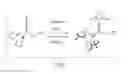



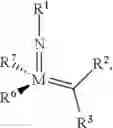
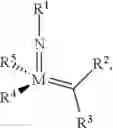

Sources:
- United States Patent and Trademark Office - verify current appl. status at the USPTO↗
Similar patent applications:
- » 20080119678
Olefin metathesis catalysts and related methods - » 20110237815
Olefin metathesis catalysts and related methods - » 20130281706
Olefin metathesis catalysts and related methods - » 20110065915
Catalysts for metathesis reactions including enantioselective olefin metathesis, and related methods - » 20170333887
Catalysts for metathesis reactions including enantioselective olefin metathesis, and related methods
Recent applications in this class:
- » 20250242340 2025-07-31
SABRE CATALYSTS CONTAINING FLUORINATED CARBON CHAINS FOR DELIVERY OF METAL-FREE MRI CONTRAST AGENTS - » 20250205693 2025-06-26
CATALYST AND METHOD OF FORMING FORMATE - » 20250153157 2025-05-15
PALLADIUM PRECATALYST EMBODIMENTS FOR ENANTIOSELECTIVE CHEMICAL REACTIONS AND METHODS OF MAKING AND USING THE SAME - » 20250010279 2025-01-09
SYNTHESIS OF CARBONYLATION CATALYSTS - » 20240216900 2024-07-04
SABRE CATALYSTS CONTAINING FLUORINATED CARBON CHAINS FOR DELIVERY OF METAL-FREE MRI CONTRAST AGENTS - » 20240009659 2024-01-11
Internal Diene Compounds And Their Periodic Group IX, X and Pt Group Metal Complexes For Catalyzed Reactions Including Hydrosilylation - » 20230398529 2023-12-14
ASYMMETRIC TRANSFER HYDROGENATION OF 2-ARYL SUBSTITUTED BICYCLIC PYRIDINE KETONES IN PRESENCE OF A CHIRAL RUTHENIUM CATALYST - » 20220168717 2022-06-02
Metal complex, method for producing same, and method for producing gamma-lactam compound using same - » 20210402384 2021-12-30
Hexahydrocyclopenta[e]-as-indacen-1-yl and octahydrobenzo[e]-as-indacen-1-yl based catalyst complexes and process for use thereof - » 20210387173 2021-12-16
HYDROGENATION PROCESS OF OXIME DERIVATIVES
Recent applications for this Assignee:
- » 20250288624 2025-09-18
LONG-TERM STABILIZATION, FORMULATION AND TABLETING OF LIVE MICROBIAL CELLS - » 20250284856 2025-09-11
GENERALIZABLE END-TO-END AUTONOMOUS DRIVING WITH MULTI-MODAL FOUNDATION MODELS - » 20250283816 2025-09-11
COMPOSITIONS FOR DETECTION OF FLUOROCARBONS AND RELATED ARTICLES, SYSTEMS, AND METHODS - » 20250281931 2025-09-11
High-Throughput Expansion Microscopy, Devices for Use With a Well Plate and Methods for Processing a Sample - » 20250278625 2025-09-04
VISUOMOTOR POLICY LEARNING VIA ACTION DIFFUSION - » 20250275716 2025-09-04
SENSORIZED WEARABLE GARMENT - » 20250275026 2025-08-28
ELECTRICALLY CONDUCTIVE FIREBRICK SYSTEM - » 20250263824 2025-08-21
ADDITIVELY MANUFACTURED OXIDE DISPERSION-STRENGTHENED ALLOY - » 20250261881 2025-08-21
FLEXIBLE ELECTRONICS FOR ANALYTE DETECTION - » 20250257316 2025-08-14
CONTROL OF NITROGEN FIXATION IN RHIZOBIA THAT ASSOCIATE WITH CEREALS