Process of manufacturing of coated spectacle frames, and coated spectacle frames so obtained
US20150131046A1
2015-05-14
14/406,270
2013-06-07
✅ Patent granted
US 9,448,419 B2
2016-09-20
WO; PCT/IB2013/001196; 20130607
WO; WO2013/182894; 20131212
Ricky Mack | Daniele Manikeu
Mark M. Friedman
2033-06-07
Abstract:
The process of manufacturing of a coated spectacle frames is characterized by the following three main manufacturing processes:
-
- A—Bonding of at least one outer layer of coating material (A, C) on at least an inner layer of material having a structural function (B). The result is a coated panel (D);
- B—Cutting of the spectacle frame (E) from that covered panel (D);
- C—Bending and shaping of the previously cut spectacle (F).
The layers that form the particular coated panel (D) may origin from different combinations of different materials, as indicated in the description and claims.
Assignee:
- HAPTER SRL 1 🇮🇹 Belluno, Italy
Applicant:
Interested in similar patents?
Get notified when new applications in this technology area are published.
Classification:
G02C5/008 » CPC main
Constructions of non-optical parts Spectacles frames characterized by their material, material structure and material properties
G02C2200/14 » CPC further
Generic mechanical aspects applicable to one or more of the groups - and - and their subgroups Laminated frame or frame portions
G02C5/00 IPC
Constructions of non-optical parts
B29D12/02 » CPC further
Spectacle frames
G02C5/006 » CPC further
Constructions of non-optical parts Collapsible frames
G02C2200/12 » CPC further
Generic mechanical aspects applicable to one or more of the groups - and - and their subgroups Frame or frame portions made from sheet type material
G02C2200/16 » CPC further
Generic mechanical aspects applicable to one or more of the groups - and - and their subgroups Frame or frame portions made from rubber
Y10T29/31 » CPC further
Metal working Spectacle-frame making
Description
The present patent application relates to a process of manufacturing of coated spectacle frames—or parts of these—, and coated spectacle frames—or parts of these—, so obtained.
At the state of the art, some types of spectacle frames are externally coated with a textile material or leather. These coatings are usually applied after the production of the spectacles structure, as an embellishment, covering their surfaces entirely or partially. Normally they are plastic glasses, that after being produced are coated with textile material or leather. There are examples of temples of eyeglasses made of metal material coated with textile material or leather, having the edges of the material sewn together by hand. In the latter case they are normally made of tubolar-shaped textile previously sewn, which are put on the metal core, but in any case after the production of the temple.
With regards to the state of the art, there is an existing patent to consider:
-
- in the patent FR 2575106 a spectacle frame is realized sticking together several layers of different materials, previously cut, specifically leather and plastic materials.
This process has the disadvantage of having multiple manufacturing steps, that are different cutting processes of the different materials, only after which the bonding process is performed. In particular this process implies the cutting of the individual layers of material before bonding, with the consequent problems of precision when positioning the layers one on the top of the other.
The process described in this application considers a single operation of bonding the covering sheets on the structural material in order to perform the cutting of the different parts of glasses or spectacle frames directly on the sheet of bonded material previously assembled, instead of bonding the previously-cut covering sheets described by the above mentioned patent FR2575106; furthermore, this process uses textile material, and not leather as in the aforementioned patent.
DESCRIPTION OF THE DRAWINGS
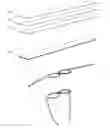
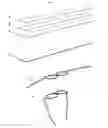
In the attached drawing, Page 1/1—FIG. 1, “A” and “C” represent the external layers of coating material that are coupled to the inner layer “B”, which acts as structural material.
Once the layers of different materials are coupled, ‘the panel coated “D” is obtained, thus composed by several layers of material coupled together.
Once the coated material “D” is cut according to the contour of the spectacles, the cut piece “E” will be obtained. The cut piece “E” will then be shaped and bent to obtain the look of spectacles “F”.
Therefore “F” represent the finish spectacles, once bent and shaped.
The eyewear “F” is therefore coated with layers of coating materials “A” and “C” previously bonded to the material “B”, prior to the operations of cutting and shaping.
DESCRIPTION OF THE INVENTION
The process of manufacturing of coated spectacles is characterized by the following three main steps of processing:
-
- A—Bonding of at least one outer layer of coating material (A, C) on at least an inner layer of material having a structural function (B). The result is a coated panel (D);
- B—Cutting the spectacle frame (E) from that bonded panel (D);
- C—Bending and shaping the previously cutted eyewear (F).
The layers that will form the particular coated panel (D) may be formed by the following combinations of different materials:
-
- The internal structural layer/s is made of metal, while the outer covering layer/s is made of textile material, or leather, or wood, or plastic, or rubber, or combinations thereof;
- The internal structural layer/s is made of composite material, while the outer covering layer/s is made of textile material, or wood, or leather, or rubber, or plastic material, or combinations thereof.
- The internal structural layer/s is made of plastic material, while the outer covering layer/s is made of textile material, or rubber, plastic material or different, or wood, or combinations thereof;
- The internal structural layer/s is made of wood, while the outer covering layer/s is made of textile material, or rubber, or plastic, or wood, or combinations thereof.
To solve cutting problems, in particular of some structural materials more difficult to cut with the current manufacturing techniques, it may be necessary in some cases to pre-cut the internal structural layer, prior to bonding it with the coating materials, and then proceed with the operation of cutting of the covered panels (D).
This production process aims at the reduction and semplification of the manufacturing steps necessary to make a coated spectacle frame, and at the rise of its quality and reliability.
To be able to reduce the number of manufacturing steps and be able to bond such different materials, such as steel and fabric together, extensive research on materials and processing techniques was necessary.
The method of manufacturing gives the product—the spectacle frame—the following characteristics and the relative specific identity:
-
- The combination of different materials with different functions (structural and coating) in a single sheet that will form, when cut and shaped, the product;
- The inner structural layer will confer the necessary stiffness, thanks to its mechanical/structural properties, while the outer coating layers will give the required softness, comfort, or aesthetic function; the edge, because the different layers will be cut according to the same cutting contour m one single operation;
- The visibility of the single layers along the edge of the spectacle, which will highlight the structural layer/s and the coating layer/s, since the cutting of the different materials will be made on the same contour.
Claims
1. Process of manufacturing of coated spectacle frames comprising the steps of:
Bonding of two outer layers of coating material on an inner layer of material having a structural function thereby resulting in a coated panel;
Cutting of the spectacle frame from the coated panel;
Bending and shaping of the previously-cut spectacle frame.
2. Process as claimed in claim 1, wherein
the inner structural layer is made of metal,
while the outer covering layers are made of textile material, or leather, or wood, or plastic material, or rubber.
3. Process as claimed in claim 1, wherein
the inner structural layers is made of composite material,
while the outer covering layers are made of textile material, or leather, or wood, or plastic material, or rubber.
4. Process as claimed in claim 1, wherein
the inner structural layer is made of plastic material,
while the outer covering layers are made of textile material, or leather, or wood, or plastic material, or rubber.
5. Process as claimed in claim 1, wherein
the inner structural layer is made of wood,
while the outer covering layers are made of textile material, or leather, or wood, or plastic material, or rubber.
6. Process as in claim 1, wherein the inner structural layer is cut prior to bonding with the outer covering material.
7. (canceled)
Images & Drawings included:
Sources:
- United States Patent and Trademark Office - verify current appl. status at the USPTO↗
Recent applications in this class:
- » 20250271685 2025-08-28
ADAPTABLE EYEWEAR FRAME AND METHOD OF USING THE SAME - » 20250264733 2025-08-21
EMBEDDED RIGID FRAME PORTIONS FOR FLEXIBLE EYEWEAR - » 20250244609 2025-07-31
BUFFALO HORN EYEWEAR AND METHOD OF USE THEREOF - » 20250189814 2025-06-12
AUGMENTED REALITY GLASSES FRAME, METHOD FOR PREPARING AUGMENTED REALITY GLASSES FRAME, AND AUGMENTED REALITY GLASSES - » 20250147337 2025-05-08
MULTI-MATERIAL EYEWEAR DEVICE - » 20240255776 2024-08-01
AR GLASSES - » 20240210727 2024-06-27
OPHTHALMIC ARTICLES MADE FROM CELLULOSE ESTER COMPOSITIONS HAVING HIGH TOUGHNESS AND DIMENSIONAL STABILITY - » 20240210726 2024-06-27
CUSTOMIZABLE, BIODEGRADABLE AND/OR COMPOSTABLE EYEGLASSES - » 20240151986 2024-05-09
FRAME FOR EYEGLASSES WITH COLOR GRADATION - » 20240077748 2024-03-07
Spectacles and use of spectacles having a spectacle frame and an additional frame