Multifunctional elliptical trainer
US20150165264A1
2015-06-18
14/406,248
2013-06-05
✅ Patent granted
US 9,242,138 B2
2016-01-26
WO; PCT/IB2013/001889; 20130605
WO; WO2014/016680; 20140130
Stephen Crow
Nadya Reingand
2033-06-05
Abstract:
A multifunctional elliptical trainer equipped with steps that have an increased size transverse to the motion trajectory thereof, allowing the foot of the user to be positioned perpendicular to the motion trajectory of said steps, wherein the steps can have an increased length allowing the user to take a wide stance for side-step movement, or normal size steps which can be rotated and repositioned to achieve the same result. In addition to imitating forward walking, the invention allows the user to do the following exercises: Lunges, side steps and crossover side steps, thus training the inner and outer leg muscles.
Inventors:
- Erzhan Karymgazyuly Mukenev 1 🇰🇿 Almaty, Kazachstan
- Erzhan Karymgazyuly MUKENEV 1 🇺🇸 , United States
Applicant:
Interested in similar patents?
Get notified when new applications in this technology area are published.
Classification:
A63B22/0664 » CPC main
Exercising apparatus specially adapted for conditioning the cardio-vascular system, for training agility or co-ordination of movements with rotating cycling movement, performing an elliptic movement
A63B22/06 IPC
Exercising apparatus specially adapted for conditioning the cardio-vascular system, for training agility or co-ordination of movements with rotating cycling movement,
A63B22/203 » CPC further
Exercising apparatus specially adapted for conditioning the cardio-vascular system, for training agility or co-ordination of movements using rollers, wheels, castors or the like, to be moved over the floor or other surface, during exercising for moving a support element in reciprocating translation, i.e. for sliding back and forth on a guide track in a horizontal plane
A63B22/001 » CPC further
Exercising apparatus specially adapted for conditioning the cardio-vascular system, for training agility or co-ordination of movements involving an exercising of arms by simultaneously exercising arms and legs, e.g. diagonally in anti-phase
A63B22/0046 » CPC further
Exercising apparatus specially adapted for conditioning the cardio-vascular system, for training agility or co-ordination of movements Details of the support elements or their connection to the exercising apparatus, e.g. adjustment of size or orientation
A63B22/04 » CPC further
Exercising apparatus specially adapted for conditioning the cardio-vascular system, for training agility or co-ordination of movements with movable steps
A63B23/0488 » CPC further
Exercising apparatus specially adapted for particular parts of the body for limbs, i.e. upper or lower limbs, e.g. simultaneously for lower limbs primarily by articulating the hip joints by spreading the legs
A63B2022/003 » CPC further
Exercising apparatus specially adapted for conditioning the cardio-vascular system, for training agility or co-ordination of movements; Particular aspects relating to the orientation of movement paths of the limbs relative to the body; Relative relationship between the movements of the limbs the movement path being non-parallel to the body-symmetrical-plane, e.g. support elements moving at an angle to the body-symmetrical-plane the movement path being perpendicular to the body-symmetrical-plane
A63B2022/0676 » CPC further
Exercising apparatus specially adapted for conditioning the cardio-vascular system, for training agility or co-ordination of movements with rotating cycling movement, performing an elliptic movement with crank and handles being on the same side of the exercising apparatus with respect to the frontal body-plane of the user, e.g. crank and handles are in front of the user
A63B22/00 IPC
Exercising apparatus specially adapted for conditioning the cardio-vascular system, for training agility or co-ordination of movements
A63B22/20 IPC
Exercising apparatus specially adapted for conditioning the cardio-vascular system, for training agility or co-ordination of movements using rollers, wheels, castors or the like, to be moved over the floor or other surface, during exercising
A63B23/04 IPC
Exercising apparatus specially adapted for particular parts of the body for limbs, i.e. upper or lower limbs, e.g. simultaneously for lower limbs
Description
CROSS-REFERENCE TO RELATED APPLICATIONS
The current application claims priority to PCT application No. PCT/IB2013/001889 filed on Jun. 5, 2013, which claims priority to Russian application No. RU2012131884 filed on Jun. 25, 2012.
DESCRIPTION OF THE INVENTION
The invention is referred to the field of sport and medicine, in particular to the exercise devices, more exactly—to cardiovascular machines.
There exists an elliptical exercise device that consists of movable steps, which move along a closed curve. The exercise device contains a crank gear, installed on the foundation and connecting the rods, which support the steps. The ends of the rods opposite to the crank gear are provided with the rolls, and they move back and forth along the horizontal or inclined guides; or the ends of the rods are hung and perform jigging motion along an arc, the radius of which is the length of the pendant, when the crank gear is rotating. At the same time, the steps are moving along the closed curve, approximating to ellipse. U.S. Pat. No. 5,242,343 dd. 30 Sep. 1992. The exercise device imitates the feet movement, resembling the movement when training on a treadmill and on an exercise bicycle simultaneously. The feet of the user training on this exercise device are placed parallel to the plane of the closed curve, along which the steps are moving. The exercise device imitates bipedal locomotion and creates effective load on the front and back muscles of the legs, but it practically doesn't load internal and external muscles of the legs, which may be loaded when walking or running sideways and even better when walking or step touch running. The steps of the exercise device are set longitudinally and have dimensions sufficient to put the foot lengthwise to the exercise device. The length of the steps exceeds a foot length of an adult more than enough, and the lateral dimension exceeds the foot width of an adult more than enough. The foot length of an adult man reaches 33 centimeters that corresponds to the 50th shoe size according to the European size chart. The human foot width is approximately 0.3-0.4 of the foot length and reaches 10-12 cm. The steps of elliptical exercise devices used nowadays have length within 35-45 cm and width of 15-20 cm. The minimal foot length of an adult woman is about 21-22 cm that corresponds to the 35th shoe size according to the European size chart. It means that even a petite woman with minimal shoe size can't comfortably and securely put the feet across the steps of the exercise device and perform “walking sideways” exercise, which loads the internal and external muscles of the legs. The steps of the elliptical exercise device move in antiphase, when the trajectories of the steps movement are identical and symmetrical towards the relative vertical longitudinal plane, located longitudinally in the middle of the exercise device. This trajectory imitates upright bipedal locomotion, it doesn't suit much to walking sideways and doesn't suit at all to touch step, as in this case the legs of the person move overlapping to the full length of the step. And the man, when walking sideways, performs overlapping of the legs at approximately 30-40% of the step length, and when performing the touch step, he joins one foot to another. To perform the touch step, it is necessary for the trajectories of the feet movement to be distributed along the length of the exercise device and not to coincide with the length of the exercise device step plus the width of two steps with sufficient gap between them. Apart from that, the steps of the elliptical exercise device are separated to the width suitable for the right position of the feet in bipedal locomotion, approximately at 25-30 cm, and when performing the touch step, the feet of a person move in one and the same plane. Thus, to provide convenient and safe performing of the exercises imitating walking sideways or step touch, and getting effective load on internal and external muscles of the legs, the construction of the exercise device needs to be modified in the following ways:
-
- 1. The steps size, that is transversal to the movement plane, should be sufficient for a man to put his foot across the step movement plane.
- 2. Movement trajectories of the steps should be distributed along the exercise device length to the exercise device step length plus the width of two steps with a gap between them.
- 3. The steps should be located in such way that the person could step on the steps across the exercise device and put his feet parallel in one plane.
To broaden the potential of the elliptical exercise device, by means of creating a wider range of loads on the muscles of the legs, in particular, by adding the functions “walking sideways” and “step touch” for loading the internal and external muscles of the legs, an elliptical exercise device is suggested, that is provided with the steps with the size transverse to the movement trajectory, which lets to put the foot across the step movement trajectory, when the steps may have an increased length, which lets the user to straddle his legs for performing step touch; or the steps of a common size can be turnable or relocatable to achieve this result.
Thus, the exercise device can be embodied in two variants:
Variant 1. Simplified. Elliptical exercise device is provided with the steps, which have the lateral size exceeding the foot length of an adult, and their length exceeds the exercise device step length. This variant lets the user, apart from performing bipedal locomotion, to perform walking with lunge on one of the legs, walking sideways and imitating step touch, but with the lunging one of the feet forward.
Variant 2. Elliptical exercise device is provided with the steps, which are installed with the possibility to be turned and relocated to different sides along the length of the exercise device. In such variant the exercise device lets the user to perform, apart from usual bipedal locomotion, walking with lunge on one of the legs, walking sideways, imitating step touch.
DRAWINGS
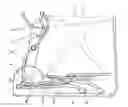
Variant 1. Simplified. Elevational view—FIG. 1.
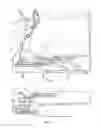
Top view—FIG. 2.
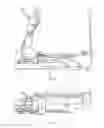
Variant 2. Elevational view—FIG. 3,
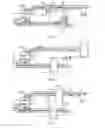
top view—FIGS. 4, 5, 6, 7, (The top view shows the roll guides and stationary handles).
The invention can be embodied on the elliptical exercise device, both with rear drive and forward drive, both with hung rods and ending rolls, which run along the guides. Elliptical exercise device with the front drive, provided with the rods, ending rolls, running along the guides, is suitable for embodiment of the invention with minimal changes in its structure. That's why a front-wheel drive elliptical exercise device is chosen for consideration the variants of possible invention embodiment on the drawings.
FIGS. 1-2. Variant 1. Front-wheel drive elliptical exercise device contains frame 4, where a crank gear 5 is installed, articulated with the rods 6, the ends of which are provided with the rolls 10, which run back and forth along the guides 9. The pivots of the rods 6 have levers 7 pivotally mounted, where there are fixed steps 8, which have enlarged width, which lets the user (the user is depicted with a dashed line) to put the foot across the step. The steps also have enlarged length, exceeding the length of the exercise device step (the exercise device step length relative to each step is shown with a dashed line on FIG. 2), which lets the user to perform the movement imitating step touch with lunge (the feet movement trajectories are depicted with a dashed line on the FIG. 1). The levers 7 are articulated with swinging levers—handles 3, installed on the bar 2. The exercise device is provided with immovable handles 1 to support the user when performing exercises “walking sideways” or “step touch”. The user is depicted, performing the exercise “step touch with lunge”. It is clear that such construction of the steps also lets the user to perform, depending on the feet position, usual elliptical exercises like bipedal locomotion, walking with lunge on this or that leg, and walking sideways with overlapping.
FIGS. 3-7. Variant 2. The difference of this exercise device from the previous is that levers 7 have straight sections of guides with the length, exceeding the exercise device step by the width of the two steps and providing sufficient gap between them (the step of the exercise device is depicted with a dashed line). On these straight sections of guides of levers 7 there are installed carriages 11, which may be moved and fixed in a place needed, and steps 8 are installed on the carriages by means of fixed joint 12. The body of the joint 12 is attached to the step 8 and may rotate and fix in the joint fixture 12, which is set in the carriage 11. The fixed joint 12 may be cylindrical or ball-type. When the joint is of ball type, apart from turning the steps 8, the user will be able to adjust the steps pitch 8. The FIG. 5 shows four main positions: a,b,c,d, in which steps 8 can be fixed in relation to carriages 11 for performing different exercises. Positions a-b: the user can perform bipedal locomotion along elliptical trajectory with minimal—a—and enlarged—b—distance between the feet. When sliding carriages 11 apart to the opposite ends of the straight parts of guides of lever 7 the user can perform walking with lunge on left or right leg, depending on which of the carriages 11 (left or right) is fixed in front. Position c: the user can perform the exercise, imitating step touch with parallel feet position in one plane, FIGS. 3-4.
Position d: the user can perform step touch with feet overlapping. At the same time, the user can perform minimal foot lunge, the minimal distance h between the feet is shown on FIG. 6; also he can increase the foot lunge, the increased distance h between the feet is shown on FIG. 7, thus the user gets different load.
Claims
1. A multifunctional elliptical exercise device, comprising: movable steps kinematically connected with a crank gear, moving along a closed curve, approximating to ellipse, with dimensions that enable a user to put its feet parallel to a movement trajectory, wherein the steps have increased size in a direction perpendicular to the movement trajectory that allow the user to put the feet across the movement trajectory to perform “walking sideways” exercises.
2. The exercise device according to claim 1, wherein the steps with enlarged transversal size have enlarged length which exceeds an exercise device stride.
3. (canceled)
4. (canceled)
5. A multifunctional elliptical exercise device, comprising: movable steps kinematically connected with a crank gear, moving along a closed curve, approximating to ellipse, with dimensions that enable a user to put its feet parallel to a movement trajectory, wherein the steps may turn 90 degrees to perform “walking sideways” exercises.
6. The exercise device according to claim 1, wherein the turnable steps are relocatable along a length of levers, on which the steps are fixed, along the distance which exceeds an exercise device stride.
7. The exercise device according to claim 1, wherein the turnable steps are installed by means of a fixable ball-type joint.
Images & Drawings included:
Sources:
- United States Patent and Trademark Office - verify current appl. status at the USPTO↗
Similar patent applications:
- » 20120277066
MULTIFUNCTIONAL SITTING TYPE ELLIPTICAL TRAINER
Recent applications in this class:
- » 20250269228 2025-08-28
EXERCISE MACHINE - » 20250128119 2025-04-24
ELLIPTICAL MACHINE - » 20230381579 2023-11-30
ELLIPTICAL EXERCISE MACHINE - » 20230173337 2023-06-08
Full body aerobic exercise machine - » 20230084138 2023-03-16
Limb exercise machine - » 20230039664 2023-02-09
Elliptical cycle - » 20230025399 2023-01-26
EXERCISE MACHINES HAVING ADJUSTABLE ELLIPTICAL STRIDING MOTION - » 20230016869 2023-01-19
Exercise machines having adjustable elliptical striding motion - » 20230001264 2023-01-05
Foldable gymnastic machine - » 20220401793 2022-12-22
Exercise machine