Reactor and agitator useful in a process for making 1-chloro-3,3,3-trifluoropropene
US20150196887A1
2015-07-16
14/669,463
2015-03-26
✅ Patent granted
US 9,993,796 B2
2018-06-12
-
-
Natasha E Young
Bruce O. Bradford
2036-08-26
Abstract:
Disclosed are a reactor and agitator useful in a high pressure process for making 1-chloro-3,3,3-trifluoropropene (1233zd) from the reaction of 1,1,1,3,3-pentachloropropane (240fa) and HF, wherein the agitator includes one or more of the following design improvements:
-
- (a) double mechanical seals with an inert barrier fluid or a single seal;
- (b) ceramics on the rotating faces of the seal;
- (c) ceramics on the static faces of seal;
- (d) wetted o-rings constructed of spring-energized Teflon and PTFE wedge or dynamic o-ring designs; and
- (e) wetted metal surfaces of the agitator constructed of a corrosion resistant alloy.
Assignee:
- HONEYWELL INTERNATIONAL INC. 4,239 🇺🇸 Morris Plains, NJ, United States
Applicant:
Interested in similar patents?
Get notified when new applications in this technology area are published.
Classification:
B01J19/18 » CPC further
Chemical, physical or physico-chemical processes in general; Their relevant apparatus Stationary reactors having moving elements inside
C07C21/185 » CPC further
Acyclic unsaturated compounds containing halogen atoms containing carbon-to-carbon double bonds containing fluorine tetrafluorethene
B01J2219/0218 » CPC further
Chemical, physical or physico-chemical processes in general; Their relevant apparatus; Apparatus characterised by their chemically-resistant properties comprising coatings on the surfaces in direct contact with the reactive components of ceramic
B01J2219/0277 » CPC further
Chemical, physical or physico-chemical processes in general; Their relevant apparatus; Apparatus characterised by their chemically-resistant properties characterised by the construction materials of the reactor vessel proper Metal based
B01J19/02 » CPC main
Chemical, physical or physico-chemical processes in general; Their relevant apparatus Apparatus characterised by being constructed of material selected for its chemically-resistant properties
C07C17/38 » CPC further
Preparation of halogenated hydrocarbons Separation; Purification; Stabilisation; Use of additives
C07C21/00 IPC
Acyclic unsaturated compounds containing halogen atoms
B01J2219/0004 » CPC further
Chemical, physical or physico-chemical processes in general; Their relevant apparatus; Chemical plants; Process aspects Processes in series
B01J19/006 » CPC further
Chemical, physical or physico-chemical processes in general; Their relevant apparatus; Details of the reactor Baffles
C07C17/383 » CPC further
Preparation of halogenated hydrocarbons; Separation; Purification; Stabilisation; Use of additives by distillation
C07C17/093 » CPC further
Preparation of halogenated hydrocarbons by replacement by halogens
B01J19/0066 » CPC further
Chemical, physical or physico-chemical processes in general; Their relevant apparatus; Details of the reactor Stirrers
B01J19/0073 » CPC further
Chemical, physical or physico-chemical processes in general; Their relevant apparatus; Details of the reactor Sealings
B01J2219/00006 » CPC further
Chemical, physical or physico-chemical processes in general; Their relevant apparatus; Chemical plants; Scale aspects Large-scale industrial plants
B01J2219/00094 » CPC further
Chemical, physical or physico-chemical processes in general; Their relevant apparatus; Controlling or regulating processes; Controlling the temperature by indirect heating or cooling employing heat exchange fluids with heat exchange elements outside the reactor Jackets
B01J2219/00123 » CPC further
Chemical, physical or physico-chemical processes in general; Their relevant apparatus; Controlling or regulating processes; Controlling the temperature by direct heating or cooling adding a temperature modifying medium to the reactants
B01J2219/00162 » CPC further
Chemical, physical or physico-chemical processes in general; Their relevant apparatus; Controlling or regulating processes controlling the pressure
B01J2219/0263 » CPC further
Chemical, physical or physico-chemical processes in general; Their relevant apparatus; Apparatus characterised by their chemically-resistant properties characterised by the construction materials of the reactor vessel proper Ceramic
B01J19/00 IPC
Chemical, physical or physico-chemical processes in general; Their relevant apparatus
C07C17/00 IPC
Compounds containing carbon and halogens with or without hydrogen
C07C17/00 IPC
Preparation of halogenated hydrocarbons
C07C17/25 » CPC further
Preparation of halogenated hydrocarbons by splitting-off hydrogen halides from halogenated hydrocarbons
C07C21/02 IPC
Acyclic unsaturated compounds containing halogen atoms containing carbon-to-carbon double bonds
C07C21/18 IPC
Acyclic unsaturated compounds containing halogen atoms containing carbon-to-carbon double bonds containing fluorine
B01J3/08 » CPC further
Processes of utilising sub-atmospheric or super-atmospheric pressure to effect chemical or physical change of matter; Apparatus therefor; Processes using ultra-high pressure, e.g. for the formation of diamonds; Apparatus therefor, e.g. moulds or dies Application of shock waves for chemical reactions or for modifying the crystal structure of substances
B01J19/26 » CPC further
Chemical, physical or physico-chemical processes in general; Their relevant apparatus Nozzle-type reactors, i.e. the distribution of the initial reactants within the reactor is effected by their introduction or injection through nozzles
Description
CROSS-REFERENCE TO RELATED APPLICATION
This application is a divisional of commonly owned, copending U.S. application Ser. No. 13/826,023, filed 14 Mar. 2013, now U.S. Pat. No. 8,xxx,xxx. The '023 Application claims domestic priority under 35 U.S.C. 119(e) to commonly owned U.S. Provisional Application Ser. No. 61/697,373, filed 6 Sep. 2012. The disclosures of these applications are hereby incorporated herein by reference.
BACKGROUND OF THE INVENTION
This invention is directed to an improved design for a reactor and agitator useful in a process for making 1-chloro-3,3,3-trifluoropropene (1233zd) from the reaction of 1,1,1,3,3-pentachloropropane (240fa) and HF. The compound 1233zd is a low global warming compound that has applications as a replacement for high global warming materials, for example in foam blowing and aerosol propellant applications.
The designation 1233 is used herein to refer to all trifluoro, monochloro propenes, namely olefin compounds having the general formula C3H2ClF3. The designation 1233zd is used herein generically to refer to 1,1,1-trifluo-3-chloropropene, independent of whether it is the cis form or the trans form. The terms “cis-1233zd” and “trans-1233zd” are used herein to describe the cis- and trans- forms of 1,1,1-trifluo-3-chlororopropene, respectively. The designation “1233zd” therefore includes within its scope cis-1233zd, trans-1233zd, and all combinations and mixtures of these.
U.S. Pat. No. 6,844,475 teaches a process for producing 1233zd from 240fa at low pressure and at temperatures lower than 150° C. The disclosure of this patent is hereby incorporated herein by reference.
U.S. Pat. No. 6,362,383 teaches a process for preparing 1,1,1,3,3-pentafluoro-propane (245fa) by (1) a first reaction step in which 1,1,1,3,3-pentachloropropane (240fa) is reacted with hydrogen fluoride in the liquid phase in the presence of a first hydrofluorination catalyst under conditions that are suitable for obtaining a mixture of reaction products comprising 1-chloro-3,3,3-trifluoropropene (1233zd) in substantial amount, and (2) a second reaction step in which the 1-chloro-3,3,3-trifluoropropene (1233zd) obtained from the first step is reacted with hydrogen fluoride in the liquid phase in the presence of a second hydrofluorination catalyst, and preferably while hydrogen chloride is continuously fed in, in order to obtain 1,1,1,3,3-pentafluoropropane (245fa). The disclosure of this patent is hereby incorporated herein by reference.
U.S. Patent Publication No. 2012-0296127 discloses a high pressure process to produce 1233zd, operating at moderate temperatures. The disclosure of this document is hereby incorporated herein by reference. In this process, hydrogen fluoride (HF) is used as a raw material and HCl is produced as a co-product. Agitation is required for the process. Because of the corrosive nature of the chemicals used and generated in the reaction, designing an agitator that will have an appropriate life is a challenge.
The present invention provides a suitable reactor and in particular an agitator used therein for conducting this process, wherein the agitator is constructed with materials that resist the effects of the corrosive chemicals of the reaction.
SUMMARY OF THE INVENTION
This invention is directed to improved designs for a liquid phase reactor and agitator useful in a high pressure process for making 1-chloro-3,3,3-trifluoropropene (1233zd) from the reaction of 1,1,1,3,3-pentachloropropane (240fa) and HF, in which HC1 is produced as a co-product. Given that agitation is required for this process both the reactor vessel and the agitator must be made out of corrosion resistant materials in order to have a useful lifetime for conducting this process.
Thus, one embodiment of the invention is directed to a reactor and agitator useful in a high pressure process for making 1-chloro-3,3,3-trifluoropropene (1233zd) from the reaction of 1,1,1,3,3-pentachloropropane (240fa) and HF, wherein the agitator includes one or more of the following improvements:
-
- (a) double mechanical seals with an inert barrier fluid or a single seal;
- (b) ceramics (parts or coatings) are employed on the rotating faces of the seal;
- (c) ceramics (parts or coatings) may also be used on the static faces of seal;
- (d) wetted o-rings constructed of spring-energized Teflon and PTFE wedge or dynamic o-ring designs; and
- (e) wetted metal surfaces of the agitator constructed of an appropriate corrosion resistant alloy.
The high pressure liquid phase reaction of 240 and HF, with or without a catalyst, yields a product stream comprising 1233zd, byproducts, HCl and unreacted HF. In certain embodiments the pressure range is from 150 psig to 600 psig. In certain embodiments, a more preferred pressure range is from 230 psig to 500 psig and a most preferred pressure range is from 350 psig to 450 psig.
In certain embodiments, the catalyst choices are selected from known Lewis acid catalysts. The preferred catalysts are TiCl4 or SbCl5, with TiCl4 being more preferred. In certain embodiments, the most preferred choice is operation of the reactor without employing any catalyst.
The typical byproducts observed in the reaction stream are precursors to 1233zd such as 241fa, 242fa, and 243fa. These can easily be separated from the reaction stream using known techniques and recycled.
In one embodiment of the high pressure process for making 1233zd, the reactants 240fa and HF are fed to an continuously stirred or agitated reactor, having the improved agitator design described herein, operating at high pressure, and;
-
- (a) the resulting product stream comprising 1233zd, HCl, HF, and other byproducts are distilled and the bottoms product, rich in HF, is recycled to the reactor;
- (b) the overhead product from the distillation column is fed to a second distillation column to remove the HCl;
- (c) the HCl in the overhead stream is scrubbed with water and recovered as an aqueous solution;
- (d) the bottom stream from the second distillation column is then phase separated to recover HF;
- (e) the HF rich top layer of the phase separation is recycled back to the reactor; and
- (f) the phase separation bottom layer components including the desired 1233zd are scrubbed, dried and distilled to meet commercial product specifications.
As described above, in a high pressure process for the production of 1233zd, the operating conditions of the reactor are extremely aggressive and the process employs reactant materials that are highly corrosive under these reaction conditions. It has been found that certain design characteristics are especially preferred for the agitator design herein, including:
-
- (a) double mechanical seal with an inert barrier fluid such as fluorolube or a single seal.
- (b) silicon carbide (parts or coatings) on the rotating faces of the seal.
- (c) silicon carbide (parts or coatings) may also be used on the static faces of seal.
- (d) wetted o-rings constructed of spring-energized Teflon (such as the OMNISEAL brand made by St. Gobain) and PTFE wedge or dynamic o-ring design
- (e) wetted metal surfaces of the agitator constructed of an appropriate nickel alloy such as Alloy 20, the Hastelloy alloys or the Inconel alloys.
It should be appreciated by those persons having ordinary skill in the art(s) to which the present invention relates that any of the features described herein in respect of any particular aspect and/or embodiment of the present invention can be combined with one or more of any of the other features of any other aspects and/or embodiments of the present invention described herein, with modifications as appropriate to ensure compatibility of the combinations. Such combinations are considered to be part of the present invention contemplated by this disclosure.
It is to be understood that both the foregoing general description and the following detailed description are exemplary and explanatory only and are not restrictive of the invention as claimed. Other embodiments will be apparent to those skilled in the art from consideration of the specification and practice of the invention disclosed herein.
BRIEF DESCRIPTION OF THE DRAWINGS
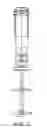
FIG. 1 illustrates a preferred agitator design of the present invention.
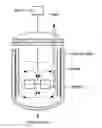
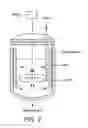
FIG. 2 illustrates a preferred continuous stirred tank reactor vessel design of the present invention.
DETAILED DESCRIPTION OF THE INVENTION
As described above, in the high pressure process for the production of 1233zd, the operating conditions of the reactor are extremely aggressive (e.g., 140° C. and 400 psig) and the process employs reactant materials that are highly corrosive under these reaction conditions. The process requires agitation to allow the reaction to proceed. As such, the design of the agitator is critical to ensure an appropriate operating lifetime in the harsh conditions. The present invention is directed to one such reactor and agitator design.
Key Characteristics of Agitator Design
-
- (a) Double mechanical seal with an inert barrier fluid such as fluorolube.
- (b) Silicon Carbide ceramics (or the like) on the rotating faces of the seal.
- (c) Silicon Carbide ceramics (or the like) may also be used on the static faces of seal.
- (d) Perfluoroelastomer o-rings and PTFE wedge design
- (e) Wetted metal surfaces of the agitator are constructed of an appropriate nickel alloy such as Alloy 20, the Hastelloy alloys or the Inconel alloys.
As shown in FIG. 1, an agitator according to the present invention includes a double mechanical seal consisting of a ceramic material, e.g., silicon carbide and equivalents, on the rotating faces, wetted parts that are constructed of an appropriate nickel alloy, and spring-energized o-rings. The agitator may be installed in a top or bottom mount position.
As shown in FIG. 2, a reactor vessel according to the present invention includes an agitator of the style of FIG. 1, materials of construction of an appropriate nickel , alloy (either solid or clad), and may contain an external or internal heating or cooling system. The design may be modified to feed reactants in the liquid or vapor phase and may be fed to the bottom or top of the vessel.
Corrosion resistant alloys are known and are preferred materials used in the construction of the reactor vessel and agitator of the present invention. Some of the commercially available corrosion resistant alloys include the following:
(a) Nickel 200
Nickel 200 is commercially pure (99.6%) wrought nickel. It has good mechanical properties and excellent resistance to many corrosive environments.
(b) Monel® 400
Monel® nickel-copper alloy 400 is a solid solution alloy that may be hardened only by cold working. It has high strength and toughness over a wide temperature range and excellent resistance to many corrosive environments.
(c) Inconel® 600
Inconel® nickel-chromium-iron alloy 600 is a standard engineering material for applications which require resistance to corrosion and heat. The alloy shows resistance to oxidizing conditions at high temperatures or in corrosive solutions.
(d) Inconel® 625
Inconel® nickel chromium alloy 625 is used for its high strength, excellent fabricability (including joining), and outstanding corrosion resistance.
(e) INCO C-276
INCO alloy C-276 is known for its outstanding corrosion resistance in a wide range of severe media. The high nickel and molybdenum contents provide good corrosion resistance in reducing environments while chromium imparts resistance to oxidizing media.
(f) Incoloy® Alloy 800
Incoloy® alloy 800 is a widely used material of construction for equipment that must have high strength and resist oxidation, carburization, and other harmful effects of high-temperature exposure. The chromium in the alloy imparts resistance to oxidation and corrosion.
(g) Incoloy® 825
Incoloy® alloy 825 is a nickel-iron-chromium alloy with additions of molybdenum, copper and titanium. The alloy's chemical composition is designed to provide exceptional resistance to many corrosive environments.
(h) Alloy 020
INCO alloy 020 is an austenitic nickel-iron-chromium alloy with additions of copper and molybdenum. The nickel content makes INCO alloy 020 resistant to chloride-ion stress-corrosion cracking Copper and molybdenum give resistance to reducing environments. The molybdenum content also provides good resistance to pitting and crevice corrosion. The chromium gives resistance to oxidizing environments.
(i) Hastelloy®
Hastelloy® is the trademark name for a range of twenty two different highly corrosion-resistant metal alloys loosely grouped by the metallurgical industry under the material term “superalloys” or “high-performance alloys”. The predominant alloying ingredient is typically the transition metal nickel.
WORKING EXAMPLE
An agitator is constructed of Alloy 20 wetted parts and a double mechanical seal with fluorolube barrier fluid, silicon carbide on all seal faces, spring-energized Teflon o-rings and a PTFE wedge system was operated at conditions ranging from 100 to 400 psig and 90° to 145° C. in a process to produce HFCO-1233zd from HF and HCC-240. The agitator operated successfully for several months.
Comparative Example 1
An agitator constructed of Alloy 020 wetted parts and a double mechanical seal with fluorolube barrier fluid, silicon carbide on all seal faces, perfluoroelastomer o-rings and a PTFE wedge system was operated at conditions ranging from 100 to 400 psig and 90° to 145° C. in a process to produce HFCO-1233zd from HF and HCC-240. The agitator seal system failed after 3 weeks of operation due to chemical attack of the perfluoroestomer wetted o-rings.
Comparative Example 2
An agitator constructed of Alloy 020 wetted parts and a double mechanical seal with fluorolube barrier fluid, tungsten carbide on the rotating seal face, perfluoro-elastomer o-rings and a PTFE wedge system was operated at conditions ranging from 100 to 150 psig and 90° to 100° C. in a process to produce HFCO-1233zd from HF and HCC-240. The agitator seal system failed after 2 weeks of operation due to failure of the seal faces.
As used herein, the singular forms “a”, “an” and “the” include plural unless the context clearly dictates otherwise. Moreover, when an amount, concentration, or other value or parameter is given as either a range, preferred range, or a list of upper preferable values and lower preferable values, this is to be understood as specifically disclosing all ranges formed from any pair of any upper range limit or preferred value and any lower range limit or preferred value, regardless of whether ranges are separately disclosed. Where a range of numerical values is recited herein, unless otherwise stated, the range is intended to include the endpoints thereof, and all integers and fractions within the range. It is not intended that the scope of the invention be limited to the specific values recited when defining a range.
It should be understood that the foregoing description is only illustrative of the present invention. Various alternatives and modifications can be devised by those skilled in the art without departing from the invention. Accordingly, the present invention is intended to embrace all such alternatives, modifications and variances that fall within the scope of the appended claims.
Claims
What is claimed is:1. A reactor and agitator useful in a high pressure process for making 1-chloro-3,3,3-trifluoropropene (1233zd) from the reaction of 1,1,1,3,3-pentachloropropane (240fa) and HF, wherein the agitator includes one or more of the following improvements:
(a) double mechanical seals with an inert barrier fluid or a single seal;
(b) ceramic parts or coatings on the rotating faces of the seal;
(c) ceramic parts or coatings on the static faces of seal;
(d) wetted o-rings constructed of spring-energized Teflon and PTFE wedge or dynamic o-ring designs; and
(e) wetted metal surfaces of the agitator constructed of a corrosion resistant alloy.
2. The reactor and agitator of claim 1, wherein the corrosion resistant alloy comprises a nickel alloy.
3. The reactor and agitator of claim 2, wherein the nickel alloy is selected from the group consisting of Alloy 020, the Hastelloy alloys and the Inconel alloys.
4. The reactor and agitator of claim 1, wherein the barrier fluid comprises fluorolube.
5. The reactor and agitator of claim 1, wherein the ceramic parts or coatings comprise silicon carbide.
6. The reactor and agitator of claim 1, wherein the spring-energized Teflon comprises the OMNISEAL brand.
7. The reactor and agitator of claim 1, wherein the reactor pressure range is from 150 psig to 600 psig.
8. The reactor and agitator of claim 1, wherein the reactor pressure range is from 230 psig to 500 psig.
9. The reactor and agitator of claim 1, wherein the reactor pressure range is from 350 psig to 450 psig.
10. The reactor and agitator of claim 1, wherein the reactor temperature range is from 90° to 145° C.
Images & Drawings included:
Sources:
- United States Patent and Trademark Office - verify current appl. status at the USPTO↗
Similar patent applications:
Recent applications in this class:
- » 20250091028 2025-03-20
REACTION CHAMBER FOR A FEEDSTOCK REACTOR - » 20250018357 2025-01-16
REACTOR FOR NON-OXIDATIVE DIRECT CONVERSION OF METHANE AND METHOD FOR PREPARING ETHYLENE AND AROMATIC COMPOUND BY USING SAME - » 20240066493 2024-02-29
HYDROGEN PRODUCTION FACILITY HAVING EQUIPMENT WITH A NITRIDATION PROTECTIVE LAYER - » 20230338915 2023-10-26
CERAMIC COATING ON METAL PARTS TO REDUCE DEPOSIT OF METALLIC TRANSITION METALS IN HYDROGENATION REACTIONS - » 20220274082 2022-09-01
Heat exchange flow reactor - » 20210146328 2021-05-20
Flow reactor plug - » 20210060516 2021-03-04
METALLURGY FOR PROCESSING BIORENEWABLE FEED - » 20210001303 2021-01-07
Stainless steel member and production method thereof - » 20200406222 2020-12-31
REACTION CHAMBER COMPONENT, PREPARATION METHOD, AND REACTION CHAMBER - » 20200254419 2020-08-13
Corrosion resistant duplex steel alloy, objects made thereof, and method of making the alloy
Recent applications for this Assignee:
- » 20230304801 2023-09-28
Delta position and delta attitude aiding of inertial navigation system - » 20230230256 2023-07-20
Systems and methods for image aided navigation - » 20230113059 2023-04-13
Edge detection via window grid normalization - » 20230097179 2023-03-30
Reducing rotation sensing errors from laser source signal and modulation cross-talk - » 20220299600 2022-09-22
Methods and systems for monitoring a fault condition of a radar altitude device - » 20220299484 2022-09-22
Hydrocarbon byproduct monitoring of fibrous substrates - » 20220298013 2022-09-22
Fibrous substrates for hydrogen generation - » 20220178963 2022-06-09
MEMS vibrating beam accelerometer with built-in test actuators - » 20220146000 2022-05-12
Frictionless rotary valve - » 20220136879 2022-05-05
Ultrasonic flow tube having a plurality of outer pipes surrounding a center pipe positioned between an inlet wall and an outlet wall having transducers therein